Burp Suite Professional is the best of the Netsparker alternatives for manual testing, rated 4.8 out of 5 on G2 from 139 reviews at $475 per user a year. OWASP ZAP is the free starting point, and Intruder suits teams that want scheduled cloud scans from $299 a month.
How we make this list: we compare pricing pages, product documentation and public user reviews, then re-check every price before each update. No product paid for a place. Disclosure.
Burp Suite Professional leads at 4.8 out of 5 on G2 from 139 reviews, at $475 per user a year, with a free Community Edition.
Intruder matches Burp at 4.8 out of 5 with the largest review base here, 209 G2 reviews, from $299 a month.
OWASP ZAP is the only fully free tool in this list, rated 4.7 out of 5 on G2 from just 14 reviews.
Five of the nine tools publish prices, from free to $3,588 a year; Acunetix, Bright Security and Qualys WAS sell by quote only.
Netsparker is now Invicti, so this list compares the scanners that compete with the Invicti platform, not Invicti itself.
What should you look for in Netsparker alternatives?
Proof matters more than scan counts. Netsparker built its name on proof-based scanning, which confirms a flaw is exploitable before reporting it, and Acunetix uses the same approach under the same owner.
Price by what you will be charged for, not by the headline. Burp Suite charges per user, StackHawk per person, Acunetix per target and Bright Security per scan, so the cheapest tool depends on how many apps and people you have.
A thin review base is a weak signal. OWASP ZAP, Bright Security and Qualys WAS each hold strong scores from 30 or fewer G2 reviews, while Intruder and Acunetix rest on more than 100 reviews each.
Free plans cover the first scan, not a program. ZAP is fully free, Beagle Security includes one lite test a month and Detectify has a free Starter tier, but scheduled scans, authenticated testing and compliance reports sit on paid plans.
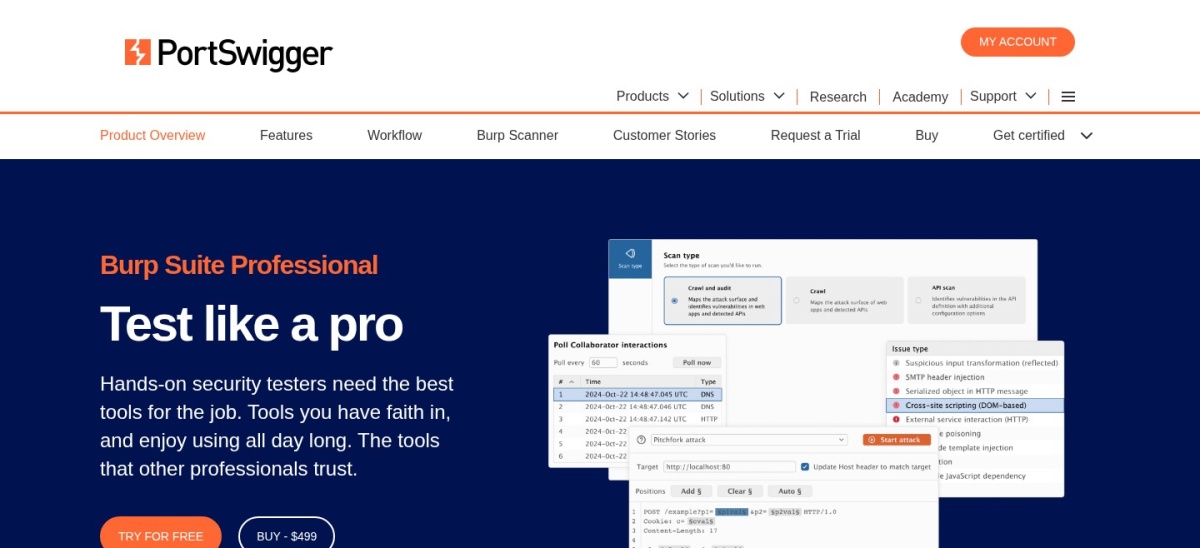
Burp Suite Professional homepage, captured Nov 2026.
Burp Suite Professional is the toolkit most penetration testers reach for first. Its proxy, Repeater, Intruder and automated scanner work together for manual testing of web applications and APIs, and the extension store adds capabilities for almost every niche. It holds 4.8 out of 5 on G2 from 139 reviews, the highest score in this list.
The trade off is price and skill. Professional costs $475 a user a year, a vendor-supplied figure on G2, and the tool assumes the tester knows what they are doing. It suits security teams that confirm scanner findings by hand.
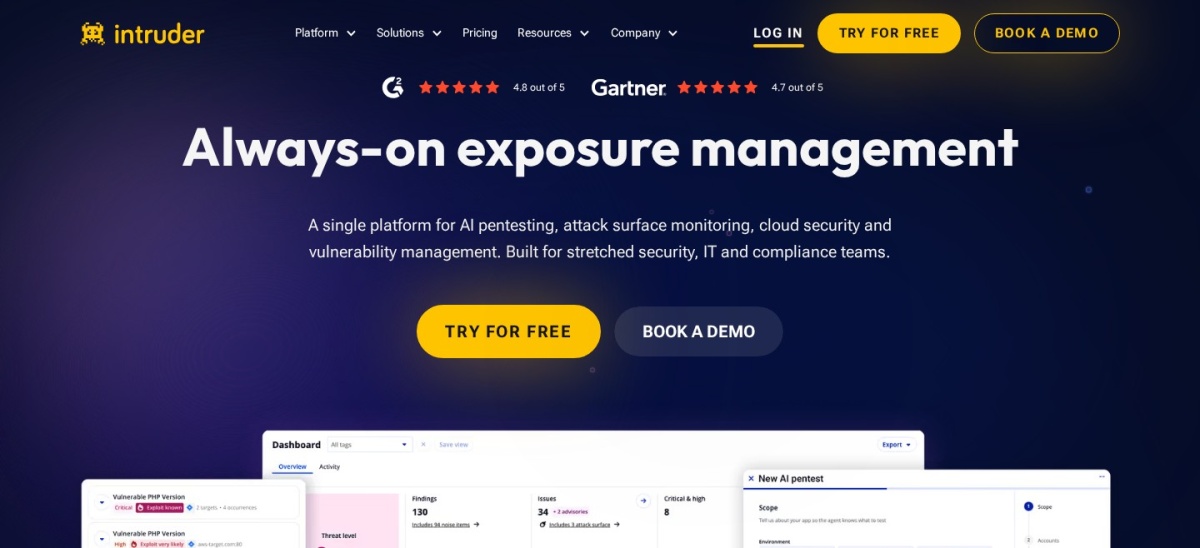
Intruder is a cloud vulnerability scanner that covers web applications, servers and cloud infrastructure from one console. Scans run on a schedule, findings come with remediation guidance, and the free tier lets small teams start without a contract. It holds 4.8 out of 5 on G2 from 209 reviews, the largest review base in this list.
The trade off is depth. Intruder is a scheduled scanner rather than a manual testing workbench, and the entry Cloud plan starts at $299 a month. It suits teams that want continuous coverage without hiring a tester.
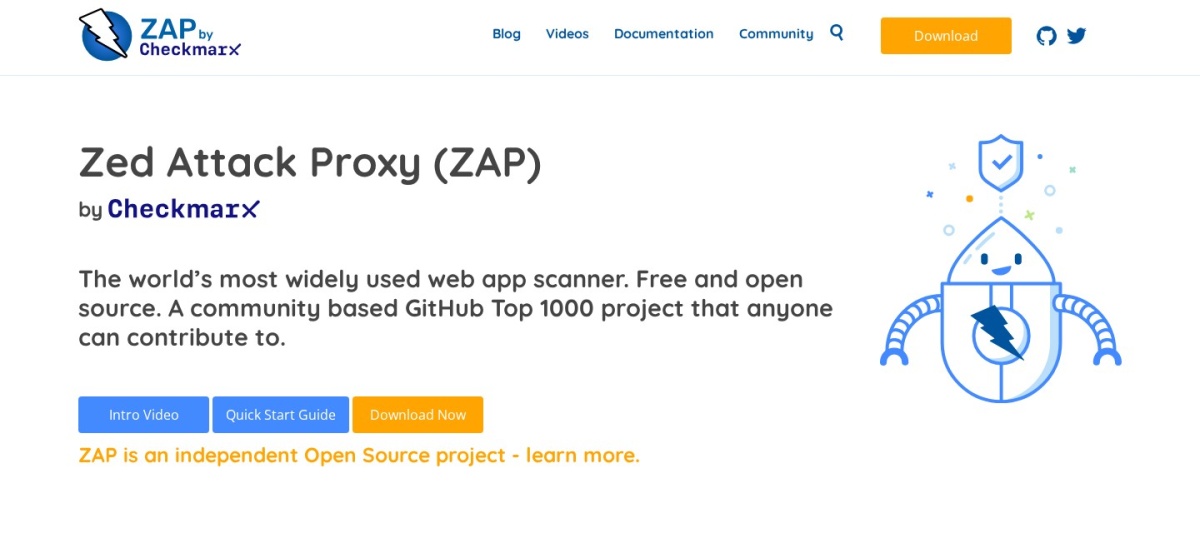
OWASP ZAP is the open-source standard for dynamic testing, maintained by a global community under the OWASP umbrella and now as ZAP by Checkmarx. It spiders and scans web applications, finds common vulnerabilities, and plugs into CI pipelines through its API and automation framework. It holds 4.7 out of 5 on G2 from 14 reviews.
The trade off is the thin review base and the tuning. Fourteen G2 reviews is the smallest base in this list, and ZAP needs in-house expertise and tuning for complex applications. It suits teams with more engineers than budget that want DAST in every build.
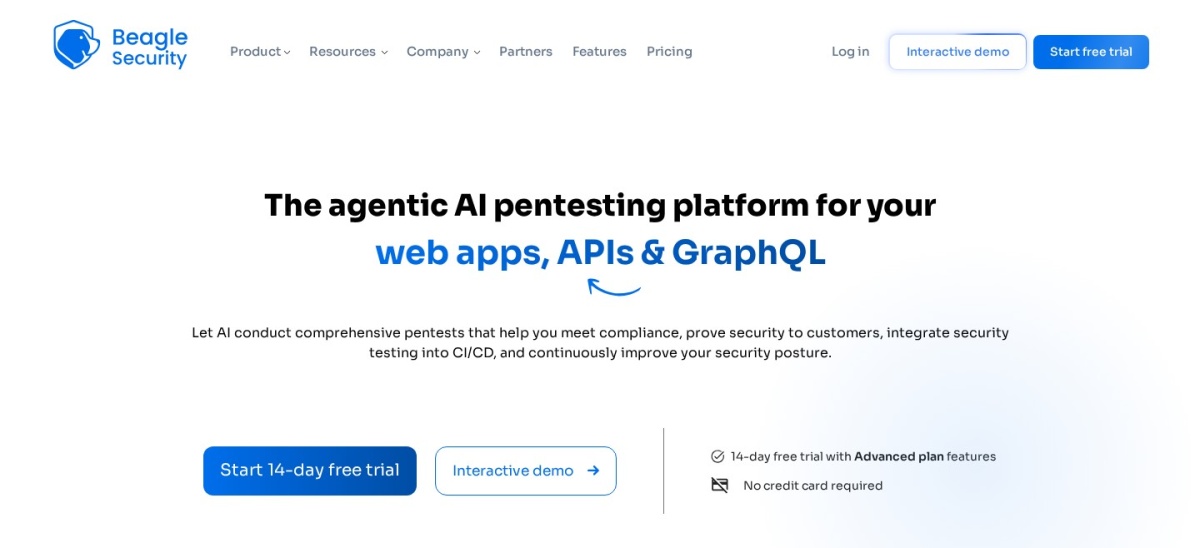
Beagle Security is an AI penetration testing platform for web applications, REST APIs and GraphQL. It runs more than 3,000 test cases covering the OWASP Top 10 and CWE Top 25, then validates and prioritises findings with plain-language fix guidance. It holds 4.7 out of 5 on G2 from 88 reviews, and the free plan includes one lite test a month.
The trade off is the test quota. Essential costs $99 a month billed annually and allows 2 tests a month with 1 concurrent test, so busy release schedules outgrow it fast. It suits small teams that scan a few apps on a schedule.
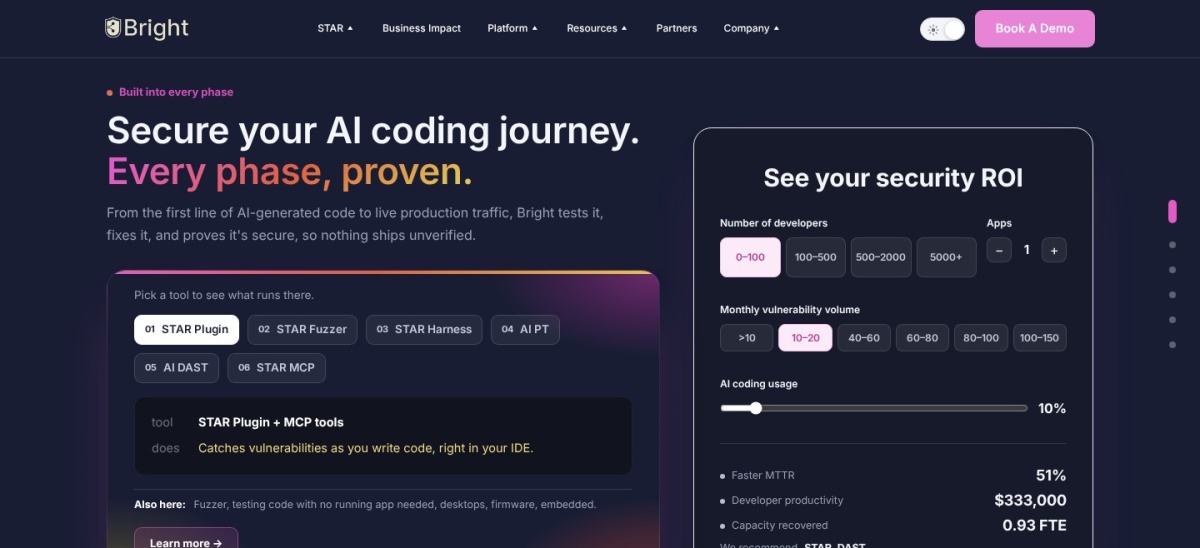
Bright Security is a developer-led DAST platform rebuilt for how software ships now: APIs, single-page apps and fast release cycles, with AI-powered test generation that adapts to each application. It holds 4.7 out of 5 on G2 from 29 reviews and covers the OWASP LLM Top 10 for AI apps.
The trade off is the thin base and the price model. Twenty-nine G2 reviews is a small sample, and Bright sells per scan with no published price list. It suits mid-size teams building AI-powered applications that need LLM security coverage.
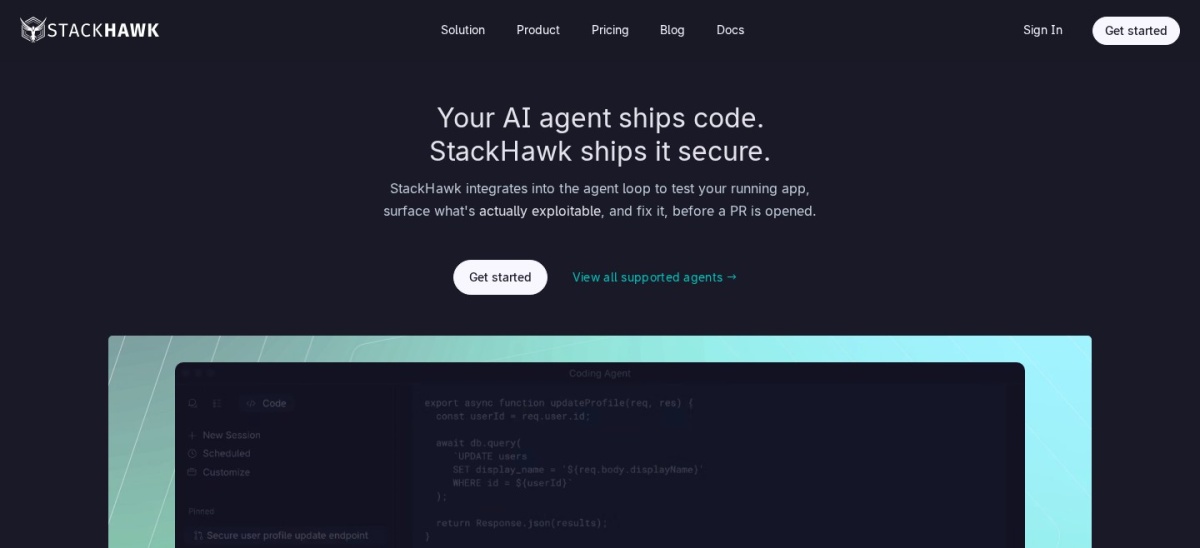
StackHawk is a developer-first DAST platform built around ZAP that puts scanning inside CI/CD pipelines, with findings in pull requests instead of PDFs. It holds 4.6 out of 5 on G2 from 68 reviews and charges a clear $10 per person a month, the lowest priced paid plan in this list.
The trade off is depth. StackHawk is built around ZAP, so its API security detection is limited and it suits application scanning more than deep manual testing. It suits developer-led teams that want DAST in every pull request.
Detectify is a dynamic application security testing and external attack surface monitoring platform backed by crowdsourced security research. It holds a 4.5 out of 5 rating on G2 across 51 reviews, offering a Starter tier from €0 and a Standard platform tier from €2,500 a year, about $2,700.
The trade off is that per-domain surface monitoring, per-target application or API scanning, and PCI ASV add-ons cost extra on top of the platform fee. It suits teams that want their subdomains watched as well as their apps scanned.
Qualys WAS is the DAST module of the Qualys cloud platform, sharing the same asset inventory and reporting as Qualys VMDR. It holds 4.5 out of 5 on G2 from 21 reviews and suits teams already using Qualys for vulnerability management.
The trade off is the thin base and the ecosystem lock-in. Twenty-one G2 reviews is a small sample, and WAS makes most sense inside a Qualys contract. It suits Qualys customers extending vulnerability management to web applications.
Acunetix is a standalone automated scanner for web applications that covers a wide range of flaws and handles modern web technologies. Owned by Invicti, it holds 4.1 out of 5 on G2 from 105 reviews and suits mid-size teams that want automated depth without a manual testing practice. In September 2026 it was renamed Invicti Web + API.
The trade off is per-target pricing. Acunetix prices by the number of scanned targets, so teams with hundreds of microservices should compare it against per-seat options like StackHawk. The only published price is up to $500 per agentic pentest.
Netsparker is now Invicti: what changed for buyers
Netsparker is the former name of the Invicti platform. The scanner, its proof-based scanning and its AcuSensor technology are the same product under a new name, so an alternative to Netsparker is an alternative to Invicti.
The same owner also sells Acunetix, now renamed Invicti Web + API, as a separate scanner. That makes Acunetix the closest in-house alternative, but it is still an Invicti product, so teams leaving the vendor entirely should look at Burp Suite, Intruder or OWASP ZAP first.
Buyers comparing quotes should ask which Invicti tier they are being sold. The platform sells by quote only, with third-party estimates near $7,000 a year for a small target bundle, while Acunetix publishes only its $500 agentic pentest price.
How we chose
We started from every web application scanner with a public rating on G2, then kept the nine with the clearest fit as Netsparker alternatives, from manual testing to developer-led CI scanning.
Prices and ratings were checked on 29 November 2026. Burp Suite at $475 a user a year is the vendor-supplied figure on G2, StackHawk at $10 a person a month and Beagle Security at $99 a month are published list prices, and Detectify Standard at €2,500 a year is about $2,700. OWASP ZAP is free and open source, and the rest sell by quote.
We left out Invicti, which is Netsparker's current name rather than an alternative, and Probely, whose G2 base of 19 reviews is thinner than every tool kept here. No vendor paid for a place, and we do not claim to have tested these tools ourselves.
How to choose a Netsparker alternative
Start with who tests and who reads the findings, then count what you will be charged for.
Start with the free scanner. Run OWASP ZAP against a staging app first. It shows what DAST finds on your stack before any budget discussion.
Decide who reads the findings. Developers need findings in pull requests, so look at StackHawk; security teams need reports and proof, so look at Burp Suite or Acunetix.
Count what you will be charged for. Users, targets, scans and apps all price differently. Count your apps and users before you compare quotes, and remember Acunetix charges per target.
Trial it on a real application. Scan a production-like app with authentication in the trial. Unauthenticated scans flatter every tool.
FAQ
What is the best Netsparker alternative in 2026?
Burp Suite Professional is the best pick for manual testing, with 4.8 out of 5 on G2 from 139 reviews. Intruder is the pick for scheduled cloud scanning, and OWASP ZAP is the best free starting point.
Is Netsparker now called Invicti?
Yes. Netsparker was renamed Invicti, and Acunetix is now sold as Invicti Web + API under the same owner. The scanner and its proof-based approach are unchanged, so this list compares tools that compete with the Invicti platform.
How much do Netsparker alternatives cost?
Entry prices run from free for OWASP ZAP to $10 a person a month for StackHawk, $99 a month for Beagle Security and $475 a user a year for Burp Suite Professional. Acunetix, Bright Security and Qualys WAS sell by quote only.
Is there a free Netsparker alternative?
Yes. OWASP ZAP is fully free and open source. Beagle Security includes one lite test a month on its free plan, Detectify has a free Starter tier, and Burp Suite and Intruder both offer free editions.
Which Netsparker alternative is best for small teams?
StackHawk is the cheapest paid option at $10 a person a month with findings in pull requests. Beagle Security suits small teams that scan a few apps, at $99 a month for 2 tests a month.
Burp Suite vs Intruder: which is better?
Both hold 4.8 out of 5 on G2, but they serve different users. Burp Suite is a manual testing workbench for penetration testers, while Intruder is a scheduled cloud scanner for teams that want continuous coverage without a tester.
Why do most DAST vendors hide their prices?
Enterprise DAST pricing depends on targets, users, scan volume and modules, so vendors quote instead of publishing. Only Burp Suite, StackHawk, Beagle Security and Detectify publish prices in this list, and ZAP is free.
SaaS SEO and WordPress specialist with about 8 years of experience. Rakib compares WordPress plugins, themes, hosting and software using public pricing, documentation and user reviews. See how we rank.