Tenable Nessus leads for broad infrastructure vulnerability scanning with a 4.5 out of 5 rating across 321 G2 reviews and a $4,790/yr license for Nessus Professional. Rapid7 InsightVM fits risk-based vulnerability management starting at $1.62/mo per asset for 500 assets, while OpenVAS suits free self-hosted scanning.
How we make this list: we compare pricing pages, product documentation and public user reviews, then re-check every price before each update. No product paid for a place. Disclosure.
Tenable Nessus holds a 4.5 out of 5 rating across 321 G2 reviews with Nessus Professional listed at $4,790/yr.
Rapid7 InsightVM scores 4.4 out of 5 across 81 G2 reviews with pricing starting at $1.62/mo per asset for 500 assets.
Intruder earns a 4.8 out of 5 rating across 224 G2 reviews and offers a Free plan alongside paid Cloud and Pro plans.
Detectify holds a 4.5 out of 5 rating across 52 G2 reviews with a Starter plan from €0 and Standard from €2,500/yr.
Qualys VMDR carries a 4.4 out of 5 rating across 168 G2 reviews with published baseline asset pricing from $199 per asset.
OpenVAS holds a 4.4 out of 5 rating across 32 G2 reviews and is available for free with the Community Feed.
What to look for in a vulnerability assessment tool
General vulnerability assessment tools scan servers, network devices, cloud workloads, and web applications to identify missing patches, exposed services, and configuration flaws. Some focus on point-in-time scans on your own hardware or VMs, while others run continuous cloud checks and risk scoring.
When comparing scanners, look at credentialed versus uncredentialed scanning depth, how quickly new vulnerability checks ship after disclosures, and whether the product handles remediation tracking or web application testing.
Pricing models vary widely across vendors. Some charge a flat annual license for unlimited IPs, others price per asset or per target with minimums, and open-source builds remain free when you manage the infrastructure yourself.
Free open-source option for self-hosted network scans
Free
Free plan
4.4/5
Price ladder: cheapest paid plan per year
List prices, USD, checked Nov 2026
OpenVASFree
InsightVM$19
Qualys VMDR$199
DetectifyFREE$2,700
IntruderFREE$3,588
Nessus$4,790
Invicti$7,000
The 7 best vulnerability assessment tools
01
Tenable Nessus
4.5/5on G2 (321 reviews, checked Nov 2026)
Starts at$4,790/yr
Best for broad network and infrastructure vulnerability scanning
ScopeNetwork, OS, compliance
G2 rating4.5 out of 5
Reviews321 on G2
Entry paid tierNessus Pro ($4,790/yr)
tenable.com
Tenable Nessus homepage, captured Nov 2026.
Tenable Nessus is a vulnerability assessment scanner used across networks, operating systems, cloud configurations, and compliance audits. It holds a 4.5 out of 5 rating on G2 from 321 reviews, while non-commercial Nessus Essentials is free for up to 5 IPs.
The trade off is that commercial Nessus Professional costs $4,790/yr for a 1-year license. It suits security teams and consultants who want deep vulnerability checks and audit templates on a single scanner.
What we like
Wide plugin library covering vulnerabilities, configurations, and compliance audits
4.5 out of 5 rating across 321 reviews on G2
Free non-commercial Essentials option available for up to 5 IPs
Watch out for
Commercial Nessus Professional requires a $4,790/yr annual license
Point-in-time scanner rather than a full enterprise asset-tracking suite on its own
Nessus Expert ($6,790/yr on Tenable's pricing page) adds web application scanning and external attack surface discovery.Visit tenable.com
02
Rapid7 InsightVM
4.4/5on G2 (81 reviews, checked Nov 2026)
Starts at$1.62/mo
Best for risk-based vulnerability management and remediation workflows
FocusRisk-based VM
G2 rating4.4 out of 5
Reviews81 on G2
Starting rate$1.62/mo per asset (500)
rapid7.com
Rapid7 InsightVM homepage, captured Nov 2026.
Rapid7 InsightVM is a vulnerability management platform that pairs scanning and endpoint agents with risk scoring and remediation tracking. It holds a 4.4 out of 5 rating on G2 across 81 reviews, with Rapid7 listing starting pricing at $1.62/mo per asset for 500 assets.
The trade off is that the published starting rate is quoted per asset at a 500-asset scale rather than a small flat fee. It suits organizations that want prioritized remediation projects across larger asset counts.
What we like
Combines vulnerability scanning with risk scoring and remediation tracking
4.4 out of 5 rating across 81 reviews on G2
Published starting rate of $1.62/mo per asset for 500 assets
Watch out for
Per-asset starting rate is tied to a 500-asset baseline rather than small flat plans
Initial setup and policy tuning can take extra effort on larger networks
Larger asset tiers, add-on modules like InsightAppSec, and enterprise bundles scale by quote and asset count.Visit rapid7.com
03
Intruder
4.8/5on G2 (224 reviews, checked Nov 2026)
Paid from$299/mo
Best for continuous external monitoring and emerging threat scans
FocusExternal & cloud scans
G2 rating4.8 out of 5
Reviews224 on G2
Entry paid tierCloud from $299/mo
intruder.io
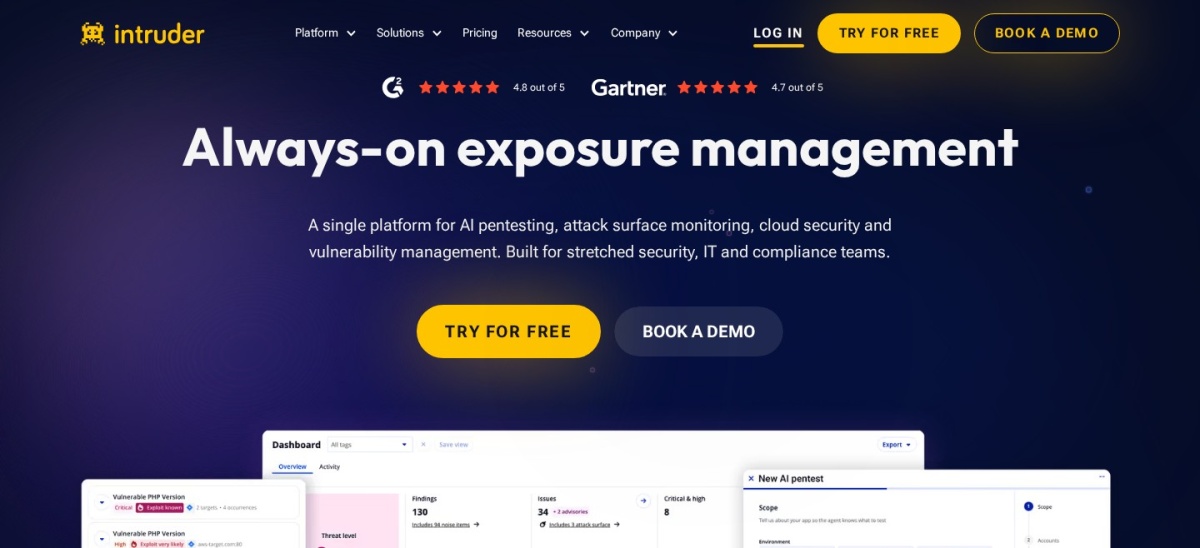
Intruder homepage, captured Nov 2026.
Intruder is a vulnerability scanning platform focused on external infrastructure, cloud accounts, container images, and web apps. It holds a 4.8 out of 5 rating on G2 across 224 reviews and offers a Free plan alongside paid tiers starting with Cloud at $299/mo.
The trade off is that paid Cloud and Pro plans add base and per-target fees that can scale up as you add assets. It suits teams that want straightforward external monitoring and fast setup.
What we like
High 4.8 out of 5 rating across 224 reviews on G2
Free plan available for basic external checks, with Cloud starting at $299/mo
Automated emerging threat scans help flag newly disclosed exposures
Watch out for
Paid Cloud and Pro plan rates scale with base and per-target licensing
Free plan does not include authenticated web application testing
Cloud, Pro, and Enterprise plans add emerging threat scans, custom schedules, web app testing, and agent scanning.Visit intruder.io
04
Detectify
4.5/5on G2 (52 reviews, checked Nov 2026)
Paid from$2,700/yr
Best for web application scanning and external attack surface discovery
FocusWeb apps & attack surface
G2 rating4.5 out of 5
Reviews52 on G2
Paid platformStandard from €2,500/yr
detectify.com
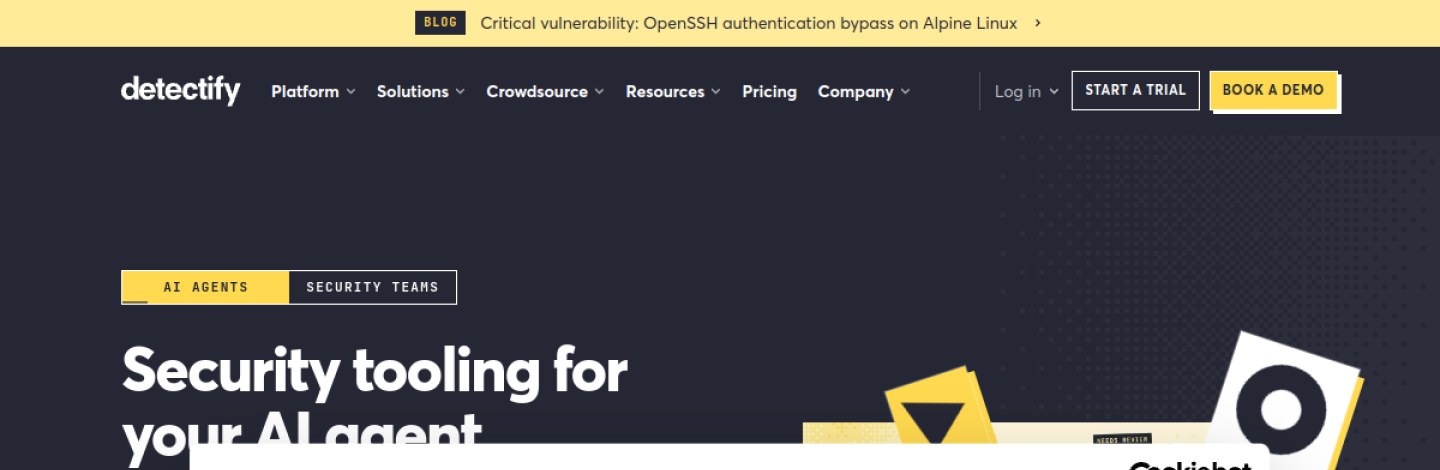
Detectify homepage, captured Nov 2026.
Detectify is a dynamic application security testing and external attack surface monitoring platform backed by crowdsourced security research. It holds a 4.5 out of 5 rating on G2 across 52 reviews, offering a Starter tier from €0 and a Standard platform tier from €2,500/yr (~$2,700/yr).
The trade off is that per-domain surface monitoring, per-target application or API scanning, and PCI ASV add-ons cost extra on top of the platform fee. It suits web and security teams focused on internet-facing apps and subdomains.
What we like
Combines web application vulnerability scanning with continuous external surface discovery
4.5 out of 5 rating across 52 reviews on G2
Starter tier begins at €0 annual platform fee for up to 5 users
Watch out for
Per-target and per-domain scanning fees add to the annual platform tier
External-focused tooling has less emphasis on internal OS patch management
Professional (€5,000/yr platform fee) and Enterprise (€15,000/yr platform fee) tiers add internal scanning agents and custom workflows.Visit detectify.com
05
Qualys VMDR
4.4/5on G2 (168 reviews, checked Nov 2026)
Starts at$199/yr
Best for enterprise asset visibility and compliance at scale
FocusEnterprise VM & assets
G2 rating4.4 out of 5
Reviews168 on G2
Published rate$199/asset baseline
qualys.com
Qualys VMDR homepage, captured Nov 2026.
Qualys VMDR is an enterprise vulnerability management and asset visibility solution covering cloud, on-premises, and remote hosts. It holds a 4.4 out of 5 rating on G2 from 168 reviews, with Qualys's published per-asset baseline listed at $199 per asset.
The trade off is that real-world enterprise contracts are typically quoted by asset count and volume tiers rather than a single small flat fee. It suits mid-sized and large organizations with formal compliance and patching workflows.
What we like
Unifies asset inventory, vulnerability detection, and prioritization workflows
4.4 out of 5 rating across 168 reviews on G2
Scales across hybrid IT estates and compliance reporting requirements
Watch out for
Contract pricing scales by asset count and modules rather than a simple small-team rate
Broader platform options can feel complex for lean security teams
Additional Qualys modules and enterprise tiers expand patch orchestration, cloud security, and compliance automation.Visit qualys.com
06
Invicti
4.5/5on G2 (72 reviews, checked Nov 2026)
Starts at$7,000/yr
Best for proof-based web application and API vulnerability scanning
FocusWeb apps & API DAST
G2 rating4.5 out of 5
Reviews72 on G2
Entry baselineFrom ~$7,000/yr
invicti.com
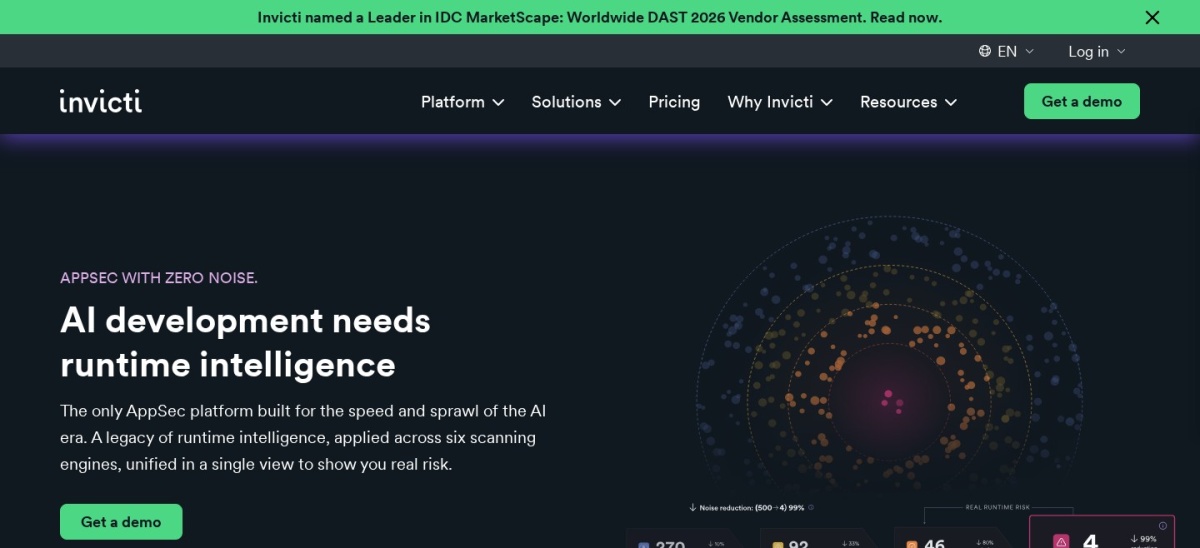
Invicti homepage, captured Nov 2026.
Invicti is a dynamic application security testing and application security platform that validates vulnerabilities using proof-based scanning across web apps and APIs. It holds a 4.5 out of 5 rating on G2 across 72 reviews, with typical entry licensing starting around $7,000/yr.
The trade off is that per-target licensing and quote-based tiers can become costly for teams with many domains or subdomains. It suits security and DevSecOps teams that want verified vulnerability findings with low manual triage.
What we like
Proof-based scanning confirms exploitability to cut false positives
4.5 out of 5 rating across 72 reviews on G2
Integrates with CI/CD pipelines and issue trackers for developer workflows
Watch out for
Entry costs around $7,000/yr are high for small budgets or single-site projects
Target-based licensing requires careful scope planning across subdomains and APIs
Best free open-source option for self-hosted network scans
LicenseFree / open-source
G2 rating4.4 out of 5
Reviews32 on G2
HostingSelf-managed or VM
greenbone.net
OpenVAS homepage, captured Nov 2026.
OpenVAS is a widely used open-source vulnerability scanning framework maintained with Greenbone that checks network services and hosts for known flaws. It holds a 4.4 out of 5 rating on G2 across 32 reviews and is free to run using the Community Feed.
The trade off is that you manage deployment, feed updates, and server maintenance yourself on the free edition. It suits technical teams and budget-conscious labs that can self-host a scanner.
What we like
Free to use with the OpenVAS Community Feed and virtual appliance option
4.4 out of 5 rating across 32 reviews on G2
Supports credentialed and uncredentialed network vulnerability scans
Watch out for
Requires self-hosting, configuration, and ongoing maintenance on the free tier
Commercial Greenbone appliances carry separate paid licensing for business support
Greenbone's commercial OPENVAS BASIC appliance (€2,524/yr on Greenbone's site) and OPENVAS SCAN target business deployments.Visit greenbone.net
Point-in-time scanners vs. continuous VM platforms
A standalone scanner focuses on running targeted or scheduled checks against IPs, hosts, or web targets and producing findings. A broader vulnerability management platform adds continuous asset tracking, risk prioritization, and remediation workflows.
Choosing between them depends on whether you need on-demand audits and external checks or ongoing asset inventory across servers, endpoints, and cloud accounts.
How we chose
We selected established general vulnerability assessment and scanning tools with public review scores on G2 and documented pricing or free tiers.
Ratings, review counts, and pricing details were checked from public review and vendor pages on 22 Nov 2026.
We excluded WordPress-only plugins and tools without a confirmable public price or free tier. No vendor paid for a place, and we do not claim testing for this list.
How to choose a vulnerability assessment tool
Follow four practical steps to pick a vulnerability scanner that fits your environment.
Map what you need to scan first. Clarify whether your priority is internal servers and network IPs, cloud workloads, external attack surfaces, or web applications.
Check how licensing scales with assets. Compare flat annual licenses against per-asset or per-target pricing so costs stay predictable as your infrastructure grows.
Factor in operational overhead. Decide whether your team prefers a managed cloud service or has the capacity to self-host and maintain an appliance or scanner.
Look beyond raw severity scores. Prioritize tools that help your team separate actively exploitable issues and critical assets from low-impact noise.
FAQ
What does a general vulnerability assessment tool do?
It scans systems, services, or applications to detect known vulnerabilities, missing patches, and misconfigurations so teams can prioritize fixes.
Does vulnerability scanning replace penetration testing?
No. Automated vulnerability scanners systematically check for known flaws and misconfigurations, whereas penetration testing simulates targeted attacks and chained exploitation.
What is the difference between authenticated and unauthenticated scans?
Unauthenticated scans inspect exposed services from the outside, while authenticated scans log into systems to check installed packages, patches, and local settings.
Are free vulnerability scanners viable for small teams?
Free or community tiers can work well for basic checks, learning, or small scopes, though larger environments often need broader coverage, automation, or support.
How often should vulnerability scans run?
Many teams run scheduled weekly or daily scans alongside targeted scans after major system changes or new vulnerability disclosures.
SaaS SEO and WordPress specialist with about 8 years of experience. Rakib compares WordPress plugins, themes, hosting and software using public pricing, documentation and user reviews. See how we rank.