Burp Suite Professional is the best DAST tool for manual penetration testing, with the highest G2 score in this list. Pick OWASP ZAP when the budget is zero, StackHawk for developer-led CI scanning, and Invicti when proof-based accuracy matters most.
How we make this list: we compare pricing pages, product documentation and public user reviews, then re-check every price before each update. No product paid for a place. Disclosure.
Burp Suite Professional is the top pick for testers: 4.8 out of 5 on G2 from 129 reviews, at $499 a user a year.
OWASP ZAP is free and open source, with 4.7 out of 5 on G2, but only 14 reviews and a need for tuning.
StackHawk is the clearest-priced developer tool at $10 a person a month, with findings in pull requests.
Invicti leads on proof-based accuracy at 4.5 out of 5 from 72 reviews, but sells by quote only.
Six of the nine tools sell by quote, and four have fewer than 30 G2 reviews, so treat the smaller ratings as weak signals.
What to look for in DAST tools
Dynamic application security testing probes your running application the way an attacker would: sending malformed input, testing session handling and crawling every page it can reach, all without reading a line of your source code.
DAST splits into three camps. Manual tools like Burp Suite suit practitioners, automated scanners like Invicti and Acunetix suit large estates, and developer-first tools like StackHawk and Bright Security put findings in pull requests. Our guide to antivirus software for business covers the endpoint side of the same security stack.
False positives decide whether developers trust the tool. Invicti and Acunetix use proof-based scanning to confirm flaws before reporting them, while ZAP and Checkmarx need more tuning and triage.
Price by target, user or scan volume before you choose. Burp Suite charges per user, StackHawk per person, Acunetix per target and Bright Security per scan, so the same tool can be cheap for one team and expensive for another.
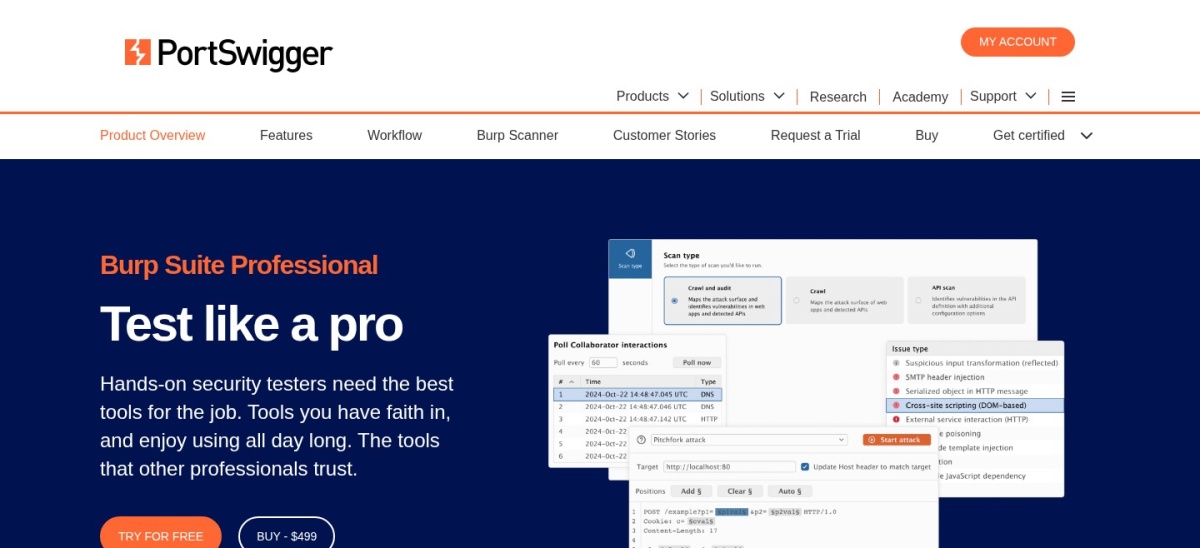
Burp Suite Professional homepage, captured Nov 2026.
Burp Suite Professional is the tool most penetration testers reach for first. Its proxy, repeater, intruder and scanner work together for manual testing of web applications and APIs, and the extension store adds capabilities for almost every niche. It holds 4.8 out of 5 on G2 from 129 reviews, the highest score in this list.
The trade off is price and skill. Professional costs $499 a user a year, a figure from October 2026 guides since the vendor buy page shows no price, and the tool assumes the tester knows what they are doing. It suits security teams that confirm scanner findings by hand.
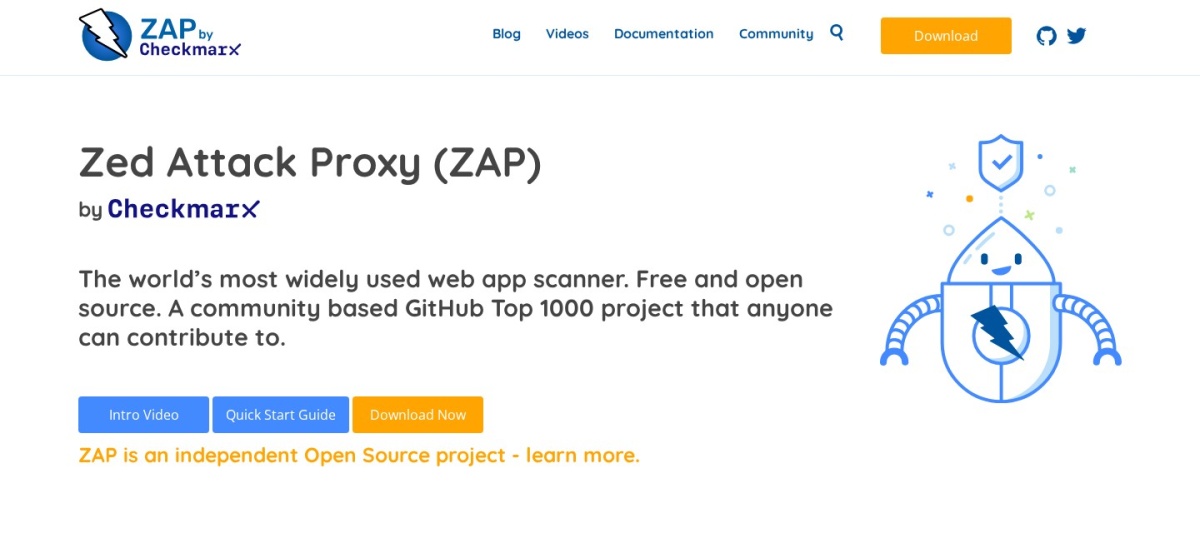
OWASP ZAP is the open-source standard for dynamic testing, maintained by a global community under the OWASP umbrella. It spiders and scans web applications, finds common vulnerabilities, and plugs into CI pipelines through its API and automation framework. It holds 4.7 out of 5 on G2 from 14 reviews.
The trade off is the thin review base and the tuning. Fourteen G2 reviews is the smallest base in this list, and ZAP needs in-house expertise and tuning for complex applications. It suits teams with more engineers than budget that want DAST in every build.
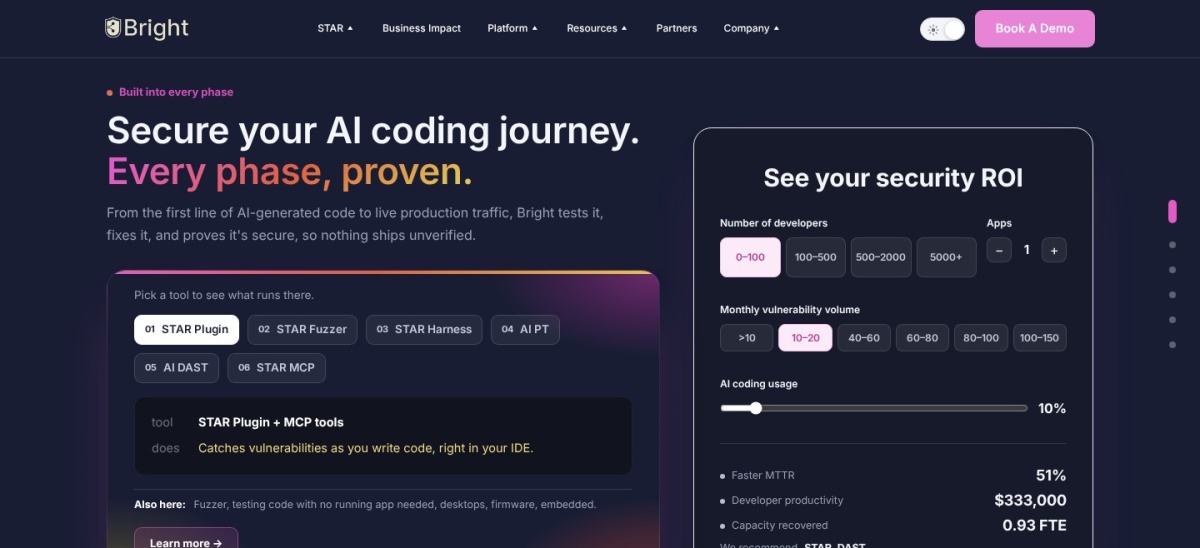
Bright Security is a developer-led DAST platform rebuilt for how software ships now: APIs, single-page apps and fast release cycles, with AI-powered test generation that adapts to each application. It holds 4.7 out of 5 on G2 from 29 reviews and covers the OWASP LLM Top 10 for AI apps.
The trade off is the thin base and the price model. Twenty-nine G2 reviews is a small sample, and Bright sells per scan with no published price list. It suits mid-size teams building AI-powered applications that need LLM security coverage.
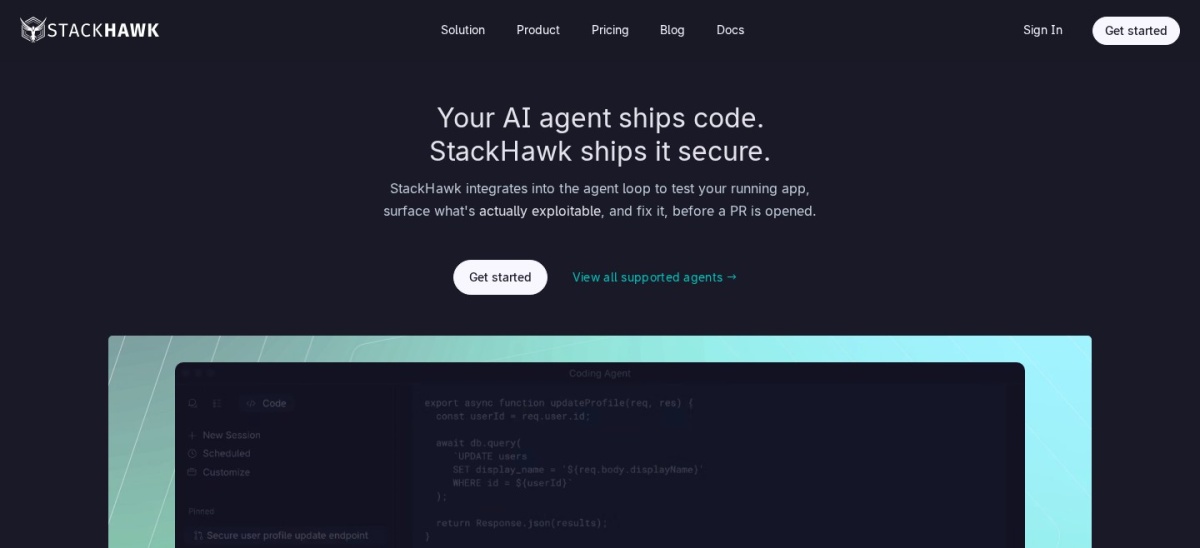
StackHawk is a developer-first DAST platform built around ZAP that puts scanning inside CI/CD pipelines, with findings in pull requests instead of PDFs. It holds 4.6 out of 5 on G2 from 68 reviews and charges a clear $10 per person a month.
The trade off is depth. StackHawk is built around ZAP, so its API security detection is limited and it suits application scanning more than deep manual testing. It suits developer-led teams that want DAST in every pull request.
Best enterprise accuracy with proof-based scanning
PricingQuote only
ScanningProof-based
DeploymentOn-premises and cloud
G2 rating4.5 from 72 reviews
invicti.com
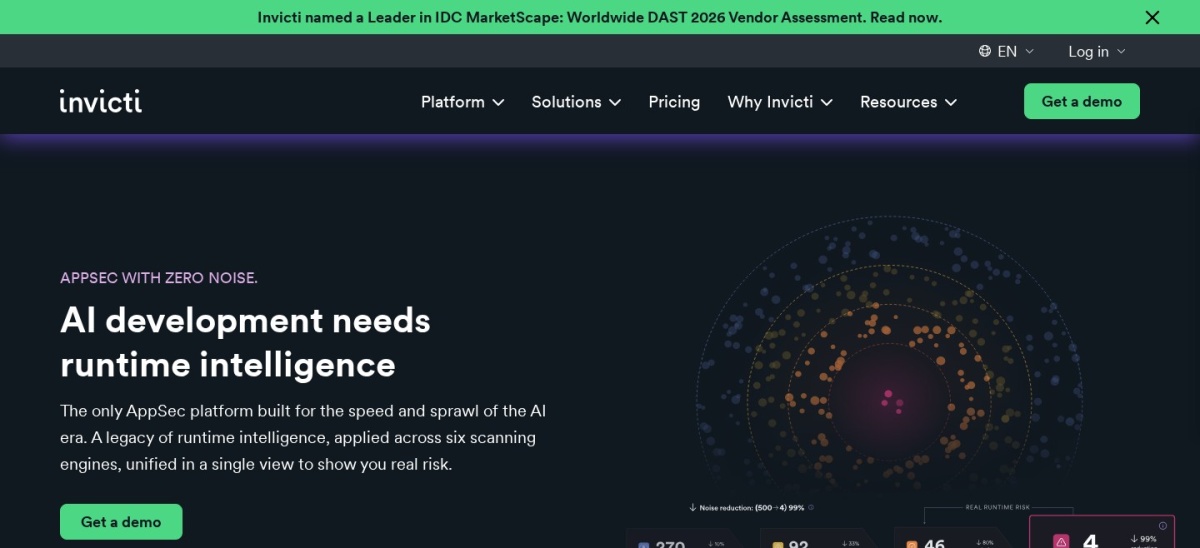
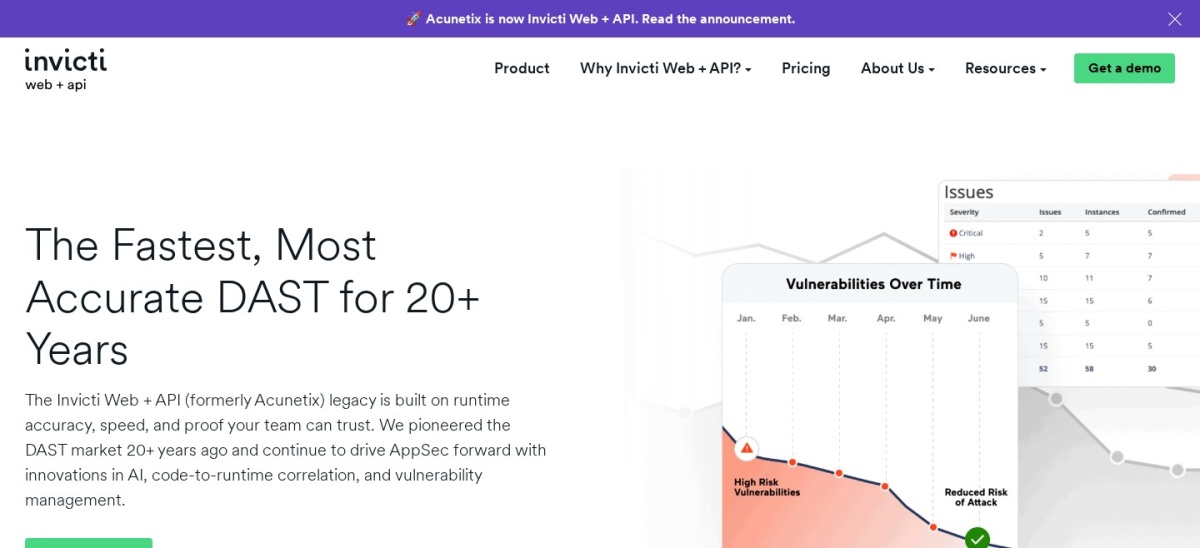
Invicti homepage, captured Nov 2026.
Invicti is built for organisations scanning many applications and needing results developers can trust. Formerly Netsparker, its proof-based scanning attempts to confirm vulnerabilities safely, which cuts the false positives that waste developer time. It holds 4.5 out of 5 on G2 from 72 reviews.
The trade off is price and scale. Invicti is quote-based and enterprise-grade, with implementation services reported as a significant extra cost for large programs. It suits large estates with hundreds of applications and JavaScript-heavy sites.
Qualys WAS is the DAST module of the Qualys cloud platform, sharing the same asset inventory and reporting as Qualys VMDR. It holds 4.5 out of 5 on G2 from 21 reviews and suits teams already using Qualys for vulnerability management.
The trade off is the thin base and the ecosystem lock-in. Twenty-one G2 reviews is a small sample, and WAS makes most sense inside a Qualys contract. It suits Qualys customers extending vulnerability management to web applications.
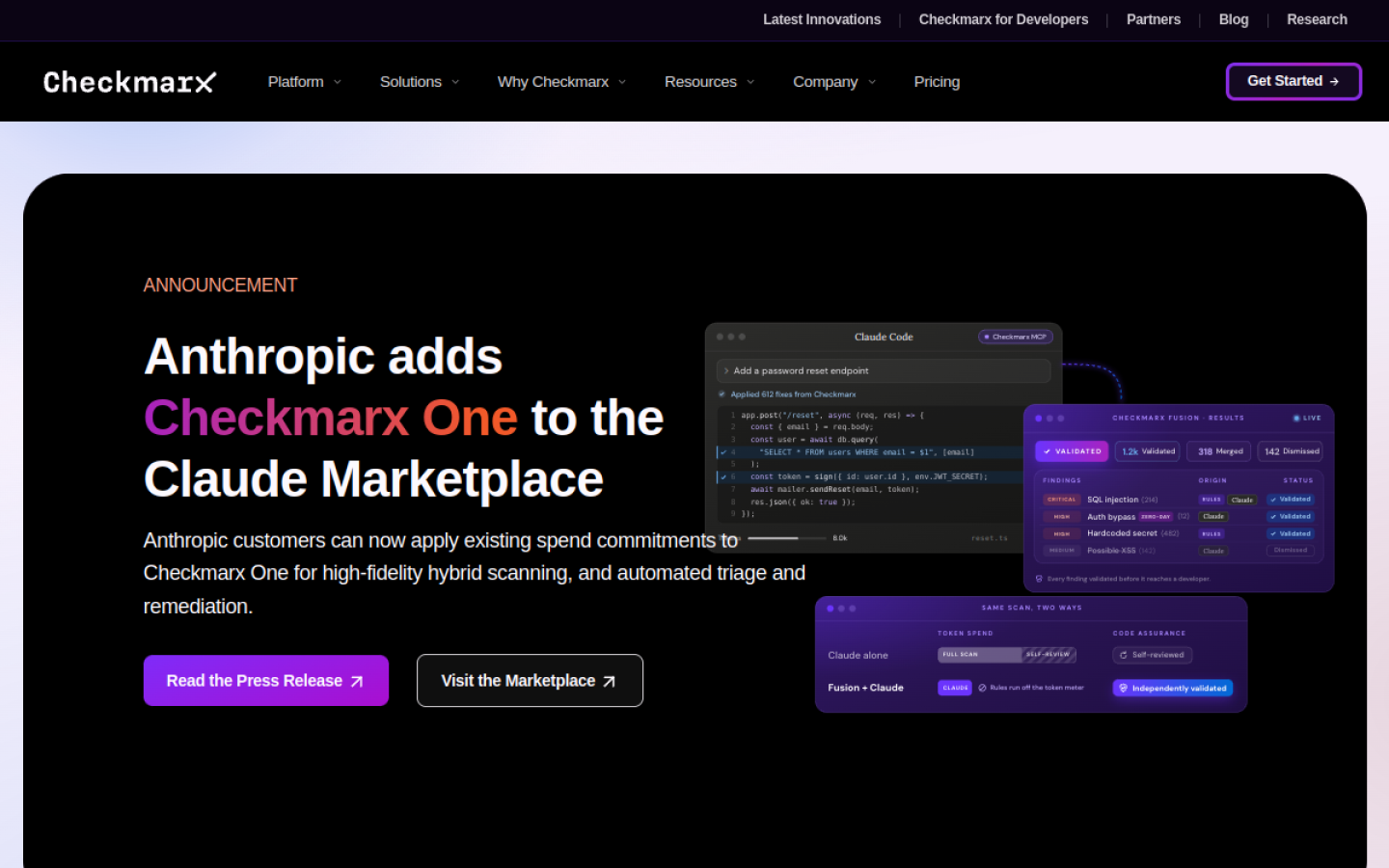
Checkmarx DAST is part of the Checkmarx One application security platform, which combines SAST, SCA, API security and DAST with AI remediation. It holds 4.2 out of 5 on G2 from 35 reviews and suits enterprises that already run Checkmarx for static analysis.
The trade off is complexity and price. Checkmarx One is quote-only with enterprise deal sizes, and reviewers cite complexity and false positives on the DAST side. It suits large enterprises that want one AppSec platform rather than point tools.
Acunetix is a standalone automated scanner for web applications that covers a wide range of flaws and handles modern web technologies. Owned by Invicti, it holds 4.1 out of 5 on G2 from 105 reviews and suits mid-size teams that want automated depth without a manual testing practice.
The trade off is per-target pricing. Acunetix prices by the number of scanned targets, so teams with hundreds of microservices should compare it against per-seat options like StackHawk. It suits teams with a handful of applications to scan deeply.
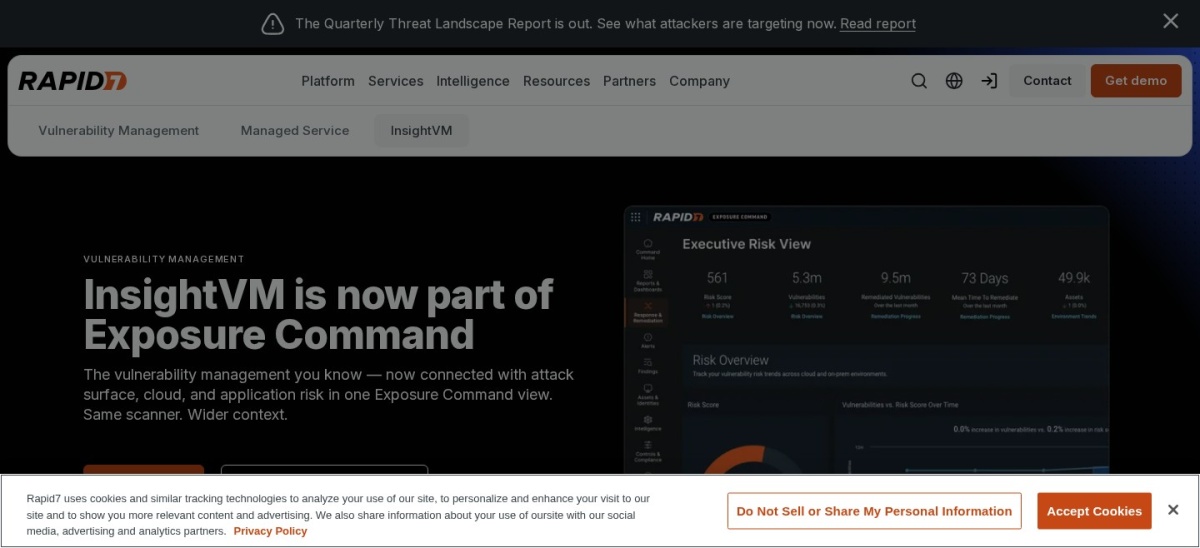
Rapid7 InsightAppSec is the cloud DAST offering inside Rapid7's Insight platform, with CI integration and attack replay that replays exploits to verify findings. It holds 3.9 out of 5 on G2 from 10 reviews and suits teams already running InsightVM.
The trade off is the thin base and the score. Ten G2 reviews and 3.9 out of 5 is the weakest rating in this list, and pricing is quote-based. It suits Rapid7 customers that want application and infrastructure risk in one view.
The biggest cost of DAST is not the licence, it is the developer time spent triaging false positives. A scanner that reports everything wastes the week; a scanner that reports only confirmed flaws gets its findings fixed.
Invicti and Acunetix use proof-based scanning: they safely exploit a suspected flaw to confirm it before reporting. Rapid7 InsightAppSec does the same with attack replay, re-running the exploit to verify the finding.
ZAP, Checkmarx and Bright Security take different approaches, and their false positive rates depend on tuning and AI validation. Ask any vendor for their false positive rate on your own applications during the trial.
How we chose
We started from every DAST tool with a public rating on G2, then kept the nine with the clearest fit for dynamic testing, from manual pentesting to developer-led CI scanning.
Prices were checked on 25 November 2026. Burp Suite Professional at $499 a user a year comes from October 2026 guides, as the vendor buy page shows no price, and StackHawk at $10 a person a month is a published list price. OWASP ZAP is free and open source, and the rest sell by quote.
We left out Astra Security and Probely, whose G2 review counts we could not verify from an independent source, and Detectify, which is primarily attack-surface monitoring. No vendor paid for a place, and we do not claim to have tested these tools ourselves.
How to choose a DAST tool
Start with who tests and who reads the findings, then count what you will be charged for.
Start with the free scanner. Run OWASP ZAP against a staging app first. It shows what DAST finds on your stack before any budget discussion.
Decide who reads the findings. Developers need findings in pull requests; security teams need reports and proof. The reader decides between StackHawk and Invicti.
Count what you will be charged for. Users, targets, scans and apps all price differently. Count your apps and users before you compare quotes.
Trial it on a real application. Scan a production-like app with authentication in the trial. Unauthenticated scans flatter every tool.
FAQ
What is the best DAST tool?
Burp Suite Professional is the best pick for manual testing, with 4.8 out of 5 on G2 from 129 reviews. Invicti is the pick for automated enterprise scanning, and OWASP ZAP is the best free starting point.
How much does DAST software cost?
Entry prices in this list run from free for OWASP ZAP to $499 a user a year for Burp Suite Professional, with StackHawk at $10 a person a month. Six of the nine tools sell by quote, so enterprise pricing depends on targets and volume.
What is the difference between DAST and SAST?
DAST tests a running application from the outside, like an attacker, while SAST reads source code for flaws before the app runs. DAST finds runtime and configuration issues; SAST finds code issues. Most AppSec programs run both.
Is OWASP ZAP good enough?
For a first DAST tool, yes. ZAP spiders and scans web apps, plugs into CI pipelines, and costs nothing. It needs tuning for complex apps and produces more false positives than proof-based scanners like Invicti.
Which DAST tool is best for developers?
StackHawk is the pick for developer-led teams: scanning inside CI with findings in pull requests at $10 a person a month. Bright Security suits teams building APIs and AI apps that need LLM coverage.
Why do most DAST vendors hide their prices?
Enterprise DAST pricing depends on targets, users, scan volume and modules, so vendors quote instead of publishing. Only Burp Suite and StackHawk publish dollar prices in this list, and ZAP is free.
SaaS SEO and WordPress specialist with about 8 years of experience. Rakib compares WordPress plugins, themes, hosting and software using public pricing, documentation and user reviews. See how we rank.