WLWPLegible EditorsLast verified 23 Nov 2026How we rank11 min read
★ Short answer
Oracle NetSuite is the best ERP software for most growing companies, with finance, inventory, CRM and ecommerce in one cloud system, rated 4.1/5 on G2. Pick Odoo if budget matters most, and Microsoft Dynamics 365 Business Central if your team already runs on Microsoft 365.
How we make this list: we compare pricing pages, product documentation and public user reviews, then re-check every price before each update. No product paid for a place. Disclosure.
NetSuite leads on breadth: finance, inventory, CRM and ecommerce in one system, from a $999 a month base fee before user licences.
Odoo is the cheapest way in, with a free one-app plan and a regular Standard price of $31.10 per user a month.
Business Central is the only pick with a published per-user price under $100: $80 a month for Essentials.
Sage Intacct scores highest on ease of use among the finance-led picks, at 4.3/5 from 4,433 G2 reviews.
Sage Intacct, Acumatica and Workday publish no list price, so get a quote before you budget.
What to look for in ERP software
An ERP system joins finance, sales, inventory and purchasing in one database, so a sale updates stock, the ledger and the customer record at the same time.
The products in this list split three ways: full suites such as NetSuite and SAP S/4HANA Cloud, finance-led systems such as Sage Intacct and Workday, and low-cost modular picks such as Odoo and ERPNext.
Price is the hardest part to compare. Only Business Central and Odoo publish a clear per-user price, while the rest quote by users, modules or resources used. If you also sell online, our ecommerce platform market share guide puts the store side of that decision in context.
Implementation usually costs more than the first year of licences. Ask every vendor for a fixed implementation estimate and a named go-live date before you sign.
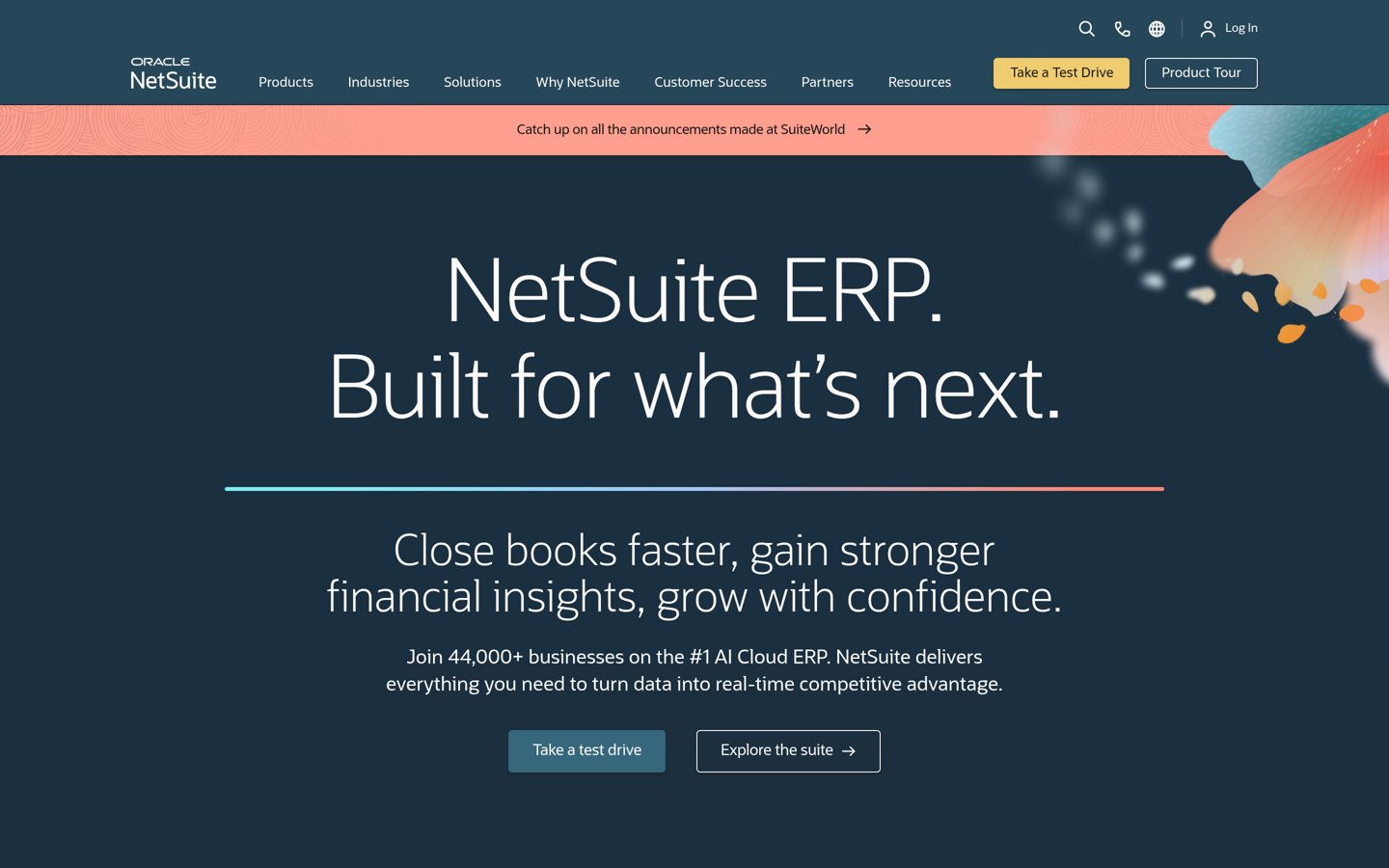
Oracle NetSuite is a cloud ERP that joins finance, inventory, order management, CRM and ecommerce in one system, with multi-subsidiary support through OneWorld. The Starter edition starts at a $999 a month base fee billed annually, before per-user licences, and most mid-market buyers land on higher editions.
The trade off is cost and setup. Full user licences run $129 a month each, and implementation typically adds $25,000 to $500,000 or more. It suits growing companies that have outgrown entry-level accounting and need one system for finance and operations.
What we like
Covers finance, inventory, CRM and ecommerce in one system
Multi-subsidiary and multi-currency support through OneWorld
Large partner network for implementation and add-ons
Watch out for
Base fee excludes per-user licences, so the real monthly cost is higher
Implementation is a large project, not a quick setup
Paid editions add modules such as manufacturing, WMS and SuiteCommerceVisit netsuite.com
02
SAP S/4HANA Cloud
4.4/5on G2 (1,061 reviews, checked Nov 2026)
Starts at$295/user/mo
Best ERP for large enterprises
Starting price$295/user/mo
Entry editionFinance Base
Free planNo
Free trialYes
sap.com
SAP S/4HANA Cloud homepage, captured Nov 2026.
SAP S/4HANA Cloud is SAP's flagship cloud ERP, built on the in-memory HANA database for real-time reporting across finance, supply chain and production. The Finance Base and Supply Chain Base editions each start at $295 per user a month, and both include Joule, SAP's AI assistant.
The trade off is price and complexity. The $295 figure covers one base module, so a full rollout costs far more per user, and implementations often run into six figures. It suits large companies with complex, multi-function processes that need SAP's depth.
What we like
Real-time analytics on the HANA database
Joule AI built into finance and supply chain
Strongest fit for large, multi-entity companies
Watch out for
One base module at $295 a month; full scope costs much more
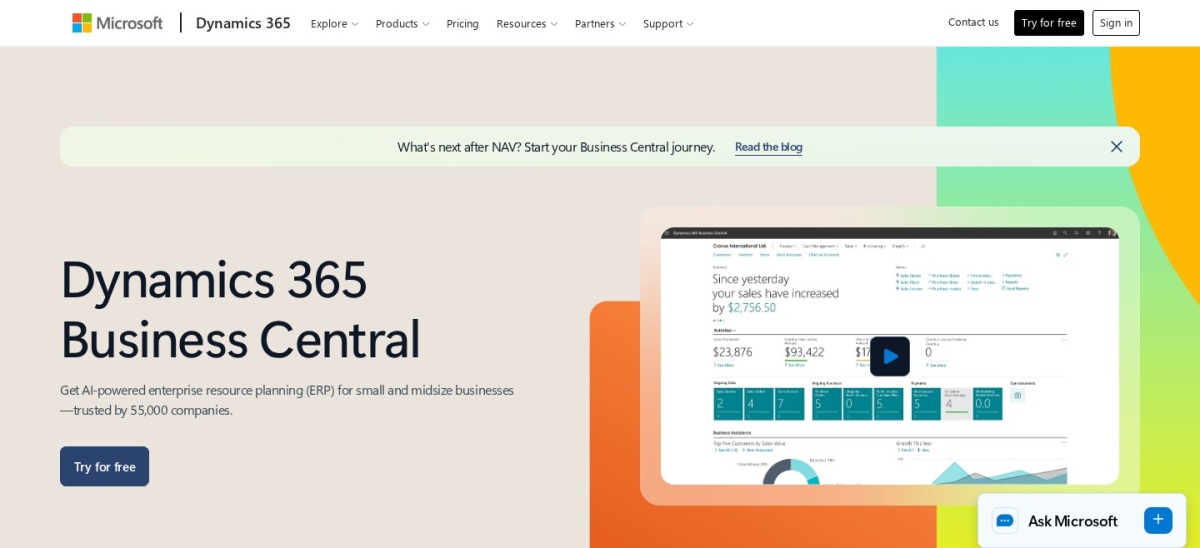
Microsoft Dynamics 365 Business Central homepage, captured Nov 2026.
Microsoft Dynamics 365 Business Central is a cloud ERP for small and mid-size companies, covering finance, sales, purchasing, inventory and projects, with Copilot included. Essentials costs $80 per user a month billed yearly, and Microsoft says it is trusted by 55,000 companies.
The trade off is that manufacturing and service management need Premium at $110 per user a month, and heavy customisation usually needs a partner. It suits teams that already live in Microsoft 365 and want their ERP in the same ecosystem.
What we like
Clear published pricing, rare in ERP
Deep Microsoft 365, Teams and Power BI integration
Team Member licences at $8 a month for light users
Odoo is a modular ERP where every app, from accounting and sales to inventory, HR and manufacturing, shares one database and one per-user price. One app is free for unlimited users, and Standard with all apps costs $31.10 per user a month at the regular yearly rate.
The trade off is the first-year discount. New customers pay $24.90 per user a month for Standard in year one, then the regular $31.10 rate applies. It suits small companies that want to start with one app and add modules as they grow.
What we like
Free one-app plan with unlimited users
Lowest regular per-user price in this list
One fee covers all apps, not one module
Watch out for
First-year price rises by about 25% at renewal
Multi-company and Studio need the $61 Custom plan
Custom adds Studio, multi-company and the external APIVisit odoo.com
05
Sage Intacct
4.3/5on G2 (4,433 reviews, checked Nov 2026)
Starts at$60/user/mo
Best finance-led ERP
Starting priceFrom $60/user/mo
Pricing modelQuote-based
Multi-entityYes
Free planNo
sage.com
Sage Intacct homepage, captured Nov 2026.
Sage Intacct is a cloud financial management system built for mid-size services businesses, software companies and nonprofits. It has a dimensional general ledger, multi-entity consolidation and automated revenue recognition for ASC 606 and IFRS 15.
The trade off is that Sage publishes no list price, and most modules are separate purchases. Reported pricing runs from about $60 per user a month, with typical mid-market subscriptions of $25,000 to $35,000 a year. It suits finance teams that need deep accounting rather than warehousing.
What we like
Highest ease-of-use scores among the finance-led picks
Strong multi-entity consolidation and dimensional reporting
Automated ASC 606 and IFRS 15 revenue recognition
Watch out for
No published price; every quote is custom
Add-on modules push the total cost up
Paid modules add projects, contracts and multi-entity supportVisit sage.com
06
Acumatica
4.4/5on G2 (2,056 reviews, checked Nov 2026)
PricingCustom/yr
Best ERP for growing manufacturers
PricingCustom, by resources used
User licencesUnlimited users
Free planNo
Typical go-live3-6 months
acumatica.com
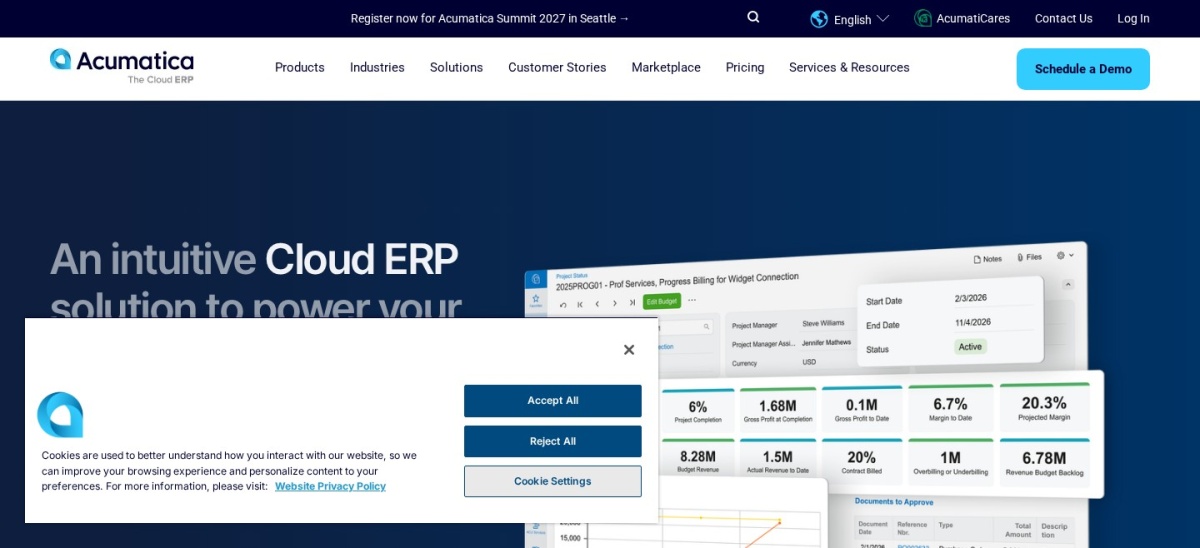
Acumatica homepage, captured Nov 2026.
Acumatica is a cloud ERP for small and mid-market manufacturers, distributors and construction firms, with finance, inventory, project accounting and CRM in one system. It charges by the computing resources used rather than per user, and lists unlimited users.
The trade off is that there is no published price at all, so you cannot budget without a quote, and implementation usually needs a partner. It suits companies with many occasional users, where per-user pricing would punish them for headcount.
What we like
Unlimited users under resource-based pricing
Strong fit for manufacturing, distribution and construction
SAP Business One is SAP's ERP for small companies, covering finance, sales, purchasing, inventory and production in one system. Reported pricing runs from about $110 to $219 per user a month, and it can run in the cloud or on your own servers.
The trade off is that every quote is custom, so the low end of the reported range is only a starting point, and customisation adds cost. It suits small manufacturers and distributors that want the SAP name without the scale of S/4HANA Cloud.
What we like
SAP depth at a small-company scale
Choice of cloud or on-premise deployment
Covers production as well as finance and sales
Watch out for
No published list price
Customisation and add-ons add cost
Paid add-ons extend warehousing, production and reportingVisit sap.com
08
Workday Financial Management
4.2/5on G2 (286 reviews, checked Nov 2026)
Starts at$150/user/mo
Best ERP for finance plus HR
Starting priceFrom $150/user/mo
Pricing modelQuote-based
Finance plus HRYes, one system
Free planNo
workday.com
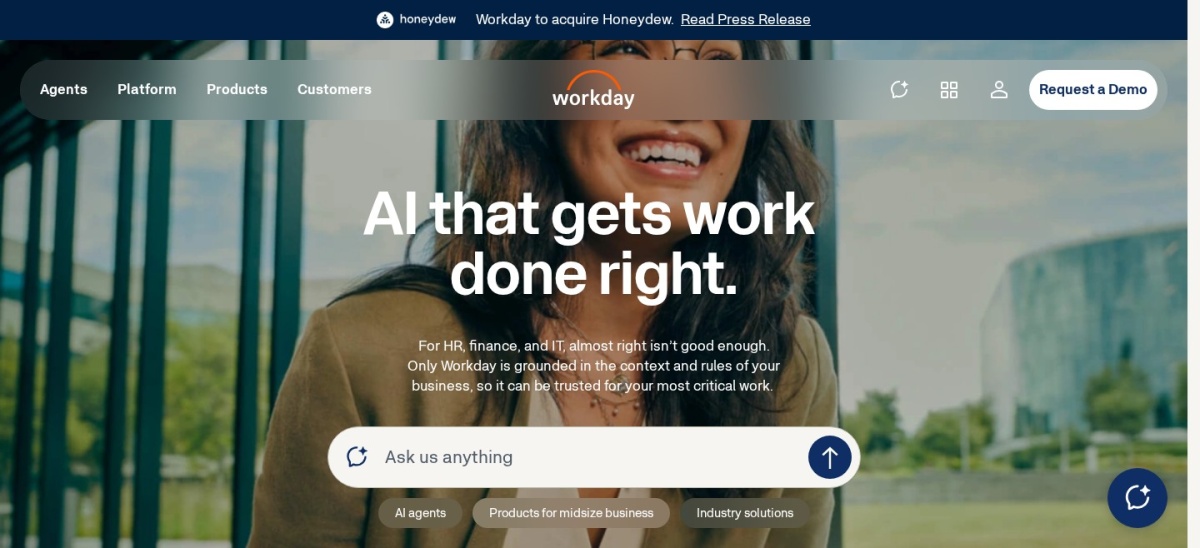
Workday Financial Management homepage, captured Nov 2026.
Workday Financial Management is a cloud system that joins finance and human resources in one platform, with real-time reporting and consolidation. Reported pricing runs from about $150 to $300 per user a month, and it is aimed at large services firms, healthcare and higher education.
The trade off is cost and scope. Implementation typically runs from $300,000 to over $1 million, and the finance module alone is a poor fit for manufacturers. It suits large organisations that want finance and HR on the same data model.
What we like
Finance and HR share one system and one data model
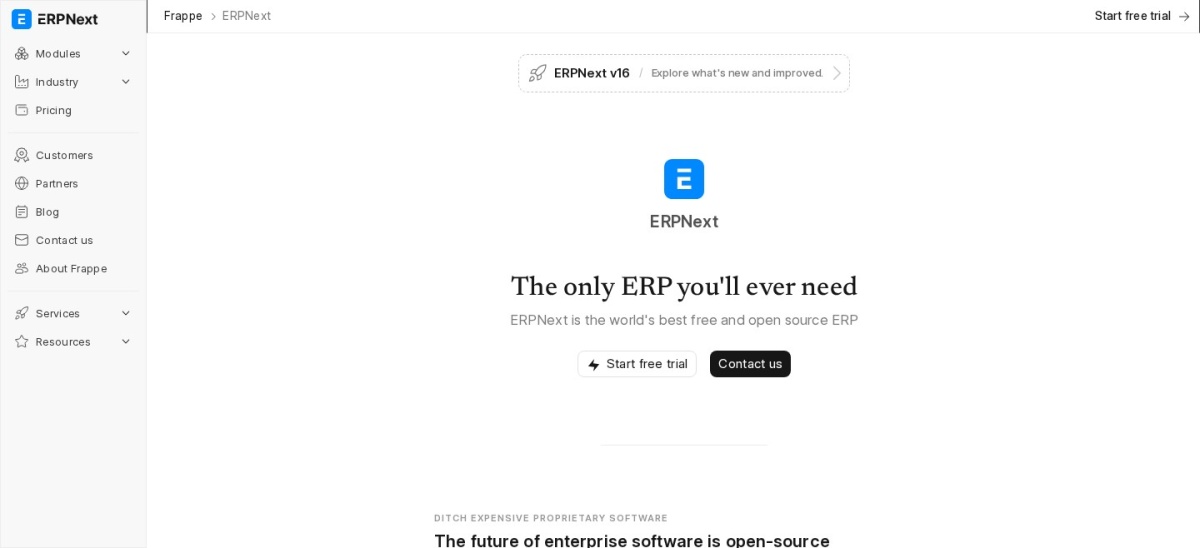
ERPNext is a free and open source ERP from Frappe, covering accounting, inventory, manufacturing, HR, CRM and projects in one system. The current version is v16, the software itself carries no per-user licence cost, and a hosted trial is available.
The trade off is that you run it yourself or pay for hosting, and the G2 review base is small at 51 reviews. It suits technical teams and small companies that want full control of their data without licence fees.
What we like
No per-user licence cost at all
Full source code, so nothing is locked in
Covers manufacturing and HR as well as finance
Watch out for
Small G2 review base of 51 reviews
Self-hosting needs technical skill or paid hosting
Paid Frappe Cloud hosting removes the self-hosting workVisit erpnext.com
Implementation: the cost beyond the licence
Licences are usually the smaller half of the first-year bill. Implementation, data migration and training are quoted separately by the vendor or a partner.
Reported implementation ranges run from $25,000 to $150,000 for Business Central, $20,000 to $80,000 for Sage Intacct, $25,000 to $500,000 or more for NetSuite, and $300,000 to over $1 million for Workday.
Acumatica implementations most often reach go-live in 3 to 6 months, according to G2 reviewers. Ask every vendor for a fixed implementation estimate and a named go-live date before you sign.
How we chose
We started from the ERP systems that appear most often in G2 comparisons and mid-market shortlists, then kept nine with a live product, a public review profile and a clear buyer fit.
Prices come from vendor pricing pages where they are published, and from reported starting figures where vendors quote only. Ratings and review counts come from G2, checked on 23 November 2026. Where a vendor shows a first-year discount, the list shows the regular price.
We left out products that are accounting tools rather than full ERP systems, and products with no public review profile. No vendor paid for a place, and we do not claim hands-on testing for this list.
How to choose ERP software
Match the system to your headcount, your stock and your sales channels before you look at demos.
Count the users who need full access. Read-only approvers can often use a cheaper licence, such as the $8 Team Member licence in Business Central or a Light User seat in Odoo.
List the modules you cannot live without. Inventory, manufacturing and multi-entity accounting change the price more than any other choice, so get those quoted first.
Ask for the full first-year cost in writing. Licences, implementation, data migration and training are separate lines. Get each one as a fixed figure, not a range.
Run a short pilot with real data. A two-week pilot with your own chart of accounts and a real order shows more than any demo script.
FAQ
What is the best ERP software?
Oracle NetSuite is the best ERP software for most growing companies. It covers finance, inventory, CRM and ecommerce in one cloud system and is rated 4.1 out of 5 on G2 from 4,912 reviews. Smaller teams should look at Odoo or Business Central first.
How much does ERP software cost?
It ranges from free for ERPNext self-hosted and $31.10 per user a month for Odoo Standard, to $80 for Business Central Essentials and $295 per user a month for SAP S/4HANA Cloud. NetSuite starts at a $999 a month base fee before user licences, and implementation often costs more than licences.
Is there a free ERP system?
Yes. Odoo offers one app free for unlimited users, and ERPNext is free and open source with no per-user licence cost. Both charge for hosting, support or extra modules, so free means free software, not a free rollout.
What is the difference between ERP and accounting software?
Accounting software handles the ledger, invoicing and tax. An ERP adds inventory, purchasing, sales, manufacturing and HR to the same database, so one sale updates stock, the ledger and the customer record together.
How long does it take to implement an ERP system?
It depends on size and scope. Acumatica implementations most often reach go-live in 3 to 6 months, according to G2 reviewers. Larger rollouts such as NetSuite or Workday usually take longer and need a partner-led project with data migration and training.
Do I need an ERP if I already use QuickBooks or Xero?
Not always. If you sell from one channel, hold little stock and have one entity, accounting software is enough. Move to an ERP when inventory, multi-entity accounting or manufacturing outgrow what your accounting tool can track.