Intruder is the best web application security testing tool for most teams, rated 4.8 out of 5 from 209 G2 reviews, with continuous scanning from $299 a month. Pick Burp Suite Professional for manual penetration testing at $499 per user a year, or OWASP ZAP for free open-source scanning.
How we make this list: we compare pricing pages, product documentation and public user reviews, then re-check every price before each update. No product paid for a place. Disclosure.
Intruder leads on G2 at 4.8/5 from 209 reviews, with web app scanning on the Cloud plan at $299 a month.
Burp Suite Professional now costs $499 per user a year, up from $449, with a free Community Edition for manual testing.
OWASP ZAP is the only fully free tool here, rated 4.7/5 but from only 14 G2 reviews.
7 of the 9 tools have a free plan or tier, and paid plans run from $10 a user a month to about $7,000 a year.
Invicti Web + API publishes no price; $7,000 a year for 5 targets is a marketplace estimate, not a vendor rate.
Astra holds the largest review base in this list at 4.7/5 from 268 G2 reviews, after its rating rose from 4.6.
What to look for in a web application security testing tool
Web application security testing means probing a running application the way an attacker would: crawling its pages, submitting crafted input, and checking whether logins, APIs and forms leak data or let code run. The tools in this list do that automatically, or give a person the controls to do it by hand.
Start with coverage. A scanner should handle authenticated areas behind a login, single-page applications, and the APIs the front end calls, not just public pages. Our guide on running a WordPress security audit shows the same idea applied to a WordPress site: check what is exposed before you trust it.
Then weigh false positives. A scanner that cries wolf on every page wastes the time it saves, so proof-based scanning and manual validation matter more than raw check counts.
Finally, match the tool to the team. A solo tester needs a desktop proxy, a development team needs a scanner inside CI/CD, and a compliance-driven team needs scheduled scans with audit-ready reports.
The 9 best security testing tools for web applications
01
Intruder
4.8/5on G2 (209 reviews, checked Nov 2026)
Paid from$299/mo
Best for continuous automated scanning
Scheduled scansWeekly on Cloud
Web app scansCloud plan and above
Free planYes, limited
Paid planCloud, $299/mo
intruder.io
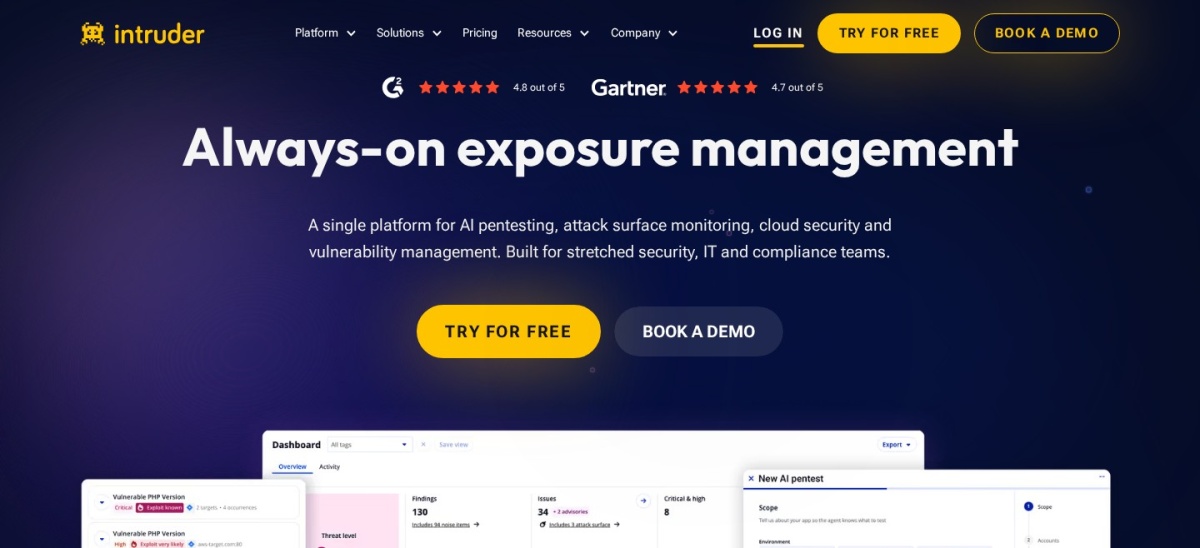
Intruder homepage, captured Nov 2026.
Intruder is a cloud vulnerability scanner that runs continuous checks across infrastructure, web applications, APIs and cloud accounts from one dashboard. Its Cloud plan adds weekly scans, cloud sync for AWS, Azure and Google Cloud, and web application scanning, with findings written in plain language and a free plan for basic monitoring.
The trade off is price and plan limits. The cheaper Essential plan, $119 a month billed yearly, covers infrastructure only, so web application scans need Cloud at $299 a month, and each target needs its own licence. It suits small teams without a security hire that want scheduled scans and clear fix guidance.
What we like
Highest G2 rating in this list, 4.8/5 from 209 reviews
Continuous scanning with plain-language findings
Covers infrastructure, web apps, APIs and cloud in one place
Watch out for
Web app scans need the $299 a month Cloud plan
Per-target licences add up as the estate grows
Cloud adds weekly scans, cloud sync and web app testingVisit intruder.io
02
Burp Suite
4.8/5on G2 (140 reviews, checked Nov 2026)
Paid from$499/user/yr
Best for manual web app penetration testing
Manual proxyYes, with Repeater
Automated scanYes, Professional
Free planCommunity Edition
Paid planProfessional, $499/user/yr
portswigger.net
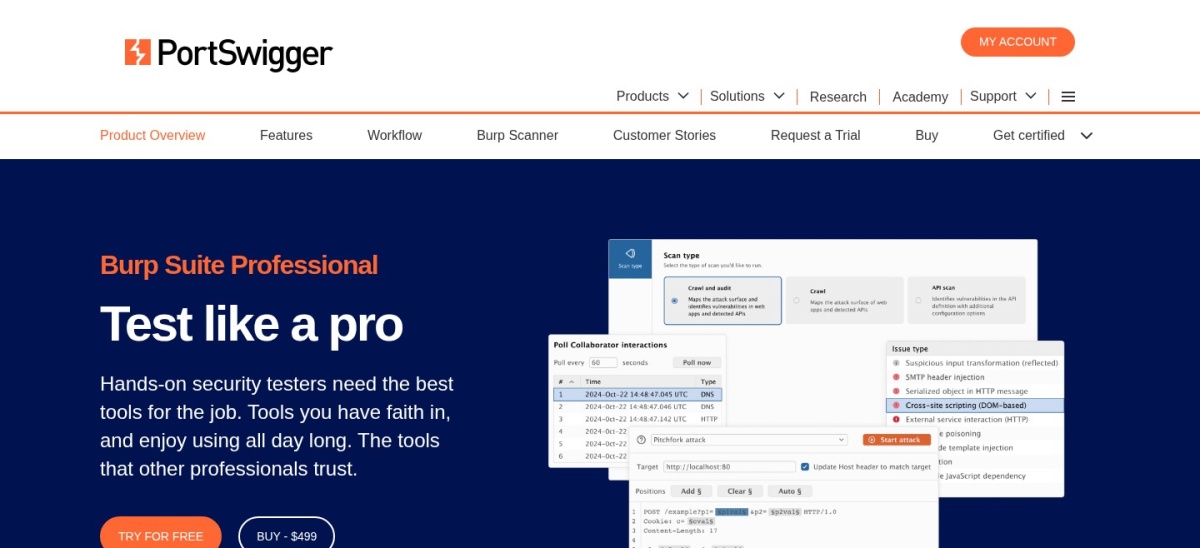
Burp Suite homepage, captured Nov 2026.
Burp Suite is the standard desktop toolkit for manual web application testing, built around an intercepting proxy, Repeater, Intruder and a web vulnerability scanner. The free Community Edition covers manual testing, while Professional at $499 per user a year adds the scanner, full-speed Intruder, project files and Burp Collaborator.
The trade off is that it is a desktop tool for one person at a time. Each tester needs a separate $499 licence, and scheduled enterprise scanning needs Burp Suite DAST on a custom quote. It suits penetration testers and security researchers who test applications by hand.
What we like
The standard tool for manual web application testing
Large extension ecosystem and strong community
Free Community Edition for manual work
Watch out for
Per-user pricing adds up for teams
No scheduled scanning without the enterprise DAST tier
Astra Security is a penetration-testing platform that pairs an automated scanner with manual tests by CREST-accredited testers. Scanner Lite costs $699 a year per target and runs more than 8,000 checks, while the dashboard maps findings to SOC 2, PCI DSS, ISO 27001, HIPAA and GDPR compliance reports.
The trade off is per-target pricing. Every web application, API or mobile app counts as a separate target, and a manual pentest starts at $2,999 a year per target with Pentest Auto. It suits teams that want a scanner plus a yearly manual pentest and a certificate in one place.
What we like
Largest G2 review base in this list, 268 reviews
Scanner plus manual pentest in one dashboard
Compliance reports for SOC 2, PCI DSS and ISO 27001
Beagle Security is an AI-driven penetration testing platform for web applications, APIs and GraphQL endpoints. It simulates real attacks, checks findings to cut false positives, and plugs into CI/CD pipelines, with compliance reports for SOC 2, PCI DSS, HIPAA, GDPR and ISO 27001.
The trade off is the monthly rate. Essential costs $99 a month billed yearly, or $119 month to month, and covers 2 tests, so larger portfolios move to Advanced at $359 a month. It suits agile teams that want automated testing with developer-friendly fix guidance.
Probely is a cloud scanner for web applications and APIs that walks through an application in a browser and reports what it finds. It covers the OWASP Top 10 plus more than 30,000 checks, prioritises findings by severity, and gives developers step-by-step fix guidance with compliance checks for PCI DSS, ISO 27001, HIPAA and GDPR.
The trade off is a thin public record. It holds a 4.7 out of 5 G2 rating from only 19 reviews, and as part of Snyk its standalone pricing may change, so confirm the $49 a month plan before buying. It suits small teams that want guided scans without running their own infrastructure.
What we like
Browser-based scans with step-by-step fix guidance
Covers the OWASP Top 10 plus 30,000+ checks
Low entry price at $49 a month
Watch out for
Only 19 G2 reviews, a thin rating base
Standalone pricing may change under Snyk ownership
OWASP ZAP is a free, open-source scanner for web applications, maintained as ZAP by Checkmarx. It spiders an application, runs passive and active scans, and plugs into CI pipelines through its API and automation framework, with add-ons that extend it for APIs and authenticated areas.
The trade off is effort. There is no paid support tier, setup takes more work than a hosted scanner, and findings need manual review to weed out false positives. It suits teams with no budget and someone on staff who can run and tune an open-source tool.
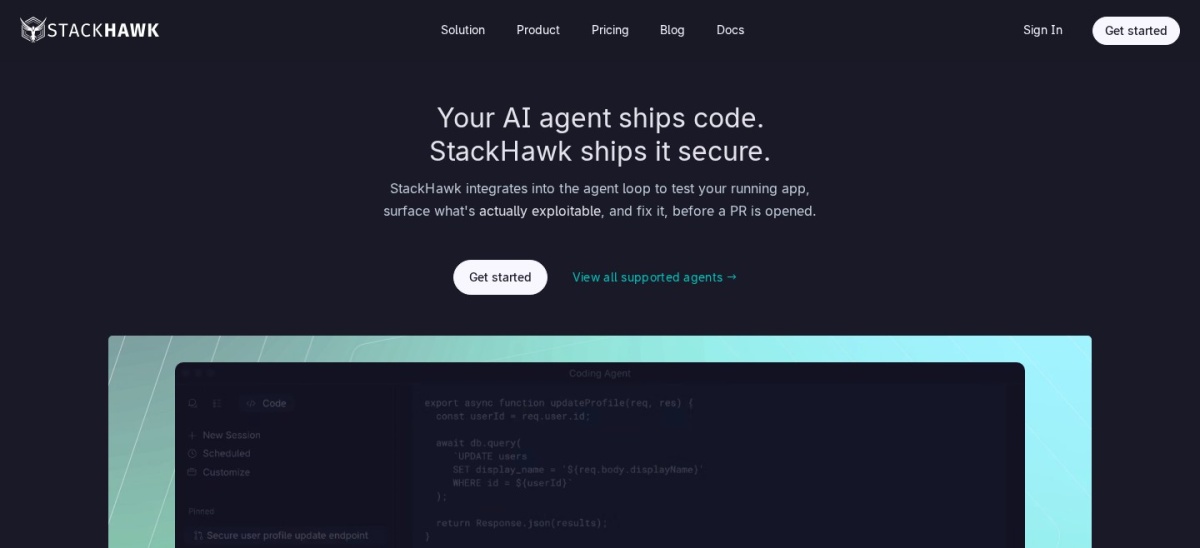
StackHawk is a DAST scanner built for developers, running inside CI/CD pipelines to test web applications and APIs as code ships. The paid Wingman plan costs $10 per user a month and adds unlimited scans and applications, CI/CD automation, and integrations with Jira and Slack.
The trade off is the price picture. G2 still lists older Secure and Scale tiers at $39 and $59 per user a month, so confirm the current plan on the vendor site, and per-user pricing grows with the team. It suits DevSecOps teams that want security findings inside pull requests.
What we like
Built for CI/CD with Docker-based scans
Unlimited scans and applications on paid plans
Lowest paid entry in this list at $10 a user a month
Watch out for
G2 lists older, higher tiers; confirm current pricing
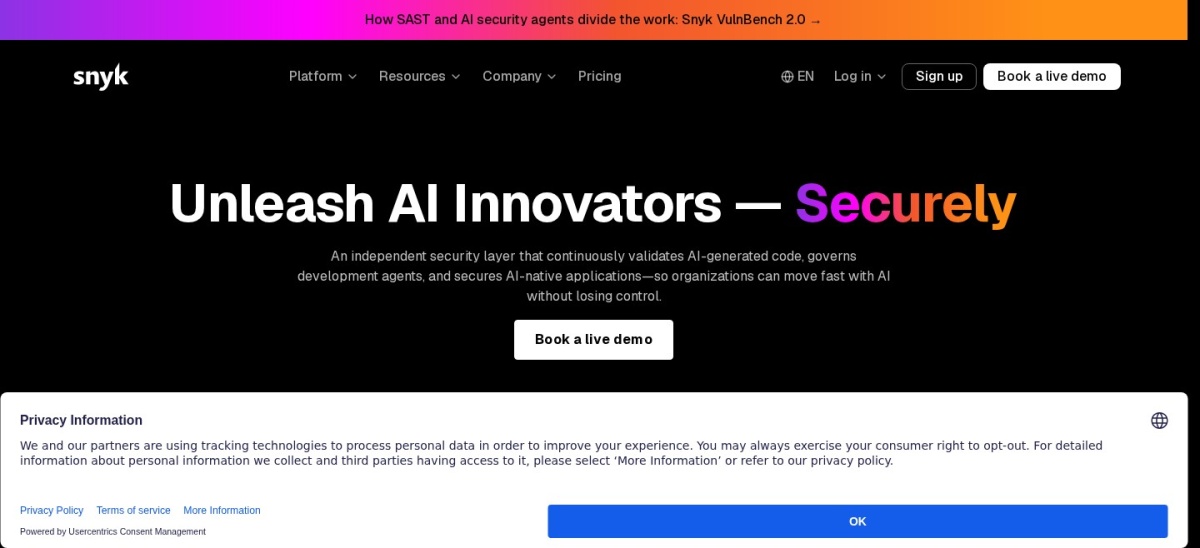
Snyk is a developer security platform that scans code, open-source dependencies, containers and infrastructure as code. The free plan includes Snyk Code with 100 tests a month, and the platform plugs into GitHub, GitLab, IDEs and CI pipelines, with AI auto-fix that suggests code changes.
The trade off is scope and scale. Team costs $25 per contributing developer a month for 5 to 10 developers, so a five-developer team pays $1,375 a year, and Snyk scans code rather than a running application. It suits small teams that want SAST, SCA and AI auto-fix in one tool.
What we like
Covers SAST, SCA, containers and IaC in one place
AI auto-fix suggests code changes, not just findings
Strong free plan for code scanning
Watch out for
Scans code, not a running application
Team plan needs 5 to 10 developers
Team adds higher test limits, Jira and license complianceVisit snyk.io
09
Invicti Web + API
4.1/5on G2 (105 reviews, checked Nov 2026)
Starts at$7,000/yr
Best for proof-based enterprise DAST
Proof-based scanningYes, validates findings
API coverageREST, SOAP, GraphQL
Free planNo, trial available
Paid planWeb + API, quote-based
invicti.com
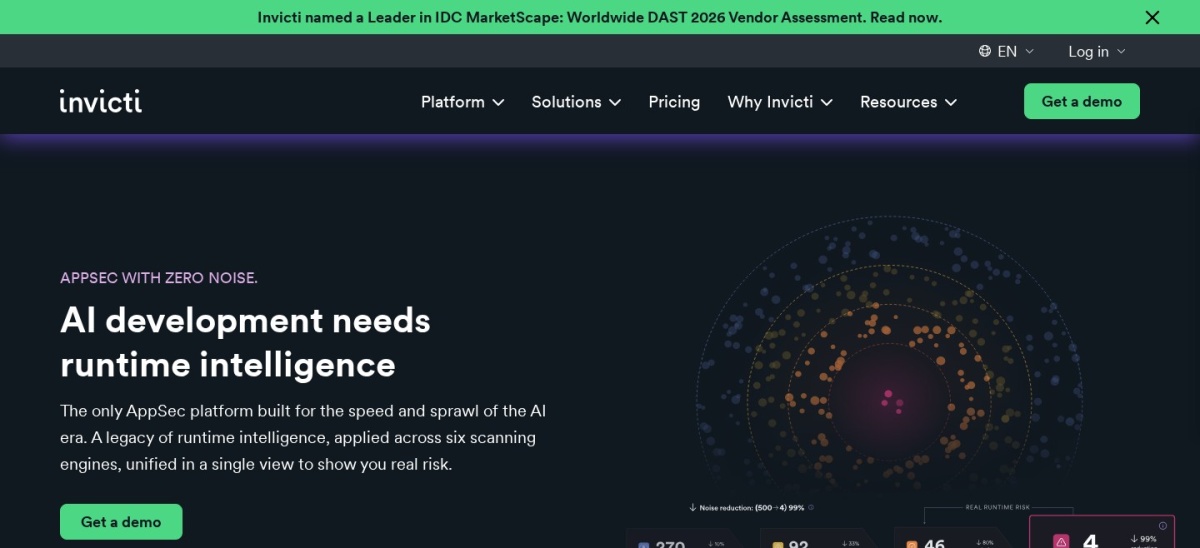
Invicti Web + API homepage, captured Nov 2026.
Invicti Web + API is a DAST scanner for web applications and APIs, formerly sold as Acunetix, that validates findings with proof-based scanning to cut false positives. Its AcuSensor agent adds code-level detail for supported languages, and scans cover REST, SOAP and GraphQL APIs plus single-page applications.
The trade off is price transparency. Invicti publishes no rate card, and the $7,000 a year figure is a marketplace estimate for a 5-target bundle, so the real quote depends on target count. It suits mid-market teams running scheduled, compliance-driven scans across a defined set of applications.
Automated scanners (DAST) crawl and attack a running application on a schedule. They catch common flaws such as SQL injection and cross-site scripting, and they run the same checks every time.
Manual testing finds what scanners miss: business-logic flaws, broken access control and chained attacks. Burp Suite is built for that work, and Astra pairs a scanner with human testers.
Most teams need both. Run an automated scan on every release, then book manual testing for major releases or before a compliance audit.
How we chose
We started from the DAST and web application testing tools with public G2 ratings, then kept those with a published price or a documented marketplace figure and a clear web application focus.
Prices come from each vendor's pricing page, checked on 26 November 2026, with Invicti's figure from an AWS Marketplace listing because the vendor publishes no rate card. Ratings and review counts come from G2 on the same day. Where a vendor shows a sale, the list shows the regular price.
We left out quote-only enterprise tools such as Qualys Web Application Scanning and Rapid7 InsightAppSec, which publish no list price. No vendor paid for a place, and we do not claim to have used these tools ourselves.
How to choose a web application security testing tool
Start with how your application is built and who will run the scans, then match the tool to that shape.
List what needs testing. Count the web applications, APIs and authenticated areas. Per-target pricing punishes teams with many small applications.
Decide between automated scans and manual testing. Pick a DAST scanner for scheduled checks on every release, and Burp Suite or a manual pentest for logic flaws scanners miss.
Check the free tier first. ZAP costs nothing, and most tools here offer a free plan or trial. Run one scan on a staging application before paying.
Confirm the real yearly cost. Per-user and per-target prices multiply fast. Add up licences for every tester and target, and ask what a renewal costs.
FAQ
What is the best security testing tool for web applications?
Intruder leads this list at 4.8 out of 5 from 209 G2 reviews, with continuous scanning from $299 a month. Burp Suite Professional is the stronger pick for manual penetration testing, and OWASP ZAP is the best free option.
Is OWASP ZAP enough for web application security testing?
ZAP covers the basics well: it spiders, scans and plugs into CI pipelines at no cost. It needs someone to set it up and review findings, and it cannot replace manual testing for business-logic flaws or a compliance audit.
What is the difference between DAST and manual penetration testing?
DAST tools attack a running application automatically on a schedule and catch common flaws such as SQL injection. Manual testing uses a person with tools such as Burp Suite to find logic flaws, broken access control and chained attacks that scanners miss.
How much does web application security testing cost?
Free tools such as ZAP cost nothing, while paid scanners in this list start at $10 per user a month for StackHawk and $49 a month for Probely. Enterprise DAST such as Invicti Web + API runs to about $7,000 a year for five targets.
Can I test a web application behind a login?
Yes, if the tool supports authenticated scanning. Burp Suite, ZAP, Invicti, Beagle and Probely all handle logged-in areas, though some need extra setup for modern login flows such as single sign-on.
Do these tools replace a penetration test?
No. Automated scanners catch known flaw patterns on a schedule, but a manual penetration test is still needed for business logic, access control and compliance evidence. Astra bundles both in one platform.
SaaS SEO and WordPress specialist with about 8 years of experience. Rakib compares WordPress plugins, themes, hosting and software using public pricing, documentation and user reviews. See how we rank.