Snyk is the best tool for the top software supply chain security use cases, with a free plan and a Team plan at 25 dollars per developer a month. GitHub Advanced Security suits teams already on GitHub, while Aikido covers every use case in one flat-priced platform.
How we make this list: we compare pricing pages, product documentation and public user reviews, then re-check every price before each update. No product paid for a place. Disclosure.
Snyk leads at $25 per contributing developer a month, with a free plan and the most complete dev-first workflow here.
GitHub Advanced Security is the cheapest add-on for teams already on GitHub, at $30 per active committer a month.
FOSSA has the lowest published paid price at $20 per project a month, with a free tier for 5 projects.
Black Duck, Sonatype and Anchore are quote-only, so budget for a sales conversation before you commit.
Anchore and Sonatype hold thin G2 ratings of 4 reviews each, so treat their scores with care.
What are the top software supply chain security use cases?
A software supply chain is everything that goes into your software before it ships: open-source libraries, container images, build tools and third-party packages. Each one can carry a vulnerability or a license problem.
The top use cases are the same across most teams: generate an SBOM for every release, scan dependencies for known vulnerabilities, check licenses, catch malicious packages and enforce policy before code ships.
No single tool covers every use case equally. Snyk and GitHub Advanced Security are the strongest all-round picks, FOSSA leads on license compliance, and Anchore leads on container images.
Quote-only pricing is common here. Three tools in this list publish no price at all, so shortlist on capability first and budget for a sales conversation before you commit.
The 9 best tools for supply chain security use cases
01
Snyk
4.5/5on G2 (135 reviews, checked Nov 2026)
Paid from$25/mo
Best for supply chain security overall
Cheapest paid planTeam, $25/dev/mo
Free planYes
SBOM formatsSPDX, CycloneDX
ScansCode, OSS, containers, IaC
snyk.io
Snyk homepage, captured Nov 2026.
Snyk is a developer-first security platform that scans open-source dependencies, containers, code and infrastructure as code, and builds an SBOM from each scan. The free plan includes 200 open-source tests a month, 100 code tests and IDE plugins, with no limit on developers.
The trade off is the per-developer price. Team costs $25 per contributing developer a month, needs at least 5 developers and caps at 10, so a 5-developer team pays $1,375 a year on annual billing. It suits small teams that want fast feedback inside pull requests.
GitHub Advanced Security homepage, captured Nov 2026.
GitHub Advanced Security is GitHub's native security, now sold as Code Security and Secret Protection. It brings dependency scanning into the repository through Dependabot, which alerts on vulnerable packages and opens update pull requests, with SBOM export included.
The trade off is that private repositories need a paid license. Code Security costs $30 per active committer a month, on top of a Team seat at $4 or Enterprise at $21, and Secret Protection adds $19. It suits teams whose code already lives on GitHub.
Aikido Security is an all-in-one platform that covers dependency scanning, static code analysis, secrets detection and cloud checks in one dashboard. The free Developer tier covers 2 users with dependency scanning, SAST and secrets detection included.
The trade off is the flat price. Basic starts at $350 a month for 10 users, so a two-person team pays for seats it does not use, and the breadth means less SCA depth than a specialist. It suits small teams that want one tool for every check.
FOSSA is a supply-chain platform focused on SBOM generation, license compliance and vulnerability management. The free tier covers 5 projects and 10 developers, and Business adds license policies that can block a build when a banned license appears.
The trade off is per-project pricing. Business costs $20 per project a month, so a team with many small repositories pays for each one. It suits teams where legal needs license reports and SBOMs for every release.
Mend is an enterprise composition analysis platform that combines software composition analysis with SBOM generation and deep license policy controls. It scans dependencies for vulnerabilities and license risk, then enforces rules that can block a build when a banned license appears.
The trade off is price and setup. Mend lists $300 per contributing developer a year, and implementation typically takes about two months. It suits enterprises that need strict open-source governance at scale.
Anchore is an SBOM-first platform for container images and software artifacts, built on the open-source Syft SBOM generator and Grype vulnerability scanner. Its policy engine checks every image against rules you write, and blocks images that break policy.
The trade off is enterprise pricing. Anchore Enterprise is quote-only, and reviewers note the first deployment needs dedicated admin work and SBOM screens can load slowly at scale. It suits compliance-heavy teams that scan containers.
Black Duck is an enterprise composition analysis platform, built for teams that need audit-grade SBOMs and license reports. It scans open-source components, flags license conflicts and produces the audit reports that enterprise buyers and regulators ask for.
The trade off is cost and setup. Pricing is quote-only and deployment takes months, so budget for a sales conversation before you commit. It suits large teams that ship software to regulated customers.
JFrog Xray is a software composition analysis tool that inspects artifacts, packages and container images for open-source risks. It recursively checks every layer, exports SBOMs and can block downloads that break policy at the registry.
The trade off is scope and price. Xray only sees what flows through Artifactory, and it starts with Enterprise X at $950 a month, or Pro X at $27,000 a year self-hosted. It suits teams already running Artifactory.
What we like
Deepest artifact-level scanning here
Blocks risky downloads at the registry
Native Artifactory integration
Watch out for
Only sees what flows through Artifactory
Expensive entry price for small teams
Pro X adds self-hosted scanning at $27,000 a yearVisit jfrog.com
09
Sonatype Lifecycle
4.2/5on G2 (4 reviews, checked Nov 2026)
PricingCustom/yr
Best for policy enforcement at scale
Cheapest paid planQuote-only
Free planNo
Policy engineYes, component quarantine
SBOM formatsSPDX, CycloneDX
sonatype.com
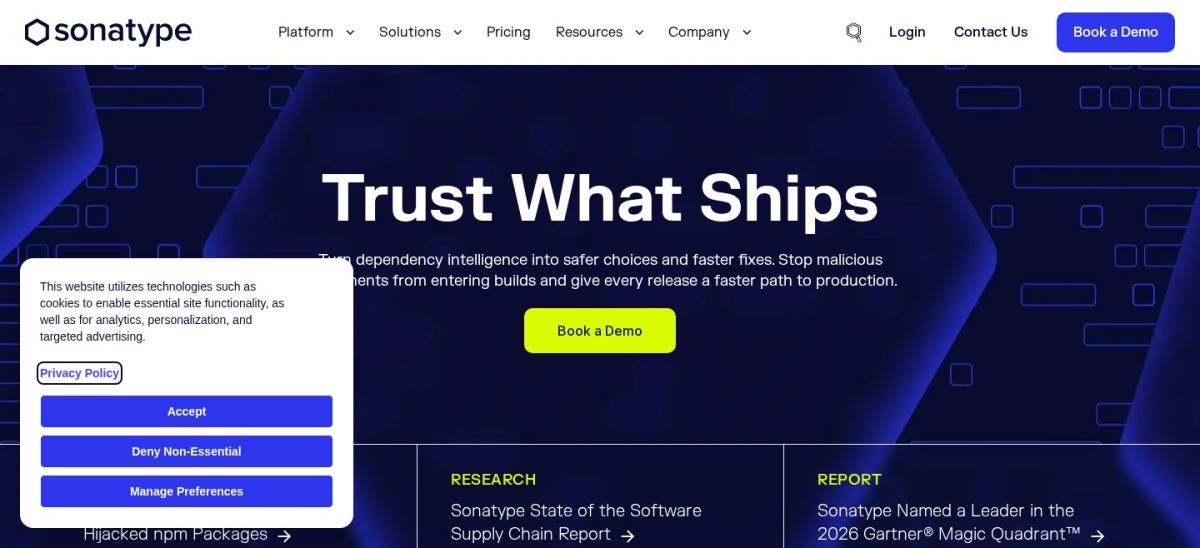
Sonatype Lifecycle homepage, captured Nov 2026.
Sonatype Lifecycle is an enterprise composition analysis platform that generates SBOMs and applies security, license, quality and architecture policies to every component. Its quarantine can block risky components before they reach production.
The trade off is that pricing is quote-only and the product is built for large teams, with annual commitments and a sales-led process. It suits Java and .NET teams that need policy enforcement at scale.
SBOM generation: Snyk, FOSSA, Sonatype Lifecycle and Anchore all export SBOMs in SPDX or CycloneDX format for every release.
Dependency vulnerability scanning: Snyk, GitHub Advanced Security, Mend and JFrog Xray scan dependencies for known vulnerabilities and suggest fixes.
License compliance: FOSSA and Mend lead here, with policies that can block a build when a banned license appears.
Malicious package detection: JFrog Xray and Aikido check packages for typosquatting and malicious code before they reach production.
Policy enforcement in CI: Sonatype Lifecycle and Anchore quarantine risky components automatically, so bad builds never ship.
How we chose
We started from the supply chain security tools ranked on G2 and in our SBOM and SCA guides, then kept the nine tools with the most reviews and the clearest fit for each use case.
Prices come from each vendor's pricing page, checked on 29 November 2026, and use the cheapest paid plan. Ratings and review counts come from G2 on the same day, and three tools publish no price at all.
We left out tools with no verifiable rating and pure runtime platforms. No vendor paid for a place, and we do not claim hands-on testing for this list.
How to choose a supply chain security tool
Start with the use case that hurts most, then match the tool to it.
Name your top use case first. If you need SBOMs for buyers, shortlist Snyk, FOSSA or Sonatype. If containers are the risk, start with Anchore or JFrog Xray.
Count your developers and repositories. Per-developer prices like Snyk at $25 a month scale very differently from flat fees like Aikido at $350 a month or per-project prices like FOSSA.
Check the free tier limits. Snyk, FOSSA, GitHub and Aikido all run free for small teams, so trial the real workflow before you pay.
Test with a real build. Run the tool on one real repository and check the SBOM it produces before you buy, so you know the output meets your buyers' requirements.
FAQ
What are the top software supply chain security use cases in 2026?
The top use cases are SBOM generation, dependency vulnerability scanning, license compliance, malicious package detection and policy enforcement in CI. Snyk covers the most of them in one tool, while FOSSA leads on licenses and Anchore on containers.
What is the best software supply chain security tool?
Snyk is the best supply chain security tool for most teams. It is rated 4.5 out of 5 on G2, its Team plan costs $25 per contributing developer a month, and it scans code, dependencies, containers and infrastructure as code.
What is an SBOM and why do I need one?
An SBOM is a list of every component in your software, like an ingredients label. Buyers and regulators now ask for one with every release, and it is the fastest way to check whether a new vulnerability affects your software.
How much does supply chain security software cost?
Published prices run from free to $950 a month. Snyk Team costs $25 per developer a month, FOSSA Business costs $20 per project a month, and JFrog Xray starts at $950 a month. Black Duck, Sonatype and Anchore are quote-only.
Is there a free supply chain security tool?
Yes. Snyk has a free plan, FOSSA is free for 5 projects, GitHub Advanced Security is free for public repositories, Aikido is free for 2 users, and Anchore is built on free open-source tools.
Snyk vs GitHub Advanced Security: which should I pick?
Pick Snyk if your team works across several code hosts or wants the strongest developer workflow. Pick GitHub Advanced Security if all your code already lives on GitHub, since Dependabot and Copilot Autofix work inside the repository.
SaaS SEO and WordPress specialist with about 8 years of experience. Rakib compares WordPress plugins, themes, hosting and software using public pricing, documentation and user reviews. See how we rank.