Qase leads the best TestRail alternatives for most QA teams, combining manual test management, automation reporting and requirements traceability with a 4.7/5 G2 rating. Choose Kualitee for affordable test and defect management or Testmo for bringing manual, exploratory and automated testing together under one team subscription.
How we make this list: we compare pricing pages, product documentation and public user reviews, then re-check every price before each update. No product paid for a place. Disclosure.
Qase earns a 4.7/5 G2 rating from 338 reviews and offers paid plans from $35 per tester per month with annual billing.
Kualitee supports 3 users and 500 test cases on its free Growth plan, with regular paid pricing of $180 per user annually.
Testmo starts at $59 per month for a team of 5 users, making its billing model attractive for small QA departments.
Testiny offers a free plan for 3 users and Starter pricing of $15.42 per user per month with annual billing.
TestMonitor costs $396 annually for 3 users and supports integrations with more than 30 automation tools.
Tricentis qTest earns 4.3/5 from 104 G2 reviews, but enterprise pricing requires a direct sales inquiry.
How do you choose the best TestRail alternatives?
The best TestRail replacement should match your existing testing workflow. Manual QA teams need organized test repositories and repeatable execution plans, while automation-heavy teams need reliable result ingestion and reporting across their development pipelines.
Licensing models can matter more than individual subscription prices. Qase charges by tester, Testmo starts with a package covering 5 users, and SpiraTest offers concurrent licensing. Compare the actual subscription required for your entire department.
Migration quality determines how disruptive switching platforms becomes. Check whether your replacement can preserve test steps, expected results, custom fields, attachments and historical execution records rather than simply importing test case titles.
Free plans are useful for small repositories and evaluation projects. Kualitee and Testiny provide permanent free options, although growing teams should examine storage limits, historical reporting and automation features before committing.
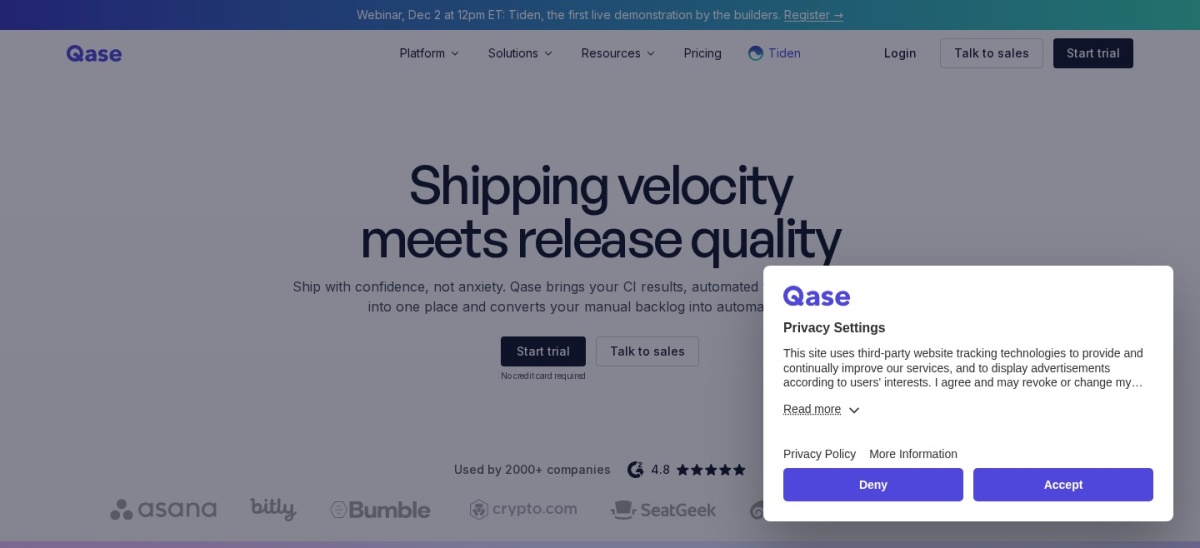
Qase is a test management platform that connects structured test cases with automated execution results and release reporting. Its free plan includes 2 projects, 500 MB of storage and 30 days of test history, while Teams removes project and test-run limits.
The trade off is that the free plan targets educational, hobby and nonprofit use cases, while professional teams may need Teams at $35 per user per month with annual billing or $42 with monthly billing. It suits development departments that want manual testing and CI results in a shared repository.
What we like
Connects manual testing with automated execution results
Requirements coverage reporting
Supports more than 35 integrations
Dedicated collaborator licensing
API access for development workflows
Watch out for
Free plan has short historical retention
Paid subscription costs increase with tester count
Enterprise pricing requires a quote
Teams adds unlimited projects, traceability and extended test historyVisit qase.io
02
Kualitee
4.6/5on G2 (243 reviews, checked Nov 2026)
Paid from$180/yr
Best for affordable test and defect management
Free users3
Free test cases500
Defect trackingIntegrated
Paid planHypergrowth, per user
kualitee.com
Kualitee homepage, captured Nov 2026.
Kualitee is a quality assurance platform combining test repositories, execution tracking and defect management. Its free Growth plan supports 3 users, 1 project, 500 test cases and 200 defects, allowing small QA teams to establish a centralized testing process.
The trade off is that larger repositories require Hypergrowth, which lists a regular annual price of $180 per user and displayed a discounted price of $108 when checked. It suits budget-conscious software teams that prefer managing defects and test cases without maintaining separate applications.
What we like
Permanent free plan for small QA teams
Integrated defect tracking
AI-assisted test case generation
Jira integration
Unlimited projects on Hypergrowth
Watch out for
Free plan supports only one project
AI credit allowances vary by subscription
Pricing explanations differ across sections of the vendor page
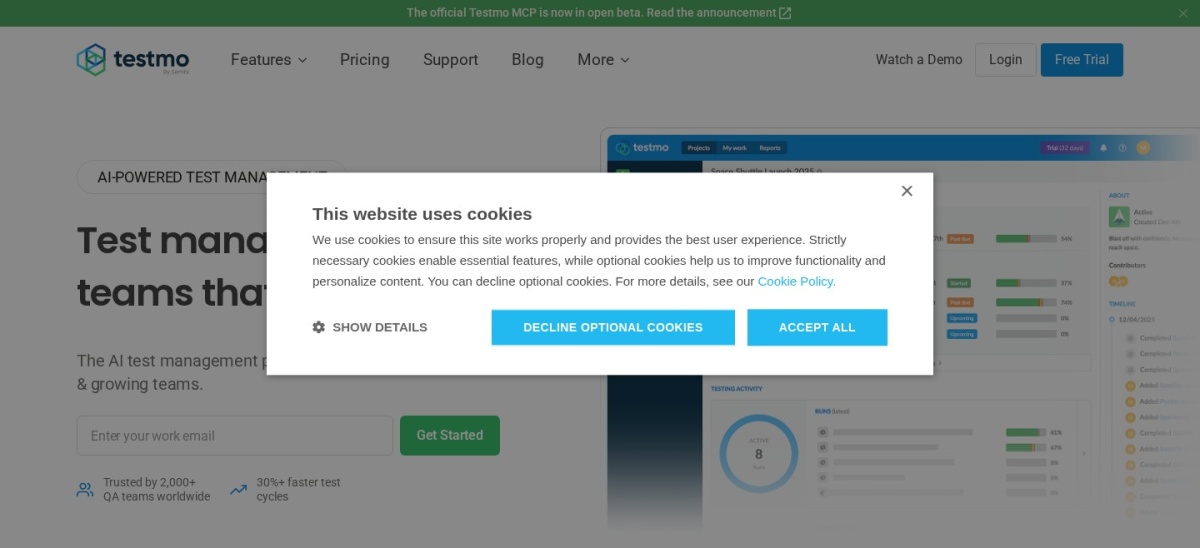
Testmo is a test management application designed to consolidate manual test runs, exploratory testing sessions and automated results. Its Team subscription includes 5 users, unrestricted project and test case creation, automation result reporting and integrations with development platforms.
The trade off is that even a solo tester must purchase the $59 monthly team package, and advanced reporting and access controls require higher subscriptions. It suits engineering departments that run several types of software testing and want consolidated visibility without paying separately for every automation result.
What we like
Dedicated exploratory testing workflows
Unlimited automated result submissions
Predictable entry package for small teams
Integrations with GitHub, GitLab and Jira
Manual and automated reporting in one application
Watch out for
No permanent free subscription
Advanced reporting requires Business
Cloud-only deployment
Business adds centralized reporting and customizable access controlsVisit testmo.com
04
Testiny
4.8/5on G2 (18 reviews, checked Nov 2026)
Paid from$15.42/mo
Best for small QA teams and straightforward testing
Free users3
Test reportingIncluded
Self-hosted optionAvailable separately
Paid planStarter, billed yearly
testiny.io
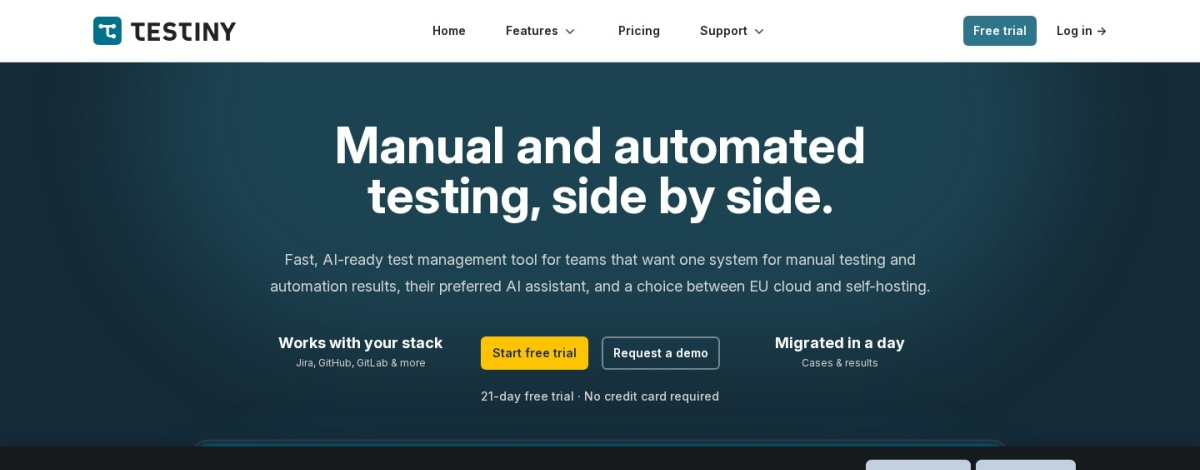
Testiny homepage, captured Nov 2026.
Testiny is a test management application focused on organized test repositories, execution planning and collaboration. Its free subscription supports 3 users and includes test case management, reporting, issue tracker integrations, API keys and two-factor authentication.
The trade off is that Starter costs $15.42 per user per month with annual billing, while automation features and advanced authentication require Business. It suits smaller QA departments seeking an accessible TestRail replacement, although its 18 G2 reviews provide a smaller evidence base than more established competitors.
What we like
Permanent free subscription for small teams
Transparent seat-based pricing
Self-hosted deployment option
Spreadsheet-friendly exports on paid plans
Custom fields and execution-step results
Watch out for
Automation features require Business
Starter has a maximum of 25 users
Relatively small public review sample
Starter adds unlimited history, custom fields and webhooksVisit testiny.io
05
TestCollab
4.4/5on G2 (37 reviews, checked Nov 2026)
Starts at$29/mo
Best for collaborative test planning and stakeholder updates
Test case versioningIncluded
Stakeholder updatesShareable test progress
Requirements coverageIncluded
Paid planPremium, $29/user/mo billed yearly
testcollab.com
TestCollab homepage, captured Nov 2026.
TestCollab is a collaborative QA platform offering reusable test steps, execution planning and requirements coverage reporting. Its Premium subscription starts at $29 per user per month with annual billing and includes unlimited test cases, test runs and execution history.
The trade off is that advanced features such as AI-assisted execution, parameterized tests and approval workflows require Elite at $39 per user per month with annual billing. It suits collaborative QA teams that want to share progress with stakeholders without purchasing editing access for every participant.
TestMonitor is a test management platform for organizing business acceptance testing, requirements and software quality reporting. Its Starter subscription covers 3 users and includes issue tracking, customizable reports, API access and integrations with more than 30 test automation tools.
The trade off is that the entry subscription costs $396 annually for the complete starter package, even when fewer people need access. It suits organizations coordinating acceptance testing between technical QA specialists and business users who need clear execution instructions and issue reporting.
Best for requirements traceability and QA governance
Requirements managementIntegrated
ProjectsUnlimited
Comment users5 per tester license
Paid planTeam, $47/user/mo billed yearly
practitest.com
PractiTest homepage, captured Nov 2026.
PractiTest is a test management system that connects requirements, execution records, defects and release readiness reporting. Its Team plan supports unlimited projects and provides 5 comment users for each tester license, allowing stakeholders to participate without receiving full editing permissions.
The trade off is that Team costs $47 per tester per month with annual billing, and the complete subscription depends on the license package. It suits established QA departments that prioritize requirements coverage, centralized reporting and visibility across several development projects.
What we like
Detailed requirements-to-test traceability
Comment access for additional stakeholders
Unlimited projects on Team
Centralized quality reporting
Suitable for structured release governance
Watch out for
Higher per-user entry pricing than several competitors
No permanent free plan
License package requirements affect total cost
Team includes end-to-end test modules and data intelligence featuresVisit practitest.com
08
SpiraTest
4.3/5on G2 (62 reviews, checked Nov 2026)
Starts at$1,372.67/yr
Best for concurrent licensing and self-hosted QA
Entry license3 concurrent users
Named usersUnlimited
DeploymentCloud or on-premises
Paid planOn-premises, 3-user license
inflectra.com
SpiraTest homepage, captured Nov 2026.
SpiraTest is an application lifecycle testing platform combining requirements management, test execution and defect tracking. Its entry on-premises license supports 3 simultaneous users while allowing unrestricted named user accounts and projects, making it suitable for departments that share testing responsibilities.
The trade off is that the entry self-hosted license costs $1,372.67 annually, while the comparable cloud package costs $1,450.01 annually. It suits organizations with rotating QA personnel, internal hosting requirements or a preference for concurrent licensing over individual tester subscriptions.
Tricentis qTest is an enterprise test management platform connecting manual testing, automation results and quality reporting across development departments. It holds a 4.3/5 rating from 104 G2 reviews and supports testing processes involving several applications and delivery teams.
The trade off is that Tricentis requires prospective customers to contact its sales department for custom pricing, preventing direct subscription cost comparisons. It suits larger organizations that need centralized testing governance and integration with an established enterprise software testing environment.
What we like
Designed for enterprise QA coordination
Supports manual and automated testing workflows
Centralized execution reporting
Integrates with the wider Tricentis ecosystem
Watch out for
No publicly available subscription price
Potentially excessive for small testing departments
Implementation requires workflow planning
Commercial licensing supports enterprise test management requirementsVisit tricentis.com
Which TestRail alternative has the most economical licensing model?
Seat-based subscriptions are not directly comparable with team packages. Testmo charges $59 monthly for 5 users, while Qase Teams starts at $35 per user per month with annual billing. A department that needs access for every tester should compare its combined subscription cost.
Concurrent licensing can benefit organizations with rotating testers. SpiraTest permits unrestricted named accounts on its entry license but restricts simultaneous access to 3 users. This arrangement may suit departments where employees execute tests at different times.
The annual price ladder shows entry subscription prices, not standardized department-wide costs. Per-user plans, minimum team packages and deployment-specific licenses represent different purchasing units. Custom-priced qTest has no numeric public price, so its zero price_year value does not indicate a free subscription.
What should you migrate when replacing TestRail?
Preserve the test repository before transferring execution workflows. Export test cases, section structures, expected results, priorities, attachments and custom fields, then confirm which elements the destination application can import.
Historical results deserve separate attention. Importing test cases does not necessarily preserve previous executions, defect references or release coverage reports. Keep an accessible archive of historical records when complete migration is unavailable.
Validate integration behavior before changing production workflows. Confirm that automated test identifiers remain consistent, issue tracker links work correctly and QA managers can reproduce the reports their stakeholders need.
How we chose
We selected established test management applications from public software directories, vendor documentation and published product comparisons. Ranking priorities included manual test organization, automation reporting, migration considerations, licensing flexibility and suitability for different QA team sizes.
We opened official pricing pages and public G2 or Capterra review profiles on 29 Nov 2026. Annual figures use regular annual subscriptions or monthly prices multiplied by twelve, with licensing units identified separately. Kualitee's crossed-out regular annual price was used instead of its displayed discount, and qTest was retained under the custom-pricing exception.
We excluded execution-only testing frameworks, products without confirmable commercial pricing or an official quote process, and applications without meaningful test management functionality. Testiny was retained despite having 18 G2 reviews because it falls close to our approximate review threshold and provides published pricing and maintained product documentation. No vendor paid for a place, and we do not claim testing for this list.
How to choose the right TestRail replacement
Compare these four purchasing considerations before transferring your QA repositories or committing to a new test management subscription.
Identify your primary testing workflow. Choose Qase or Testmo when automation reporting matters alongside manual execution. Consider TestMonitor when business users participate heavily in acceptance testing, or PractiTest when requirements coverage and release governance are priorities.
Calculate the complete subscription cost. Count paid testers, stakeholders, administrators and simultaneous users separately. Compare Testmo's fixed entry package with per-user subscriptions and concurrent licenses rather than assuming the smallest displayed price produces the lowest total cost.
Verify migration coverage before purchasing. Request documentation for importing your existing test repository, custom fields, execution history and attachments. Confirm whether migration assistance is included and whether historical results remain accessible after the transition.
Check integration and reporting requirements. Confirm compatibility with your issue tracker, CI pipeline and automated testing frameworks. Review requirements traceability, export capabilities, access permissions and reporting options against your actual release management processes.
FAQ
What is the best TestRail alternative in 2026?
Qase is the best TestRail alternative for most modern QA departments because it combines manual test management, automation reporting and requirements traceability. It earns 4.7/5 from 338 G2 reviews, and its Teams plan starts at $35 per user per month with annual billing.
What is the best free alternative to TestRail?
Kualitee is a strong free TestRail alternative for small professional QA teams. Its Growth subscription supports 3 users, 500 test cases and integrated defect tracking. Testiny is another option for small departments that prioritize straightforward test organization and execution.
Which TestRail alternative is best for automated testing?
Testmo is particularly suitable for teams combining automated execution results with manual and exploratory testing. Its $59 monthly Team package covers 5 users and unlimited automation results, allowing QA departments to consolidate reporting across different testing frameworks.
How much do TestRail alternatives cost?
TestRail alternatives use different licensing models. Testiny starts at $15.42 per user per month with annual billing, Testmo costs $59 monthly for a team package, and PractiTest starts at $47 per tester per month with annual billing. Enterprise platforms such as qTest require custom quotes.
Is Qase better than Kualitee?
Qase is better suited to development teams prioritizing automation integrations, requirements traceability and consolidated execution reporting. Kualitee is preferable for budget-conscious teams that want integrated defect tracking and a permanent free subscription supporting 3 users.
Can I migrate existing test cases from TestRail?
Yes, migration is possible through supported import formats, APIs or vendor migration services, depending on the replacement platform. Test case structures are generally easier to transfer than historical execution records, attachments and custom fields, so verify the destination's specific import capabilities.
Which TestRail alternative supports self-hosting?
SpiraTest and Testiny offer self-hosted deployment options. SpiraTest is particularly relevant for organizations that want concurrent licensing alongside internal infrastructure control, while Testiny offers a separate on-premises deployment for teams seeking its test management interface.
What is the best TestRail alternative for beginners?
Testiny is a suitable starting point for beginners because its free plan provides test case organization, execution tracking and reporting for up to 3 users. TestMonitor is another option when less technical business users need to participate in acceptance testing.
Which TestRail alternative is best for enterprise QA teams?
Tricentis qTest is a strong enterprise alternative for centralized test management and automation coordination across multiple departments. PractiTest is another suitable choice when requirements traceability and release readiness reporting are particularly important and buyers prefer published entry pricing.
SaaS SEO and WordPress specialist with about 8 years of experience. Rakib compares WordPress plugins, themes, hosting and software using public pricing, documentation and user reviews. See how we rank.