Cisco Catalyst SD-WAN is the strongest of the MPLS alternatives for most enterprises, rated 4.4/5 from 91 G2 reviews with central management and zero-touch provisioning. Pick Fortinet Secure SD-WAN for firewall and SD-WAN in one box, or Aryaka if you want a fully managed global WAN.
How we make this list: we compare pricing pages, product documentation and public user reviews, then re-check every price before each update. No product paid for a place. Disclosure.
Cisco Catalyst SD-WAN leads for large estates, rated 4.4/5 from 91 G2 reviews, the most in this list.
Versa Networks and FatPipe SD-WAN share the highest G2 rating here at 4.7/5, but from only 13 and 14 reviews.
All eight tools are quote based: no vendor publishes a starting price, so budget per site and bandwidth.
Aryaka and Cato replace carrier MPLS with a managed service or a private global backbone.
No SD-WAN matches MPLS quality guarantees on a poor internet link, so pilot with real branch traffic first.
How do you choose the best MPLS alternatives?
MPLS is a private circuit, and every alternative trades its guarantees for flexibility. SD-WAN routes traffic over broadband, LTE and any remaining MPLS links, steering each application over the best available path.
Start from the sites, not the vendor. Count branches, map their link quality and list the applications that cannot tolerate jitter, such as voice and video, before you compare products.
Security decides the shortlist. Some tools bundle firewall and Zero Trust access, while others need a separate security service, so confirm firewall, segmentation and logging coverage for every traffic path.
Price everything per site. Hardware or virtual edges, licenses, support, broadband, LTE backup and managed service fees all add up, so compare the full cost against the MPLS circuit each site replaces.
Pilot on real branches. Pick sites with different link quality, including one with poor broadband, and measure latency, jitter, packet loss and SaaS performance before retiring a circuit.
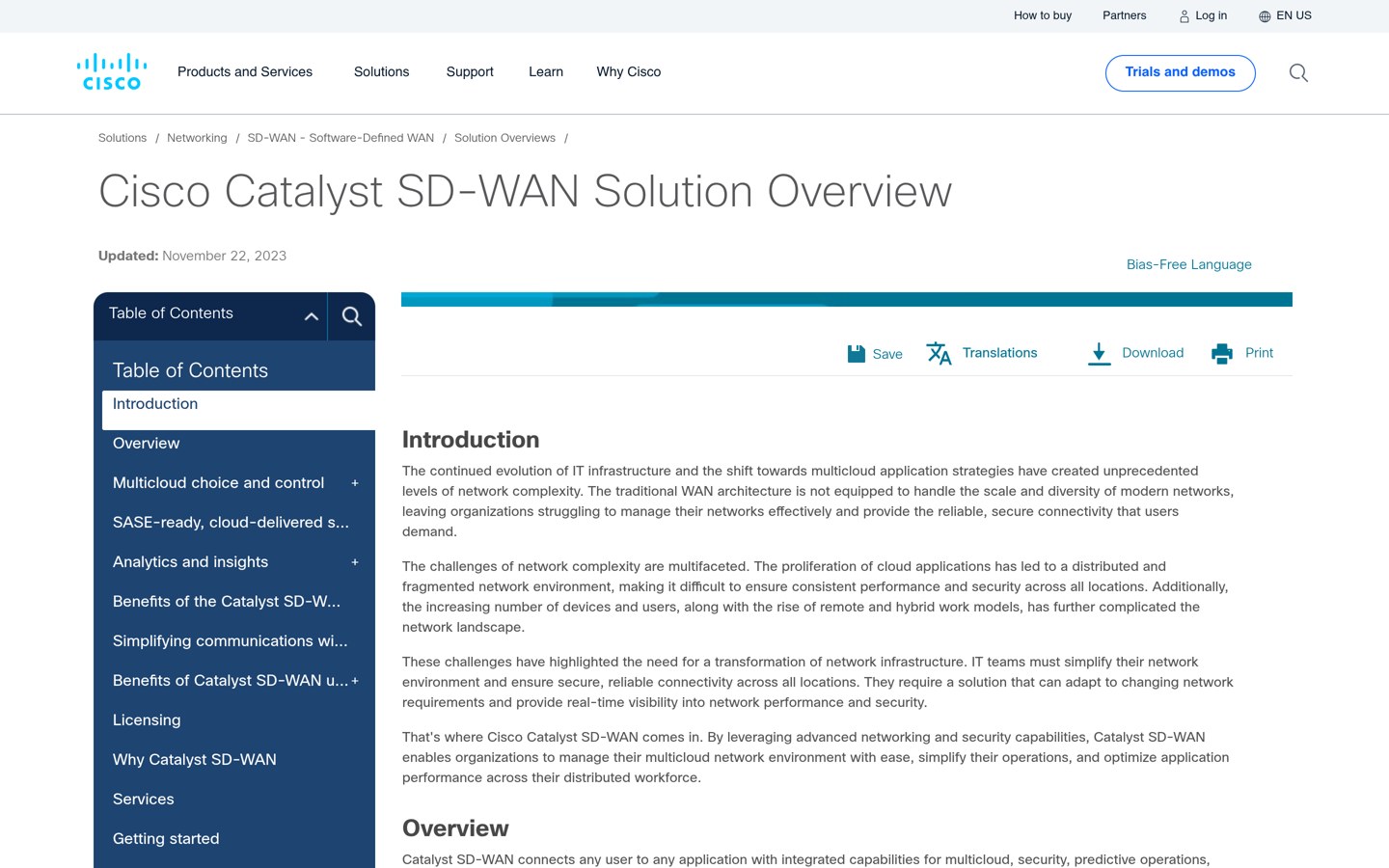
Cisco Catalyst SD-WAN homepage, captured Nov 2026.
Cisco Catalyst SD-WAN is the enterprise SD-WAN built on Catalyst routers and cloud-delivered controllers, grown out of the Viptela acquisition. It steers traffic across broadband, LTE and remaining MPLS links from one central policy, with zero-touch provisioning for new branches and multicloud access built in.
The trade off is licensing complexity. Pricing is quote based and depends on router hardware, license tier and support, and Cisco also sells Meraki SD-WAN, so buyers must pick the right line per site. It suits large estates already standardized on Cisco routing.
What we like
Central policy and zero-touch provisioning
Broad router and controller portfolio
Strong multicloud connectivity
Most-reviewed SD-WAN on G2 in this list, with 91 reviews
Watch out for
Quote-based pricing tied to hardware and tier
Two Cisco SD-WAN lines can confuse buyers
Licensing takes time to scope per site
Paid licenses add security, analytics and multicloud features by tierVisit cisco.com
02
Fortinet Secure SD-WAN
4.6/5on G2 (57 reviews, checked Nov 2026)
PricingCustom/yr
Best security plus SD-WAN in one box
HardwareFortiGate appliance or virtual
FirewallBuilt in, NGFW
ManagementFortiManager central console
PricingCustom quote
fortinet.com
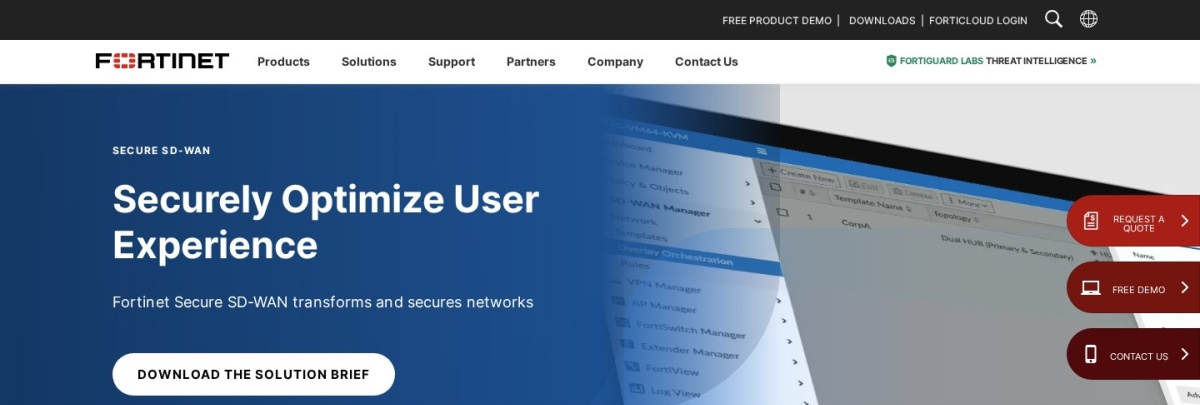
Fortinet Secure SD-WAN homepage, captured Nov 2026.
Fortinet Secure SD-WAN is SD-WAN built into FortiGate appliances, so one box handles firewall, SD-WAN routing, switching and wireless at a branch. It combines application-aware steering, segmentation and security enforcement under FortiManager, which appeals to teams that want fewer devices and one console for network and security policy.
The trade off is sizing. An undersized FortiGate can bottleneck encrypted SD-WAN throughput, and advanced features need higher license tiers. It suits retail, healthcare and distributed offices where security cannot be an afterthought.
What we like
Firewall and SD-WAN on one appliance
Central management through FortiManager
Strong value for security-led teams
Rated 4.6/5 on G2 from 57 reviews
Watch out for
Appliance sizing needs care for peak encrypted throughput
Aryaka is a managed SD-WAN service delivered over its own private global backbone, rather than boxes you run yourself. It handles deployment, monitoring, last-mile services and carrier issues, and bundles security options in its unified SASE offer, which suits international firms with limited local IT staff at remote sites.
The trade off is control. Teams that want to tune every routing policy themselves, or that already run a strong network operations center, may find a managed service restrictive. It suits global sites where carrier lead times and inconsistent broadband are the main pain.
What we like
Private global backbone
Fully managed deployment and operations
Bundled security in unified SASE offer
Highest G2 support scores in this list, at 9.3
Watch out for
Managed model gives less direct control
Quote-based pricing
Less suited to DIY network teams
Paid service is quoted per site, bandwidth and regionVisit aryaka.com
04
Cato Networks
4.5/5on G2 (87 reviews, checked Nov 2026)
PricingCustom/yr
Best converged SASE platform
ArchitectureCloud-native SASE
BackboneGlobal private backbone
SecurityFWaaS, SWG, IPS, ZTNA
PricingCustom quote
catonetworks.com
Cato Networks homepage, captured Nov 2026.
Cato Networks is a cloud-native SASE platform that converges SD-WAN and network security on one global private backbone. Sites and remote users connect to the Cato cloud, where firewall, secure web gateway, intrusion prevention and Zero Trust access run under one policy and one log set, managed from a single console.
The trade off is commitment. Cato works best when you adopt its platform as a whole, so buyers who want to keep a separate security vendor for the SSE layer may prefer a more modular option. It suits mid-market and enterprise buyers consolidating network and security tools.
What we like
Single converged SD-WAN and security platform
Global private backbone
One policy and one log set across sites
Most reviewed SASE platform here, with 87 G2 reviews
Versa Networks is a secure SD-WAN and SASE platform built multi-tenant from the ground up, which is why carriers, managed service providers and large enterprises use it to serve many customers or business units from one platform. It can be delivered as software, on appliances or as a managed service, with strong segmentation and security controls.
The trade off is delivery. Buying Versa through an MSP means the provider matters as much as the product, and its G2 review base is small at 13 reviews. It suits carriers, MSPs and enterprises that must isolate traffic by tenant, site or application.
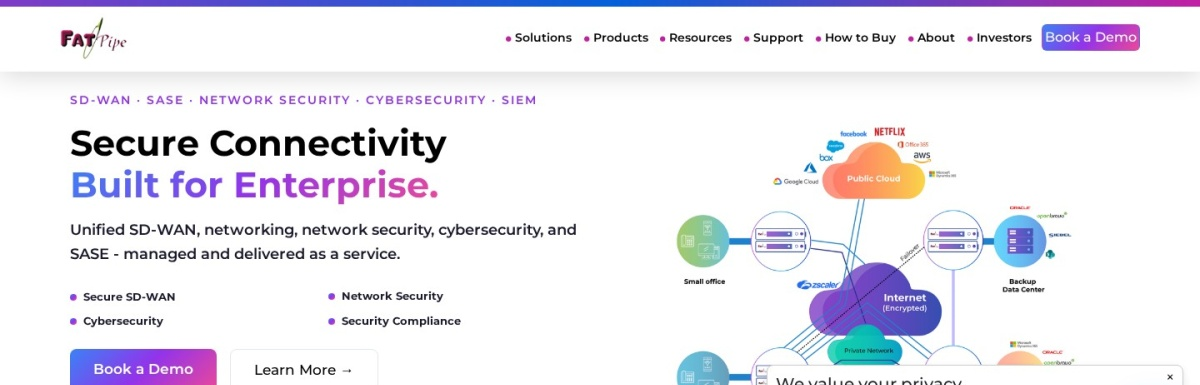
FatPipe SD-WAN is a multi-link WAN platform that bonds broadband, LTE and other links into one resilient connection with sub-second failover. Its MPVPN technology keeps sessions alive when a link drops, and central management covers branch routers, failover policies and link quality from one console.
The trade off is scale. FatPipe suits redundancy-focused sites and smaller estates better than global SASE rollouts, and its G2 review base is small at 14 reviews. It suits branches, retail sites and remote locations where a dropped link cannot interrupt work.
Cisco Meraki SD-WAN is the cloud-managed branch option in the Cisco family, run from the Meraki dashboard alongside switching, wireless and security. It suits lean IT teams that need to run many sites without on-site experts, since policies, VPNs and traffic shaping are all managed from one cloud console.
The trade off is depth. Meraki trades some of the advanced routing and policy control of Catalyst SD-WAN for simplicity, and larger estates may outgrow it. It suits smaller branches and distributed sites where simple cloud management matters more than routing depth.
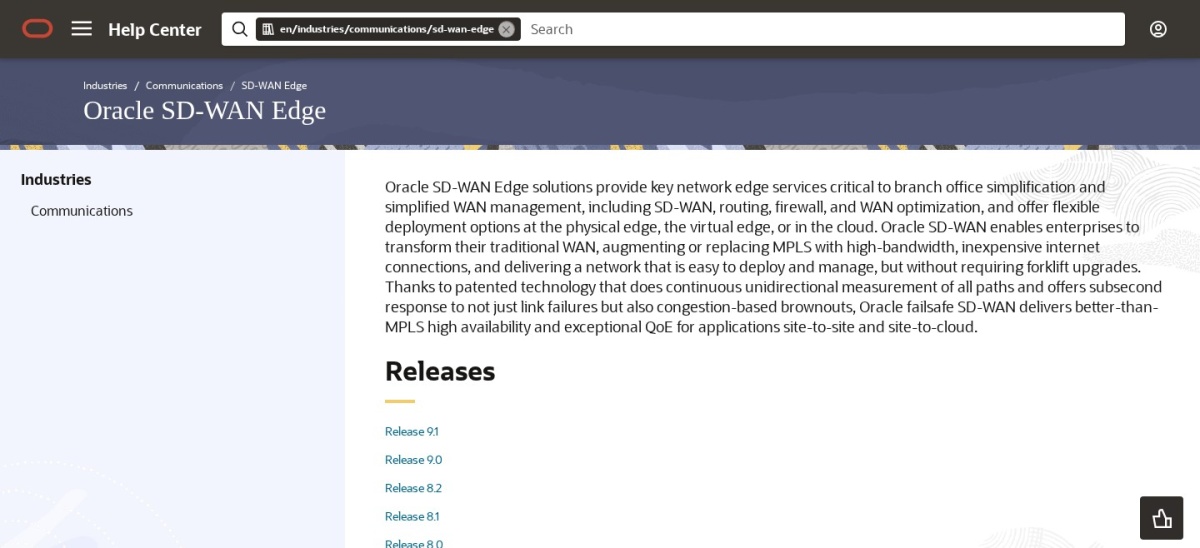
Oracle SD-WAN is Oracle's software-defined WAN for enterprises connecting branches, data centers and Oracle Cloud workloads. It offers centralized control and analytics, application-aware routing and WAN reliability features, and fits teams already running Oracle applications or cloud infrastructure.
The trade off is ecosystem fit. Oracle SD-WAN makes most sense inside Oracle estates, and its G2 review base is small at 29 reviews. It suits Oracle-heavy organizations that want WAN management aligned with their cloud and application stack.
What we like
Centralized control and analytics
Application-aware routing
Improved WAN reliability noted by reviewers
Strong support experiences on G2
Watch out for
Small G2 review base of 29 reviews
Best fit is Oracle estates
Quote-based pricing with no published starting price
Every tool in this list publishes no starting price. Expect a sales call, a demo and a quote based on sites, bandwidth, hardware and support.
Ask whether the quote covers implementation, training and support, or whether those are billed separately. Compare the full per-site cost with the MPLS circuit each site replaces.
How we chose
We started from the SD-WAN, SASE and managed WAN services most often named in MPLS replacement projects, then kept the eight sold today that can carry branch, data center and cloud traffic.
Prices come from each vendor's pricing page, checked on 29 November 2026. Every tool in this list is quote based, so the list shows Custom rather than an invented price. Ratings come from G2 on the same day, with the review count shown beside each rating.
We left out products without a verifiable public rating, including Palo Alto Prisma SD-WAN and Cloudflare Magic WAN, and we did not include MPLS itself, since this list covers alternatives to it. No vendor paid for a place, and we do not claim to have used these tools ourselves.
How to choose an MPLS alternative
Start with your worst branch, then work outward to the rest of the estate.
Map every site and link. List branches, data centers and cloud connections, note the quality of each internet link, and flag the applications that cannot tolerate jitter or loss.
Decide how much security to bundle. Choose between a routing-only SD-WAN with a separate security service and a converged SASE platform, then confirm firewall, segmentation and logging coverage.
Pilot on real traffic. Run two or three branches with different link quality for a full business cycle and measure latency, jitter, packet loss and SaaS performance.
Model the full cost per site. Add edge hardware, licenses, support, broadband, LTE backup and any managed service fees, then compare that total with the MPLS circuit it replaces.
FAQ
What are the best MPLS alternatives in 2026?
Cisco Catalyst SD-WAN is the strongest overall pick, rated 4.4/5 from 91 G2 reviews. Fortinet Secure SD-WAN fits security-led teams, and Aryaka is the best fully managed option for global sites.
How much do MPLS alternatives cost?
All eight tools in this list are quote based, with no published starting price. Expect a quote per site based on hardware, license tier, bandwidth and support, plus broadband and any managed service fees.
Is there a free MPLS alternative?
No. None of the eight tools offers a free plan, and enterprise SD-WAN is sold per site or per appliance. Open-source routing tools exist, but they need in-house expertise and carry no vendor support or service guarantees.
Can SD-WAN fully replace MPLS?
For most workloads, yes, but not for every link. SD-WAN over broadband cannot match MPLS quality guarantees on a poor internet connection, so keep MPLS for latency-sensitive or regulated traffic and pilot SD-WAN on real branch traffic first.
Which MPLS alternative is best for small teams?
Cisco Meraki SD-WAN is the simplest fit, with cloud management from one dashboard and the largest G2 review base here at 200+ reviews. Small teams with few sites should also look at Fortinet, which puts firewall and SD-WAN on one appliance.
Cisco Catalyst SD-WAN vs Fortinet Secure SD-WAN: which is better?
Cisco Catalyst SD-WAN wins for large Cisco estates, with broader routing depth and 91 G2 reviews against 57 for Fortinet. Fortinet wins for security-led teams, putting firewall and SD-WAN on one FortiGate appliance with central management through FortiManager.
Do I still need MPLS with SD-WAN?
Not always, but many migrations keep one MPLS link during a hybrid period. Run SD-WAN over broadband for general traffic and keep MPLS for latency-sensitive or regulated traffic until the pilot proves the new links hold up.
SaaS SEO and WordPress specialist with about 8 years of experience. Rakib compares WordPress plugins, themes, hosting and software using public pricing, documentation and user reviews. See how we rank.