Pulumi is the best Terraform alternative for developer-led teams, with a free plan and Essentials at $40 a month for up to 500 managed resources. Spacelift suits governed platform teams at $399 a month, while Ansible and AWS CDK cost nothing for teams happy with open source.
How we make this list: we compare pricing pages, product documentation and public user reviews, then re-check every price before each update. No product paid for a place. Disclosure.
Pulumi leads at 4.8 out of 5 on G2 from 25 reviews, with Essentials at $40 a month for up to 500 managed resources.
Spacelift matches Pulumi at 4.8 out of 5, but its Starter plan starts at $399 a month for 10 users.
Five of the nine tools cost nothing to start: Ansible, AWS CDK, CloudFormation, SaltStack and Puppet Core.
Ansible has the largest review base here, 4.6 out of 5 from 377 G2 reviews, and needs no agent on target machines.
CloudFormation and AWS CDK only manage AWS, so multi-cloud teams should pick Pulumi, Spacelift or Ansible instead.
How do you choose the best Terraform alternative?
Start with the layer you need. Provisioning tools create cloud resources, configuration tools set up machines that already exist, and orchestration platforms govern both through pipelines.
Language is the next split. Pulumi and AWS CDK let developers write infrastructure in TypeScript, Python or Go, while Ansible, Chef and SaltStack use YAML or Ruby and suit operators.
Pricing models differ more than the tools do. Pulumi charges a flat $40 a month for Essentials, Spacelift starts at $399 a month, and five tools in this list are free open source.
Check the cloud scope before you commit. CloudFormation and AWS CDK only manage AWS, so a second cloud means a second tool. Our guide on deploying WordPress with GitHub Actions shows how automation fits a real deploy pipeline.
Ratings in this list come from G2, checked on 29 November 2026. Small review counts mean a high score is less certain, so read the counts beside each rating.
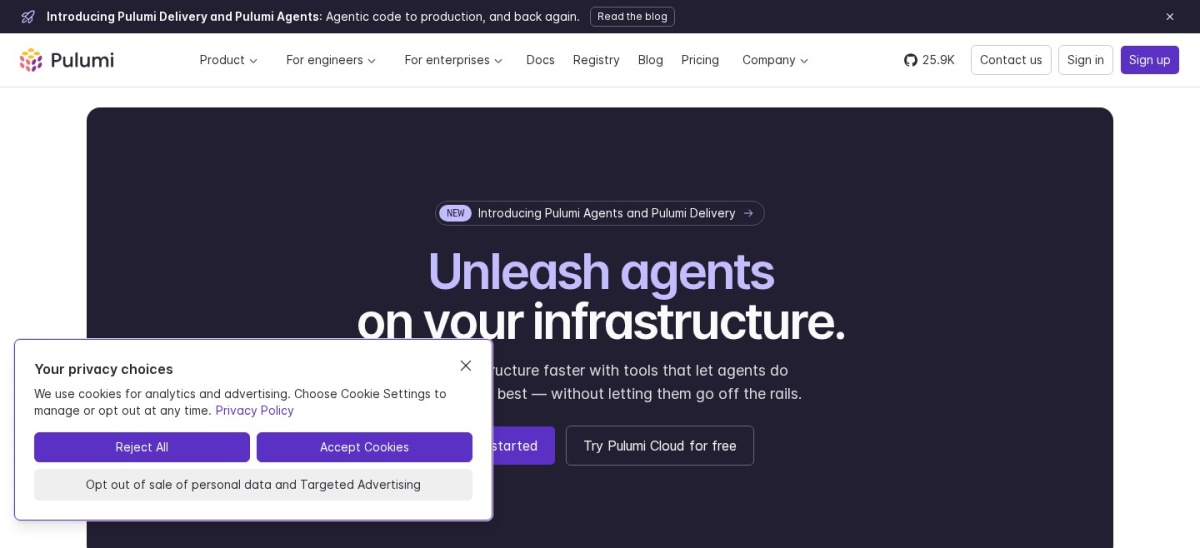
Pulumi is infrastructure as code in real programming languages. You define cloud resources in TypeScript, Python, Go, C# or Java, with loops, functions and unit tests like application code. The engine is Apache 2.0 open source, and the free Pulumi Cloud plan covers one user with state management and deployments.
The trade off is price. Essentials starts at $40 a month for up to 500 managed resources, and Pro jumps to $400 a month, so costs climb fast as your estate grows. It suits developer-led teams that already write in one of its languages and want tests for their infrastructure.
What we like
Highest G2 rating in this list at 4.8 out of 5
Real languages with tests, loops and IDE support
Open-source engine with self-hosted state options
Policy as code and drift detection on paid plans
Watch out for
Only 25 G2 reviews, so the rating is less certain
Pro plan at $400 a month is a steep jump
Harder for operators who do not write code
Essentials adds unlimited users, collaboration and managed secretsVisit pulumi.com
02
Spacelift
4.8/5on G2 (23 reviews, checked Nov 2026)
Paid from$399/mo
Best for governing several IaC tools
EnginesTerraform, Pulumi, more
Free plan2 users, $0
Paid planStarter, $399/mo
Policy engineYes, on Starter
spacelift.io
Spacelift homepage, captured Nov 2026.
Spacelift is an orchestration platform that runs Terraform, OpenTofu, Pulumi, Ansible and CloudFormation through one governed workflow. Stacks connect a repository to a runtime, with policy checks, approvals, drift detection and audit trails. The free plan covers two users, and the Starter plan adds the policy engine and private module registry.
The trade off is the entry price. Starter starts at $399 a month, which is a large jump from the two-user free plan for a small team. It suits platform teams that run several IaC tools across many environments and need guardrails on every change.
What we like
One workflow for Terraform, Pulumi, Ansible and more
Policy as code, approvals and audit trails built in
Drift detection and self-service blueprints
Rated 4.8 out of 5 on G2
Watch out for
Only 23 G2 reviews, so the rating is less certain
Starter at $399 a month is the priciest entry here
Free plan is limited to two users
Business adds drift detection, blueprints and unlimited usersVisit spacelift.io
03
Ansible
4.6/5on G2 (377 reviews, checked Nov 2026)
PriceFree
Best free pick for configuration
LanguageYAML playbooks
AgentsNone, agentless
Free planOpen source
Paid planPer managed node
ansible.com
Ansible homepage, captured Nov 2026.
Ansible is an agentless automation engine that configures servers, networks and applications with YAML playbooks. It connects over SSH, needs no agent on the target machines, and the open-source core is free. Red Hat sells Ansible Automation Platform for teams that want a web interface, role-based access and workflow runs.
The trade off is that Ansible keeps no state file, so it cannot tell you what drifted since the last run without extra tooling. The paid platform is priced per managed node and has no single list price on Red Hat's page. It suits teams that patch fleets and enforce settings across many machines.
What we like
No agents to install or maintain on targets
Largest G2 review base in this list
Playbooks are readable YAML, easy to review
Works across servers, networks and cloud tasks
Watch out for
No state file, so drift is harder to spot
Paid platform pricing is not listed as one figure
Large playbooks can get slow on big fleets
Automation Platform adds a web interface and role-based accessVisit ansible.com
04
AWS CDK
4.4/5on G2 (139 reviews, checked Nov 2026)
PriceFree
Best code-first pick for AWS only
LanguageTypeScript, Python, more
CloudsAWS only
Free planYes, open source
Paid planNone, free framework
aws.amazon.com
AWS CDK homepage, captured Nov 2026.
AWS CDK is a free open-source framework for defining AWS resources in TypeScript, Python, Java, Go or C#. You build reusable constructs for common patterns, and the CDK turns them into CloudFormation templates at deploy time. There is no licence fee and no paid tier for the framework itself.
The trade off is scope. The CDK only manages AWS, so teams with Azure or Google Cloud estates need a second tool, and constructs add a layer to learn on top of CloudFormation. It suits AWS-only teams whose developers already write in one of its languages.
AWS CloudFormation is the native way to provision AWS infrastructure as code. You model resources in YAML or JSON templates, and CloudFormation creates, updates and rolls them back as stacks. The service itself costs nothing, and you pay only for the AWS resources it provisions.
The trade off is scope. CloudFormation only manages AWS, so teams with Azure or Google Cloud estates need a second tool. Templates can also be hard to debug when a stack fails halfway. It suits AWS-only teams that want deep coverage of AWS services at no extra cost.
Chef is a policy-as-code platform that automates infrastructure with Ruby cookbooks and recipes. Chef Infra Client converges each node to its declared state, and Chef InSpec audits compliance against built-in checks. The open-source client is free, and the Business plan starts at $59 per node a year.
The trade off is the learning curve. Writing cookbooks in Ruby takes time, and the agent must run on every node you manage. It suits large teams that need repeatable, testable configuration with compliance reporting across cloud, on-prem and air-gapped environments.
What we like
Cookbooks are testable, reusable code
Built-in compliance audits with InSpec
Works in air-gapped and on-prem environments
Long-lived ecosystem with deep enterprise use
Watch out for
Ruby skills needed to write cookbooks
Agent required on every managed node
Enterprise plan jumps to $189 per node a year
Business adds orchestration, compliance and standard supportVisit chef.io
07
SaltStack
4.3/5on G2 (99 reviews, checked Nov 2026)
PriceFree
Best for fast event-driven automation
LanguageYAML states
AgentsMinions, agent-based
Free planOpen source
Paid planCustom quote
saltproject.io
SaltStack homepage, captured Nov 2026.
SaltStack, now the Salt Project, is an open-source configuration management tool known for speed and event-driven automation. A master sends commands to minions over a fast message bus, so runs finish quickly even across thousands of machines. The open-source project is free to run yourself.
The trade off is packaging. Commercial Salt is sold through Broadcom as part of larger platform bundles, with no standalone list price, so budgeting needs a sales conversation. It suits teams that run large fleets and need fast, event-driven reactions to change.
Puppet is a configuration management platform that keeps servers, networks and cloud resources in their desired state. You define state in its declarative language, agents check in on a schedule, report drift and correct it. Puppet Core is free for under 25 nodes, and the Forge lists more than 7,000 ready-to-use modules.
The trade off is price transparency. Paid plans for Puppet Enterprise and Advanced are custom quotes, so you cannot budget from a published price. It suits enterprises that need strict enforcement, compliance reporting and a long-lived module ecosystem.
What we like
Agents enforce state continuously, not just on demand
More than 7,000 modules on Puppet Forge
Strong compliance and drift reporting
Handles hybrid and edge estates
Watch out for
No published price for paid plans
Only 43 G2 reviews, the second-smallest base here
Agent-based model adds overhead per node
Enterprise adds compliance reporting and premium supportVisit puppet.com
09
env0
4.1/5on G2 (35 reviews, checked Nov 2026)
PriceFree
Best for GitOps environment runs
EnginesTerraform, OpenTofu, Pulumi
Free plan250 runs/mo
Paid planCustom quote
Drift managementYes
env0.com
env0 homepage, captured Nov 2026.
env0 is a cloud automation platform that runs Terraform, OpenTofu and Pulumi through GitOps workflows. Pull requests get speculative plans, cost estimates and policy checks before anything applies, and drift management keeps environments in line. The free tier covers 250 runs a month and 30 active environments.
The trade off is that paid pricing is not published. Cloud Navigator and Cloud Pilot are custom quotes, so small teams cannot see what scaling up will cost. It suits platform teams that manage many environments and want self-service infrastructure with guardrails.
What we like
Pull-request plans with cost estimates built in
Free tier covers 250 runs a month
Supports Terraform, OpenTofu and Pulumi in one place
Unlimited users even on the free tier
Watch out for
No published price for paid plans
Lowest G2 rating in this list at 4.1 out of 5
Only 35 G2 reviews, so the rating is less certain
Paid plans add drift remediation, cost tools and AI analysisVisit env0.com
Provisioning vs configuration: pick the right layer
Provisioning tools such as Pulumi, CloudFormation and AWS CDK create cloud resources and track them in a state file. They know what exists and what should change.
Configuration tools such as Ansible, Chef, Puppet and SaltStack install software and enforce settings on machines that already exist. They run again and again to correct drift.
Orchestration platforms such as Spacelift and env0 sit above both layers. They run your provisioning and configuration tools through governed pipelines with approvals and audit trails.
How we chose
We started from the tools most often named in 2026 Terraform alternative round-ups, then kept the nine with a public G2 rating and a live pricing page or free edition.
Prices come from each vendor's pricing page, checked on 29 November 2026. Ratings and review counts come from G2 on the same day. Where a vendor charges per node or per run, the list shows the free entry point and names the paid model in the text.
We left out OpenTofu, which has no G2 rating to check, and Crossplane, whose review counts are thin and conflicting across sites. No vendor paid for a place, and we do not claim to have used these tools ourselves.
How to choose a Terraform alternative
Start with the layer you need, then match the tool to your team.
Decide which layer you need. If you create cloud resources, start with a provisioning tool. If you manage servers that already exist, start with a configuration tool.
Match the language to your team. HCL suits platform teams, YAML suits operators, and Pulumi suits developers who already write TypeScript or Python every day.
Check the pricing model against your scale. Per-resource and per-run pricing grows with your estate or change rate, while free open-source tools cost time instead of money.
Keep everything in version control. Store your automation files in Git and review changes like code. See how to deploy WordPress with GitHub Actions for the same workflow on a smaller stack.
FAQ
What is the best Terraform alternative in 2026?
Pulumi is the best Terraform alternative for most developer-led teams. It is rated 4.8 out of 5 on G2 from 25 reviews, its free plan covers one user, and Essentials costs $40 a month for up to 500 managed resources.
What is the best free alternative to Terraform?
Ansible is the strongest free option, rated 4.6 out of 5 from 377 G2 reviews, and its open-source core costs nothing. AWS CDK and CloudFormation are also free, but only for AWS. OpenTofu is the closest free drop-in, though it has no public G2 rating to compare.
How much does Pulumi cost?
Pulumi Cloud is free for one user. Essentials costs $40 a month and covers up to 500 managed resources with unlimited users. Pro jumps to $400 a month and adds governance features such as SSO, audit logs and drift detection.
Is Spacelift or Pulumi better for a small team?
Pulumi is the better fit for a small team. Essentials costs $40 a month, while Spacelift Starter starts at $399 a month for 10 users. Spacelift wins once several teams share one governed workflow with approvals and policy checks.
Which Terraform alternative is best for AWS only?
AWS CloudFormation is the best fit for AWS-only estates. The service itself costs nothing, templates use YAML or JSON, and it covers nearly every AWS service with rollback and drift detection. AWS CDK is the code-first way to generate those templates.
Which Terraform alternative is best for beginners?
Ansible is the easiest starting point for operators. Its playbooks are readable YAML, it needs no agent on target machines, and the open-source core is free. Developers who already code should start with Pulumi or AWS CDK instead.
SaaS SEO and WordPress specialist with about 8 years of experience. Rakib compares WordPress plugins, themes, hosting and software using public pricing, documentation and user reviews. See how we rank.