Spacelift is the best Terraform Cloud alternative for most platform teams, with a 4.8 out of 5 G2 rating and a governed multi-tool workflow that runs Terraform, OpenTofu and Pulumi from one place. Pick Pulumi Cloud if your team writes infrastructure in real programming languages, or Scalr if you want a drop-in Terraform backend billed per run.
How we make this list: we compare pricing pages, product documentation and public user reviews, then re-check every price before each update. No product paid for a place. Disclosure.
Spacelift leads at 4.8 out of 5 on G2 with the widest engine support, but Starter starts at $399 a month.
Pulumi is the cheapest governed paid start at $40 a month, for teams that write infrastructure in TypeScript, Python or Go.
Scalr is the closest drop-in replacement at $0.99 a run, but its G2 rating rests on a single review.
Atlantis is the only fully free option, yet it is self-hosted only and has no drift detection.
Firefly is the priciest start at $2,499 a month, aimed at drift, inventory and recovery rather than plain runs.
How do you pick the right Terraform Cloud alternative?
Billing is the first split. HCP Terraform charges per managed resource, so a large estate keeps costing more even when nothing changes. Alternatives bill per run, per seat, per worker or a flat monthly fee, and the cheapest model depends on how often you apply.
Fit is the second split. A hosted control plane such as Spacelift or env0 runs your Terraform for you, while Atlantis leaves the running to a server you host yourself. Pulumi goes further and replaces the language itself, so teams write infrastructure in code they already know.
Policy and drift decide the third split. Some tools include approvals, policy checks and drift detection on every plan, while others gate them behind higher tiers. Check the feature sits in the plan you would actually buy.
Review counts matter as much as scores. Three tools in this list rest on fewer than 40 reviews, and two on fewer than five, so treat their scores as weak signals and weigh the free tier trial more heavily.
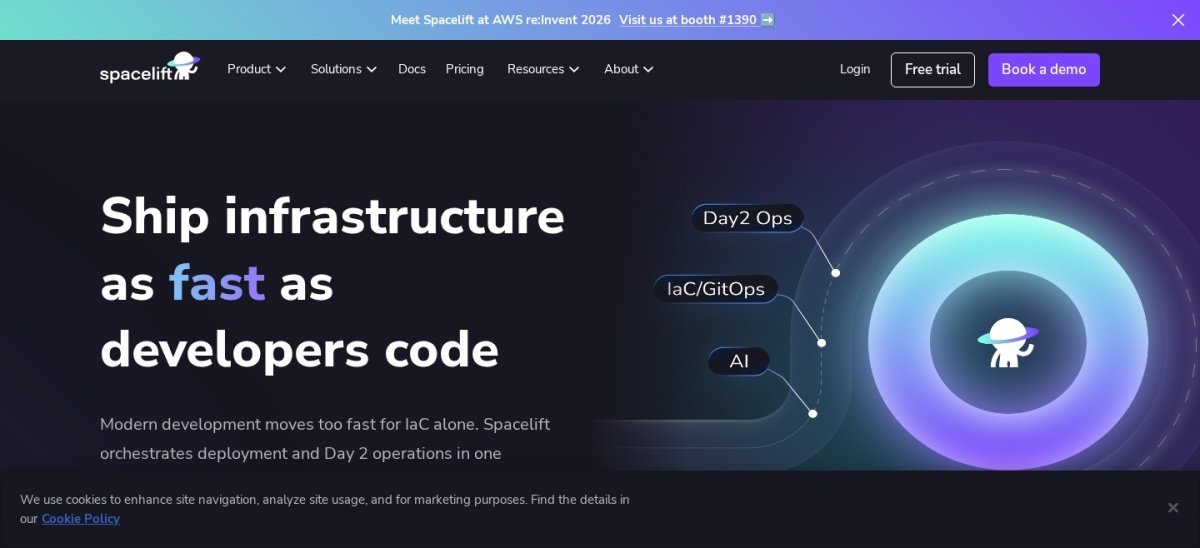
Spacelift is an infrastructure orchestration platform that runs Terraform, OpenTofu, Pulumi, CloudFormation, Kubernetes and Ansible through one governed workflow. Stacks connect a repository to a runtime, with policy checks, approvals, drift detection and audit trails. The free plan covers 2 users with 1 public worker, and Starter adds the policy engine and a private module registry.
The trade off is the entry price. Starter starts at $399 a month on an annual plan for 10 users and 2 public workers, a large jump from the two-user free plan. It suits platform teams that run several IaC tools and need policy and approvals in one place.
What we like
Highest-rated governed platform in this list at 4.8 out of 5
Runs six IaC engines through one workflow
Policy as code and private module registry on Starter
Drift detection and audit trails included
Watch out for
Starter at $399 a month is a steep jump from free
Free plan covers only 2 users
Only 23 G2 reviews, so the rating is less certain
Starter adds policy enforcement, a private module registry and webhooksVisit spacelift.io
02
Pulumi
4.8/5on G2 (25 reviews, checked Nov 2026)
Paid from$40/mo
Best for teams that code infrastructure
LanguagesTypeScript, Python, Go
Free plan1 user, $0
Paid planEssentials, $40/mo
Managed resources500 on Essentials
pulumi.com
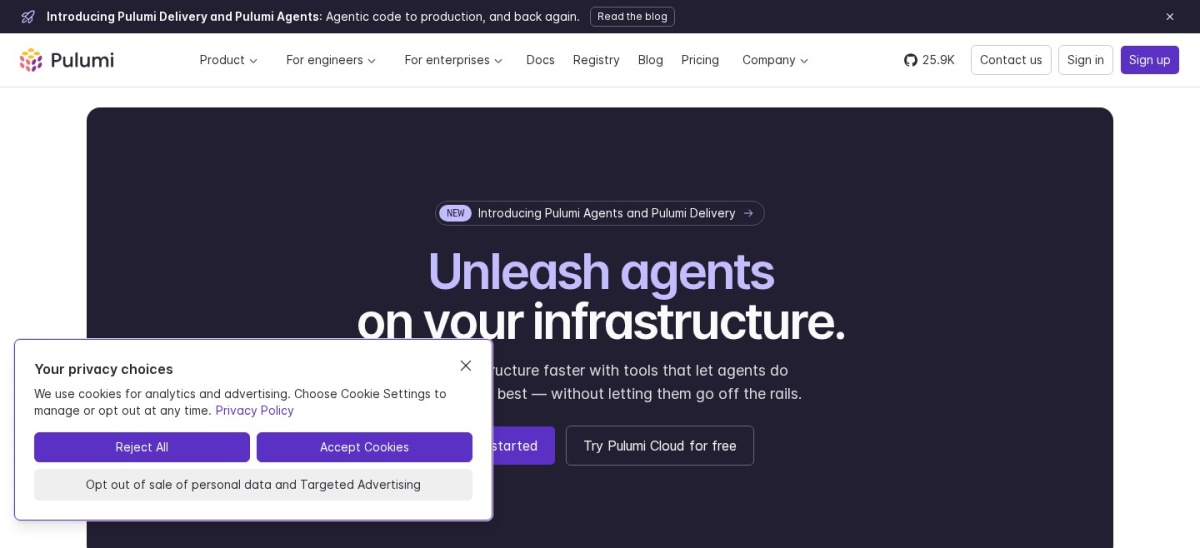
Pulumi homepage, captured Nov 2026.
Pulumi is infrastructure as code in real programming languages. You define cloud resources in TypeScript, Python, Go, C# or Java, with loops, functions and unit tests like application code. The engine is Apache 2.0 open source, and the free Pulumi Cloud plan covers one user with state management and deployments.
The trade off is price. Essentials starts at $40 a month for up to 500 managed resources, and Pro jumps to $400 a month, so costs climb fast as your estate grows. It suits developer-led teams that already write in one of its languages and want tests for their infrastructure.
What we like
Highest G2 rating in this list at 4.8 out of 5
Real languages with tests, loops and IDE support
Open-source engine with self-hosted state options
Cheapest paid start in this list at $40 a month
Watch out for
Only 25 G2 reviews, so the rating is less certain
Pro plan at $400 a month is a steep jump
Harder for operators who do not write code
Essentials adds unlimited users, collaboration and managed secretsVisit pulumi.com
03
Harness
4.6/5on G2 (335 reviews, checked Nov 2026)
PricingCustom/yr
Best for enterprises standardising delivery
IaC moduleHarness IaCM
Free planFree tier
Paid planCustom quote
Also coversCI, CD, GitOps
harness.io
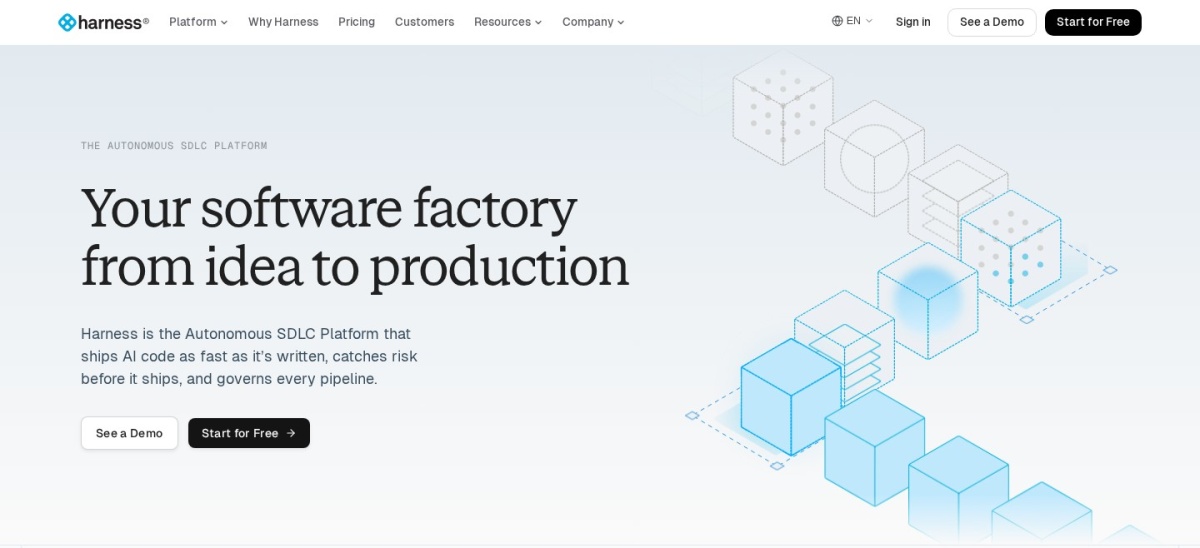
Harness homepage, captured Nov 2026.
Harness is a software delivery platform whose infrastructure-as-code module runs Terraform and OpenTofu through pipelines with approvals, policy checks and rollback. It sits beside CI, CD and GitOps modules, so one platform covers code, delivery and infrastructure. A free tier exists for small teams getting started.
The trade off is scope and price. IaC is one module of a large platform, and paid plans are custom quotes, so a team that only needs Terraform runs pays for breadth it may not use. It suits enterprises already standardising delivery on Harness.
What we like
Largest review base in this list at 335 G2 reviews
IaC, CI, CD and GitOps in one platform
Approvals, policy checks and rollback built in
Strong fit for regulated enterprise teams
Watch out for
Paid plans are custom quotes with no public price
IaC is one module of a much larger platform
Three-month typical implementation time on G2
Paid plans are quoted; the free tier covers getting startedVisit harness.io
04
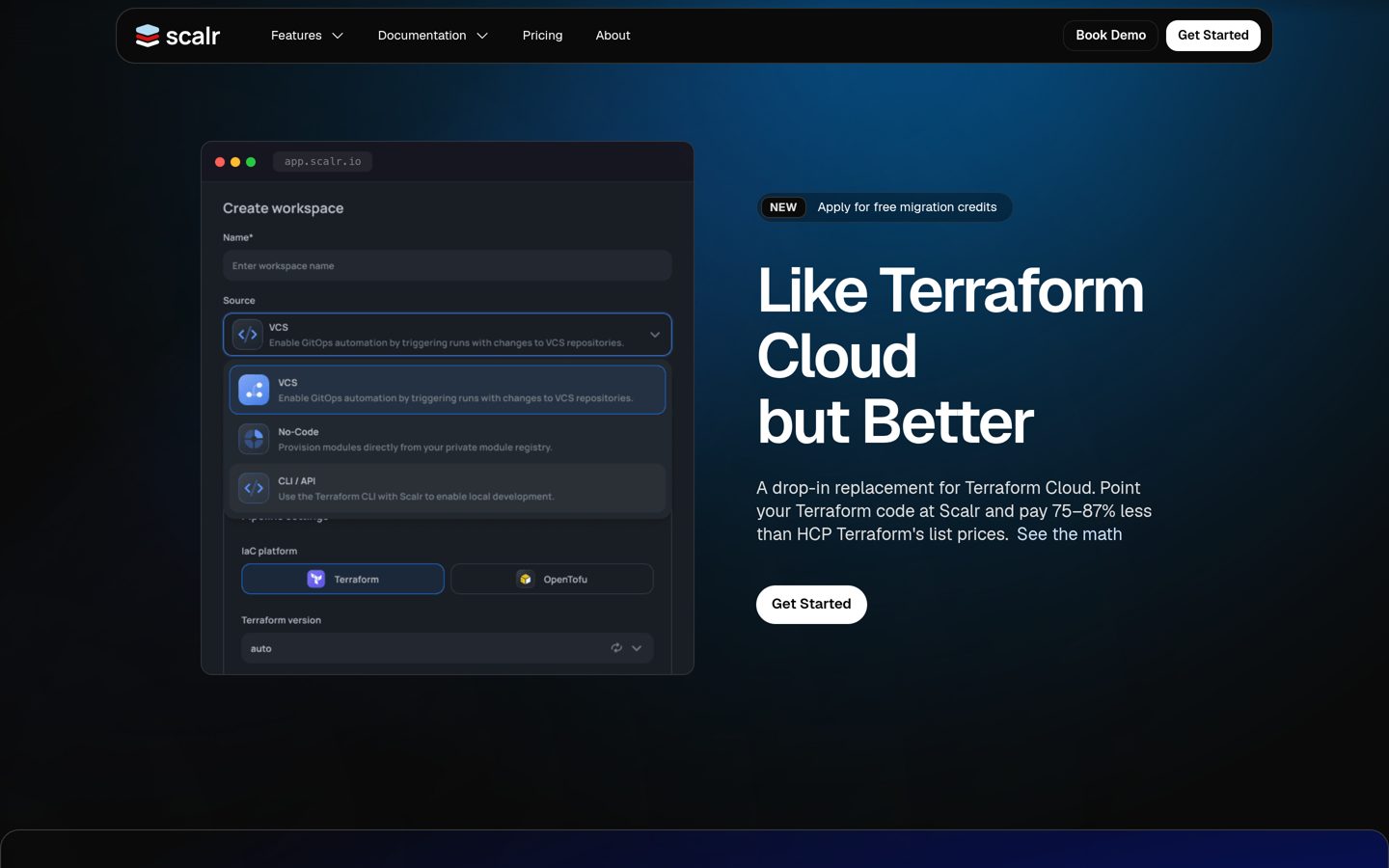
Scalr
5/5on G2 (1 reviews, checked Nov 2026)
Paid from$99/mo
Best drop-in Terraform Cloud replacement
Free plan50 runs/mo
Paid planBusiness, $0.99/run
UsersUnlimited, no seat fee
EnginesTerraform, OpenTofu
scalr.com
Scalr homepage, captured Nov 2026.
Scalr is a hosted Terraform and OpenTofu platform built as a drop-in replacement for Terraform Cloud. It works with the Terraform cloud block and CLI, stores state, runs remote plans and applies, and adds drift detection, OPA policies and a module registry. The free plan covers 50 runs a month with no charge for users or resources.
The trade off is the thin review record. Its G2 rating rests on a single review, so the 5.0 score says almost nothing about typical experience. Business bills $0.99 a run after the free allowance, so a 100-run month costs $99. It suits Terraform-only teams that want predictable per-run billing.
What we like
Closest drop-in replacement for Terraform Cloud
Per-run billing with no seat or resource fees
Free plan includes drift detection and policies
Unlimited users, workspaces and concurrency
Watch out for
G2 rating rests on a single review
Terraform and OpenTofu only, no other engines
Bill grows with every plan and apply run
Business adds standard support; runs cost $0.99 each after 50 freeVisit scalr.com
05
env0
4.1/5on G2 (35 reviews, checked Nov 2026)
PricingCustom/yr
Best for GitOps environment runs
EnginesTerraform, OpenTofu, Pulumi
Free plan250 runs/mo
Paid planCustom quote
Drift managementYes
env0.com
env0 homepage, captured Nov 2026.
env0 is a cloud automation platform that runs Terraform, OpenTofu and Pulumi through GitOps workflows. Pull requests get speculative plans, cost estimates and policy checks before anything applies, and drift management keeps environments in line. The free tier covers 250 runs a month and 30 active environments.
The trade off is that paid pricing is not published. Cloud Navigator and Cloud Pilot are custom quotes priced per apply or environment, so small teams cannot see what scaling up will cost. A separate Cloud Compass coverage package lists at $1,500 a month. It suits platform teams that manage many environments and want self-service infrastructure with guardrails.
What we like
Pull-request plans with cost estimates built in
Free tier covers 250 runs a month
Supports Terraform, OpenTofu and Pulumi in one place
Unlimited users even on the free tier
Watch out for
No published price for paid automation plans
Lowest G2 rating in this list at 4.1 out of 5
Only 35 G2 reviews, so the rating is less certain
Paid plans add drift remediation, cost tools and AI analysisVisit env0.com
06
Firefly
4.8/5on G2 (12 reviews, checked Nov 2026)
Starts at$2,499/mo
Best for drift, inventory and recovery
Free planNo, 14-day trial
Paid planEssential, $2,499/mo
FocusDrift, inventory, recovery
IaC outputTerraform, Pulumi, Crossplane
firefly.ai
Firefly homepage, captured Nov 2026.
Firefly is a cloud resilience platform that scans AWS, Azure, Google Cloud and Kubernetes to build an inventory of every asset, then finds unmanaged resources, drift and misconfigurations. It turns live resources into Terraform, Pulumi or Crossplane code and can rebuild environments from snapshots after an outage or breach.
The trade off is price and focus. Essential starts at $2,499 a month billed annually, with no free plan beyond a 14-day trial, and the product centres on inventory and recovery rather than everyday runs. It suits large cloud estates where drift and recovery matter more than run cost.
What we like
Finds unmanaged resources other tools miss
Turns live cloud resources into IaC code
Rebuilds environments from snapshots after incidents
Rated 4.8 out of 5 on G2
Watch out for
Essential at $2,499 a month is the priciest start here
No free plan, only a 14-day trial
Only 12 G2 reviews, so the rating is less certain
Essential adds the full inventory; Scale and Enterprise add recovery testingVisit firefly.ai
07
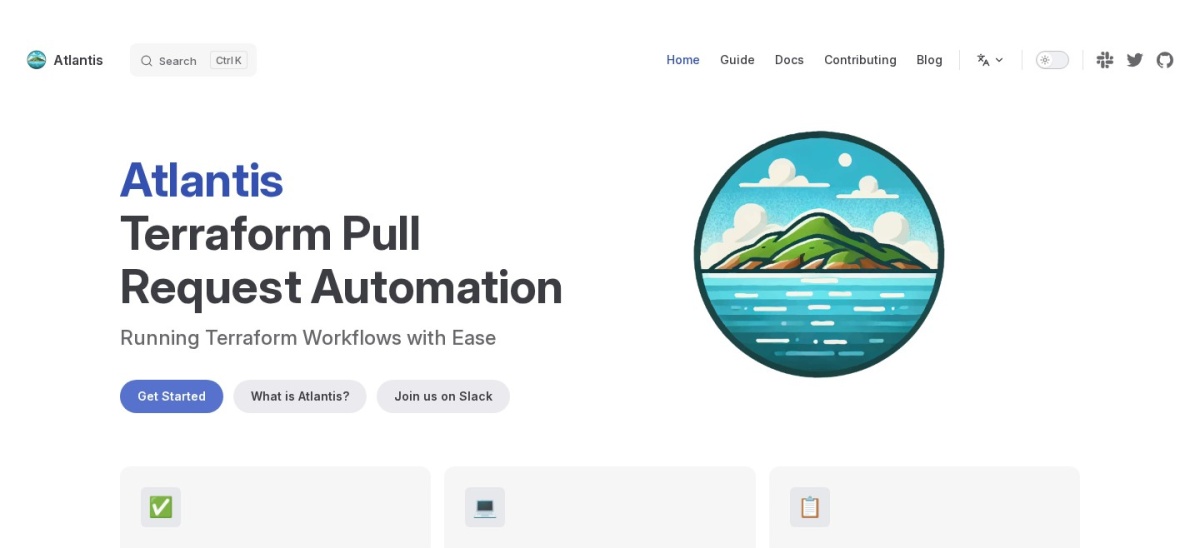
Atlantis
4.5/5on SpotSaaS (290 reviews, checked Nov 2026)
PriceFree
Best free Terraform Cloud alternative
Free planFree, open source
Paid planNone, self-hosted
WorkflowPR comments
LockingWorkspace locking
runatlantis.io
Atlantis homepage, captured Nov 2026.
Atlantis is a free, open-source tool that runs Terraform plan and apply from pull request comments. When a PR touches Terraform files, Atlantis runs the plan, posts the output as a comment and applies after approval, with workspace locking to stop two applies colliding. It supports GitHub, GitLab, Bitbucket and Azure DevOps.
The trade off is that you host and secure it yourself. There is no company behind it, no paid support and no drift detection, cost estimation or managed state view. It suits small teams that want PR-driven Terraform without a subscription and can run a server.
What we like
Completely free under the Apache 2.0 licence
Plan output lands in the review thread itself
Workspace locking stops concurrent applies
Battle-tested PR workflow with thousands of deployments
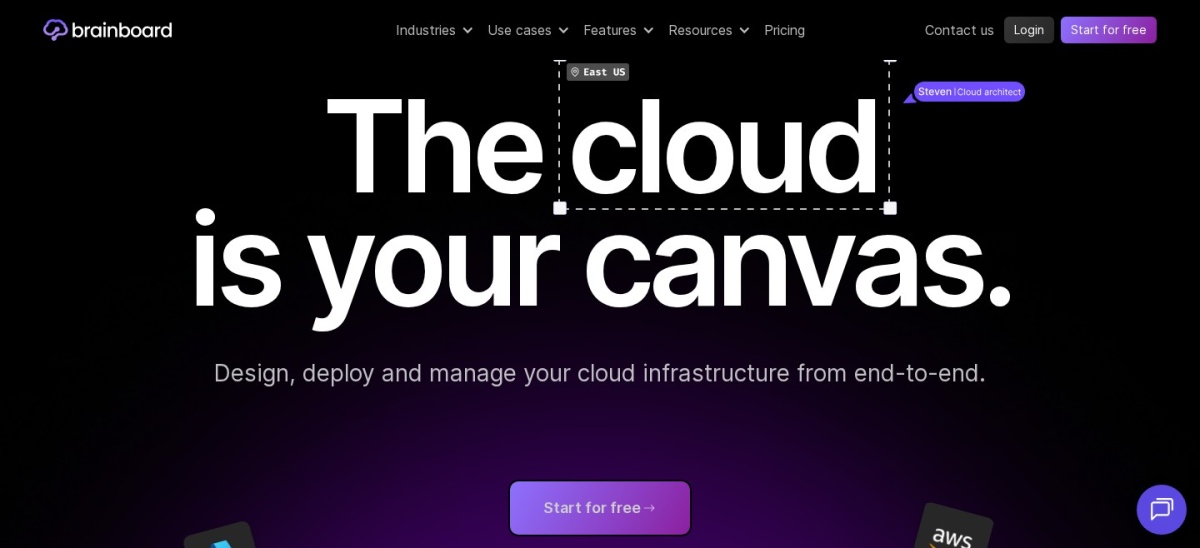
Brainboard is a visual cloud design platform that turns diagrams into Terraform or OpenTofu code. You draw architecture on a canvas and it generates clean, formatted code in real time, with drift detection, cost estimation and a built-in CI/CD engine. The free tier covers unlimited architectures and code generation.
The trade off is per-seat price and a thin review record. Pro lists at $99 per user a month, or $999 per user a year billed annually, and its G2 rating rests on three reviews. Editing generated code needs the Enterprise tier. It suits architects who design visually and want code that stays in sync with the diagram.
Per-resource vs per-run vs per-seat: how the billing differs
Per-resource billing, the HCP Terraform model, charges for every resource under management, so the bill grows with the estate even in quiet months. It is predictable for stable estates and punishing for large ones.
Per-run billing, used by Scalr and env0, charges for work performed. A team that applies rarely pays little, while a team that plans on every pull request pays for each of those runs.
Per-seat and per-worker billing, used by Brainboard and Spacelift, charges for people or parallel capacity. It fits teams with steady headcount and heavy change volume, but the entry tier can be a large jump from free.
How we chose
We started from the tools most often named in 2026 Terraform Cloud alternative round-ups, then kept the eight with a public rating and a live pricing page or free edition.
Prices come from each vendor's pricing page or published pricing data, checked on 29 November 2026. Ratings and review counts come from G2 on the same day, except Atlantis, whose rating comes from SpotSaaS, and Scalr and Brainboard, whose G2 ratings rest on one and three reviews. The list order weighs review-base size and fit, not the headline score alone.
We left out OpenTofu, which has no G2 rating to check, and Digger, which has no published rating or price list. No vendor paid for a place, and we do not claim to have used these tools ourselves for this list.
How to choose a Terraform Cloud alternative
Start with how your bill grows, then check who runs the platform.
Count what you will pay for. Add up resources, runs or seats under each model. A team with many resources and few changes usually pays less per run; a team with constant applies may pay less per resource.
Decide who hosts the control plane. A hosted platform removes server upkeep but holds your state and credentials. Self-hosted Atlantis keeps both in your hands and adds maintenance work.
Check policy and drift on the plan you would buy. Some tools gate drift detection, approvals or audit logs behind higher tiers. Confirm the feature sits in the plan you can afford, not just in the product.
Try the free tier with one real workspace. Run a plan and an apply through a pull request before you migrate. Our guide on deploying WordPress with GitHub Actions shows the pull-request workflow pattern.
FAQ
What is the best Terraform Cloud alternative in 2026?
Spacelift is the best Terraform Cloud alternative for most platform teams. It runs Terraform, OpenTofu, Pulumi and more through one governed workflow, is rated 4.8 out of 5 on G2, and its Starter plan costs $399 a month for 10 users.
What is the cheapest Terraform Cloud alternative?
Atlantis is the cheapest because it is free and open source, though you host it yourself. The cheapest paid start with a published price is Pulumi Essentials at $40 a month, while Scalr is free for 50 runs a month and then $0.99 a run.
Is there a free Terraform Cloud alternative?
Yes. Atlantis is free and open source, Spacelift has a free plan for 2 users, env0 is free for 250 runs a month, Scalr is free for 50 runs a month, and Pulumi Cloud is free for one user.
Which Terraform Cloud alternative is best for small teams?
Pulumi Essentials at $40 a month or Scalr at $0.99 a run fit small teams best, since both start cheap and scale with use. Spacelift only suits small teams on its free tier, which covers just 2 users before the $399 a month Starter plan.
Spacelift vs Scalr: which is better?
Spacelift is better for teams running several IaC tools with strict policy needs, with OPA policies and a private module registry on Starter. Scalr is better for Terraform-only teams that want a drop-in backend billed per run, with no seat or resource fees.
Does any alternative replace Terraform itself?
Most alternatives run Terraform rather than replace it. Pulumi replaces the language with TypeScript, Python or Go, while OpenTofu replaces the engine under an open licence. OpenTofu is not in this list because it has no G2 rating to check.
SaaS SEO and WordPress specialist with about 8 years of experience. Rakib compares WordPress plugins, themes, hosting and software using public pricing, documentation and user reviews. See how we rank.