BigCommerce is the best commercetools alternative for most teams, with a published plan from $39 a month and native B2B tools. Shopify suits brands that want the largest app ecosystem, while Elastic Path fits complex B2B catalogues with a published entry price.
How we make this list: we compare pricing pages, product documentation and public user reviews, then re-check every price before each update. No product paid for a place. Disclosure.
BigCommerce is the cheapest published start here at $39 a month, with B2B features on its Growth plan.
Shopify has the largest review base in this list at 4.4 out of 5 from 5,129 G2 reviews.
Elastic Path is the only composable platform here with a published entry price: $49,500 a year.
Adobe Commerce, Salesforce, Spryker, VTEX and SAP Commerce Cloud all sell by quote, so budget for a sales process.
Open-source options exist, but none of the free commerce frameworks here has a verifiable G2 rating.
How do you choose the best commercetools alternatives?
Published prices are rare in enterprise commerce. Most vendors in this list sell by quote, so the two platforms with a public price deserve a closer look before any sales call.
Match the platform to the buying model, not the feature list. A direct-to-consumer brand needs fast checkout and apps, while a B2B seller needs quotes, price books and account hierarchies on day one.
Headless support varies more than the marketing suggests. Some platforms were built API-first, while others added a storefront API to an older core, and the difference shows up in build time and cost.
Implementation time is part of the price. G2 data puts typical implementation at about 5 months for Adobe Commerce and SAP Commerce Cloud, and about 9 months for Spryker, and that work is usually billed separately. Our guide to the best headless commerce platforms compares the same field on architecture.
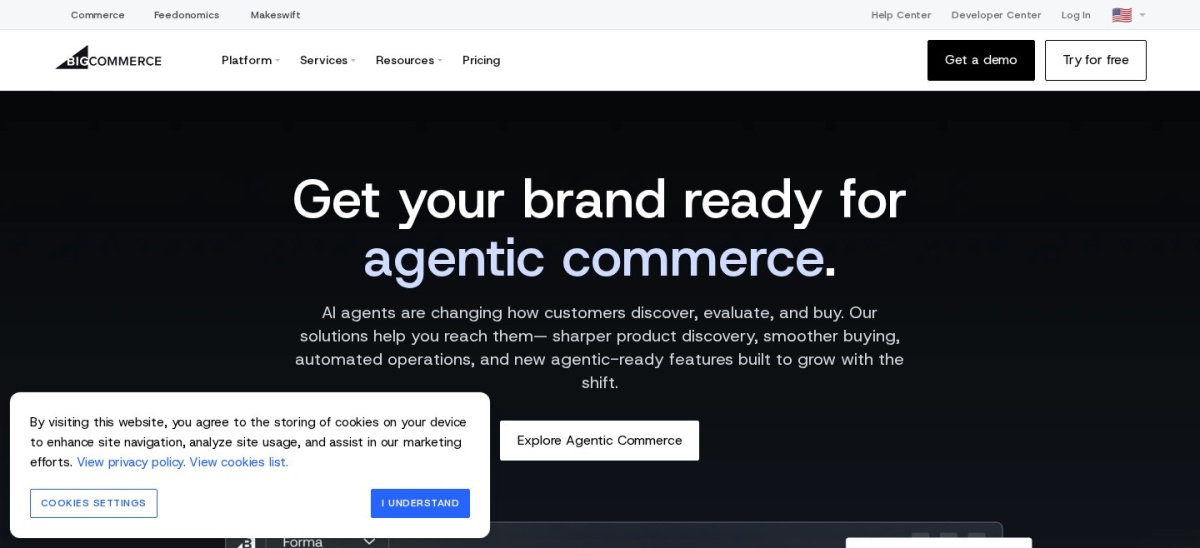
BigCommerce is a hosted SaaS commerce platform with a headless option called Catalyst, built on Next.js. Its Core plan starts at $39 a month, or $29 a month billed annually, and includes unlimited products, unlimited staff accounts and no transaction fees on external payment providers.
The trade off is the sales cap. Each plan carries a trailing 12-month sales limit, starting at $30,000 a year on Core, and crossing it moves the store to a higher plan. It suits mid-market teams that want composable flexibility without running their own infrastructure.
What we like
Only hosted platform here with full published prices
Shopify is a hosted commerce platform whose Hydrogen framework turns it into a headless storefront on its own backend. The Basic plan costs $39 a month, or $29 a month billed annually, and includes a full online store, checkout, hosting and 2 staff accounts.
The trade off is depth. Hydrogen keeps checkout on Shopify, and serious B2B workflows need Plus, which starts at $2,300 a month. It suits direct-to-consumer brands that want the fastest launch and the widest choice of apps and themes.
What we like
Largest G2 review base here at 5,129 reviews
Fastest time to launch of the enterprise options
Checkout converts well and needs no hosting work
Hydrogen is included on paid plans
Watch out for
B2B depth is thinner than the B2B-native platforms
Elastic Path is an API-first composable commerce platform built for complex B2B and B2B2C selling. Entry starts at $49,500 a year, all-in, for up to 15,000 orders or $5 million in GMV, with unlimited catalogs, price books, storefronts and business users included.
The trade off is the small review base. Only 29 G2 reviews support its 4.2 rating, so there are fewer peers to reference-check than for Adobe Commerce or Salesforce. It suits engineering-led teams that want composable architecture with a real number for budget approval.
What we like
Only composable platform here with a published price
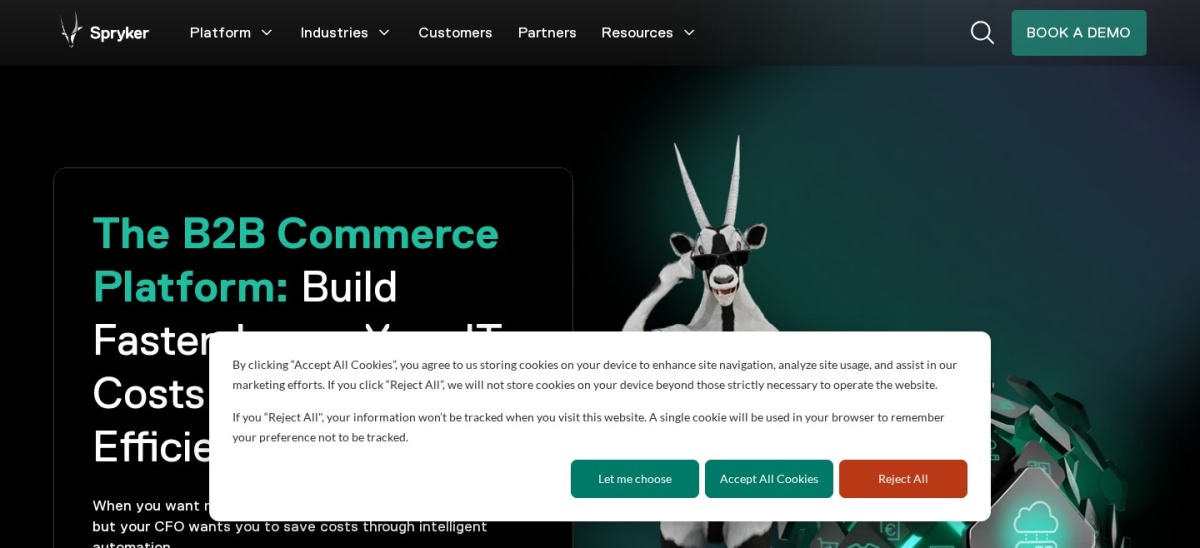
Spryker is a modular commerce platform built for B2B manufacturers, distributors and multi-vendor marketplaces. Its composable architecture lets teams assemble only the commerce capabilities they need, with quotes, punchout, marketplace and approval workflows in the core product.
The trade off is time and cost. G2 data puts typical implementation at about 9 months, the longest in this list, and pricing is by quote with no published starting figure. It suits enterprises building non-standard B2B or marketplace models with a large development team.
Salesforce Commerce Cloud homepage, captured Nov 2026.
Salesforce Commerce Cloud is a managed commerce platform sold as B2C Commerce and B2B Commerce editions, sharing data with Salesforce CRM, Service Cloud and Marketing Cloud. Pricing is a negotiated percentage of gross merchandise value, with no published rate card.
The trade off is lock-in and cost. The platform makes most sense where sales, service and marketing already live in Salesforce, and the GMV-based fee grows with revenue. It suits large B2C and B2B brands that want one data model across commerce and CRM.
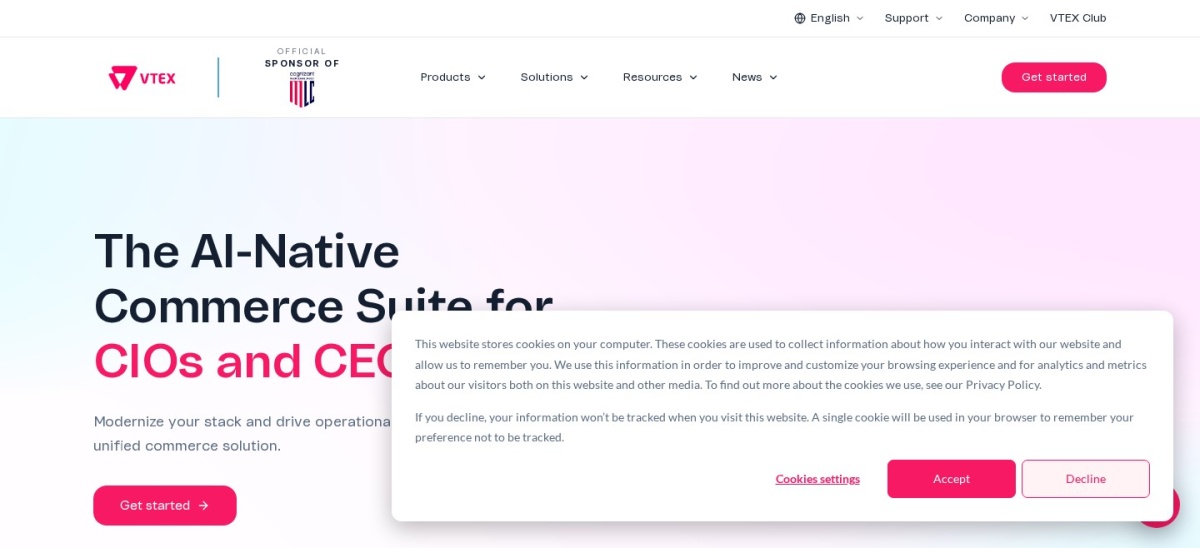
VTEX is a cloud commerce platform that unifies storefront, order management and marketplace operations in one product. Its native OMS tracks orders across channels, and its checkout orchestration centralises cart, payment and fulfilment behaviour across brands and markets.
The trade off is evidence. VTEX holds the highest G2 score in this list at 4.5 out of 5, but from only 37 reviews, and pricing is a custom revenue-share arrangement. It suits global B2C and B2B brands, especially in Latin America, that want one platform for commerce and fulfilment.
Adobe Commerce is the paid version of Magento, built for large and complex catalogs that can run headless through its APIs. It ships a native B2B module with company accounts, approvals, quoting and requisition lists, plus one of the largest extension marketplaces in commerce.
The trade off is weight. Pricing is quote-only and tiered by GMV, implementation typically takes about 5 months, and the platform usually needs an agency partner on retainer. It suits enterprises with an existing Magento codebase and an Adobe ecosystem commitment.
SAP Commerce Cloud is an enterprise commerce platform for companies that already run SAP ERP, with native product, pricing and order data shared across the business. It covers B2C and B2B storefronts, product content management and omnichannel order fulfilment from one suite.
The trade off is scope. Pricing is by quote, implementation typically takes about 5 months, and the platform is at its best only where SAP already runs the back office. It suits large enterprises with complex B2B operations inside the SAP ecosystem.
Only three tools in this list publish a price. BigCommerce and Shopify list monthly plans from $39, and Elastic Path lists $49,500 a year as its entry point.
The rest sell by quote because the price depends on GMV, order volume, markets and implementation. A vendor that publishes one number would mislead most buyers.
Budget for implementation as well as the licence. G2 reviewers report about five months for Adobe Commerce and SAP Commerce Cloud, and about nine for Spryker.
How we chose
We started from the platforms buyers shortlist against commercetools most often, then kept those with a verifiable G2 rating and a real headless or composable story.
Prices come from each vendor's own pricing page, checked on 29 November 2026. BigCommerce and Elastic Path publish full prices; Shopify's $39 Basic plan is confirmed by November 2026 reads of its pricing page. Ratings and review counts come from G2 on the same day.
We left out open-source frameworks with no verifiable G2, Capterra or Trustpilot rating. No vendor paid for a place, and we do not claim hands-on testing for this list.
How to choose a commercetools alternative
Start with the buying model, then check the price and the build time before any demo.
Decide B2B or direct-to-consumer first. B2B sellers need quotes, price books and account hierarchies on day one, while consumer brands need checkout speed and apps.
Ask for a written price, not a range. Only three tools here publish a price. Get the quote in writing, including implementation, before comparing totals.
Check the headless story in detail. API-first platforms and retrofitted storefront APIs build very differently, so ask for a reference store with the same frontend stack.
Count the implementation months. Five to nine months is normal at this level, so start the evaluation a full quarter before the launch date.
FAQ
What is the best commercetools alternative in 2026?
BigCommerce is the best commercetools alternative for most teams. Its Core plan costs $39 a month, it publishes every price, and its B2B Edition covers quotes and buyer portals. Shopify is the stronger pick for direct-to-consumer brands.
How much do commercetools alternatives cost?
Published prices run from $39 a month for BigCommerce and Shopify to $49,500 a year for Elastic Path. Adobe Commerce, Salesforce, Spryker, VTEX and SAP Commerce Cloud all sell by quote, so budget for a sales process.
Which commercetools alternative is best for B2B?
Elastic Path is the strongest B2B-native pick with a published price, at $49,500 a year with unlimited price books. Spryker suits marketplaces, and BigCommerce B2B Edition covers quotes and buyer portals at a lower entry price.
Is there a free commercetools alternative?
No hosted platform here has a free plan, though most offer a trial. Adobe Commerce has a free open-source Magento edition, but it needs hosting and development, so it is not a free hosted alternative.
BigCommerce or Shopify: which is better as a commercetools alternative?
BigCommerce wins on published B2B depth and zero transaction fees, while Shopify wins on app choice and launch speed. BigCommerce is rated 4.2 out of 5 on G2 from 580 reviews, against 4.4 from 5,129 for Shopify.
How long does it take to switch from commercetools?
Expect five to nine months for an enterprise switch, based on G2 implementation data for Adobe Commerce, SAP Commerce Cloud and Spryker. Hosted platforms such as BigCommerce and Shopify launch faster, but data migration still takes weeks.
SaaS SEO and WordPress specialist with about 8 years of experience. Rakib compares WordPress plugins, themes, hosting and software using public pricing, documentation and user reviews. See how we rank.