WLWPLegible EditorsLast verified 22 Nov 2026How we rank6 min read
★ Short answer
Perdoo leads for structured strategy maps, OKRs, and KPI tracking with a free tier for up to 5 users. Tability fits teams wanting lightweight weekly check-ins from $6/user/mo billed yearly, while Mooncamp suits configurable goal trees from €7/user/mo billed annually.
How we make this list: we compare pricing pages, product documentation and public user reviews, then re-check every price before each update. No product paid for a place. Disclosure.
Perdoo offers a free plan for up to 5 users and paid tiers starting at €6.40/user/mo billed annually.
Tability starts at $6/user/mo billed yearly on Basic ($7 monthly) with a 14-day trial and no permanent free plan.
Mooncamp starts at €7/user/mo billed annually on Essential with a 5-user minimum and a 14-day trial.
Weekdone includes a free plan for up to 3 users with a 14-day trial for larger teams.
15Five starts at $4/user/mo billed annually on Engage, while OKRs and Goals sit on Perform at $11/user/mo.
What to look for when choosing OKR software
Strong OKR software keeps company objectives, team key results, and weekly progress updates visible without burying teams in manual spreadsheet work. Look first at whether a platform fits standalone strategy tracking or ties goals directly into performance reviews and project tasks.
Pricing structure matters as headcount grows. Some tools offer free plans for very small groups, while others charge per seat monthly or annually, set minimum user counts, or gate goal features behind higher HR or project tiers.
Check how easily the tool updates key results from your existing stack, such as Slack, Microsoft Teams, Jira, or spreadsheets. Automated data pulls and clear check-in reminders help keep updates consistent across departments.
Finally, match governance and reporting depth to your organization size. Smaller teams usually benefit from fast setup and simple check-ins, whereas larger groups often need multi-level alignment, custom dashboards, and role permissions.
Perdoo is a goal and strategy execution platform that pairs OKRs and KPIs with visual strategy maps. Its free plan supports up to 5 users with OKRs, KPIs, strategy maps, and Slack or Teams integrations.
The trade off is that paid plans are priced in euros starting at €6.40 per user per month on Premium billed annually, and some users note a learning curve when configuring views. It suits teams that want structured strategy cascading alongside KPI tracking.
What we like
Free plan includes strategy maps and KPIs for up to 5 users
Connects company vision, team OKRs, and ongoing KPIs
Integrates with Slack, Microsoft Teams, Jira, and calendar tools
Rated 4.4/5 across 550 reviews on G2
Watch out for
Euro list pricing adds currency conversion for USD budgets
Mobile experience feels less flexible than desktop workflows
Paid plans (Premium and Supreme) add custom dashboards, expanded AI allowances, and deeper reporting.Visit perdoo.com
02
Tability
4.6/5on G2 (165 reviews, checked Nov 2026)
Starts at$72/yr
Best for weekly check-in habits
Basic annual$6/user/mo ($72/yr)
Basic monthly$7/user/mo
Trial14-day free trial
G2 rating4.6/5 (165 reviews)
tability.io
Tability homepage, captured Nov 2026.
Tability is a goal-tracking platform centered on recurring check-ins, strategy maps, and outcome updates. Basic starts at $6 per user per month billed annually ($72 per user per year) or $7 monthly, with a 14-day trial.
The trade off is that there is no permanent free tier after the 14-day trial, and data connectors and SAML SSO require Premium at $10 per user per month annually. It suits teams that want lightweight weekly check-ins without heavy enterprise setup.
What we like
Transparent USD pricing starting at $6/user/mo billed annually
Supports monthly billing alongside annual plans
Includes strategy maps, initiatives, and Slack, Teams, Jira, and Linear links
Rated 4.6/5 across 165 reviews on G2
Watch out for
No free plan beyond the 14-day trial
Some reviewers mention slower support response times
Premium ($10/user/mo annually) adds data connectors, SAML SSO, SCIM, AI credits, and read-only seats.Visit tability.io
03
Mooncamp
4.8/5on G2 (298 reviews, checked Nov 2026)
Starts at$92/yr
Best for flexible goal structures
Essential plan€7/user/mo annual (5 min)
Professional plan€10/user/mo annual
Trial14-day free trial
G2 rating4.8/5 (298 reviews)
mooncamp.com
Mooncamp homepage, captured Nov 2026.
Mooncamp is a customizable strategy and goal-execution platform built around flexible goal hierarchies and check-ins. Essential starts at €7 per user per month billed annually (roughly $92/yr per seat equivalent) with a 14-day trial.
The trade off is a 5-user minimum on paid plans and no permanent free tier, while goal trees and custom charts sit on Professional at €10 per user per month annually. It suits growing teams that want configurable goal fields and clean dashboards.
What we like
High 4.8/5 rating across 298 reviews on G2
Flexible goal setup with reporting and check-ins on Essential
Integrates with Microsoft Teams, Slack, and Jira
14-day trial available without a credit card
Watch out for
Requires at least 5 users and lacks a free tier
Goal tree view and custom charts require upgrading to Professional
Professional (€10/user/mo annually) adds goal trees, custom charts, goal rules, and more shared dashboards.Visit mooncamp.com
04
Weekdone
4.5/5on Capterra (63 reviews, checked Nov 2026)
PriceFree
Best for weekly PPP team updates
Free tierUp to 3 users
Larger teams14-day trial, dynamic per-user
IntegrationsSlack, Teams, Jira, Asana
Capterra rating4.5/5 (63 reviews)
weekdone.com
Weekdone homepage, captured Nov 2026.
Weekdone is an OKR and weekly reporting tool that connects quarterly objectives with weekly Plans, Progress, and Problems updates. Its free plan covers up to 3 users with full included features.
The trade off is that teams with 4 or more users move to paid per-user pricing after a 14-day trial, and support experiences vary across reviews. It suits small teams and managers who want weekly status rhythms tied to OKRs.
What we like
Free plan for up to 3 users with core features included
Combines OKR alignment with weekly team reporting
Connects with Slack, Microsoft Teams, Jira, Asana, and Basecamp
Rated 4.5/5 across 63 reviews on Capterra
Watch out for
Free tier caps out at 3 users
Some reviewers report mixed support responsiveness
Paid plans for larger teams scale per user with volume steps and include onboarding and coaching options.Visit weekdone.com
05
Asana
4.4/5on G2 (14,142 reviews, checked Nov 2026)
Paid from$132/yr
Best for linking goals to project tasks
Starter annual$10.99/user/mo ($131.88/yr)
Goals & portfoliosAdvanced at $24.99/user/mo annual
Free planPersonal up to 2 users
G2 rating4.4/5 (14,142 reviews)
asana.com
Asana homepage, captured Nov 2026.
Asana is a work management platform that links company and team goals directly to projects, timelines, and tasks. Paid plans start on Starter at $10.99 per user per month billed annually ($131.88 per user per year), with a free Personal tier for up to 2 users.
The trade off is that full goal tracking and strategy maps sit on Advanced at $24.99 per user per month billed annually, and seat blocks or AI caps apply. It suits teams already running daily projects in Asana.
What we like
Connects goals directly to project progress and task execution
Broad adoption with 14,142 reviews at 4.4/5 on G2
Includes reporting dashboards, automations, and custom fields from Starter
Free Personal tier available for up to 2 users
Watch out for
Full goals and strategy map require the higher-priced Advanced tier
Can feel heavy if you only need standalone OKR tracking
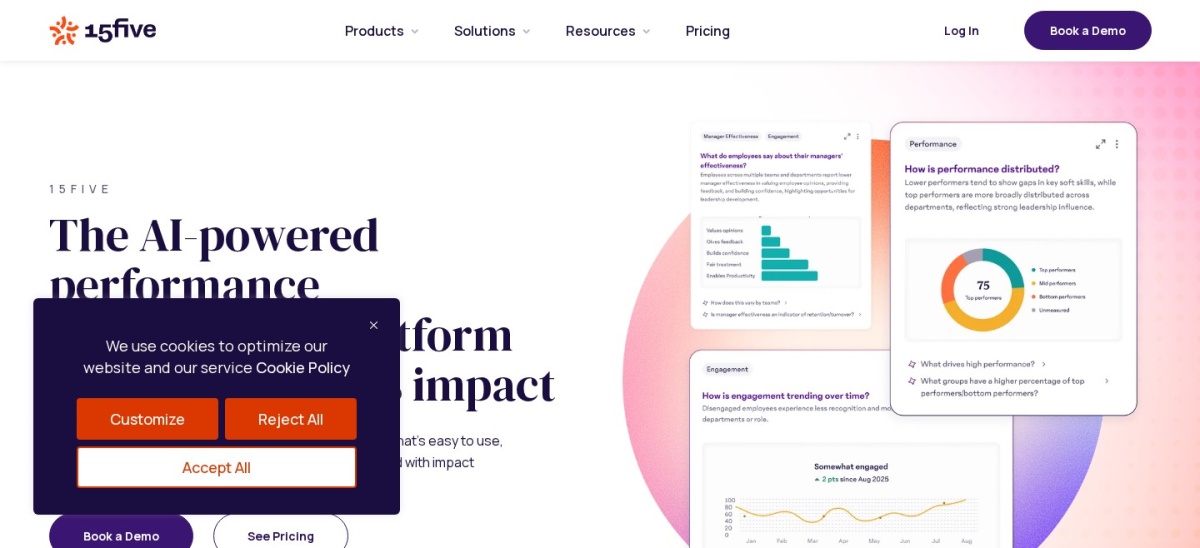
15Five is a performance and engagement platform that pairs weekly check-ins and 1-on-1s with OKRs and goals. Entry pricing starts on Engage at $4 per user per month billed annually ($48 per user per year), while OKRs and Goals are included on Perform at $11 per user per month billed annually.
The trade off is annual-only billing and needing Perform at $11 per user per month for OKRs and performance reviews. It suits HR and people teams that want goals tied to weekly check-ins and reviews.
What we like
Connects OKRs with weekly check-ins, 1-on-1s, and performance reviews
Entry Engage plan starts at $4/user/mo billed annually
Rated 4.6/5 across 2,017 reviews on G2
Integrates with Slack, Teams, Jira, and Asana
Watch out for
OKRs and Goals require Perform ($11/user/mo annually) rather than Engage
Annual billing commitment and weekly check-ins can add overhead
Perform ($11/user/mo annually) adds OKRs and Goals, performance reviews, 360 feedback, and career plans.Visit 15five.com
07
Wrike
4.2/5on G2 (4,648 reviews, checked Nov 2026)
Paid from$120/yr
Best for enterprise project-linked OKRs
Team annual$10/user/mo ($120/yr)
Business annual$25/user/mo ($300/yr)
Free planAvailable with core tasks
G2 rating4.2/5 (4,648 reviews)
wrike.com
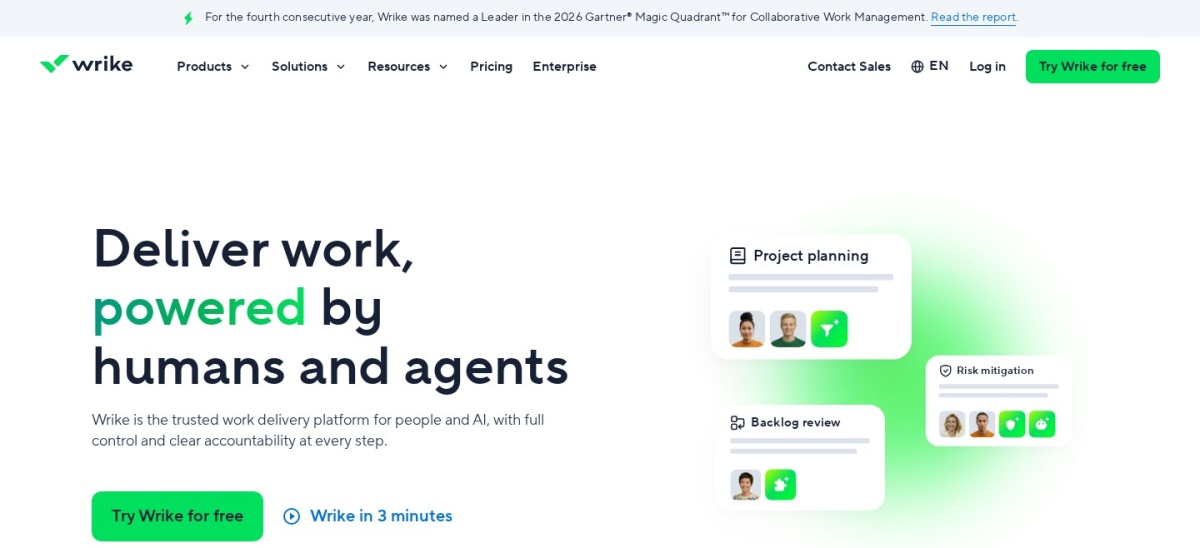
Wrike homepage, captured Nov 2026.
Wrike is a collaborative work management platform used by project-heavy teams to connect workflows, dashboards, and organizational goals. Its paid Team plan starts at $10 per user per month billed annually ($120 per user per year) for 2 to 15 users, alongside a free tier.
The trade off is a steep learning curve across many views and higher per-seat pricing on Business at $25 per user per month billed annually. It suits mid-sized and larger teams managing complex cross-functional delivery.
What we like
Includes Gantt charts, shareable dashboards, and task tracking on Team
Free plan available to test basic task workflows
Large review base with 4,648 reviews at 4.2/5 on G2
Configurable workflows for multi-team operations
Watch out for
Dense menus and views create a noticeable learning curve
Team plan caps at 15 users before stepping up tiers
Business ($25/user/mo annually) expands workflow customization, reporting, and broader team scale.Visit wrike.com
Dedicated OKR tools vs. HR or project suites
Dedicated OKR tools like Perdoo, Tability, and Mooncamp focus on goal alignment, strategy maps, and recurring check-ins without forcing you to replace your HR system or project tracker. They are often faster to adopt if your team already likes its daily tools.
Work and HR suites like Asana, 15Five, and Wrike keep goals close to daily tasks or performance reviews. That connection saves duplicate entry when everyone already works inside the same platform, though entry tiers may not include every goal or reporting feature.
How we chose
We built this list around active OKR and goal-tracking platforms that serve small teams, growing companies, and cross-functional organizations across dedicated goal tools and broader work or HR suites.
Prices, plan structures, and review ratings were checked on 22 Nov 2026 from each vendor's official pricing page and public review directories (G2 and Capterra).
We excluded tools without published starting prices or clear seat terms on their pricing pages, as well as discontinued goal tools. No vendor paid for a place, and we do not claim testing for this list.
How to choose the right OKR software
Follow four steps to pick a tool that fits your team size and check-in habit.
Decide whether you want a dedicated OKR tracker or an all-in-one suite. Pick a dedicated goal platform if you want focused strategy maps and check-ins, or a work/HR suite if goals should live beside tasks or reviews.
Check free tiers, trials, and minimum seat counts. Verify whether a free plan fits your headcount or whether paid plans require annual billing or minimum user counts like 5 seats.
Confirm integrations with your daily communication and work tools. Look for native connections to Slack, Microsoft Teams, Jira, or spreadsheets so check-ins stay quick and metrics stay current.
Match reporting and permissions to your review cadence. Choose simple weekly check-ins for smaller teams, and look for custom dashboards, hierarchies, and role controls as more departments join.
FAQ
What is the best free OKR software for small teams?
Perdoo offers a free plan for up to 5 users with OKRs, KPIs, and strategy maps, while Weekdone includes a free tier for up to 3 users. Asana also offers a free Personal tier for up to 2 users, though full goal features sit on higher plans.
How much does OKR software usually cost per user?
Published entry paid plans commonly start around $4 to $10 per user per month (or equivalent euro rates) when billed annually, depending on the tier. Total costs depend on billing frequency, seat minimums, and whether goal tools are bundled with HR or project features.
Do I need dedicated OKR software if we already use Asana or Wrike?
Not necessarily if your team already tracks projects there and wants goals tied directly to tasks. A dedicated OKR tool can still make sense if you want cleaner strategy maps, lighter check-ins, or independent goal tracking across mixed tools.
Should OKRs be tied directly to employee performance reviews?
Many HR platforms like 15Five connect goals with check-ins, 1-on-1s, and reviews. Other teams keep weekly OKR check-ins focused on learning and progress rather than compensation or evaluations.
What is the biggest reason OKR rollouts stall in software?
Teams often treat OKRs as a one-time quarterly form instead of updating key results on a weekly rhythm. Picking a tool with simple check-in reminders and clear ownership helps keep updates consistent.
Can small teams start on a trial before committing annually?
Yes, platforms such as Tability, Mooncamp, and Weekdone offer 14-day trials so you can test check-in workflows with your team first. Always check whether a trial requires a credit card and what happens to seats after it ends.