Langfuse is the best LLM observability tool overall, offering 50,000 monthly units on its free cloud plan alongside open-source deployment options. Choose LangSmith for debugging complex AI agent workflows or Arize AX for production monitoring with integrated evaluation and issue detection.
How we make this list: we compare pricing pages, product documentation and public user reviews, then re-check every price before each update. No product paid for a place. Disclosure.
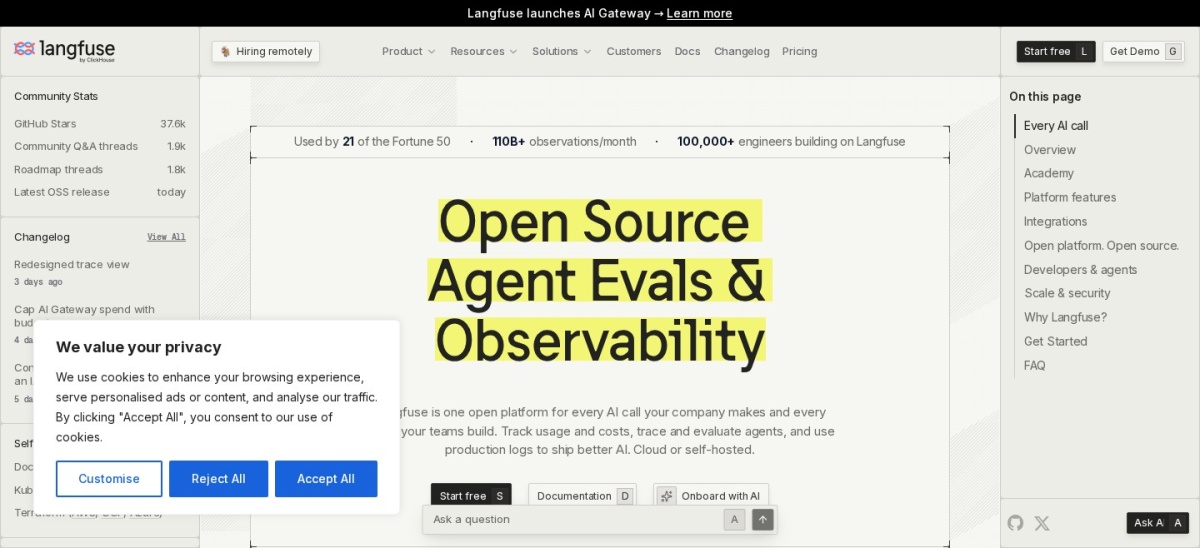
Langfuse offers 50,000 free monthly units, with paid cloud plans starting at $29 per month.
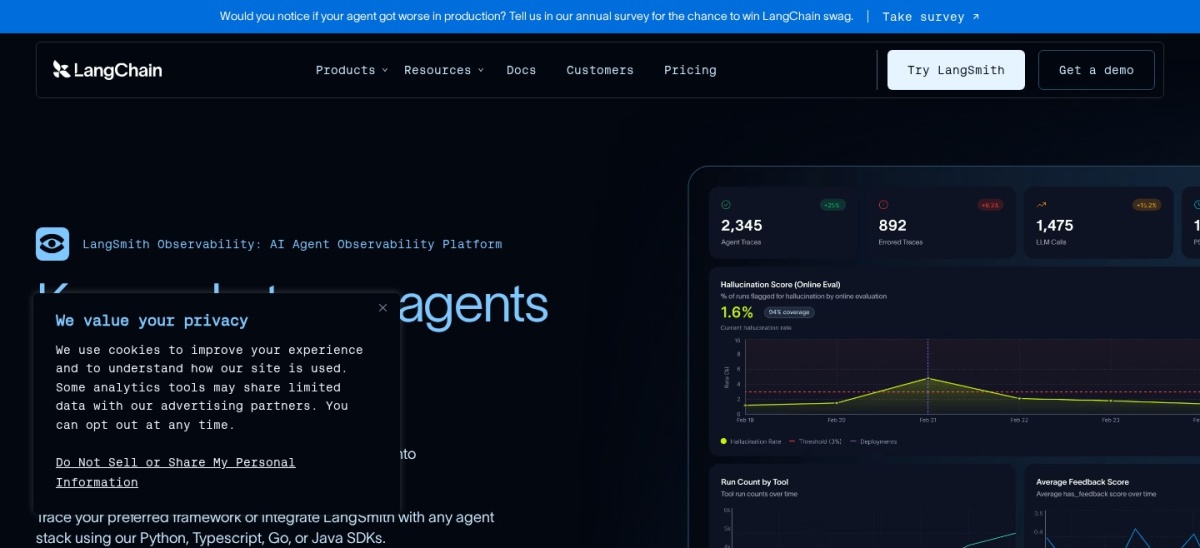
LangSmith includes 5,000 monthly base traces on its free Developer plan.
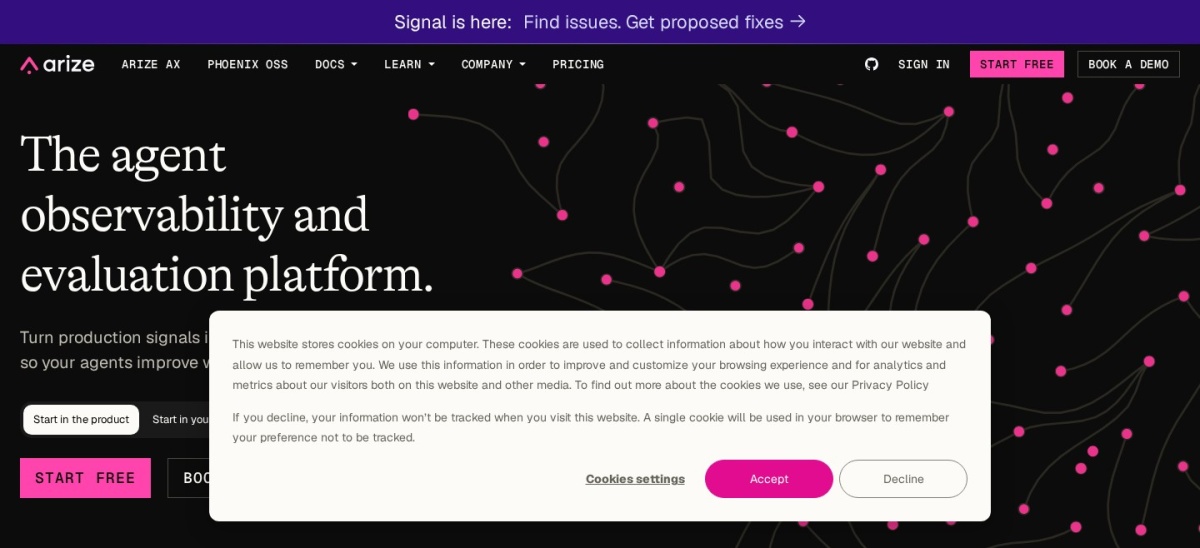
Arize AX provides 25,000 monthly spans and unlimited evaluations on its free plan.
Opik has the lowest fixed paid subscription in this comparison at $228 per year.
Braintrust supports 10,000 monthly evaluation scores on its Starter plan.
Datadog includes 40,000 monthly LLM spans on its free Agent Observability tier.
What to look for in an LLM observability platform
Traditional application monitoring tells you whether a service is available and responding quickly. LLM observability goes further by examining model inputs, generated responses, retrieval operations, tool calls and evaluation results.
Look for distributed tracing that connects individual operations to the original user request. This makes it easier to determine whether an incorrect answer originated from retrieval, prompt construction, model behavior or an external tool.
Cost monitoring matters because different models consume tokens at different rates. A useful observability platform connects model expenditure to individual requests, users, workflows and application features.
Evaluation features help teams detect hallucinations, incomplete answers and unexpected changes in response quality. Production traces should also be reusable as examples in regression testing datasets.
Compare billing units carefully. A trace, span, evaluation score and billable observation represent different amounts of work, so advertised usage allowances are not directly interchangeable.
Langfuse is an open-source AI engineering platform covering application tracing, prompt management, response evaluation and usage analytics. Its free Hobby plan includes 50,000 monthly units, access for two users and 30 days of historical data.
The trade off is usage-based billing and limited historical access on lower-priced subscriptions. Core costs $29 per month, includes 100,000 units and extends data access to 90 days, with additional usage charges possible. It suits developers who want flexible deployment and control over observability infrastructure.
What we like
Open-source deployment option
Integrated prompt version management
Supports OpenTelemetry instrumentation
Tracks token consumption and model expenditure
Unlimited users on Core
Watch out for
Self-hosting requires infrastructure maintenance
Billable units can accumulate during complex workflows
LangSmith is an AI agent engineering platform from LangChain that combines execution tracing, monitoring, evaluation and dataset management. Its Developer plan supports one user and includes 5,000 monthly base traces before usage-based charges apply.
The trade off is that collaboration introduces both subscription and metered usage costs. Plus starts at $39 per user per month and includes 10,000 monthly base traces, while self-hosted deployment requires Enterprise. It suits engineering teams building multi-step agents that need detailed execution visibility.
What we like
Detailed nested execution traces
Works with different agent frameworks
Production and development evaluations
Annotation workflows for human reviewers
Agent deployment services available
Watch out for
Per-seat pricing increases collaboration costs
Self-hosting requires Enterprise
Additional usage can increase monthly expenditure
Plus adds team collaboration, higher trace allowances and agent deployment services.Visit langchain.com
03
Arize AX
4.3/5on G2 (79 reviews, checked Nov 2026)
Paid from$50/mo
Best for production AI monitoring
Free usage25,000 spans/month
Free ingestion1 GB/month
Free retention15 days
Paid planAX Pro
arize.com
Arize AX homepage, captured Nov 2026.
Arize AX is a managed AI observability platform focused on identifying production failures and improving agent performance. Its free tier includes 25,000 monthly spans, 1 GB of ingestion, unlimited users and unlimited evaluations.
The trade off is that production teams may quickly exceed the free ingestion and retention allowances. AX Pro costs $50 per month and increases monthly capacity to 50,000 spans and 10 GB of ingested data. It suits organizations monitoring AI quality across multiple applications.
What we like
Unlimited users on the free tier
Integrated production issue detection
Evaluation workflows for model responses
Transparent entry-level subscription pricing
Watch out for
Short historical retention on the free plan
Self-hosted AX deployment requires Enterprise
Separate ingestion and span limits require monitoring
AX Pro increases ingestion capacity, span allowances and data retention.Visit arize.com
04
Opik
4.1/5on G2 (37 reviews, checked Nov 2026)
Paid from$19/mo
Best for affordable observability and testing
Free usage25,000 spans/month
Free cloud members10
Free retention60 days
Paid planPro Cloud
comet.com
Opik homepage, captured Nov 2026.
Opik is Comet's open-source platform for observing LLM applications, evaluating generated responses and testing agent behavior. Its free hosted version supports 10 team members, 25,000 monthly spans and 60 days of data retention.
The trade off is that growing applications need additional span capacity or their own hosting infrastructure. Pro Cloud starts at $19 per month and includes 100,000 monthly spans for up to 50 team members. It suits cost-conscious AI development teams that want integrated tracing and regression testing.
What we like
Lowest fixed paid subscription in this comparison
Open-source and managed deployment options
Agent playground for inspecting executions
Test suites and response assertions
Python and TypeScript SDKs
Watch out for
Self-hosting creates operational responsibilities
Enterprise security features require a separate plan
G2 rating covers Comet's broader product platform
Pro Cloud adds higher usage allowances and configurable capacity and retention.Visit comet.com
05
Braintrust
4.3/5on G2 (65 reviews, checked Nov 2026)
Paid from$249/mo
Best for evaluation-driven AI development
Free scores10,000/month
Free processed data1 GB/month
Free retention14 days
Paid planPro
braintrust.dev
Braintrust homepage, captured Nov 2026.
Braintrust is an AI development platform that connects production observability with structured evaluations, experiments and reusable datasets. Its free Starter subscription includes 10,000 monthly scores, 1 GB of processed data and access for unlimited users.
The trade off is the relatively expensive fixed subscription upgrade and additional metered charges. Pro costs $249 per month, includes 50,000 scores and increases standard retention to 30 days. It suits teams that use evaluation results as a formal requirement before deploying AI application changes.
What we like
Production data can inform evaluation datasets
Unlimited projects and users on Starter
Integrated experimentation workflows
Supports structured response scoring
Custom reporting options on Pro
Watch out for
Highest fixed entry subscription in this comparison
Separate charges for additional processing and scores
Short default retention on Starter
Pro adds custom charts, environments, role-based permissions and larger allowances.Visit braintrust.dev
06
CoreWeave Forge
4.5/5on G2 (83 reviews, checked Nov 2026)
Paid from$60/mo
Best for combined AI and ML monitoring
Free tracingYes
Application scoringYes
ML experiment trackingYes
Paid planPro
coreweave.com
CoreWeave Forge homepage, captured Nov 2026.
CoreWeave Forge is an AI development platform incorporating the former Weights & Biases product ecosystem, including application tracing and evaluation capabilities associated with Weave. Its free subscription includes AI application scoring, model experiment tracking and community support, while Pro starts at $60 per month.
The trade off is that its broader machine learning functionality can introduce unnecessary complexity for teams that only need LLM traces. The $60 monthly Pro subscription targets early-stage organizations with fewer than 50 employees. It suits teams developing both conventional machine learning models and generative AI applications.
What we like
Combines model experiments and LLM observability
Application tracing on the free plan
Integrated scoring and asset management
Team permissions on paid subscriptions
CI/CD automation support
Watch out for
Broader feature set introduces a learning curve
Larger organizations may require Enterprise
G2 rating reflects the former Weights & Biases platform
Pro adds team permissions, service accounts, automation and priority support.Visit coreweave.com
07
Datadog
4.4/5on G2 (746 reviews, checked Nov 2026)
Paid from$160/mo
Best for full-stack AI observability
Free usage40,000 LLM spans/month
Free trace retention15 days
Paid usage100,000 LLM spans/month
Paid planAgent Observability Pro
datadoghq.com
Datadog homepage, captured Nov 2026.
Datadog is a general observability platform with a dedicated Agent Observability product for monitoring AI workflows and connecting model behavior to application infrastructure. Its free tier includes 40,000 monthly LLM spans, unlimited evaluations and 15 days of trace retention.
The trade off is subscription cost and potentially separate charges for other infrastructure monitoring products. Agent Observability Pro starts at $160 per month with an annual commitment, or $200 on a monthly commitment. It suits DevOps teams that want AI monitoring integrated with existing application performance data.
What we like
Connects AI traces with backend service monitoring
Built-in sensitive data detection
Supports production quality evaluations
Only model-call spans count toward span billing
Available without another Datadog subscription
Watch out for
Lowest advertised rate requires annual commitment
Extended trace retention costs extra
G2 rating covers Datadog's broader platform
Pro raises monthly model-call capacity and supports additional metered usage.Visit datadoghq.com
How traces, spans and evaluation scores affect your bill
A trace represents an execution associated with a request or workflow. Spans represent individual operations within that execution, such as a model request, document retrieval or external tool invocation.
An evaluation score records an assessment of an output. Depending on the platform, several scores can be attached to the same response to measure factual accuracy, relevance, formatting or compliance with application requirements.
Langfuse charges according to billable units, LangSmith meters traces alongside user subscriptions, and Braintrust measures processing volume and evaluation scores. Datadog's Agent Observability pricing counts model-call spans rather than every surrounding workflow operation.
Estimate consumption using representative application traffic before committing to a subscription. The annual prices in this comparison represent fixed starting subscription costs, not total expenditure after metered usage, additional seats, infrastructure or evaluation model charges.
Should you self-host your LLM observability platform?
Self-hosted observability gives engineering teams more control over where application traces, prompts and generated responses are stored. Langfuse and Opik provide open-source deployment options that are particularly relevant when applications handle confidential information.
Managed subscriptions reduce responsibility for infrastructure provisioning, backups, upgrades and database performance. They are often a practical choice for small teams that need to concentrate on developing their AI products.
Self-hosting does not eliminate costs. Compare server expenditure, storage growth, engineering maintenance and security requirements against the total cost of a managed subscription before deciding.
How we chose
We shortlisted established and actively maintained AI observability products using official vendor documentation, subscription pages and public G2 reviews. Ranking priorities included execution tracing, evaluation workflows, deployment flexibility, pricing transparency and production monitoring.
The editorial check date is 22 Nov 2026. Live pricing and review pages were consulted during preparation, so these figures are not archived snapshots of that exact date. Annual prices represent the lowest published fixed paid subscriptions, excluding additional usage. Ratings for Opik, CoreWeave Forge and Datadog reflect their broader product platforms, while Langfuse has a limited G2 review sample.
We excluded discontinued products, tools without meaningful LLM observability functionality and vendors whose current subscription pricing could not be confirmed. Products were ranked by their suitability for common AI engineering workflows rather than review scores alone. No vendor paid for a place, and we do not claim testing for this list.
How to choose the best LLM observability tool
Compare your application's monitoring requirements, architecture, evaluation workflow and expected usage before selecting a subscription.
Identify your main observability requirements. Decide whether your biggest challenge is debugging agent executions, detecting incorrect responses, measuring model expenditure or connecting AI behavior to backend application performance.
Check framework and model compatibility. Confirm support for your programming languages, model providers, agent frameworks and retrieval infrastructure. Prefer instrumentation that does not require extensive changes to existing application code.
Calculate realistic monthly usage. Estimate how many traces, spans, scores and data volumes your application will generate. Include evaluation model costs, additional seats and historical data requirements in your budget.
Review deployment and security requirements. Determine whether a managed cloud service is acceptable or self-hosting is necessary. Check data redaction, access permissions, retention controls and the ability to export or delete application data.
FAQ
What is the best LLM observability tool?
Langfuse is our top overall recommendation because it combines tracing, prompt management, evaluation and flexible deployment. LangSmith is particularly suitable for complex agent workflows, while Arize AX is a strong choice for teams focused on production issue detection.
What is LLM observability?
LLM observability is the process of collecting and analyzing information about how large language model applications behave. It covers model inputs, generated outputs, execution steps, response latency, token consumption, errors and evaluation results across development and production environments.
What is the cheapest paid LLM observability tool?
Opik has the lowest published fixed subscription in this comparison, starting at $19 per month. However, additional usage and evaluation costs can affect the final bill, so the cheapest starting subscription is not necessarily the least expensive option at scale.
Are there free LLM observability tools?
Yes. Langfuse, LangSmith, Arize AX, Opik, Braintrust, CoreWeave Forge and Datadog all provide free entry tiers. Their usage allowances, collaboration restrictions and retention periods differ, so review the billing definitions before comparing their free capacity.
Which LLM observability tools are open source?
Langfuse and Opik offer open-source versions that developers can deploy on infrastructure they control. These options are useful for organizations with specific data governance requirements or engineering teams that prefer to manage their observability infrastructure independently.
What is the difference between LLM monitoring and observability?
Monitoring tracks known indicators such as response latency, error rates and token consumption. Observability helps developers investigate unexpected behavior by examining connected execution traces, intermediate operations, model responses and supporting context to understand why a problem occurred.
Can LLM observability tools detect hallucinations?
Many platforms support evaluation methods designed to identify unsupported or inaccurate model responses. These methods can include reference-based scoring, custom evaluation functions and model-based judges, but their reliability depends on evaluation design, available evidence and appropriate human oversight.
Do LLM observability tools support AI agents?
Yes. Platforms such as LangSmith, Arize AX, Langfuse and Opik can record multi-step agent executions, including model calls, retrieval operations and tool interactions. Developers can inspect individual operations to identify where an agent produced incorrect or unexpected behavior.
How much does LLM observability cost?
Published fixed paid subscriptions in this comparison start between $19 and $249 per month. Actual expenditure depends on application traffic, billing units, evaluation frequency, team size, retention requirements and whether the platform is managed or self-hosted.
SaaS SEO and WordPress specialist with about 8 years of experience. Rakib compares WordPress plugins, themes, hosting and software using public pricing, documentation and user reviews. See how we rank.