Arize AX is the best LLM monitoring tool overall, offering unlimited evaluations and 25,000 monthly trace spans on its free plan. Choose Braintrust for evaluation-driven development or Sentry for connecting LLM monitoring with application errors and performance issues.
How we make this list: we compare pricing pages, product documentation and public user reviews, then re-check every price before each update. No product paid for a place. Disclosure.
Arize AX includes 25,000 monthly trace spans and unlimited evaluations on its free plan.
Braintrust Pro costs $249/month and includes 50,000 scores.
Sentry Team starts at $312/year with annual billing.
Comet Opik offers 60-day data retention on its free cloud plan.
New Relic includes 100 GB of monthly data ingestion on its free tier.
What to look for in an LLM monitoring tool
Large language model applications can fail without returning an application error. An incorrect answer, unnecessary tool call or expensive prompt may appear successful to conventional monitoring software.
Look for distributed tracing that connects model requests, retrieval operations and agent actions. This helps developers identify which component caused an unexpected response.
Evaluation features help teams measure response quality against predefined criteria. Production evaluations are particularly useful for identifying quality regressions after model or prompt changes.
Compare token consumption, latency, retention periods and billing units. A platform that charges by trace volume can have a different cost profile from one that charges by processed data.
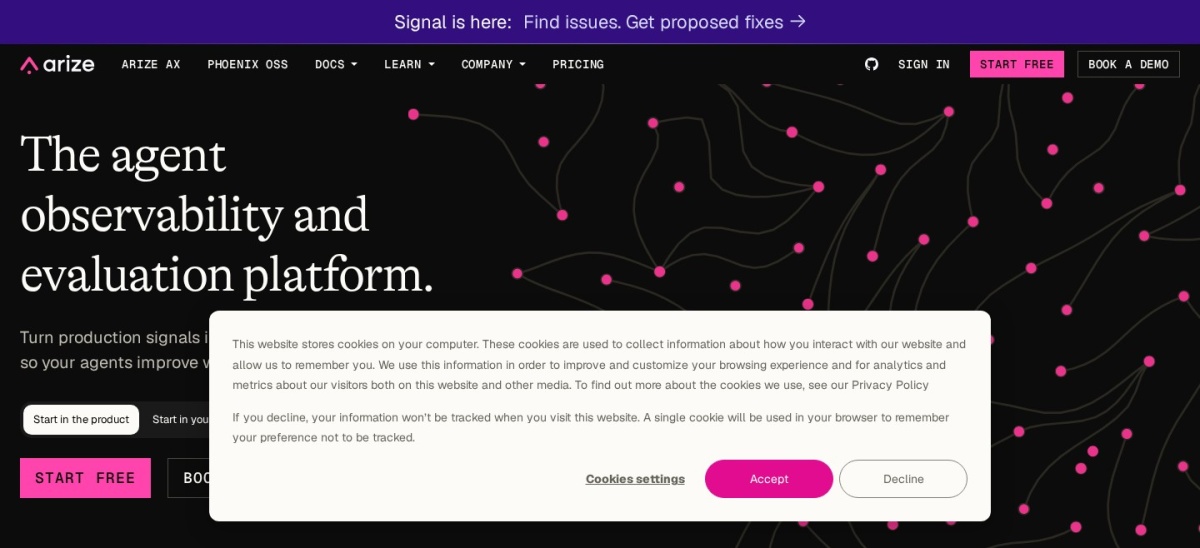
Arize AX is an AI observability platform for monitoring model behavior, agent workflows and response quality. Its free plan includes 25,000 monthly trace spans, unlimited users, unlimited evaluations and 15-day retention.
The trade off is that the free plan has limited ingestion and retention capacity. AX Pro costs $50 per month and increases retention to 30 days. It suits teams that want dedicated AI monitoring without starting with an enterprise contract.
What we like
Unlimited evaluations on the free plan
Unlimited users
Dedicated AI issue detection
Published paid subscription pricing
Watch out for
Limited free trace volume
Shorter retention on the free plan
Requires application instrumentation
AX Pro adds 50,000 monthly spans and 30-day retention.Visit arize.com
02
Braintrust
4.3/5on G2 (65 reviews, checked Nov 2026)
Paid from$249/mo
Best for evaluation-driven development
Free processed data1 GB
Free scores10,000
Free retention14 days
Paid planPro
braintrust.dev
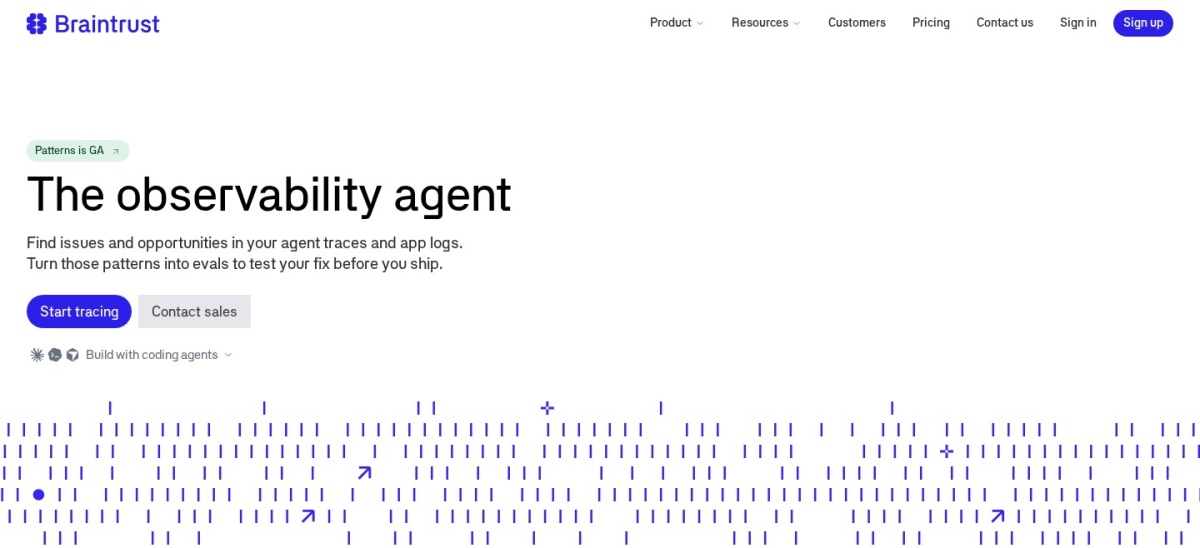
Braintrust homepage, captured Nov 2026.
Braintrust is an AI engineering platform that connects production logs with experiments, datasets and response evaluations. Its Starter plan includes 1 GB of processed data, 10,000 scores and unlimited projects.
The trade off is the subscription cost and additional usage charges. Pro costs $249 per month, with allowances for processed data and scoring. It suits AI development teams that regularly compare prompts and measure response quality before releasing changes.
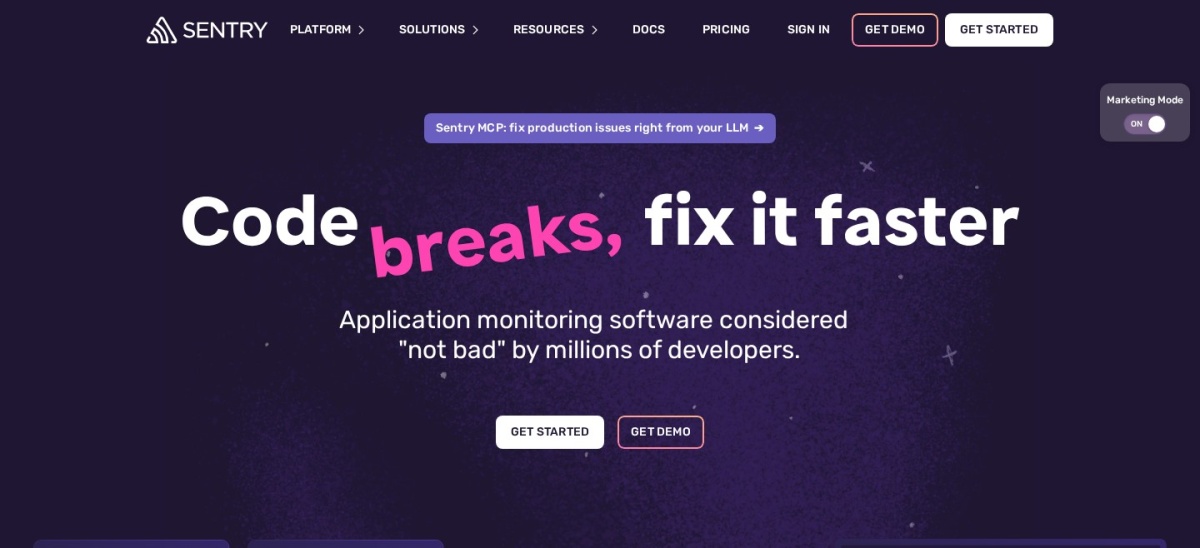
Sentry is an application monitoring platform with AI observability for model calls, prompts, tool usage and token consumption. Its free Developer plan includes error monitoring, tracing and 10 custom dashboards.
The trade off is that its billing depends on monitored application events rather than a dedicated LLM subscription. Team costs $26 per month with annual billing or $29 with monthly billing. It suits developers who want to investigate AI failures alongside software errors.
What we like
Connects AI traces with application errors
Free Developer subscription
Established application monitoring ecosystem
Unlimited users on Team
Watch out for
Less focused on model quality evaluations
Usage-based costs require monitoring
Free plan restricted to an individual user
Team adds integrations, unlimited users and additional dashboards.Visit sentry.io
04
Comet Opik
4.1/5on G2 (37 reviews, checked Nov 2026)
Paid from$19/mo
Best for affordable LLM tracing
Free trace spans25,000/month
Free retention60 days
Self-hostingOpen source
Paid planPro Cloud
comet.com
Comet Opik homepage, captured Nov 2026.
Comet Opik is an open-source AI observability and evaluation product from Comet. Its free cloud plan includes 25,000 monthly spans, support for 10 team members and 60-day retention. The displayed G2 rating covers the broader Comet platform.
The trade off is that growing applications may exceed the included span allowance. Pro Cloud costs $19 per month and increases that allowance to 100,000 spans. It suits smaller AI teams that want affordable monitoring and a self-hosting option.
What we like
Low entry subscription cost
Open-source deployment option
Agent testing and tracing
Long free retention period
Watch out for
Self-hosting requires infrastructure maintenance
Cloud plans impose span limits
Public rating covers the broader Comet product
Pro Cloud adds higher trace limits and support for 50 team members.Visit comet.com
05
Datadog
4.4/5on G2 (746 reviews, checked Nov 2026)
Starts at$3.50/mo
Best for full-stack AI observability
Billing unit10,000 LLM spans
Default trace retention15 days
EvaluationsOnline and offline
InstrumentationSDK and OpenTelemetry
datadoghq.com
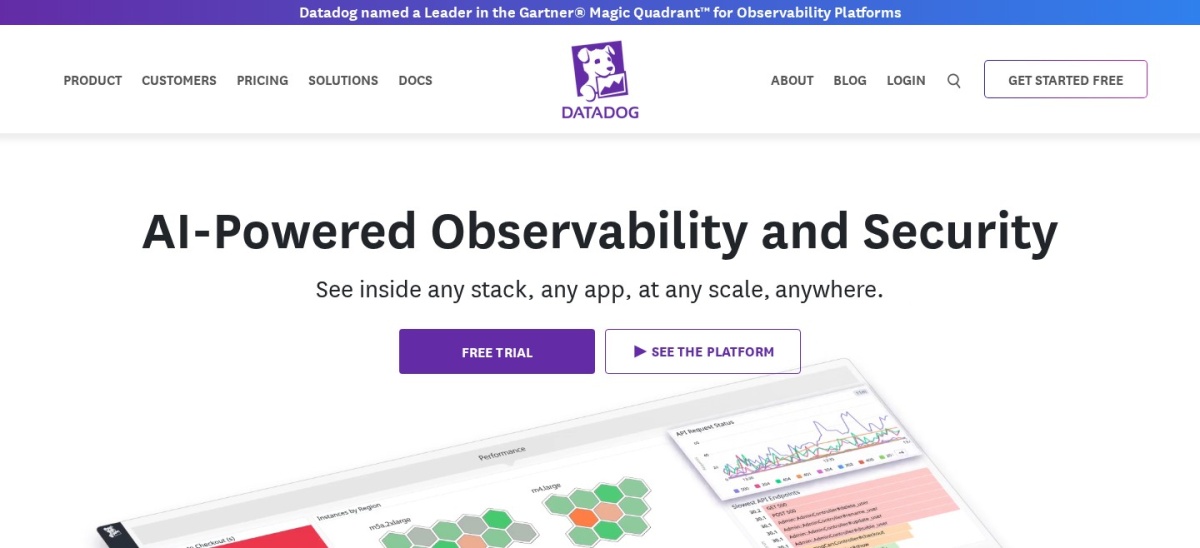
Datadog homepage, captured Nov 2026.
Datadog is a full-stack monitoring platform with a dedicated Agent Observability product. It connects agent traces, evaluations, experiments and backend telemetry, with annual usage pricing starting at $3.50 per 10,000 LLM spans.
The trade off is consumption-based billing rather than a fixed subscription price. The equivalent annual cost is $42 for 10,000 billable spans each month at the published annual rate, excluding other charges. It suits engineering teams that already monitor complex production infrastructure.
What we like
Connects AI and backend telemetry
Production and offline evaluations
Sensitive data scanning
Standalone agent monitoring availability
Watch out for
Total cost depends on span consumption
Extended retention costs extra
Broader platform rating rather than an AI-specific rating
Paid monitoring includes tracing, evaluations, experiments and dashboards.Visit datadoghq.com
06
New Relic
4.4/5on G2 (599 reviews, checked Nov 2026)
PricingCustom pricing
Best for existing observability workflows
Free data ingestion100 GB/month
Free full-platform users1
Application monitoringSupported
Paid planStandard
newrelic.com
New Relic homepage, captured Nov 2026.
New Relic is an application observability platform that helps engineering teams investigate AI workloads alongside conventional software services. Its perpetual free tier includes 100 GB of monthly data ingestion and access for an individual full-platform user.
The trade off is that Standard pricing requires a vendor inquiry through the pricing page. Costs depend on the selected subscription and consumption requirements. It suits organizations that want AI monitoring integrated into an existing application performance workflow.
What we like
Generous free data ingestion allowance
Integrated application monitoring
Centralized operational dashboards
Support for production troubleshooting
Watch out for
Paid subscription requires a pricing inquiry
Consumption can affect total costs
Less specialized in evaluation-led AI development
Standard adds ticketed support and additional full-platform users.Visit newrelic.com
07
Dynatrace
4.5/5on G2 (1,377 reviews, checked Nov 2026)
PricingCustom pricing
Best for enterprise AI operations
Billing modelAnnual commitment
Root cause analysisSupported
Application monitoringSupported
Free accessTrial
dynatrace.com
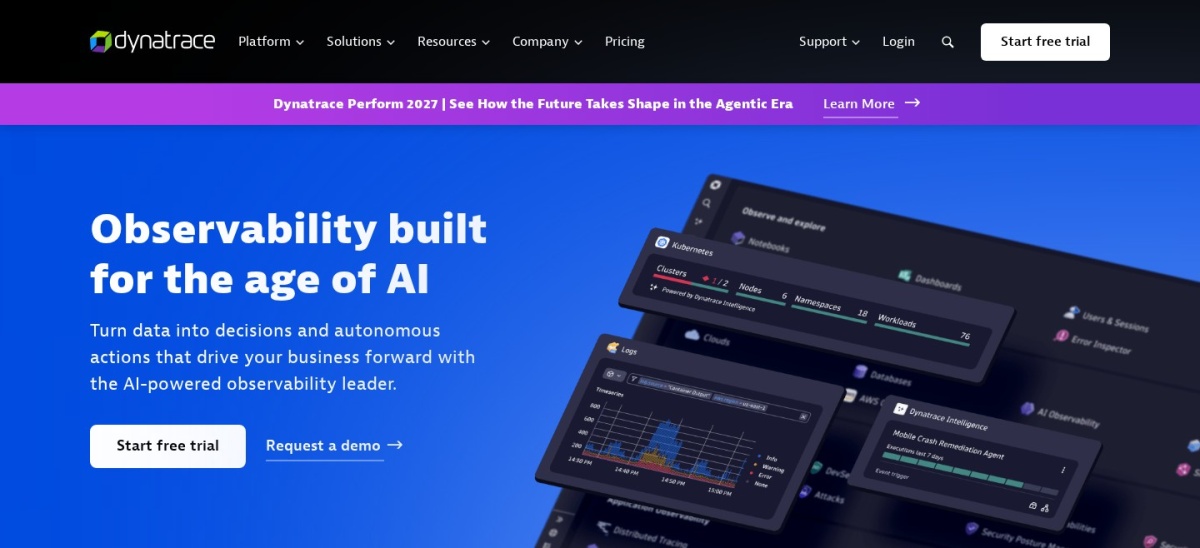
Dynatrace homepage, captured Nov 2026.
Dynatrace is an enterprise observability platform for investigating application performance and infrastructure dependencies, with a G2 rating of 4.5 from 1,377 reviews. Its subscription model gives organizations access to platform capabilities through an annual spending commitment.
The trade off is that the total subscription commitment requires a custom pricing discussion. Organizations consume services against that commitment at published usage rates. It suits enterprise operations teams that need coordinated monitoring across AI applications and supporting infrastructure.
What we like
Enterprise-wide observability
Automated root cause analysis
Application dependency visibility
Established public review history
Watch out for
Annual commitment complicates budgeting
No permanent free subscription confirmed
Learning curve for smaller development teams
Paid subscriptions provide platform access against an annual commitment.Visit dynatrace.com
LLM monitoring vs. LLM evaluation
LLM monitoring records what happens when an AI application runs. It captures model requests, response times, errors, token consumption and agent activity.
LLM evaluation measures whether those responses meet quality requirements. Combining production monitoring with evaluations helps teams identify technically successful requests that still produce unsuitable answers.
How LLM monitoring pricing works
Some platforms charge a fixed subscription with included usage. Others bill by trace spans, processed data or application events. Compare expected workloads before selecting a subscription.
The price ladder shows published subscription prices or an annualized billing-unit estimate. Custom pricing entries use zero as a technical placeholder, not as an indication that the product is free.
G2 ratings for general observability platforms reflect their broader products rather than exclusively their LLM monitoring features.
How we chose
We selected dedicated AI observability products and established application monitoring platforms with relevance to production LLM workloads. We compared tracing, evaluation capabilities, retention, pricing models and public user reviews.
Pricing and ratings were checked against vendor websites and G2 during November 2026. The requested editorial date is 22 Nov 2026, but the live verification occurred on 25 Nov 2026. Published subscription prices exclude variable usage charges unless otherwise stated.
We excluded products with insufficient public review histories or unclear product availability. Quote-based subscriptions are identified separately, and broader platform ratings are distinguished from LLM-specific feedback. No vendor paid for a place, and we do not claim testing for this list.
How to choose the right LLM monitoring tool
Compare your application architecture, evaluation requirements and expected monitoring volume before committing to a subscription.
Identify the failures you need to detect. Decide whether your priority is incorrect responses, slow model requests, excessive token consumption or errors across agent workflows.
Check integration compatibility. Confirm that the monitoring platform supports your programming language, model providers, orchestration framework and deployment environment.
Estimate production usage. Calculate expected trace volume, data ingestion and retention requirements before comparing subscription fees and additional consumption charges.
Review data governance requirements. Check whether the platform provides appropriate access controls, sensitive data handling, retention settings and deployment options for your application.
FAQ
What is the best LLM monitoring tool?
Arize AX is our overall pick because its free subscription combines agent tracing with unlimited evaluations. Braintrust is another option for teams that organize development around experiments and response scoring.
Are there free LLM monitoring tools?
Yes. Arize AX, Braintrust, Comet Opik, Sentry and New Relic offer free subscriptions. Their allowances differ, so compare trace capacity, processed data, retention and evaluation limits before choosing a platform.
What metrics should an LLM monitoring tool track?
Useful metrics include response latency, token consumption, model errors, request volume, estimated inference costs and response quality. Agent applications also benefit from monitoring tool execution, retrieval operations and workflow failures.
Can LLM monitoring detect hallucinations?
Monitoring platforms can identify potentially unsupported responses through evaluation rules, reference comparisons and groundedness checks. These methods are not definitive, so important outputs may still require human review or independent verification.
What is the difference between LLM monitoring and APM?
Application performance monitoring focuses on software availability, errors and performance. LLM monitoring adds visibility into prompts, model outputs, tokens, agent actions and evaluation results that conventional application metrics may overlook.
Is open-source LLM monitoring cheaper?
Open-source monitoring can reduce subscription expenses, especially when existing infrastructure is available. However, storage, hosting, maintenance, security updates and engineering time contribute to the total cost of operating a self-hosted deployment.
SaaS SEO and WordPress specialist with about 8 years of experience. Rakib compares WordPress plugins, themes, hosting and software using public pricing, documentation and user reviews. See how we rank.