Sage Intacct is the best ERP accounting software for finance-led mid-market companies, with native revenue recognition and more than 4,400 G2 reviews behind it. NetSuite suits larger product companies, while Business Central is the best pick for Microsoft shops.
How we make this list: we compare pricing pages, product documentation and public user reviews, then re-check every price before each update. No product paid for a place. Disclosure.
Sage Intacct is the best finance-first pick, with native ASC 606 revenue recognition and a 4.3/5 G2 rating.
NetSuite is the broadest ERP here, running finance, inventory, CRM and commerce on one data model.
Six of the nine vendors publish no price list, so every shortlist needs quotes on identical scope.
Business Central is the only enterprise ERP here with a published price: $80 per user per month.
Odoo and ERPNext are the budget routes, at $31.10 per user per month and free self-hosted software respectively.
What ERP accounting software should cover
ERP accounting software runs the general ledger, payables, receivables and financial reporting for a whole company, and in a full ERP it shares one data model with inventory, orders and CRM.
Most vendors in this category do not publish prices. NetSuite, Sage Intacct, Acumatica, SAP Business One, SYSPRO and Epicor Kinetic are all quote-only, so a shortlist needs a sales conversation before any budget is final. Our guide to ERP software compares the wider ERP market.
Only two tools here print a firm price: Business Central at $80 per user per month and Odoo at $31.10 per user per month after the first year. ERPNext charges nothing for the software itself.
Implementation is the hidden cost. A mid-market ERP deployment typically costs as much as the first year of licences, and sometimes far more, so ask for implementation quotes alongside the subscription.
Sage Intacct is a cloud financial management system built for mid-market companies that need serious accounting depth. Its core includes native ASC 606 revenue recognition, multi-entity consolidation and dimensional reporting, and the AICPA has endorsed it for several years running.
The trade off is price opacity. Sage publishes no price list, and partners report full named-user licences at $400 to $800 per user per month, with modules such as budgeting and consolidations charged separately. It suits finance-led companies with several entities and a board that expects a fast, clean close.
What we like
Native ASC 606 revenue recognition in the core
Multi-entity consolidation and dimensional reporting
Highest finance-team satisfaction in this list
Watch out for
No published price list
Add-on modules raise the bill fast
Modules for budgeting and consolidations are extraVisit sage.com
02
NetSuite
4.1/5on G2 (4,912 reviews, checked Nov 2026)
PricingCustom/yr
Best full ERP suite
Free plan3-day test drive
PricingBy quote, per user plus modules
ScopeFinance, inventory, CRM, commerce
DeploymentCloud only
netsuite.com
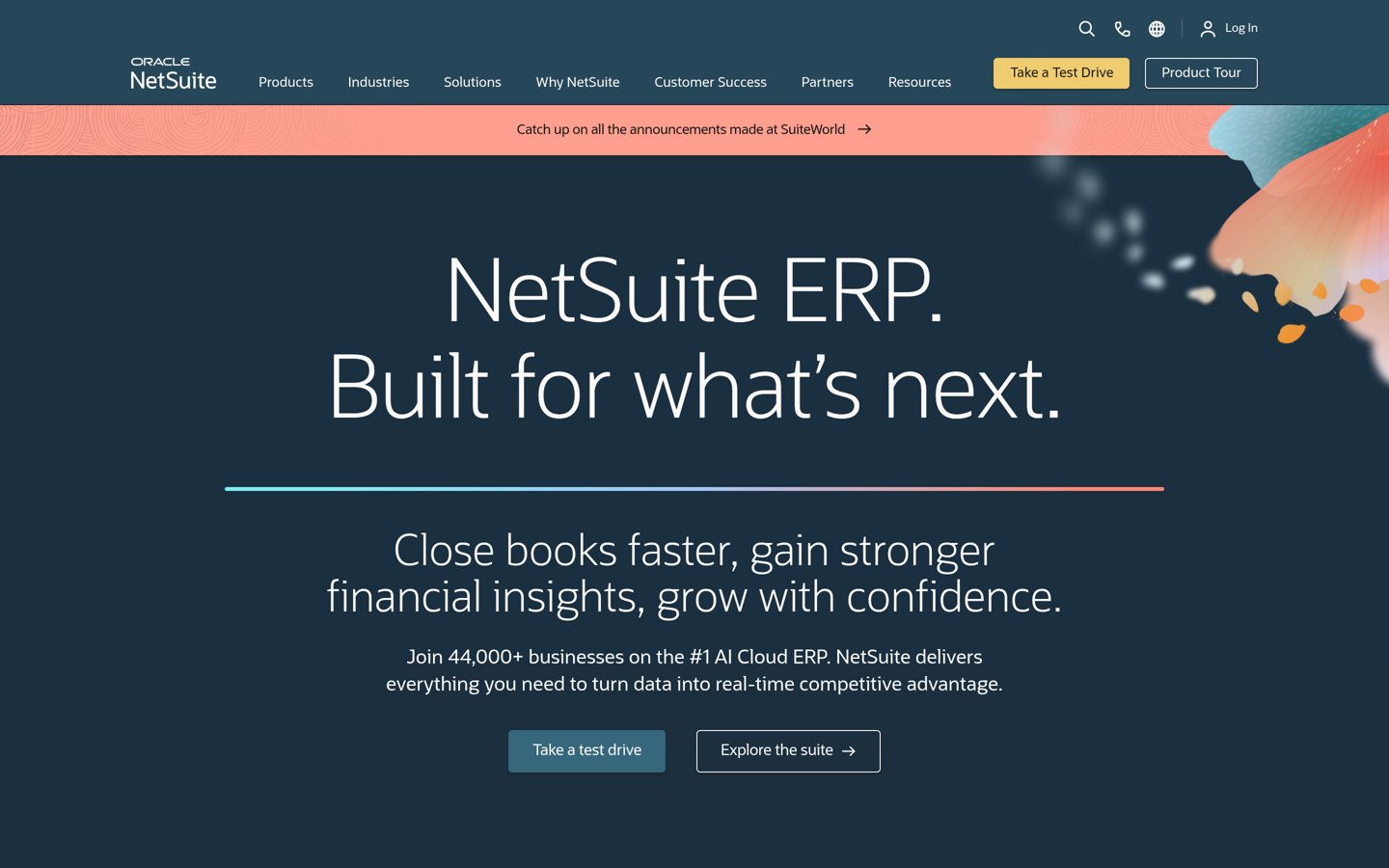
NetSuite homepage, captured Nov 2026.
NetSuite is Oracle's cloud ERP suite, running financials, inventory, orders, CRM and e-commerce under one data model. It is the only tool here that covers full multi-entity consolidation, inventory and commerce without add-ons, and it suits companies that expect to add entities, currencies or acquisitions.
The trade off is cost and complexity. NetSuite publishes no price list, and partner guides put the base platform near $999 a month plus $99 to $199 per user per month, with implementation from $30,000. It suits mid-size product companies that have outgrown separate accounting and operations tools.
What we like
Finance, inventory, CRM and commerce in one system
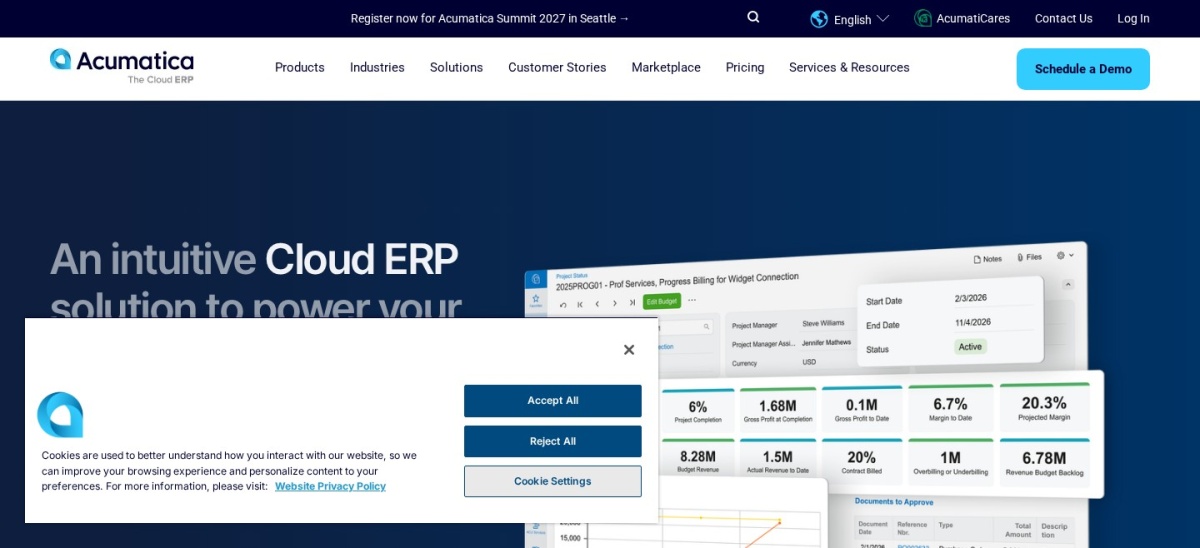
Acumatica is a cloud-native ERP built for companies tired of per-user licensing. Its pricing is based on resources consumed, so adding users does not raise the bill, and it offers industry editions for construction, distribution, manufacturing, retail and professional services.
The trade off is that nothing is published. Pricing is quote-only through partners, and high transaction volumes raise costs, with most mid-market deployments reported at $1,800 to $3,000 a month. It suits user-heavy companies such as distributors and builders where per-seat pricing would punish growth.
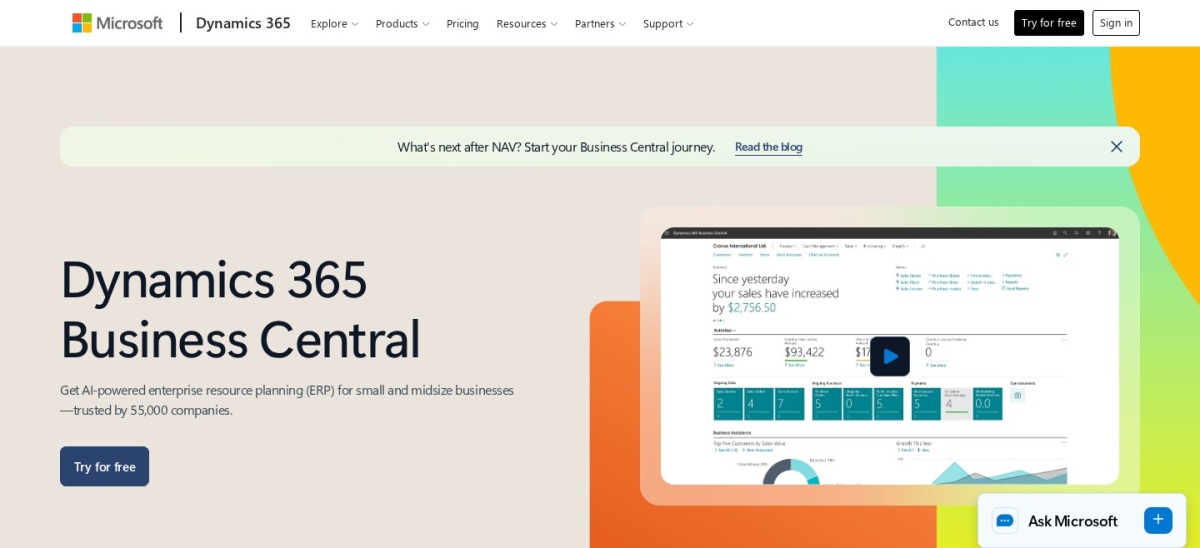
Dynamics 365 Business Central homepage, captured Nov 2026.
Dynamics 365 Business Central is Microsoft's ERP for small and mid-size companies, connecting finance, sales, inventory and operations with Outlook, Excel, Teams and Copilot. It is the only enterprise ERP here with a published price: Essentials at $80 per user per month, Premium at $110, and Team Members at $8.
The trade off is the partner model. Business Central is sold and supported through partners, so the licence price is only part of the bill, and advanced multi-entity consolidation often needs third-party modules. It suits companies already on Microsoft 365 that want a price they can read before a demo.
SAP Business One is SAP's ERP for small businesses, covering accounting and financials, purchasing, inventory, sales, CRM and reporting in one package. SAP positions it as quick to deploy and proven across 170 markets, with HANA-powered analytics and a mobile client.
The trade off is the partner model. Business One is sold only through SAP partners, with no self-serve signup, no public pricing and no free trial, so every evaluation starts with a partner conversation. It suits smaller manufacturers and distributors that want SAP depth without S/4HANA scale.
What we like
Full ERP scope for smaller companies
Local partner support almost everywhere
HANA-powered analytics included
Watch out for
No public pricing or free trial
Sold only through partners
Implementation and support come from SAP partnersVisit sap.com
06
Odoo
4.2/5on G2 (355 reviews, checked Nov 2026)
Paid from$31.10/mo
Best budget ERP
Free planOne App Free, Community edition
Paid planStandard, $31.10/user/mo
First year$24.90/user/mo, then $31.10
DeploymentCloud, on-prem or hybrid
odoo.com
Odoo homepage, captured Nov 2026.
Odoo is a modular ERP with a large catalogue of apps, so a team can start with accounting and inventory, then add CRM, manufacturing, HR or e-commerce as it grows. One App Free covers one app with unlimited users, and the Standard plan costs $24.90 per user per month in the first year, then $31.10.
The trade off is scale. Odoo is the cheapest real ERP here, but larger finance teams usually outgrow it and move to Intacct or NetSuite, and the per-user price climbs with every hire. It suits startups and small companies that want a polished hosted ERP on a tight budget.
What we like
One App Free with unlimited users
Lowest published price in this list
Thousands of apps extend the core
Watch out for
Per-user pricing climbs with headcount
Finance depth lags Intacct and NetSuite
Custom plan adds Studio and multi-company supportVisit odoo.com
07
ERPNext
4.3/5on G2 (51 reviews, checked Nov 2026)
PriceFree
Best open source ERP
Free planYes, free self-hosted software
Paid planNone; hosting from $5/mo
LicenceOpen source, GPL-3.0
DeploymentCloud or self-hosted
erpnext.com
ERPNext homepage, captured Nov 2026.
ERPNext is a full open source ERP with accounting, stock, manufacturing, HR, projects and CRM in one database, so a quote, a stock move and an invoice share the same records. The software costs nothing and has no per-user licence fee, and hosted Frappe Cloud plans start at $5 a month for a shared site.
The trade off is ownership. Implementation, hosting and maintenance fall on your team, and engineering time replaces the licence invoice. It suits technically capable manufacturers, distributors and service firms that want full ERP control without licence economics.
SYSPRO is an ERP built for manufacturers and distributors, keeping inventory and production transactions tightly aligned with financial postings as shop-floor activity moves into the ledger. It covers production, inventory, financial management and distribution in one system.
The trade off is price transparency. SYSPRO publishes no price list, so budgeting needs a partner quote, and its review base is smaller than the big suites at 254 G2 reviews. It suits mid-size manufacturers replacing an aging on-premises ERP with deep operational control.
Epicor Kinetic is an ERP suite for manufacturers and distributors, with manufacturing, supply chain, finance, distribution and workforce management in one system. Its manufacturing workflow configuration keeps shop-floor execution aligned with order-to-ship and consolidation-ready financials.
The trade off is opacity and usability. Epicor publishes no list prices, and Capterra reviewers rate its ease of use near 3.8 out of 5, below the leaders here. It suits discrete manufacturers that need deep shop-floor and job costing depth rather than a finance-first tool.
Six of the nine tools here publish no price list, so headline comparisons are impossible without quotes. Send every vendor the same scope: user count, entities, currencies and modules.
Ask each vendor to split the quote into subscription, implementation and annual support, because the subscription alone can be less than half of year-one cost.
Use the two published prices as anchors. Business Central at $80 per user per month and Odoo at $31.10 give you a floor to judge the quotes against.
How we chose
We started from the ERP systems that appear most often in 2026 mid-market comparisons, then kept those with a verifiable rating on G2.
Prices come from each vendor's pricing page, checked on 25 November 2026. Six vendors publish no price list, so those tools are listed as quote-only, which the vendors themselves confirm. Ratings and review counts come from G2 on the same day.
We left out tools with no verifiable rating on G2, Capterra or Trustpilot. No vendor paid for a place, and we do not claim hands-on testing for this list.
How to choose ERP accounting software
Start with your finance team, not the feature list, and let the close process decide the shortlist.
Map your close process first. List entities, currencies, revenue rules and reports. A tool that cannot handle your close will cost more in workarounds than any licence saving.
Shortlist by finance fit, not by brand. Finance-led teams should start with Sage Intacct, product companies with NetSuite, and Microsoft shops with Business Central.
Get quotes on identical scope. Send every vendor the same user count, entities and modules, and ask for subscription, implementation and support split out.
Pilot the close, not the demo. Run one real month-end in a trial or sandbox before signing, and check the revenue recognition and consolidation reports your board expects.
FAQ
What is the best ERP accounting software?
Sage Intacct is the best ERP accounting software for finance-led mid-market companies, thanks to native ASC 606 revenue recognition and a 4.3/5 G2 rating from more than 4,400 reviews. NetSuite is the stronger pick for larger product companies with inventory and commerce.
How much does ERP accounting software cost?
Most ERP vendors do not publish prices, so expect a quote. Published prices here are Business Central at $80 per user per month and Odoo at $31.10 per user per month after the first year. Implementation often costs as much as the first year of licences.
Is NetSuite or Sage Intacct better for accounting?
Sage Intacct is the better pure accounting tool, with native revenue recognition, multi-entity consolidation and dimensional reporting built into the core. NetSuite is the broader ERP, adding inventory, CRM and commerce on the same data model.
Does Odoo work as ERP accounting software?
Yes, for smaller companies. Odoo covers the general ledger, invoicing, expenses and reporting, with a free One App plan and a Standard plan at $31.10 per user per month after the first year. Larger finance teams usually outgrow it and move to Intacct or NetSuite.
Is ERPNext really free?
The ERPNext software is free and open source, with no per-user licence fee, so you can self-host it at no licence cost. Hosted Frappe Cloud plans start at $5 a month for a shared site, and implementation and support are the real costs.
What is the difference between ERP and accounting software?
Accounting software covers the ledger, invoicing and reporting. ERP accounting adds operations on the same data model: inventory, purchasing, orders, manufacturing and CRM, so a sale, a stock move and an invoice share one record.
SaaS SEO and WordPress specialist with about 8 years of experience. Rakib compares WordPress plugins, themes, hosting and software using public pricing, documentation and user reviews. See how we rank.