Temporal is the best enterprise workflow orchestration platform for most teams, with durable execution that survives crashes and deploys, and cloud pricing from $50 per million actions. Pick Camunda for BPMN business processes, Prefect for Python data pipelines, or Apache Airflow for the widest open-source ecosystem.
How we make this list: we compare pricing pages, product documentation and public user reviews, then re-check every price before each update. No product paid for a place. Disclosure.
Temporal leads for durable, long-running workflows: code-first execution that resumes after crashes, from $50 per million actions on Temporal Cloud.
Camunda is the BPMN choice, rated 4.5 out of 5 on G2 from 328 reviews, with a free development tier and production priced by quote.
Prefect is the lightest start for Python teams: a free Hobby tier, then Starter at $100 a month for 3 users.
Apache Airflow is free and open source, rated 4.4 out of 5 from 131 G2 reviews, but you operate the scheduler yourself.
Dagster+ Solo is the cheapest managed start at $10 a month plus credits, though its G2 rating rests on only 2 reviews.
What enterprise workflow orchestration means
Enterprise workflow orchestration is the layer that schedules, runs and recovers multi-step work across systems. A good platform retries failed steps, keeps state through crashes and shows what ran, when and why.
The market splits into two families. Data orchestrators such as Airflow, Dagster and Prefect schedule pipelines, while durable execution engines such as Temporal run long-lived application workflows that can sleep for months. Our guide on workflow automation software covers the simpler visual builders.
Pricing is hard to compare because billing units differ: per action, per user, per hour of compute or by quote. Read the per-unit rate, not just the headline plan price, and trial the free tier before committing.
Check the review base as well as the score. A 4.5 from 2 reviews means far less than a 4.5 from 328, and several tools here publish no customer counts at all.
List prices in each vendor's currency, checked Nov 2026
TemporalFREE$50
CamundaFREECustom
AirflowFree
AstroUsage-based
WorkatoCustom
n8nFREE€20
KestraFree
DagsterFREE$120
PrefectFREE$1,200
The 9 best enterprise workflow orchestration platforms
01
Temporal
4.5/5on G2 (46 reviews, checked Nov 2026)
Pricing$50/1M actions
Best for durable, long-running workflows
DefinitionCode, not DAGs
Free tier$150 cloud credits
Cloud price$50 per 1M actions
SDKsGo, Java, Python, TS, .NET
temporal.io
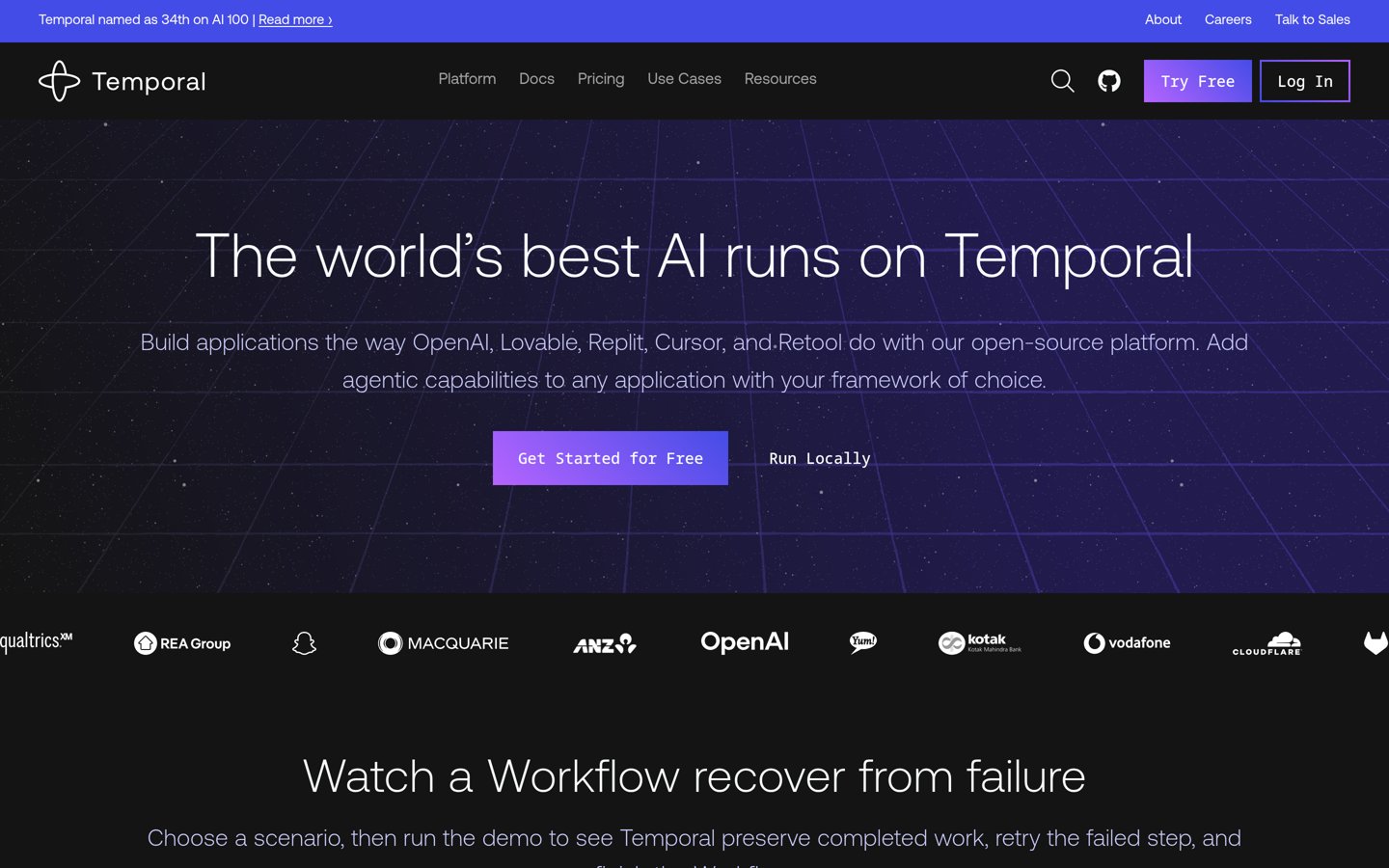
Temporal homepage, captured Nov 2026.
Temporal is a code-first durable execution platform: workflows are written as ordinary code in Go, Java, Python, TypeScript and other languages, and the platform records every step so a workflow resumes exactly where it stopped after a crash or deploy. The open-source server is free to self-host, and Temporal Cloud starts at $50 per million actions with $150 in free credits for 90 days.
The trade off is that pricing is usage-based, so a busy system needs careful estimates of actions and storage, and there is no fixed monthly plan to budget against. It suits engineering teams running long-lived processes, sagas and AI agent workflows that must survive failures without custom recovery code.
What we like
Workflows survive crashes and deploys by design
No features locked behind plan upgrades
SDKs for Go, Java, Python, TypeScript and more
Watch out for
Usage-based pricing needs careful cost estimates
No built-in alerting; wire up Prometheus or Datadog
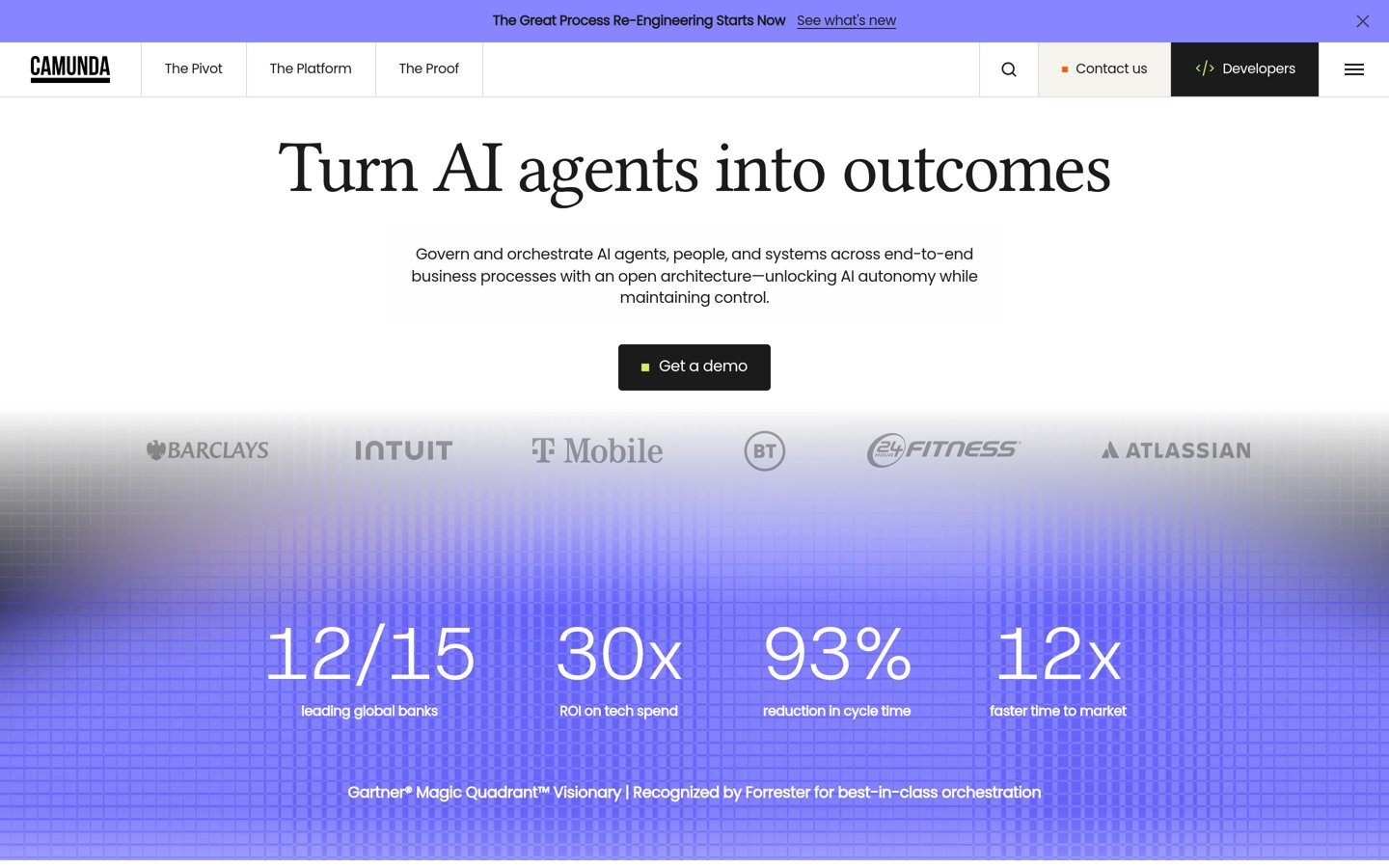
Camunda is a process orchestration platform built on the BPMN 2.0 and DMN standards, with the Zeebe engine executing long-lived processes across people, systems and devices. The development tier is free for building and testing locally, and Camunda 8.9 added AI agent orchestration features, while production use needs an Enterprise licence or a SaaS plan.
The trade off is price transparency: production pricing is by quote only, so budgeting needs a sales conversation, and the BPMN learning curve is real for teams new to process modelling. It suits enterprises that need governed, auditable processes with human approvals and strict versioning.
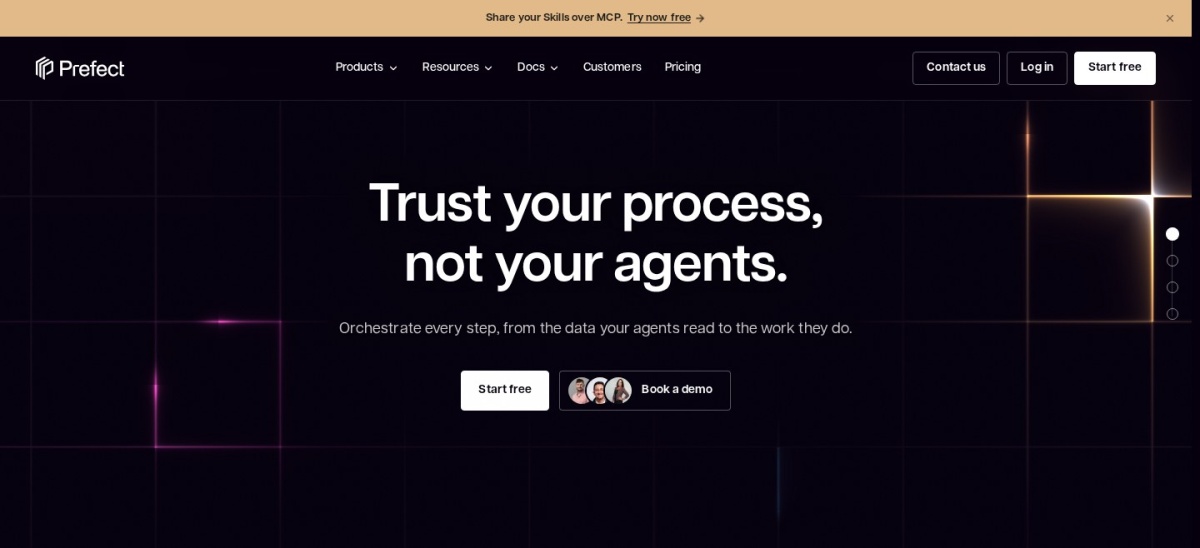
Prefect is a Python-native orchestration platform where a plain function becomes a workflow with a decorator, adding scheduling, retries and observability without restructuring code into DAG files. The Hobby tier is free for 2 users and 5 deployments with 500 serverless minutes a month, and Starter costs $100 a month for 3 users and 20 deployments.
The trade off is that Prefect charges by seats and workspaces, so a growing team pays $100 per user a month on Team, and its strength is data pipelines rather than long-lived business processes. It suits Python-first data teams that want the lightest setup and predictable flat pricing.
What we like
Lightest setup: a decorator turns code into a flow
Apache Airflow is the open-source standard for data pipeline orchestration, defining pipelines as Python DAGs with a scheduler, a web UI and a large library of provider integrations. It is free to self-host under the Apache licence, it is rated 4.4 out of 5 on G2 from 131 reviews, and G2 reports a typical implementation time of 3 months.
The trade off is operations: running Airflow well in production means managing the scheduler, workers and upgrades yourself, and the setup is often called complex by reviewers. It suits data engineering teams with existing Airflow investment and Python expertise that want the widest ecosystem.
Astronomer Astro is the managed Airflow platform, running Apache Airflow without the work of operating the scheduler, workers and upgrades. Pricing is usage-based, with dedicated clusters from $2.40 an hour, and the Team plan adds AI-assisted DAG authoring, hibernating deployments and 24 by 5 support.
The trade off is cost control: metered compute can climb with heavy workloads, and the entry tiers lack 24 by 7 support and SSO enforcement. It suits teams committed to Airflow that want a managed service with observability, rollbacks and audit logging built in.
Dagster is an asset-based orchestrator that treats data assets, not tasks, as the unit of work, inferring execution order and tracking lineage and asset health automatically. The open-source core is free, and Dagster+ Solo costs $10 a month plus $0.040 per credit, with a 30-day free trial of the cloud plans.
The trade off is a thin review base: G2 shows a 4.5 rating from only 2 reviews, so the score says little, and reviewers warn of a steep learning curve. It suits modern data teams that think in assets and want lineage, data quality checks and dbt integration built in.
Workato is a low-code enterprise automation platform that orchestrates processes across SaaS apps, databases and APIs with pre-built connectors and AI-assisted recipe building. It is rated 4.7 out of 5 on G2 from 777 reviews, the highest review count in this list, and it targets mid-market and enterprise teams.
The trade off is price: Workato is sold by quote only, and reviewers warn that costs can rise sharply as usage scales. It suits enterprises that want business users to build governed automations across hundreds of apps without writing code.
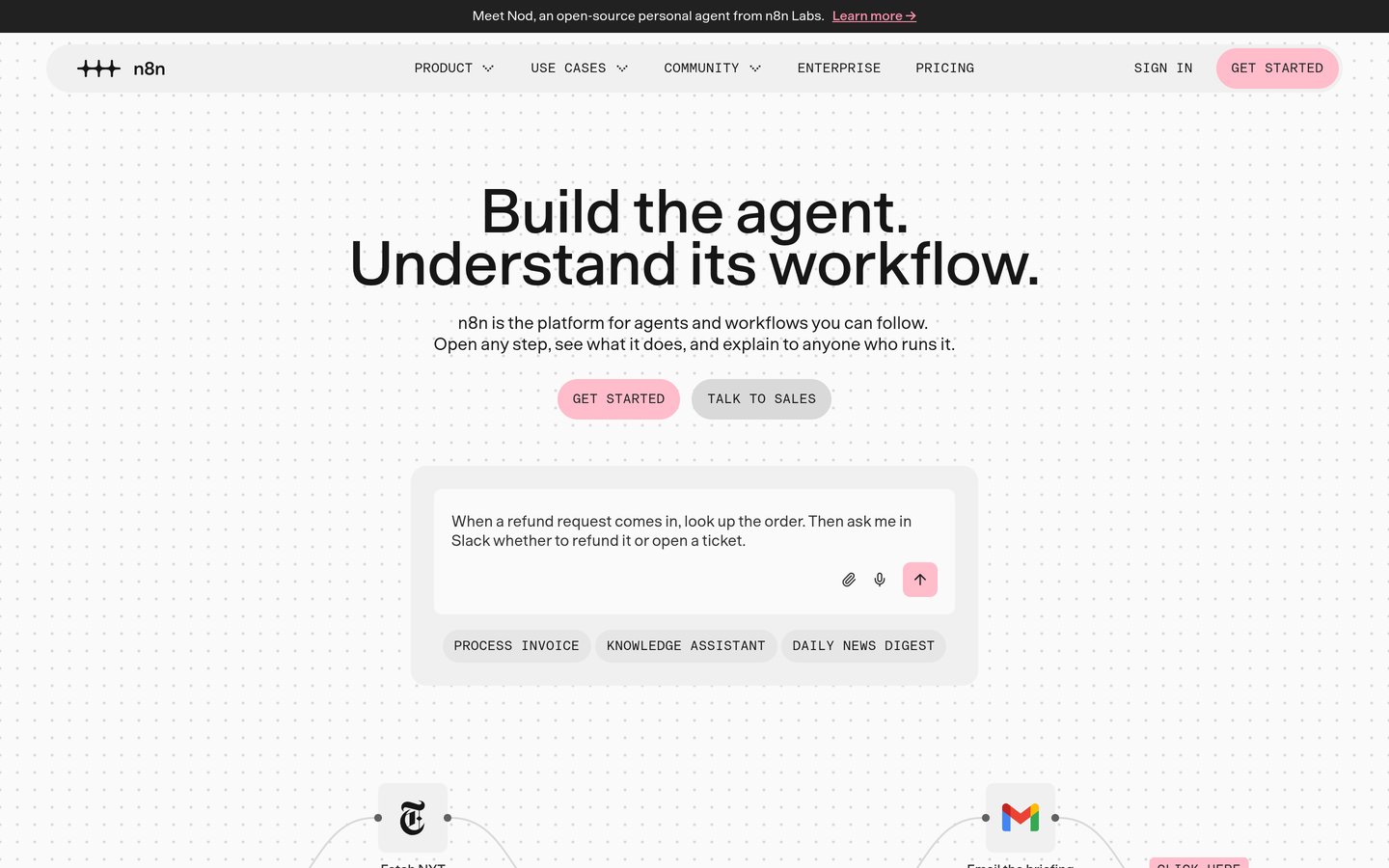
n8n is a visual workflow automation tool with a node editor, 400-plus integrations and growing AI agent features, and its Community Edition is free to self-host. Cloud Starter costs 20 euros a month billed annually, and n8n is rated 4.7 out of 5 on G2 from 328 reviews.
The trade off is currency and fit: cloud prices are in euros, not dollars, and n8n is an automation builder rather than a durable execution engine for long-lived processes. It suits small teams that want a low entry price, self-hosting and strong flexibility.
What we like
Low entry price with a free self-hosted edition
Flexible node editor with 400-plus integrations
Strong AI agent features for automation
Watch out for
Cloud prices are in euros, not dollars
Not a durable execution engine
Debugging complex flows can lag, per reviewers
Pro at €50 a month adds more executions and usersVisit n8n.io
09
Kestra
4.6/5on G2 (25 reviews, checked Nov 2026)
PriceFree
Best declarative YAML orchestration
DefinitionDeclarative YAML
LicenceApache 2.0, free
VersioningGit-based
PluginsHundreds available
kestra.io
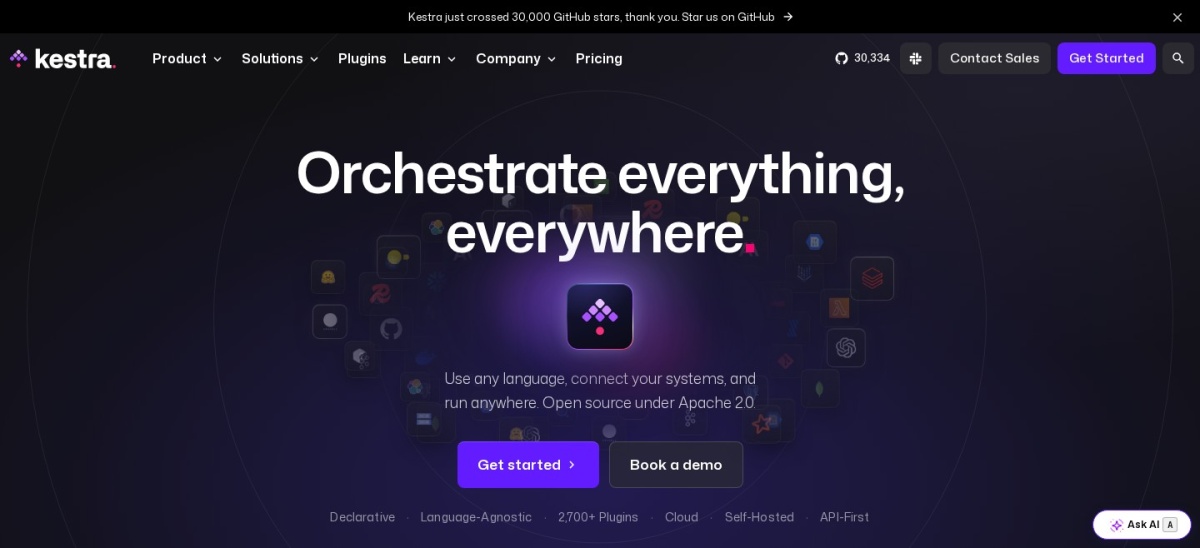
Kestra homepage, captured Nov 2026.
Kestra is an open-source orchestration platform where workflows are declared in YAML with a visual editor that stays in sync, plus Git-based versioning and hundreds of plugins. It is free under the Apache 2.0 licence, and it is rated 4.6 out of 5 on G2 from 25 reviews.
The trade off is maturity: the ecosystem is younger than Airflow's, reviewers note alert overload in the UI, and cloud and enterprise pricing are usage-based or by quote. It suits engineering-led teams that want declarative, language-agnostic orchestration with full self-hosted control.
What we like
Declarative YAML with a synced visual editor
Free under the Apache 2.0 licence
Git-based versioning and hundreds of plugins
Watch out for
Younger ecosystem than Airflow
Reviewers note alert overload in the UI
Cloud pricing is usage-based, not flat
Enterprise adds long-term support and scale featuresVisit kestra.io
Durable execution vs data pipelines: pick the right family
Durable execution engines such as Temporal keep workflow state through crashes, deploys and long sleeps, so a process that waits weeks for an approval resumes safely. They suit application workflows, sagas and AI agents.
Data orchestrators such as Airflow, Dagster and Prefect schedule pipelines that move and transform data on a timetable. They suit analytics engineering, ETL and machine learning pipelines.
Some teams need both. A common pattern is Airflow or Prefect for data movement with Temporal or Camunda for the business process that consumes the data.
If you are unsure which family fits, start from the trigger: a timetable and a dataset point to a data orchestrator, while a customer order or approval points to durable execution.
How we chose
We started from the platforms enterprises actually evaluate in 2026: open-source and commercial orchestrators with real production adoption across data, application and integration workloads.
Prices come from each vendor's pricing page, checked on 25 November 2026. Ratings and review counts come from G2 on the same day. Where a vendor sells by quote only, the list says Custom rather than inventing a figure.
We left out tools with no verifiable rating on G2, Capterra or Trustpilot. No vendor paid for a place, and we do not claim hands-on testing for this list.
How to choose an enterprise workflow orchestration platform
Start from the kind of work you orchestrate, then check the billing unit before you commit.
Decide which family you need. Data pipelines point to Airflow, Dagster or Prefect; long-lived business processes point to Temporal or Camunda.
Check the billing unit. Per-action, per-user and per-hour pricing behave very differently at scale, so model a month of real runs before signing.
Trial the free tier first. Most tools here have a free tier or trial; run a real workflow through it and watch retries, logging and alerting.
Confirm governance needs. SSO, audit logs, RBAC and SLAs sit on paid or enterprise tiers, so check they exist before you commit.
FAQ
What is the best enterprise workflow orchestration platform?
Temporal is the best pick for most teams. Its durable execution survives crashes and deploys without custom recovery code, it is rated 4.5 out of 5 on G2, and Temporal Cloud starts at $50 per million actions with $150 in free credits.
What is the difference between Airflow and Temporal?
Airflow schedules data pipelines as Python DAGs and is the standard for analytics engineering, while Temporal runs long-lived application workflows as code with durable state. Airflow is free and open source; Temporal Cloud bills per action. Many teams use both for different jobs.
Is Camunda free?
Camunda is free for local development and testing, including the process engine, Operate, Tasklist and the desktop modeller. Production use needs an Enterprise licence for self-managed deployments or a paid SaaS plan, and both are priced by quote after a 30-day SaaS trial.
How much does Prefect Cloud cost?
Prefect Cloud has a free Hobby tier for 2 users and 5 deployments. Starter costs $100 a month for 3 users and 20 deployments, and Team costs $100 per user a month. Pricing is flat by seats and workspaces, not by task volume.
Which orchestration tool is cheapest to start?
Apache Airflow, Kestra and the open-source Temporal server cost nothing to self-host apart from your own infrastructure. Among managed clouds, Dagster+ Solo starts at $10 a month plus usage credits, while Prefect Hobby and Camunda development tiers are free.
Do I need an enterprise plan for SSO and audit logs?
Usually yes. SSO, audit logs, RBAC and uptime SLAs sit on paid or enterprise tiers in most of these tools, including Prefect, Dagster and Camunda. Check the plan comparison table before buying, since the free tiers focus on core execution.
SaaS SEO and WordPress specialist with about 8 years of experience. Rakib compares WordPress plugins, themes, hosting and software using public pricing, documentation and user reviews. See how we rank.