Integrate.io leads for predictable enterprise data integration with a flat Core plan starting at $1,999 per month for unlimited data volume, pipelines, and connectors. For teams that prefer usage-based or open-source paths, Airbyte starts at $20 per month on Cloud and Hevo Data starts at $265 per month billed annually.
How we make this list: we compare pricing pages, product documentation and public user reviews, then re-check every price before each update. No product paid for a place. Disclosure.
Integrate.io Core starts at $1,999/month billed annually with unlimited data volume, pipelines, and connectors.
Airbyte Cloud starts at $20/month on Standard with 5 credits included, plus a free self-hosted Airbyte Core option.
Hevo Data offers a free tier up to 1M events/month and paid Starter plans starting at $265/month billed annually.
Skyvia Data Integration starts at $79/month billed annually for 5M records on Basic, with a free 10,000-record tier.
Coupler.io starts at $24/month billed annually on Starter for daily refreshes up to 5,000 rows per run.
What to look for in enterprise ETL tools
Enterprise data integration moves data from databases, SaaS applications, and files into warehouses, lakes, or operational systems while keeping schemas aligned. Teams also rely on change data capture and transformations to keep reporting and downstream apps accurate.
Pricing models split sharply across vendors. Fixed-fee plans keep monthly spend steady when row counts spike, while usage-based plans charge by monthly active rows, events, or compute credits that can grow with traffic.
Deployment control and governance matter just as much as connector count. Regulated teams often look for role-based access control, single sign-on, audit logs, and options to run inside their own cloud or virtual private cloud.
Matching the tool to your team's skills avoids pipeline maintenance bottlenecks. Low-code builders help analysts and operations teams ship flows faster, while code-first or warehouse-native tools fit engineers who want Git workflows and custom logic.
The 7 best enterprise etl tools for data integration
01
Integrate.io
4.4/5on G2 (213 reviews, checked Nov 2026)
Starts at$1,999/mo
Best for predictable flat-fee operational ETL
Entry planCore ($1,999/mo billed annually)
Connectors150+ plus universal REST API
Sync speed60-second pipeline frequency
Billing modelFixed fee for unlimited volume
integrate.io
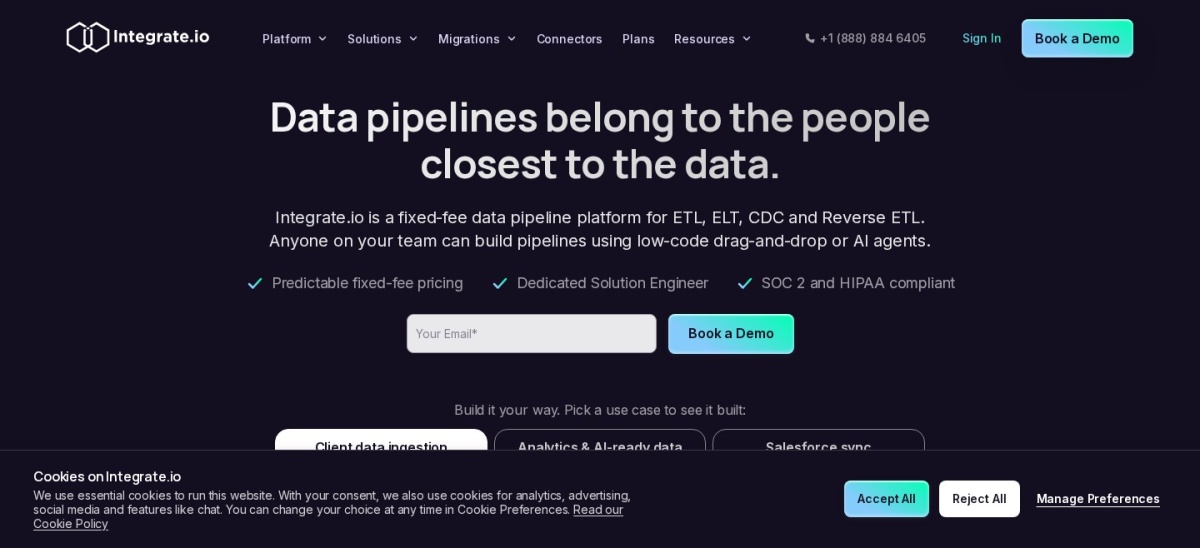
Integrate.io homepage, captured Nov 2026.
Integrate.io is a cloud data integration platform covering ETL, ELT, change data capture, reverse ETL, and API generation across 150+ connectors. Its published Core plan starts at $1,999 per month billed annually and includes unlimited data volume, unlimited pipelines, unlimited connectors, and 30-day onboarding.
The trade off is the $1,999 per month entry price and lack of a permanent free tier beyond a 14-day trial, while role-based access control and HIPAA readiness sit in a quote-based tier. It suits mid-market and growing teams that want flat costs and white-glove support.
What we like
Flat $1,999/month Core pricing avoids surprise bills when data volume spikes
Includes 220+ drag-and-drop transformations and 60-second pipeline frequency
Provides 30-day onboarding with a dedicated Solution Engineer
Watch out for
Higher starting price than usage-based entry plans
Role-based access control and HIPAA readiness require a custom plan
Sync speedHourly on Standard; faster on higher tiers
airbyte.com
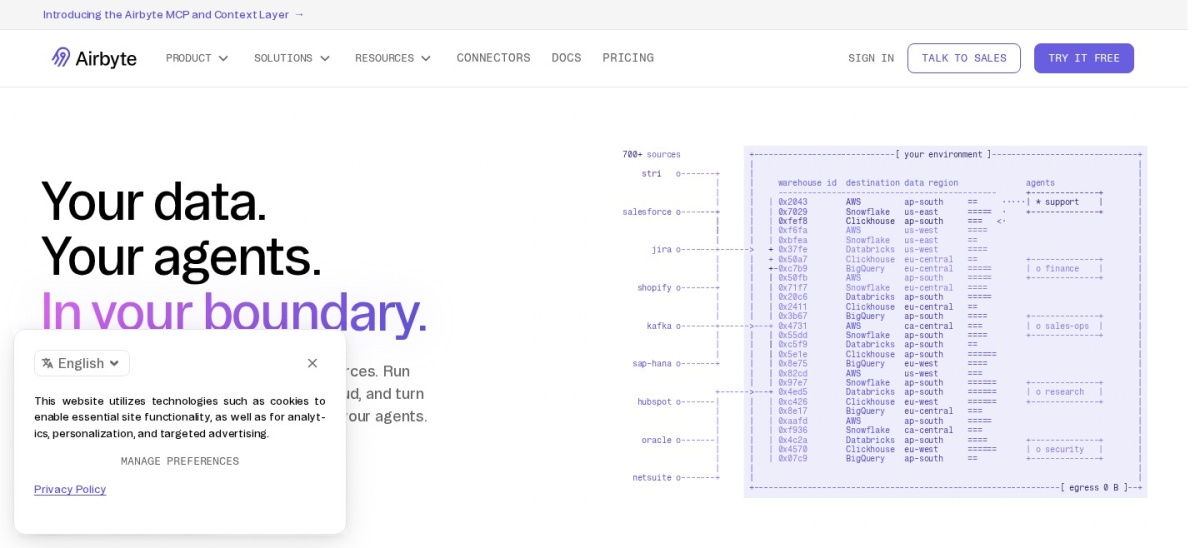
Airbyte homepage, captured Nov 2026.
Airbyte is an ELT and data movement platform offering 700+ connectors, a connector builder, and self-hosted or cloud deployment options. Its self-hosted Airbyte Core is free to run on your own infrastructure, while Airbyte Cloud Standard starts at $20 per month with 5 credits included.
The trade off is credit consumption on Standard ($5 per extra credit) and self-hosting maintenance if you run Airbyte Core yourself, while SSO starts on Plus at $189 per month. It suits engineering-led teams that want connector breadth and deployment control.
What we like
Free self-hosted Airbyte Core option plus low $20/month Cloud entry
Large catalog of 700+ connectors with custom connector building tools
Supports cloud, hybrid, self-hosted, and on-premises architectures
Watch out for
Extra credits on Standard and full-refresh syncs can raise cloud bills
Self-hosted setups require infrastructure and maintenance effort
Plus starts at $189/month for 40 credits, SSO, and 15-minute syncs; Pro and Enterprise Flex use custom capacity quotes.Visit airbyte.com
03
Hevo Data
4.4/5on G2 (297 reviews, checked Nov 2026)
Paid from$265/mo
Best for no-code pipelines with a free tier
Entry planStarter ($265/mo annual, $299 monthly)
Free tierUp to 1M events/month, up to 5 users
Connectors170+ sources to warehouses
Schedule1-hour scheduling on Starter
hevodata.com
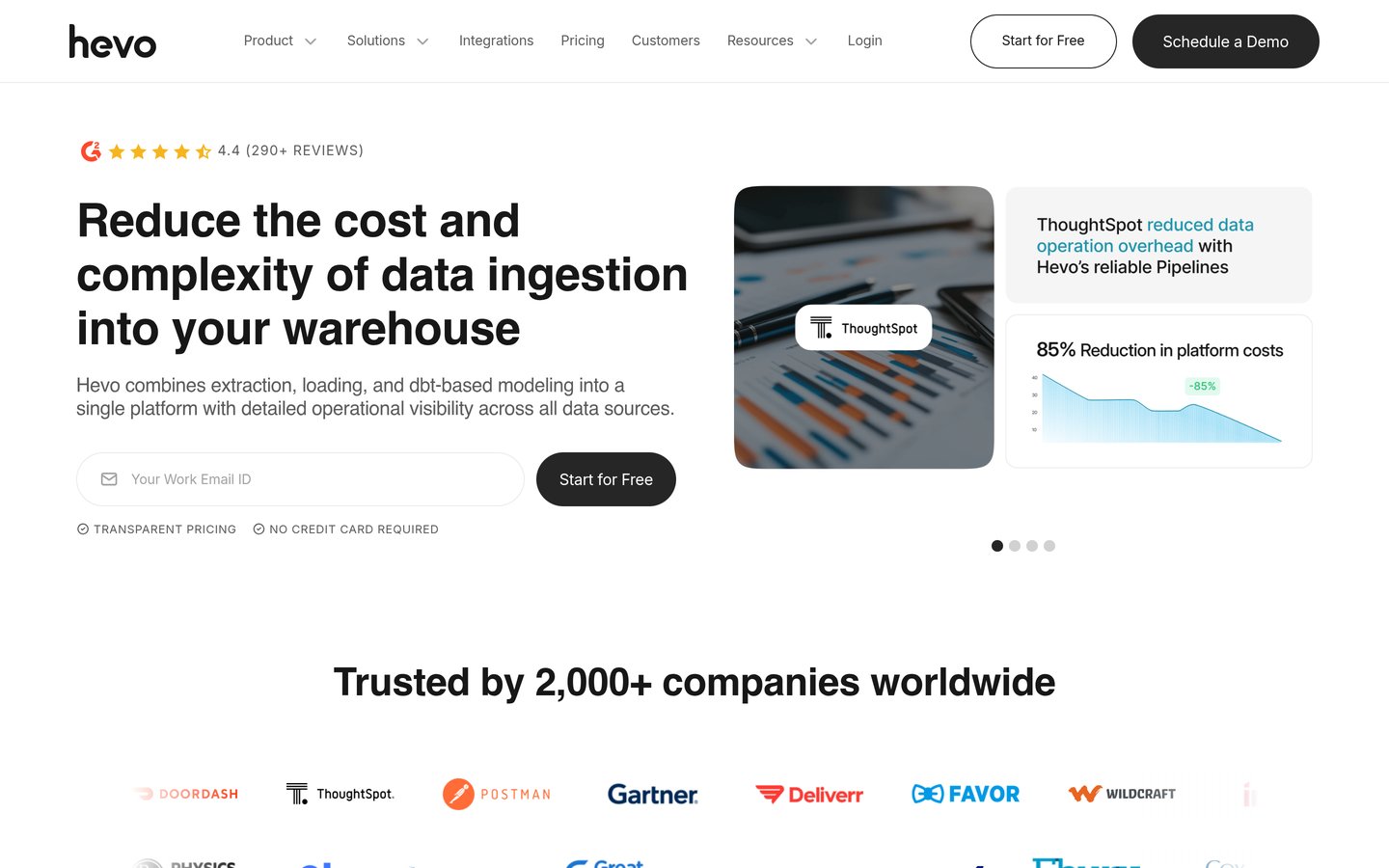
Hevo Data homepage, captured Nov 2026.
Hevo Data is a no-code data pipeline platform that loads data from databases, SaaS apps, and events into warehouses with dbt support. It offers a free tier up to 1 million events per month for up to 5 users, while Starter begins at $265 per month billed annually ($299 monthly).
The trade off is event-based billing where higher sync frequency or volume pushes you into higher event tiers, and Starter caps access at 10 users. It suits teams that want straightforward no-code setup and predictable annual tiers for moderate event volumes.
What we like
Free tier covers up to 1 million events per month for evaluation
No-code pipeline setup with 170+ connectors and dbt integration
Includes 24/7 email and live chat support on paid tiers
Watch out for
Event-based pricing increases when row counts or sync frequencies rise
Starter limits accounts to 10 users and 1-hour scheduling
Professional starts at $750/month billed annually with unlimited users and API access; Business Critical uses custom quotes.Visit hevodata.com
04
Skyvia
4.8/5on G2 (326 reviews, checked Nov 2026)
Paid from$79/mo
Best for budget-friendly no-code sync and ETL
Entry planBasic ($79/mo annual, $99 monthly)
Free tier10,000 records/month, daily sync
Record volume5M records/month on Basic
ScheduleDaily on Basic; hourly on Standard
skyvia.com
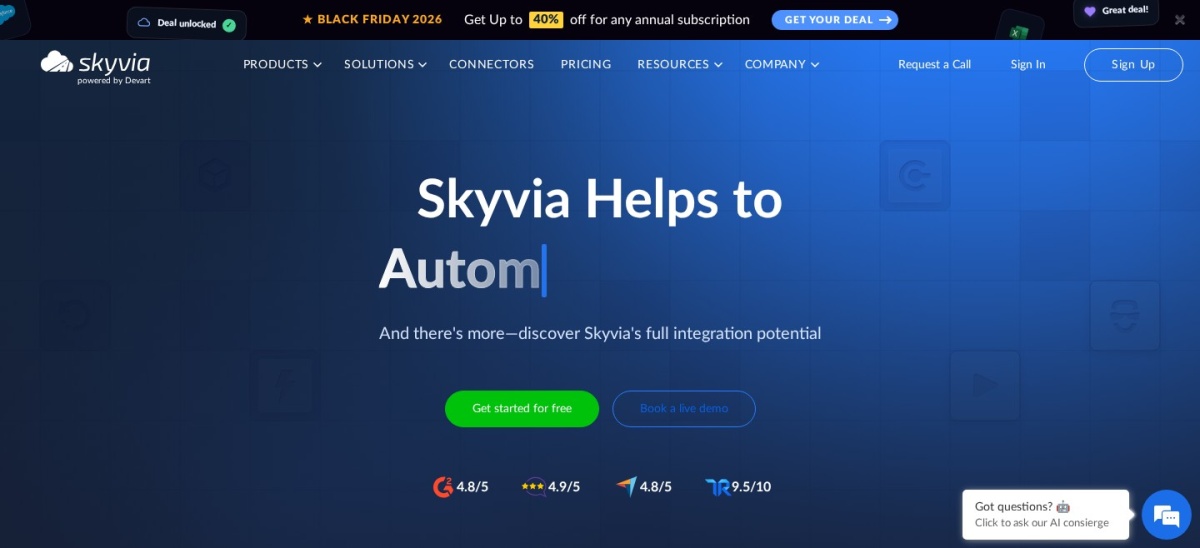
Skyvia homepage, captured Nov 2026.
Skyvia is a cloud data platform for ETL, ELT, replication, import/export, and two-way synchronization between apps, databases, and warehouses. It offers a free tier up to 10,000 records per month, while Data Integration Basic starts at $79 per month billed annually ($99 monthly) for 5 million records.
The trade off is that Basic limits runs to daily scheduling and excludes Data Flow transformations, which require Standard starting at $159 per month billed annually. It suits teams that need affordable no-code sync and replication without heavy engineering.
What we like
Low entry pricing at $79/month billed annually for 5 million records
Visual no-code interface supports sync, replication, import, and export
Free plan available for testing with up to 10,000 monthly records
Watch out for
Basic tier restricts schedules to once per day
Separate Skyvia products like Backup or Query are billed independently
Standard starts at $159/month billed annually with hourly syncs and Data Flow transformations; Professional starts at $399/month.Visit skyvia.com
05
Coupler.io
4.8/5on G2 (104 reviews, checked Nov 2026)
Paid from$24/mo
Best for spreadsheet, BI, and warehouse reporting
Entry planStarter ($24/mo annual, $32 monthly)
Free tierManual refresh, 1 source, 1 destination
Connectors400+ data sources
Refresh rateDaily on Starter; hourly on Pro
coupler.io
Coupler.io homepage, captured Nov 2026.
Coupler.io is a data integration and reporting automation platform connecting 400+ sources to spreadsheets, BI tools, and warehouses like BigQuery and PostgreSQL. It offers a free manual-refresh plan, while Starter begins at $24 per month billed annually ($32 monthly) with daily refresh and up to 5,000 rows per run.
The trade off is the 5,000-row-per-run cap and single-user limit on Starter, while Active ($99/month billed annually) removes the row cap for daily refreshes. It suits analysts and operations teams feeding dashboards and reporting tables.
What we like
Affordable Starter plan at $24/month billed annually with 400+ sources
Includes built-in data transformations and prebuilt dashboard templates
Active plan at $99/month billed annually removes row-volume limits
Watch out for
Starter caps runs at 5,000 rows and supports 1 user and daily refreshes
Focused on reporting and sync workflows rather than heavy database CDC
Active starts at $99/month billed annually with unlimited users and rows; Pro starts at $199/month with hourly refresh.Visit coupler.io
06
Fivetran
4.4/5on G2 (1081 reviews, checked Nov 2026)
Paid from$500/mo
Best for hands-off managed warehouse replication
Entry planStandard (usage-based, from $500/1M MAR)
Free tierUp to 500,000 MAR on connections
Connectors700+ managed sources, 200+ destinations
Sync speed15-minute syncs on Standard
fivetran.com
Fivetran homepage, captured Nov 2026.
Fivetran is a managed ELT platform with 700+ connectors and automated schema handling that replicates operational data into cloud warehouses. It provides a free tier up to 500,000 monthly active rows, while paid Standard usage starts around $500 per million monthly active rows per connection.
The trade off is monthly active row pricing per connection plus a $5 base charge on small connections, which can climb across high-churn tables. It suits data teams that want low-maintenance managed replication and can forecast row growth.
What we like
700+ prebuilt connectors with automated schema drift handling
Free tier up to 500,000 monthly active rows and 5,000 transformation runs
Includes 15-minute syncs, unlimited users, and dbt Core integration on Standard
Watch out for
Per-connection monthly active row pricing can scale unpredictably on busy tables
Small connections incur a $5 monthly base charge on paid plans
Enterprise and Business Critical tiers add 1-minute syncs, custom roles, and stricter cloud deployment controls.Visit fivetran.com
07
Celigo
4.6/5on G2 (1133 reviews, checked Nov 2026)
PricingCustom/yr
Best for ERP, CRM, and business process automation
Entry planStandard Edition (custom quote)
Trial30-day free trial available
GovernanceRBAC, SSO, and auditability by edition
FocusApp, ERP, CRM, and B2B EDI workflows
celigo.com
Celigo homepage, captured Nov 2026.
Celigo is an integration platform offering prebuilt connectors, integration templates, AI agents, and error management for business applications and ERP workflows. Teams can start with a 30-day free trial before moving into its Standard, or higher editions.
The trade off is quote-based pricing rather than published self-serve tiers, and complex custom flows can still require script hooks. It suits enterprises connecting CRM, ERP, e-commerce, and operational apps with strong error handling.
What we like
Strong prebuilt templates and connectors for ERP, CRM, and order-to-cash flows
Built-in error management and marketplace templates speed up rollouts
Supports governance controls including RBAC and SSO across editions
Watch out for
Public pricing requires a sales quote rather than fixed list rates
Deep custom logic may require JavaScript hooks alongside visual steps
Higher editions expand API builder tools, sandboxes, SSO, and enterprise compliance SLAs.Visit celigo.com
Flat-fee vs. usage-based pricing in 2026
Enterprise ETL pricing falls into two main camps: flat or capacity-based plans and per-row or credit-based usage plans. Flat pricing makes annual budgeting straightforward when pipelines ingest millions of updated records each month.
Usage-based tools can start much cheaper for light or infrequent workloads, such as a $20/month cloud plan or a free tier. However, frequent syncs and high-churn tables can push bills higher over time if row counts grow fast.
How we chose
We selected established data integration platforms that support enterprise pipelines, warehouse or application destinations, and active maintenance in 2026. Each entry was evaluated using public product documentation, pricing pages, and verified G2 user reviews.
All pricing figures, free-tier limits, and G2 ratings and review counts were checked on 22 Nov 2026. Where a vendor uses custom quotes rather than public list prices, we noted quote-based pricing instead of estimating a number.
We excluded unmaintained tools, narrow single-purpose utilities, and products without verifiable public pricing or review data on our checked sources. No vendor paid for a place, and we do not claim testing for this list.
How to choose an enterprise ETL tool
Follow four practical steps to narrow down the right data integration platform for your stack.
Map your sources, destinations, and sync cadence. List every database, SaaS app, and warehouse or business system you need to connect, along with whether you need hourly, 15-minute, or near-real-time updates.
Model your data volume and growth rate. Estimate monthly changed rows, events, or runtime credits so you can compare predictable flat pricing against usage-based plans as data grows.
Check security, deployment, and governance needs. Verify requirements for role-based access control, single sign-on, audit logs, data residency, or running pipelines inside your own network.
Match workflow style to your team's skills. Pick low-code visual pipelines if analysts and ops teams maintain flows, or choose code-friendly and extensible tools if data engineers own the stack.
FAQ
What is the difference between ETL and ELT for enterprise teams?
ETL transforms data before loading it into the destination, while ELT loads raw data first and transforms it inside the target warehouse or lakehouse. Many modern platforms support both patterns depending on whether transformations happen in transit or downstream.
Which enterprise ETL tool is best if we want predictable costs?
Integrate.io offers flat Core pricing starting at $1,999 per month billed annually for unlimited data volume, pipelines, and connectors. Teams with steady lower volumes can also compare flat or capacity-oriented options like Coupler.io or Skyvia.
Are there free or low-cost options to start with?
Yes. Airbyte offers free self-hosted Airbyte Core software and a $20/month Cloud Standard plan, while Hevo Data, Skyvia, Coupler.io, and Fivetran provide free tiers or trials with volume or feature limits.
How do usage-based ETL bills usually increase over time?
Usage-based bills typically rise when you add new connections, sync tables more frequently, or process more changed rows or events per month. Historical backfills and full refreshes can also consume extra credits or rows.
Should enterprises choose a low-code tool or a developer-focused tool?
Low-code tools help operations teams, analysts, and smaller engineering groups build and monitor pipelines faster. Developer-focused tools or platforms with custom scripting and APIs fit teams with complex custom sources and strict CI/CD workflows.
Do all enterprise ETL tools support change data capture?
No. While many database and warehouse pipelines support incremental or log-based change data capture, lighter reporting or app-sync tools may rely on scheduled API pulls or daily refreshes.
SaaS SEO and WordPress specialist with about 8 years of experience. Rakib compares WordPress plugins, themes, hosting and software using public pricing, documentation and user reviews. See how we rank.