Best Cloud Data Integration Platforms in 2026: 7 Tools Compared
WLWPLegible EditorsLast verified 22 Nov 2026How we rank6 min read
★ Short answer
Skyvia leads for accessible no-code cloud data integration with a 4.8 out of 5 rating on G2 across 326 reviews and entry pricing starting at $79/month billed annually. Fivetran fits teams wanting managed warehouse replication with a free plan up to 500,000 monthly active rows, while Airbyte suits engineering teams that want open-source flexibility and cloud pipelines starting at $20/month.
How we make this list: we compare pricing pages, product documentation and public user reviews, then re-check every price before each update. No product paid for a place. Disclosure.
Skyvia holds a 4.8/5 rating on G2 from 326 reviews and offers a free tier with 10,000 records/month before paid plans start at $79/month billed annually.
Fivetran carries a 4.3/5 rating across 857 G2 reviews and includes a free tier covering up to 500,000 monthly active rows for connections.
Airbyte holds a 4.4/5 rating across 81 G2 reviews with open-source self-hosting and managed Standard cloud plans starting at $20/month.
Albato holds a 4.6/5 rating from 510 G2 reviews, with Pro plans starting at $22/month billed monthly or $15/month billed annually.
Integrate.io holds a 4.4/5 rating from 213 G2 reviews and uses fixed-fee pricing starting at $1,999/month.
What to look for in a cloud data integration platform
Cloud data integration platforms move data between SaaS applications, relational databases, APIs, and cloud warehouses or data lakes without requiring you to manage underlying servers. Depending on your stack, a platform may focus on batch or near-real-time ELT replication into a warehouse, visual workflow automation across business apps, or low-code transformation pipelines.
Pricing models vary widely across vendors and often determine total cost as data volume grows. Some tools charge by monthly active rows or records synced, some meter compute credits or runtime hours, and others charge a flat monthly fee or per-event quota.
Before committing to a platform, check sync frequency limits, schema change handling, data residency regions, and whether transformations happen in-flight or after loading into your destination. Teams with strict compliance needs should also verify regional hosting options and security certifications on the vendor documentation.
Smaller teams and analysts often prefer visual wizards and predictable entry tiers, while data engineers frequently prioritize custom connectors, SQL or Python control, and transparent usage meters.
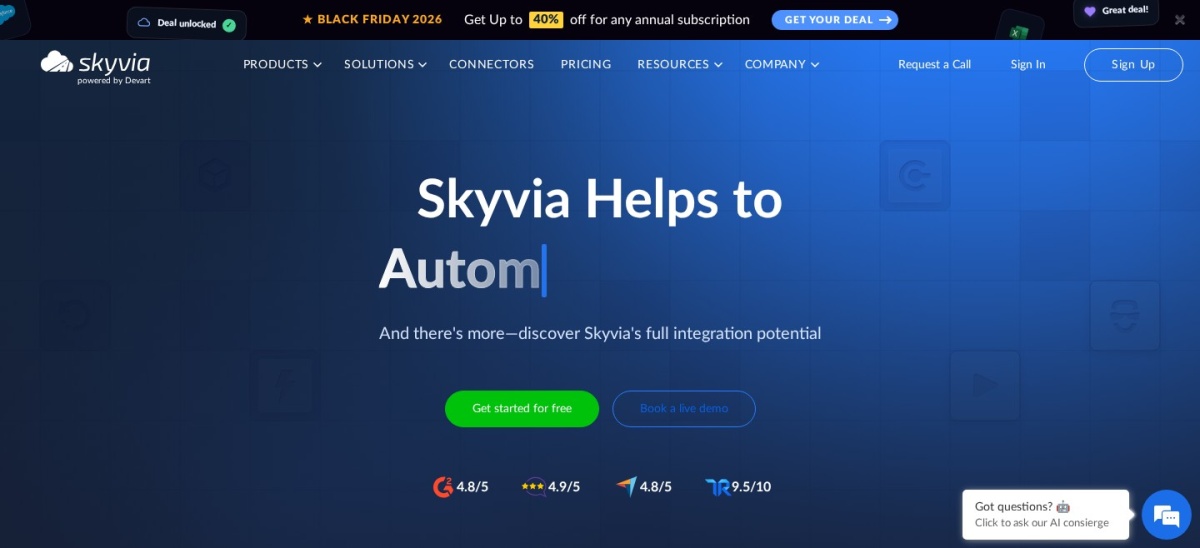
Skyvia is a cloud data platform covering integration, automation, backup, query, and connectivity with no-code wizards and SQL options. Its Free plan includes up to 10,000 records per month with daily scheduling and up to two scheduled integrations.
The trade off is that Basic starts at $79/month billed annually ($99/month billed monthly) for 5 million records per month and limits advanced mapping and Data Flow features. It suits small and mid-sized teams that want straightforward cloud app and database syncs without heavy engineering.
What we like
High 4.8/5 user rating across 326 reviews on G2
Free plan available with 10,000 monthly records
Covers integration, automation, and backup in one interface
Clear published tiers from 5M to 200M records per month
Watch out for
Free and Basic plans restrict advanced mapping and Data Flow
Large data volumes can require higher tiers with custom limits
Paid Data Integration plans add higher monthly record quotas, scheduled integrations, and advanced features like Data Flow on Standard.Visit skyvia.com
02
Make
4.6/5on G2 (510 reviews, checked Nov 2026)
Paid from$9/mo
Best for visual multi-app workflows
G2 rating4.6/5 (510 reviews)
Free tier1,000 credits/mo
Entry paid planCore from $9/mo
App catalog3,500+ pre-built apps
make.com
Make homepage, captured Nov 2026.
Make is a visual workflow and integration platform connecting over 3,500 apps with drag-and-drop scenarios, routers, and filters. Its Free plan provides 1,000 credits per month and a 15-minute minimum interval between runs.
The trade off is that credit consumption scales with multi-step scenarios, starting at $9/month on Core for 10,000 monthly credits, and enterprise controls sit on upper tiers. It suits teams automating operational app workflows and lightweight cloud data transfers visually.
What we like
Generous catalog of 3,500+ native cloud app integrations
Free tier includes 1,000 monthly credits with no time limit
Intuitive visual scenario builder for branching logic
Watch out for
Credit usage can rise quickly in multi-step or high-frequency flows
Enterprise features such as audit logs and on-prem agents require higher plans
Paid plans unlock unlimited active scenarios, tighter scheduling intervals down to the minute, API access, and larger monthly credit pools.Visit make.com
03
Albato
4.6/5on G2 (510 reviews, checked Nov 2026)
Paid from$15/mo
Best for flexible transaction packages
G2 rating4.6/5 (510 reviews)
Free tier100 transactions/mo
Entry paid planPro from $15/mo annual ($22/mo monthly)
App catalog1,000+ apps
albato.com
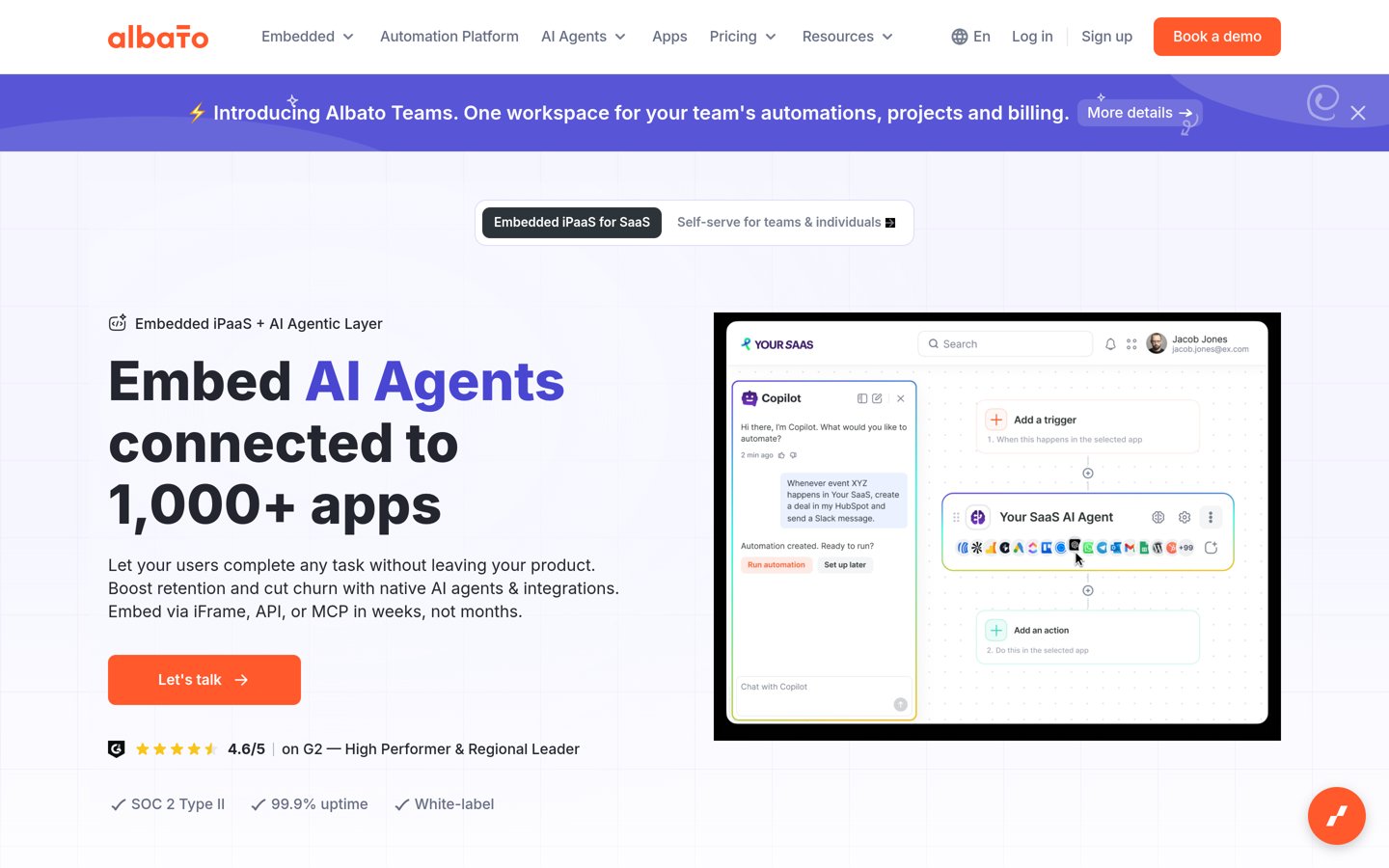
Albato homepage, captured Nov 2026.
Albato is a cloud integration and automation platform supporting over 1,000 apps alongside custom webhooks and APIs. Its Free plan includes 100 transactions per month, up to five active automations, and a 15-minute update interval.
The trade off is that Pro starts at $22/month billed monthly ($15/month billed annually with up to 30% annual savings) and limits the free tier to two steps per automation. It suits small businesses and agencies building app-to-app syncs or embedded workflows.
What we like
Separates base plan features from selectable transaction packages
Free tier includes 1,000+ app connections and 7-day log storage
Supports custom webhooks, APIs, and multi-step automations on paid plans
Watch out for
Free tier restricts automations to two steps and 100 monthly transactions
Some niche app connectors may have fewer fields than major platforms
Pro removes step and automation caps, shortens update intervals to 5 minutes, extends log storage to 30 days, and adds data migration tools.Visit albato.com
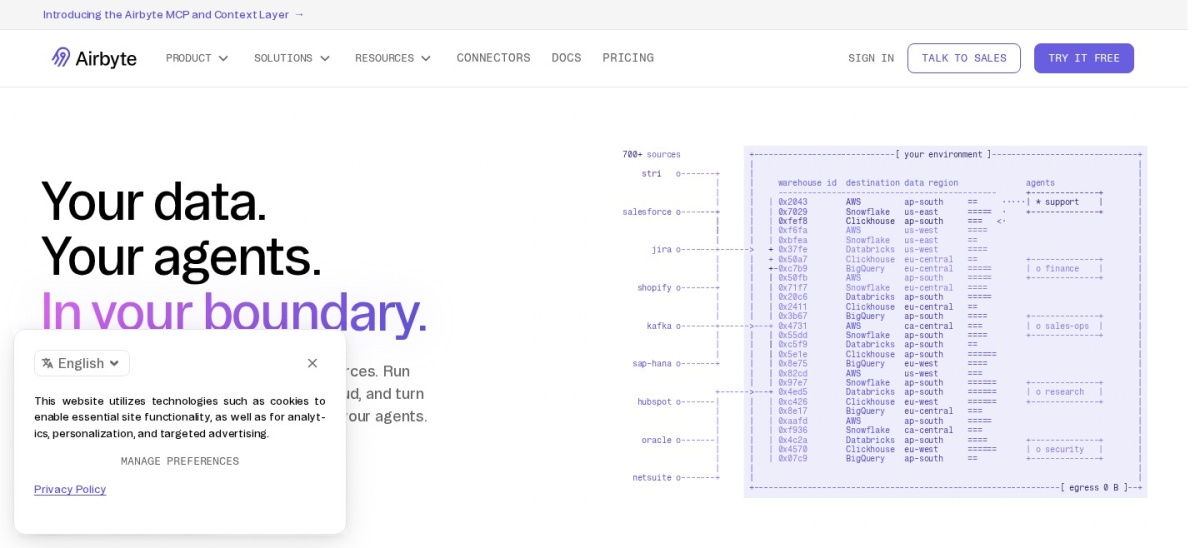
Airbyte is an open-source data integration platform for replicating data from databases, APIs, and files into cloud warehouses and data lakes. Teams can self-host open-source Airbyte at no licensing cost or use managed cloud plans starting at $20/month on Standard with 5 credits included.
The trade off is that Standard runs syncs as often as hourly and Plus starts at $189/month for 15-minute syncs and SSO, while self-hosting requires infrastructure maintenance. It suits data engineering teams that want open-source control and custom connector building.
What we like
Open-source core avoids vendor lock-in and supports custom connectors
Affordable Standard cloud entry tier starting at $20/month
Offers both volume-based cloud tiers and capacity-based enterprise options
Watch out for
Standard cloud plan limits sync intervals to hourly and omits SSO
Self-hosted deployments require your team to manage compute and upgrades
Managed cloud plans handle hosting and scaling, with Plus adding 15-minute syncs, SSO, up to two workspaces, and a 24-hour support SLA.Visit airbyte.com
05
Fivetran
4.3/5on G2 (857 reviews, checked Nov 2026)
Paid from$60/yr
Best for low-maintenance warehouse ELT
G2 rating4.3/5 (857 reviews)
Free tierUp to 500,000 MAR/mo
MeteringMonthly Active Rows ($5/mo min per connection)
Connector count700+ managed connectors
fivetran.com
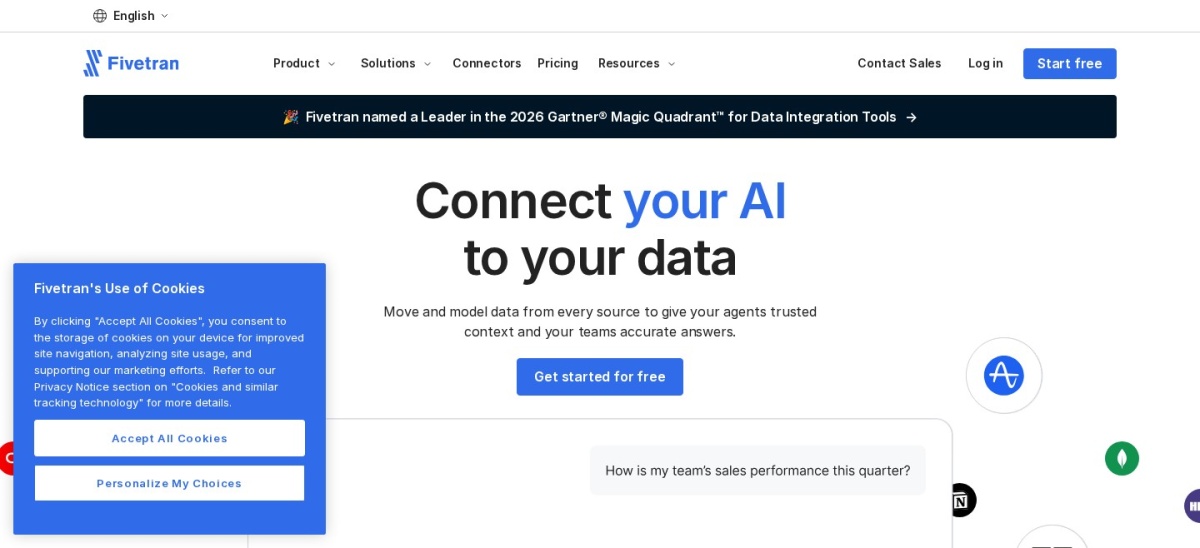
Fivetran homepage, captured Nov 2026.
Fivetran is a managed ELT platform that automates schema drift handling, incremental syncs, and warehouse loading across 700+ connectors. Its Free plan covers up to 500,000 monthly active rows for connections, 3,500 MAR for activations, and 5,000 monthly transformation model runs.
The trade off is that consumption-based MAR pricing carries a $5/month minimum per active connection above free limits and can grow costly on high-change tables. It suits analytics teams that want hands-off warehouse ingestion with minimal pipeline upkeep.
What we like
Free plan includes up to 500,000 monthly active rows and 15-minute syncs
Large library of 700+ connectors with automated schema handling
Supports multiple data processing regions across major clouds
Watch out for
Monthly active row billing can become expensive at high data volumes
Enterprise database connectors and Hybrid Deployment require upper plans
Paid usage and annual contracts scale beyond free MAR and transformation limits, with Enterprise and Business Critical adding specialized connectors and cloud controls.Visit fivetran.com
06
Hevo Data
4.4/5on G2 (297 reviews, checked Nov 2026)
Paid from$3,588/yr
Best for no-code warehouse pipelines
G2 rating4.4/5 (297 reviews)
Free tierUp to 1M events/mo on free sources
Entry paid planStarter from $299/mo (5M events default)
Billing unitMonthly events loaded to destination
hevodata.com
Hevo Data homepage, captured Nov 2026.
Hevo Data is a no-code ELT pipeline platform for moving data from databases, SaaS apps, and event sources into cloud warehouses. Its Free plan supports up to 1 million events per month using eligible free sources without requiring a card.
The trade off is that Starter begins at $299/month for 5 million default events and event quotas can climb as row counts expand. It suits startups and analytics teams that want fast, code-free warehouse replication.
What we like
Free plan includes up to 1 million monthly events on supported sources
Guided setup with automated schema mapping and pipeline monitoring
Offers monthly and annual billing options with a 12% annual discount
Watch out for
Event-based pricing increases as high-volume tables grow
Free plan restricts access to paid sources and pauses excess events until reset
Starter and higher tiers unlock paid sources, increase monthly event quotas via slider, and expand pipeline capacity for production teams.Visit hevodata.com
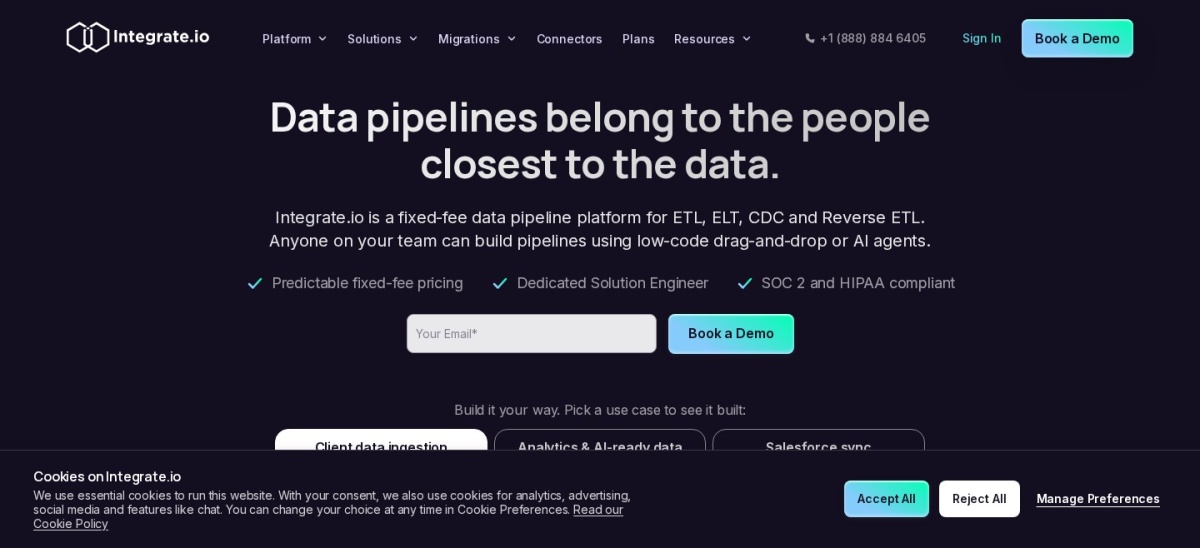
Integrate.io is a low-code cloud data integration platform supporting ETL pipelines, change data capture, visual transformations, and reverse ETL across 200+ sources and destinations. It offers a 14-day free trial and fixed-fee pricing starting at $1,999/month.
The trade off is a higher entry price than usage-based tools, with no permanent free tier once the 14-day trial ends. It suits mid-market and data teams with steady or high data volumes that want predictable fixed-fee billing.
What we like
Predictable flat-fee pricing starting at $1,999/month avoids row-spike surprises
Combines ETL, CDC, data transformations, and reverse ETL in one platform
Includes 24/7 support and guided onboarding across plans
Watch out for
No free tier after the 14-day trial, making it costly for tiny workloads
Higher upfront monthly commitment than entry-level cloud tools
Paid plans provide full pipeline access across ingestion, transformation, and reverse ETL with 24/7 support and onboarding assistance.Visit integrate.io
How pricing models affect total cost
Row-based and event-based meters work well when your monthly active rows or loaded events are small or easy to forecast, as seen with Fivetran's 500,000 MAR free tier and Hevo Data's 1 million monthly event free tier. Once a transactional database updates millions of rows each month, per-row or per-event bills can rise faster than expected.
Flat-fee and capacity-based plans trade low entry prices for budget predictability. Integrate.io starts at $1,999/month on a fixed-fee model, while Make and Albato tie costs to workflow credits or transactions.
How we chose
We selected established cloud data integration and workflow platforms with active product development, public pricing details, and verified user review profiles across 2026 comparison directories and vendor documentation.
All pricing tiers, free limits, G2 ratings, and review counts were checked on 22 Nov 2026 directly from official vendor pricing pages, documentation, and G2 product review pages.
We excluded tools lacking transparent starting pricing or recent public review data in our checks, as well as software without active cloud data integration capabilities for this category.
No vendor paid for a place, and we do not claim testing for this list.
How to choose a cloud data integration platform
Follow four practical steps to narrow down the right platform for your team.
Map your primary data sources and destinations first. List every database, SaaS app, API, and warehouse or destination you need to connect, and confirm native connector support and sync frequency.
Match the billing meter to your data change rate. Compare row, event, credit, and flat-fee pricing against realistic monthly volumes rather than initial pilot numbers.
Check where transformations and compliance controls happen. Decide whether you want in-pipeline transformations, warehouse-side SQL or dbt modeling, or fixed regional data hosting.
Test real connectors during a trial or free tier. Verify schema handling, error logs, and support responsiveness using a representative dataset before signing an annual commitment.
FAQ
What is a cloud data integration platform?
A cloud data integration platform moves and synchronizes data between cloud apps, databases, APIs, and warehouses over the cloud. It automates extraction, loading, and optional transformation so teams do not have to build and maintain custom scripts for every connector.
Which platform is best if we want a free tier to start?
Skyvia, Make, Albato, Airbyte, and Fivetran all offer free options or open-source entry points. The right choice depends on whether you need warehouse syncs in rows or events, or visual automation across business apps.
How does row-based pricing differ from flat-fee pricing?
Row-based or event-based pricing charges according to how much data moves each month, which can stay low on small workloads but climb on busy tables. Flat-fee pricing charges a set monthly rate, helping teams with heavy or fluctuating data volumes budget predictably.
When should a team choose open-source over a managed cloud service?
Open-source tools like Airbyte make sense when your team wants full control over connectors and infrastructure or plans to self-host. Managed cloud plans fit better when you want the vendor to handle hosting, updates, and operational maintenance.
Do I need ETL or ELT for a modern cloud data warehouse?
Many cloud warehouse teams use ELT, loading raw data into the warehouse quickly and transforming it there with SQL or modeling tools. Tools like Integrate.io also support ETL and reverse ETL when you need transformations or operational syncs back to apps.
Why do monthly active rows matter more than total table size?
A large database table may have millions of historical rows while only a fraction changes in a given month. Platforms that count monthly active rows or incremental changes only bill for new, modified, or deleted rows rather than unchanged records.