WooCommerce Alternatives in 2026: 7 Best Tools Compared
WLWPLegible EditorsLast verified 22 Nov 2026How we rank12 min read
★ Short answer
Shopify is the best WooCommerce alternative for most online stores, with managed hosting, built-in checkout and a Basic plan starting at $29 per month when billed yearly. SureCart is better for businesses staying on WordPress, while Easy Digital Downloads specializes in selling downloadable products, software and subscriptions.
How we make this list: we compare pricing pages, product documentation and public user reviews, then re-check every price before each update. No product paid for a place. Disclosure.
Shopify Basic costs $29/month billed annually, or $348/year, with hosting, checkout and store management included.
SureCart has 70,000+ active WordPress installations and a 4.8/5 rating from 289 ratings. Its free Launch plan charges a 2.9% transaction fee, while Pro costs $199/year.
Easy Digital Downloads has 40,000+ active installations and a 4.7/5 rating. Its Personal plan renews at $199/year after introductory discounts.
BigCommerce Core costs $39/month billed annually, with a $30,000 trailing annual sales threshold and a 2% fee on eligible open-provider transactions.
WP EasyCart Pro costs $119/year and removes the additional 2% plugin fee charged on supported payments in its free edition.
Ecwid Starter costs $5/month for a catalog of up to 10 products, while Venture costs $29/month billed annually and supports up to 100 products.
What to look for in a WooCommerce alternative
WooCommerce gives WordPress websites extensive control over products, checkout, payments and store design. Its flexibility comes with responsibilities such as hosting, software updates, plugin compatibility and maintaining a reliable checkout.
The biggest choice is between hosted ecommerce platforms and WordPress shopping cart plugins. Shopify and BigCommerce manage hosting and core store infrastructure, while SureCart, Easy Digital Downloads and WP EasyCart let you keep WordPress as your website platform.
Consider what you sell. Physical products need shipping, inventory and tax tools, while digital products benefit from secure file delivery, software licensing and subscription management. A platform built around your product type may require fewer add-ons.
Compare the total cost of ownership, not just subscription pricing. Payment processing, transaction fees, themes, extensions, hosting and ongoing maintenance can change the real annual cost.
Finally, review migration options. Moving from WooCommerce may involve transferring products, images, customers, orders, variations and URLs. Some information may need third-party migration tools or manual adjustments.
Shopify is a hosted ecommerce platform rated 4.4/5 from 5,146 G2 reviews. Its Basic plan includes secure hosting, online storefronts, checkout, inventory management and selling across supported channels. The platform handles core infrastructure and software maintenance, reducing the technical work associated with a self-hosted WooCommerce store.
The trade off is less control over the underlying platform, alongside recurring subscription, app and payment processing costs. Basic regularly costs $29 per month billed annually, or $348 per year, with an introductory $1 monthly offer available for eligible new stores. It suits retailers wanting managed ecommerce rather than WordPress maintenance.
What we like
Hosting and core store infrastructure included
Built-in checkout, inventory and order management
Large third-party app and theme ecosystem
Supports online and in-person selling
Managed updates and platform security
Watch out for
Ongoing subscription required for a live store
Third-party apps can increase total costs
Additional transaction fees may apply with external payment providers
Less server-level customization than WooCommerce
Grow adds more staff accounts, improved payment rates and additional shipping benefits.Visit shopify.com
02
SureCart
4.8/5on WordPress.org (289 reviews, checked Nov 2026)
Paid from$199/yr
Best WordPress-native WooCommerce alternative
Active installs70K+
Free transaction fee2.9%
Free planLaunch
Paid plan$199/yr
surecart.com
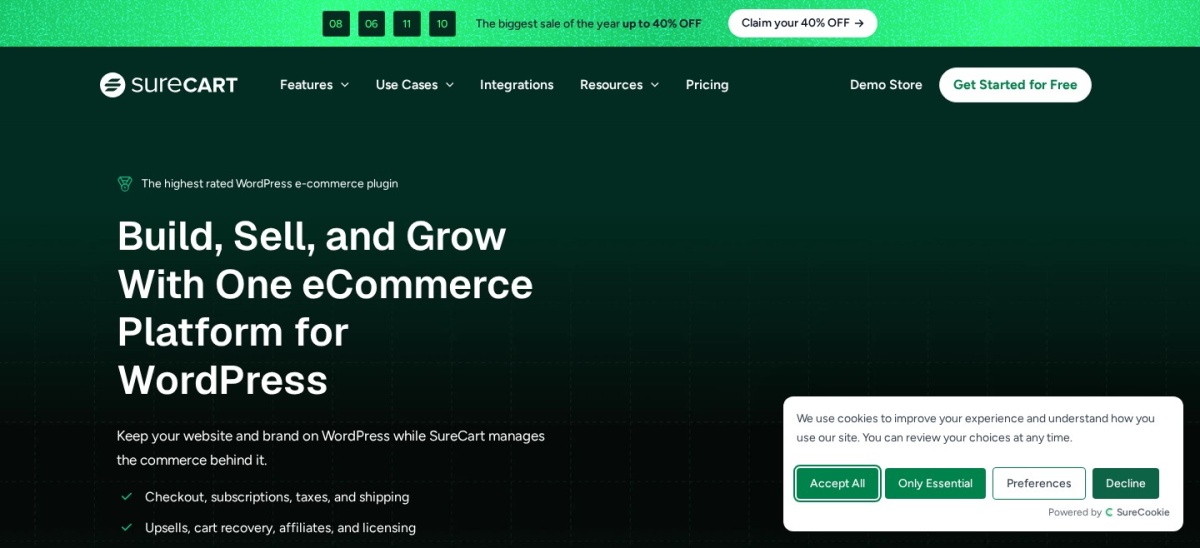
SureCart homepage, captured Nov 2026.
SureCart is a WordPress ecommerce plugin with more than 70,000 active installations and a 4.8/5 rating from 289 ratings. Its free Launch plan supports physical products, digital downloads, subscriptions, checkout customization and payment management. The platform also includes inventory tools, coupons, order management and automated tax functionality.
The trade off is that the free Launch plan charges a 2.9% SureCart transaction fee in addition to payment processing charges. The regular Pro annual plan costs $199 for one store and removes SureCart's transaction fee, with a temporary $159 promotional offer. It suits WordPress businesses selling products, services and recurring subscriptions.
What we like
Works directly with existing WordPress websites
Free plan supports subscriptions and digital sales
Built-in checkout and order management
Paid plan removes SureCart transaction fees
Supports physical and digital products
Watch out for
Free plan charges an additional transaction fee
Uses SureCart's connected commerce infrastructure
Different extension ecosystem from WooCommerce
Annual Pro subscription required to remove platform fees
Pro removes the additional SureCart transaction fee and provides paid-plan benefits.Visit surecart.com
03
Easy Digital Downloads
4.7/5on WordPress.org (594 reviews, checked Nov 2026)
Paid from$199/yr
Best for selling digital downloads
Active installs40K+
Product focusDigital goods
Personal license1 website
Paid plan$199/yr
easydigitaldownloads.com
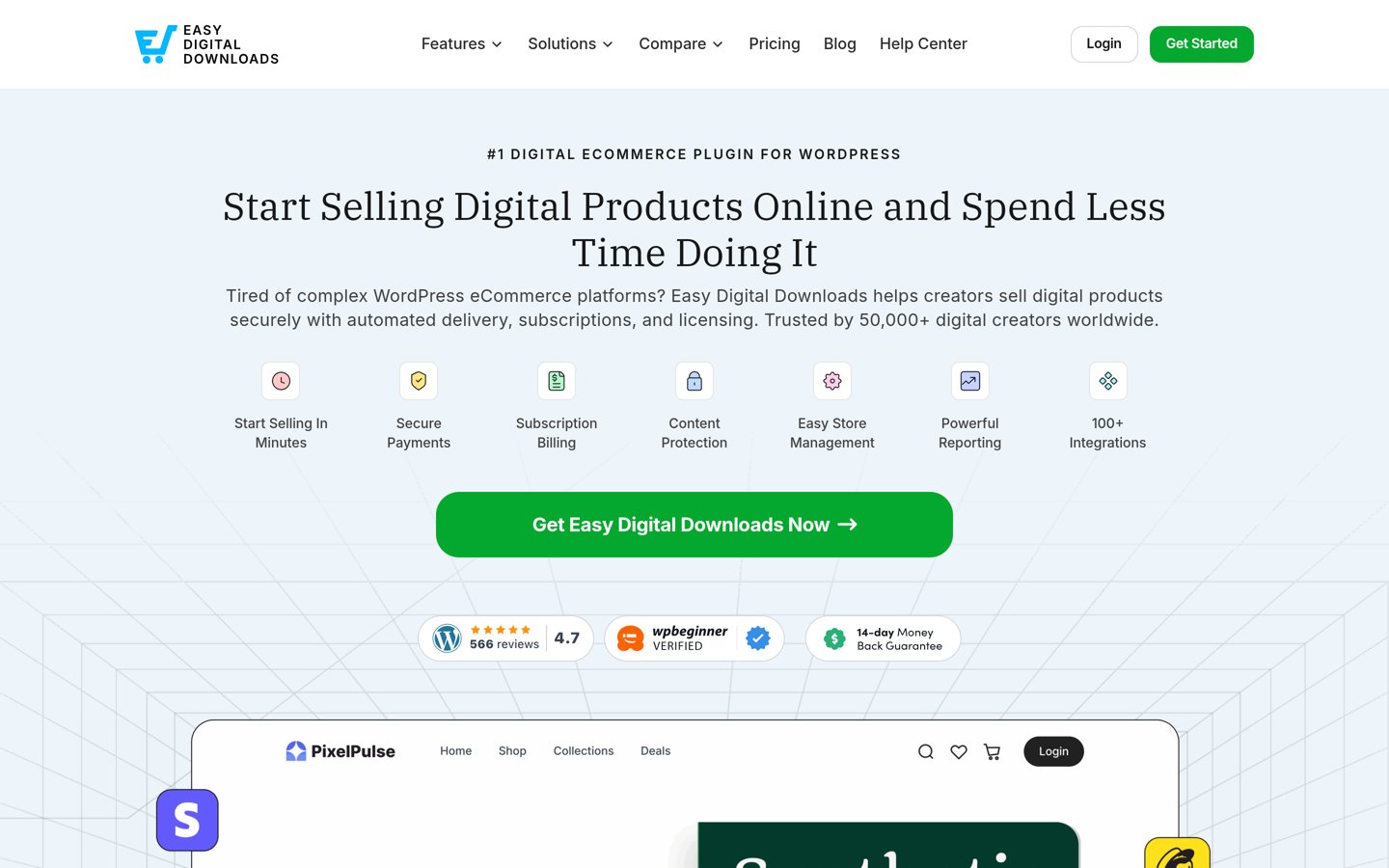
Easy Digital Downloads homepage, captured Nov 2026.
Easy Digital Downloads is a WordPress ecommerce plugin with more than 40,000 active installations and a 4.7/5 rating from 594 ratings. Its free version provides digital product listings, file delivery, shopping cart functionality, payment processing and customer management. It is designed for downloadable files rather than traditional physical product catalogs.
The trade off is that advanced subscriptions, revenue tools and premium integrations require paid licensing. Personal regularly costs $199 per year for one website, although an introductory $99.50 offer is advertised. It suits software sellers, creators and publishers who want digital commerce without WooCommerce's physical-store-oriented features.
What we like
Designed specifically for downloadable products
Free digital checkout and file delivery
Supports unlimited product listings
Integrates with WordPress content workflows
Premium extensions support advanced digital businesses
Watch out for
Not primarily designed for physical product fulfillment
Advanced subscription and licensing features depend on paid plans
Regular renewal is higher than the introductory price
Some specialized integrations require higher license tiers
BigCommerce is a hosted ecommerce platform rated 4.2/5 from 589 G2 reviews. Its Core plan includes responsive storefronts, checkout, product management, sales channel integrations and customer support. The platform is designed for retailers needing centralized commerce tools without maintaining a self-hosted WordPress store.
The trade off is that Core has a $30,000 trailing annual GMV threshold and charges 2% on qualifying transactions through open payment providers. The regular annual-billing price is $39 per month, or $468 yearly, although a temporary half-price first-year offer is available. It suits businesses planning structured ecommerce growth.
What we like
Hosted infrastructure and commerce administration
Multichannel selling capabilities
Single-page checkout
Supports growing product catalogs
Built-in store management and analytics
Watch out for
Core plan has an annual sales threshold
Open payment provider fees may apply
Higher regular entry cost than Shopify Basic
Some advanced features require higher plans
Growth increases the sales threshold and adds more advanced commerce capabilities.Visit bigcommerce.com
05
Ecwid
4.5/5on WordPress.org (228 reviews, checked Nov 2026)
Starts at$5/mo
Best for adding ecommerce to an existing website
Active installs20K+
Starter products10
HostingManaged storefront
Paid entry$60/yr
ecwid.com
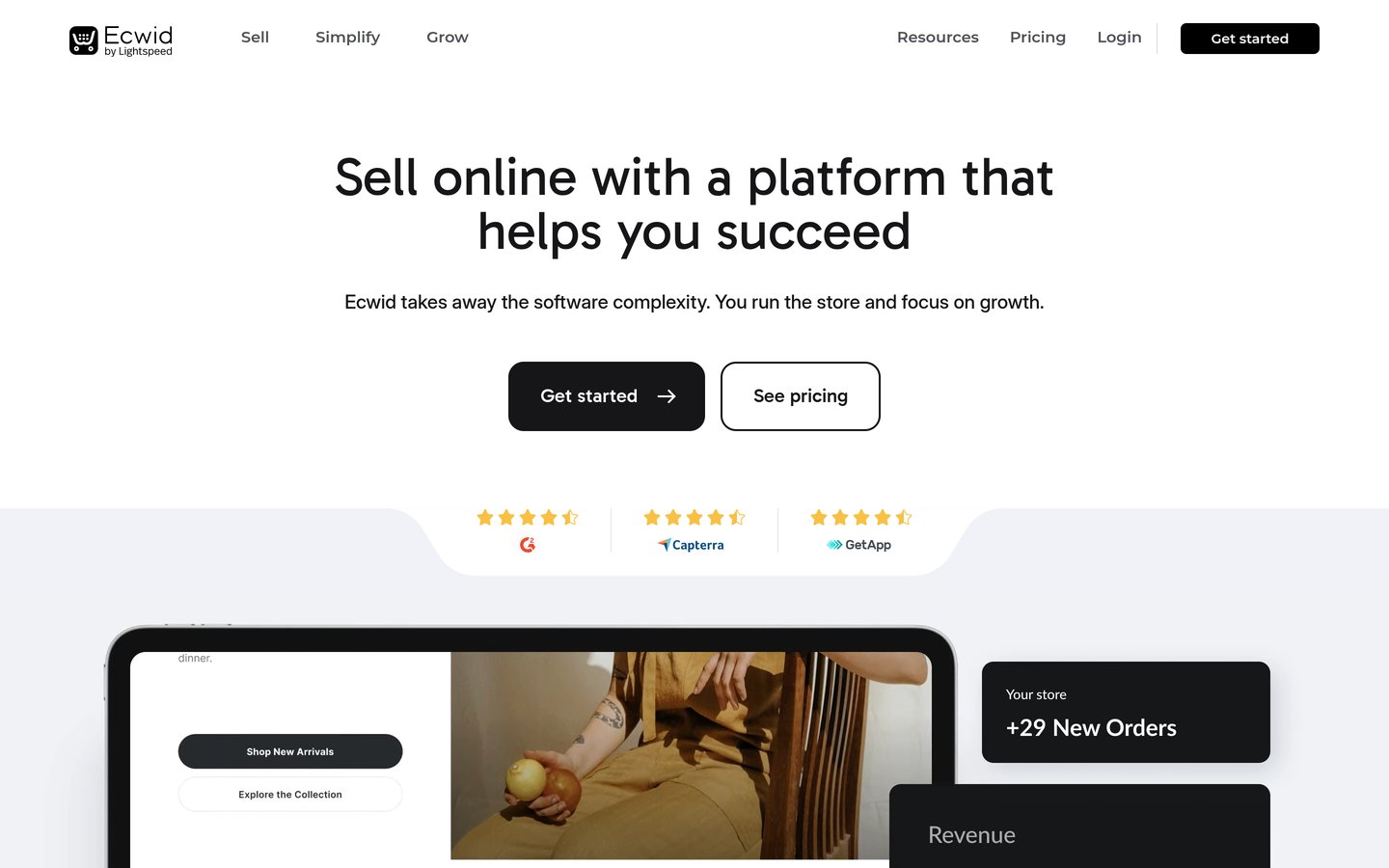
Ecwid homepage, captured Nov 2026.
Ecwid is a hosted ecommerce service with a WordPress integration used on more than 20,000 active installations and rated 4.5/5 from 228 WordPress.org ratings. Its Starter plan supports up to 10 products, an embeddable storefront, website templates, payment options and basic store management. It also provides a standalone site builder.
The trade off is that Starter limits catalog size and excludes features such as advanced discounts, digital goods and expanded selling channels. Starter costs $5 per month, equivalent to $60 annually, while Venture costs $29 monthly with annual billing. It suits smaller sellers wanting ecommerce without replacing their existing website.
What we like
Adds a storefront to an existing WordPress website
Managed ecommerce infrastructure
Low-cost entry plan for small catalogs
Supports selling through multiple website platforms
Higher plans include social selling and marketing tools
Watch out for
Starter limits catalogs to 10 products
No permanent free plan for new stores
Digital goods and advanced promotions require Venture
Higher plans can become expensive as requirements grow
Venture expands the catalog to 100 products and adds digital goods, discounts and social selling.Visit ecwid.com
06
WP EasyCart
4.5/5on WordPress.org (207 reviews, checked Nov 2026)
Paid from$119/yr
Best traditional WordPress shopping cart alternative
Active installs3K+
Free platform fee2%
Product typesPhysical and digital
Paid plan$119/yr
wpeasycart.com
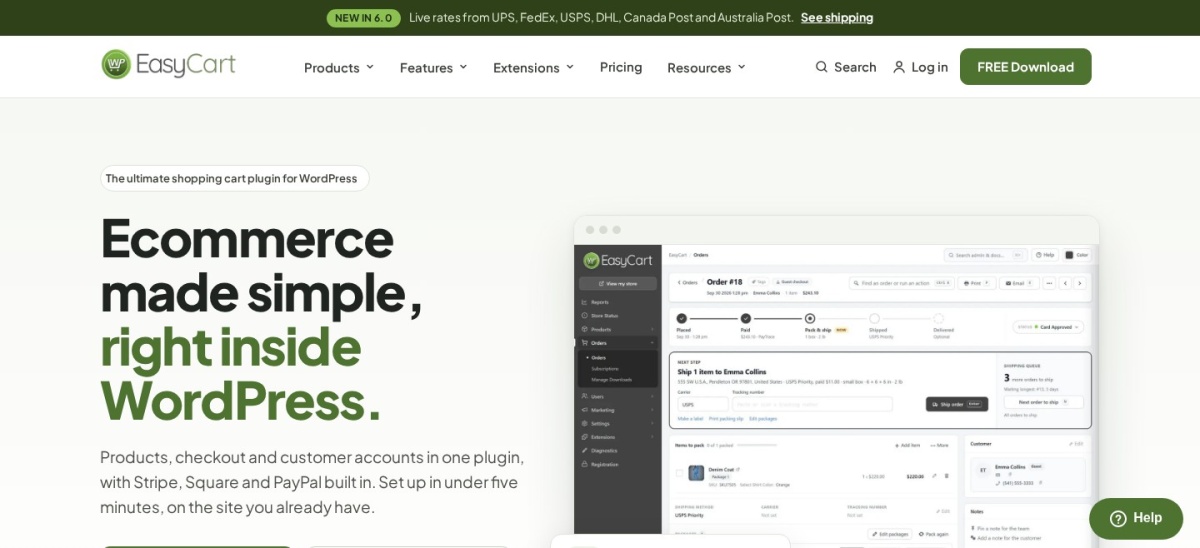
WP EasyCart homepage, captured Nov 2026.
WP EasyCart is a WordPress shopping cart plugin with more than 3,000 active installations and a 4.5/5 rating from 207 ratings. Its free edition supports product listings, shopping carts, checkout, digital downloads and order management. The plugin provides an alternative ecommerce system without requiring WooCommerce extensions.
The trade off is that its free edition adds a 2% plugin fee to payments through Stripe, Square and PayPal, alongside normal processing costs. WP EasyCart Pro costs $119 per year and removes that fee while unlocking more commerce features. It suits small retailers wanting familiar WordPress administration with fewer separate extensions.
What we like
WordPress-native shopping cart and checkout
Free edition supports physical and digital products
Pro removes the additional plugin transaction fee
Includes inventory and order management
Premium offers additional shipping and business integrations
Watch out for
Free edition adds a 2% fee on supported payment methods
Smaller ecosystem than WooCommerce
Advanced features require paid licensing
Premium integrations may require the higher tier
Pro removes plugin payment fees and adds expanded payments, shipping and selling tools.Visit wpeasycart.com
07
Squarespace
4.4/5on G2 (1,137 reviews, checked Nov 2026)
Starts at$19/mo
Best for design-led small online stores
PlatformHosted website builder
Entry planBasic
Store transaction fee2% on Basic
Annual-billing cost$228
squarespace.com
Squarespace homepage, captured Nov 2026.
Squarespace is a hosted website and ecommerce builder rated 4.4/5 from 1,137 G2 reviews. Its Basic plan provides designer templates, visual page editing, managed hosting, SEO controls and online selling. The platform combines website presentation and commerce management, making it suitable for stores where brand design is a priority.
The trade off is that Basic charges a 2% online store transaction fee and has fewer advanced selling tools than higher plans. Basic costs $19 per month billed annually, or $228 yearly, while Core adds more commerce features and removes that platform transaction fee. It suits creative businesses and small product catalogs.
What we like
Visual website builder with designer templates
Managed hosting included
Built-in ecommerce and checkout
Suitable for portfolio-led and creative businesses
Integrated website analytics and SEO controls
Watch out for
Basic plan charges a 2% online store transaction fee
Less flexibility than self-hosted WooCommerce
Advanced ecommerce features require higher plans
Limited access to underlying server infrastructure
Core removes online store transaction fees and adds advanced commerce and marketing tools.Visit squarespace.com
Hosted ecommerce platforms vs WordPress plugins
Hosted ecommerce services handle infrastructure, checkout services and core platform maintenance. Shopify, BigCommerce and Squarespace are suitable when you prefer predictable store administration without managing WordPress updates and hosting configurations.
WordPress-based alternatives keep your existing content platform. SureCart, Easy Digital Downloads and WP EasyCart integrate with WordPress while offering different approaches to payments, checkout and product management.
Ecwid operates between these approaches. Its commerce system is hosted, but the storefront can be embedded into an existing WordPress website or another supported platform.
There is no universally cheaper model. Hosted platforms require subscriptions, while WordPress stores introduce hosting, maintenance and extension costs. Compare payment fees, required features and the cost of operating the complete store.
Consider how much control you need over your store's data, checkout design and integrations before deciding whether to leave WordPress entirely.
How to migrate from WooCommerce to another platform
Before changing ecommerce platforms, create a complete backup containing your products, orders, customer information, media files and current WordPress database.
Review the replacement platform's import tools. Products, descriptions, categories and images are commonly transferable, but product variations, subscriptions, memberships and customer passwords may require special handling.
Export relevant WooCommerce information and identify unsupported fields before importing anything. Keep an organized record of product identifiers, SKUs, shipping rules, tax settings and existing URLs.
After migration, verify products, prices, checkout, payment gateways, stock levels, shipping options and customer communications. Test purchases and refunds before sending live traffic to the replacement store.
Preserve important URLs where possible and configure redirects for changed product and category addresses. Keep the original store available until orders, customer access and integrations have been verified.
How we chose
We selected established ecommerce platforms and WordPress shopping cart plugins that offer meaningful alternatives to WooCommerce. The comparison includes fully hosted stores, WordPress-native commerce tools, embedded storefronts and specialized digital selling solutions. We prioritized functional overlap, product management, payment options, customization and migration suitability.
Pricing pages, G2 reviews and WordPress.org listings were checked on 22 Nov 2026. WordPress.org provided ratings, rating counts, installation figures and maintenance information for plugin-based products, while G2 supplied public ratings for hosted platforms. Regular paid prices were used instead of temporary introductory promotions, with monthly prices converted into annual equivalents.
We excluded outdated or closed plugins, products without confirmable pricing and services with insufficient public feedback. We distinguished platform transaction fees from separate payment processor charges and considered whether products could replace WooCommerce for specific store types. No vendor paid for a place, and we do not claim testing for this list.
How to choose the right WooCommerce alternative
Identify your store's core requirements before choosing a replacement, then compare ecommerce features, ongoing costs and migration complexity.
Match the platform to what you sell. Choose Shopify or BigCommerce for general retail, Easy Digital Downloads for downloadable products, and SureCart for subscriptions and digital or physical sales within WordPress. Squarespace suits design-focused shops, while Ecwid works well for adding commerce to an existing site.
Compare the complete annual operating cost. Include subscriptions, hosting, payment processing, additional transaction fees, extensions and maintenance. A low entry price can become expensive when a store needs advanced shipping, subscriptions, automation or third-party applications.
Check the features included in the entry plan. Review catalog limits, product variations, checkout customization, inventory, shipping, reporting and customer accounts. Confirm that the cheapest plan covers your actual selling workflow instead of assuming every advertised feature is included.
Plan the data migration before committing. Export WooCommerce products, customers and orders, then review the new platform's import capabilities. Test payment processing, shipping settings and product URLs on the replacement store before completing the move.
FAQ
What is the best alternative to WooCommerce?
Shopify is the best overall alternative for businesses wanting a fully hosted ecommerce platform with managed infrastructure, checkout and store administration. SureCart is a stronger choice when you want to remain on WordPress, while Easy Digital Downloads specializes in downloadable products and software.
Is Shopify better than WooCommerce?
Shopify is often easier to manage because hosting, core platform updates and checkout infrastructure are included. WooCommerce offers greater control over WordPress customization and server configuration. Shopify may suit businesses prioritizing simpler administration, while WooCommerce can be better for stores needing extensive custom development.
Is there a free alternative to WooCommerce?
Yes. SureCart, Easy Digital Downloads and WP EasyCart all offer free WordPress plugins. However, free does not always mean zero selling costs. SureCart Launch and WP EasyCart Free charge additional platform fees on qualifying transactions, while payment providers charge their own processing fees.
What is the cheapest WooCommerce alternative?
Ecwid Starter costs $5 per month and supports a small catalog of up to 10 products. SureCart, Easy Digital Downloads and WP EasyCart also offer free plugin entry points. Compare their transaction fees and feature restrictions before choosing the lowest advertised price.
Which WooCommerce alternative is best for digital products?
Easy Digital Downloads is designed around selling downloadable files, software and other digital products. SureCart is another option for digital products, subscriptions and recurring payments. Shopify can sell digital products through compatible applications, but specialized WordPress solutions may better suit digital-first businesses.
Can I replace WooCommerce without leaving WordPress?
Yes. SureCart, Easy Digital Downloads and WP EasyCart operate within WordPress, while Ecwid can embed a hosted storefront into an existing website. You should still review migration compatibility because WooCommerce-specific product data, subscriptions, extensions and customer accounts may not transfer automatically.
Which alternative is best for subscriptions?
SureCart supports recurring payments and subscription workflows in its commerce system, including functionality available through its free Launch plan. Easy Digital Downloads offers subscription capabilities through its premium products. The better choice depends on whether you sell digital files, memberships, services or physical subscription products.
Will switching from WooCommerce hurt SEO?
Changing ecommerce platforms does not automatically reduce search visibility, but migration mistakes can affect rankings. Preserve important product and category URLs where possible, configure redirects, transfer metadata and inspect canonical tags. Check the new website's sitemap, internal links and indexing status after migration.
Do hosted ecommerce platforms include hosting?
Yes. Shopify, BigCommerce and Squarespace include hosting as part of their subscriptions, reducing the need to maintain separate WordPress hosting. WordPress-based alternatives typically require an existing WordPress installation and hosting plan, although some use connected cloud services for checkout or order processing.