SqlDBM is the best of the flexible data modeling software options for most cloud teams, with browser modeling, version control and AI help in one plan. Teams that need governed enterprise models should look at erwin, while Lucidchart suits quick diagrams and shared discussion.
How we make this list: we compare pricing pages, product documentation and public user reviews, then re-check every price before each update. No product paid for a place. Disclosure.
SqlDBM leads for cloud warehouse teams, with browser modeling and version control in one plan.
erwin and ER/Studio are the governed enterprise picks, but both sell by quote or at $2,687 per user.
Lucidchart is the cheapest way into shared diagrams at $9 a month, though it is not a full modeler.
Redgate Data Modeler brings team modeling to the browser from $189 a year, the clearest published price here.
DbSchema and Moon Modeler sell one-time licences, $294 and $99, with no subscription to renew.
How do you choose flexible data modeling software options for your stack?
Flexibility means the tool follows your databases, not the other way round. A flexible modeler covers relational tables, cloud warehouses and document stores in one workspace, so one team can model Snowflake, PostgreSQL and MongoDB without switching tools.
Start with where your data lives. Cloud-first teams need a browser tool with Git versioning, while enterprise architects need governed repositories, glossaries and approval flows.
Price shapes the shortlist fast. Quote-only enterprise tools suit large estates, while per-user prices from $8 a month and one-time licences suit small teams.
Check the export before you commit. A modeler that cannot generate clean DDL or reverse-engineer a live database will slow every migration, however good its diagrams look.
The 9 best flexible data modeling software options
01
SqlDBM
4.5/5on G2 (24 reviews, checked Nov 2026)
PricingCustom/yr
Best flexible data modeling software overall
DeploymentBrowser, no install
Cloud warehousesSnowflake, Databricks, BigQuery
Version controlGit-based, with comments
Paid planOne plan, by quote
sqldbm.com
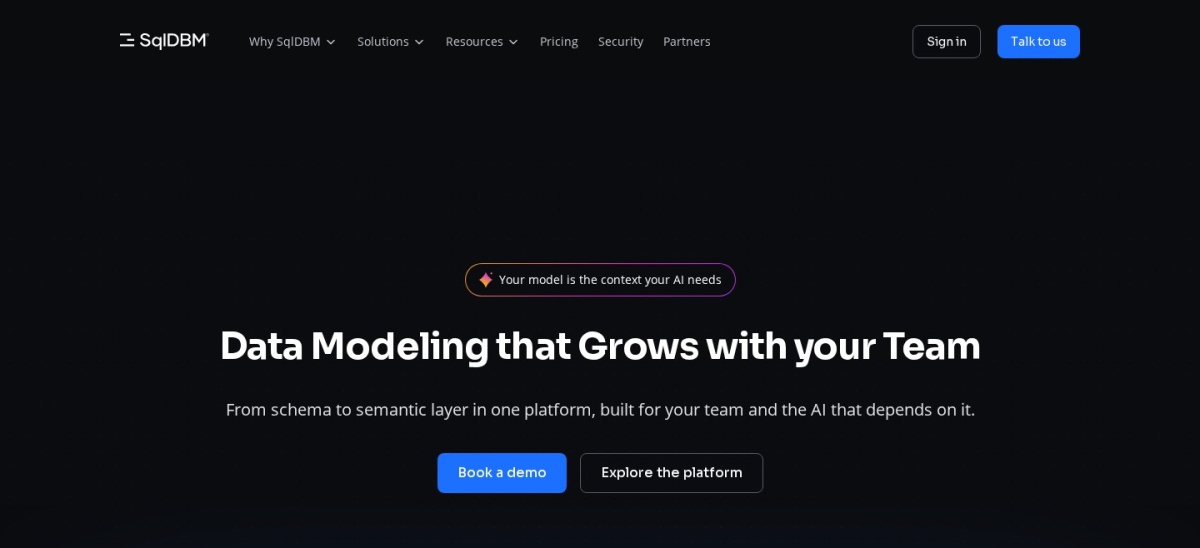
SqlDBM homepage, captured Nov 2026.
SqlDBM is a browser-based data modeling platform built for cloud warehouses such as Snowflake, Databricks and BigQuery, plus PostgreSQL, SQL Server, Oracle and MySQL. It covers conceptual, logical and physical models with forward and reverse engineering, team comments and Git version control in one workspace.
The trade off is price opacity. SqlDBM sells one plan with every feature, priced per user by quote, so small teams cannot budget it without a sales call. It suits data teams modelling cloud warehouses together who want no installer and a single source of truth.
erwin Data Modeler is the long-standing enterprise modeler, now owned by Quest, with more than thirty years behind the name. It ties conceptual, logical and physical models into governance and metadata management, with forward and reverse engineering across relational, NoSQL and cloud targets.
The trade off is the sales process. erwin publishes no price and sells through Quest sales and resellers, so budgeting takes a quote and a conversation. It suits large data architecture teams that need governed models across a complex database estate.
What we like
Deepest governance and metadata links
Widest database coverage in this list
Actively developed, with version 15.2 in 2026
Watch out for
No public price, sold by quote
Desktop tool, heavier to roll out than browser rivals
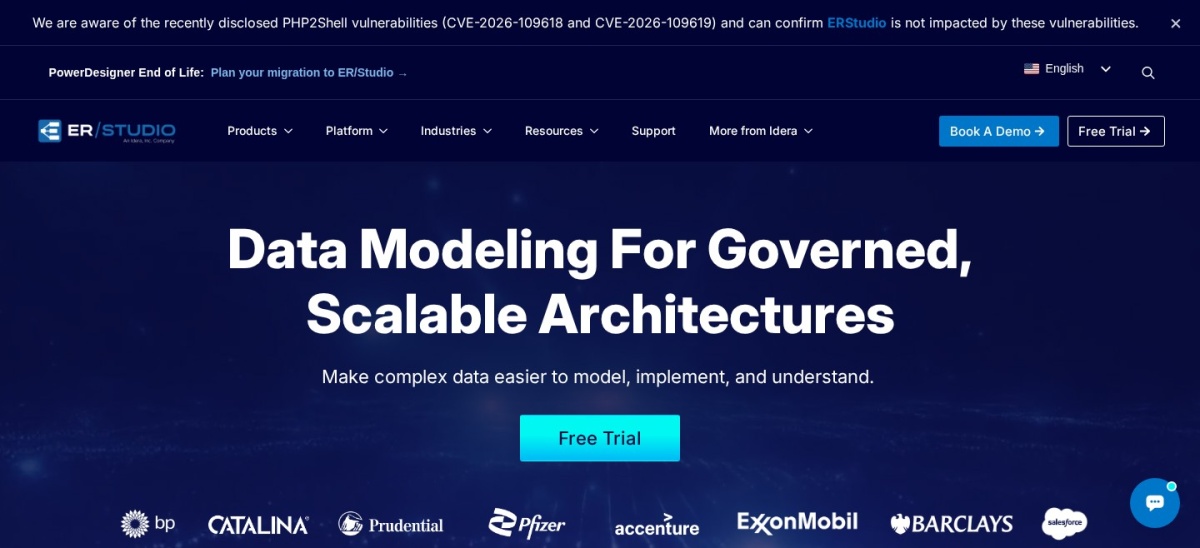
ER/Studio is Idera's enterprise data architecture tool, and erwin's oldest rival, covering conceptual, logical and physical modeling with AI-assisted design. It syncs with governance platforms such as Collibra and Microsoft Purview, and a shared Team Server keeps large teams on one model.
The trade off is cost and weight. Data Architect lists at $2,687 per user as a subscription price, and the vendor does not state the term, so confirm it before budgeting. It suits enterprises that want governed models and a published price without a quote-only sales cycle.
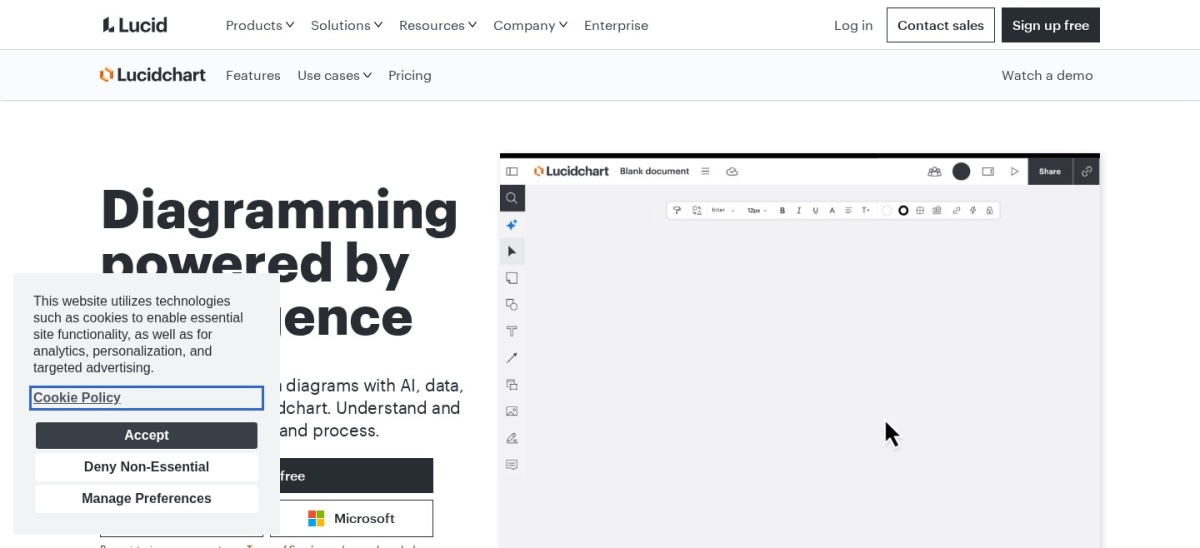
Lucidchart is a visual collaboration platform that draws clean entity-relationship diagrams for cross-functional teams. It offers drag-and-drop ERDs, real-time co-editing and AI diagram generation, and its 4.5 rating rests on more than 8,600 G2 reviews, the largest base here.
The trade off is depth. Lucidchart diagrams well but does not forward-engineer DDL or govern schemas like a dedicated modeler. It suits teams that need shared, readable diagrams fast, and pairs well with a real modeler for the database itself.
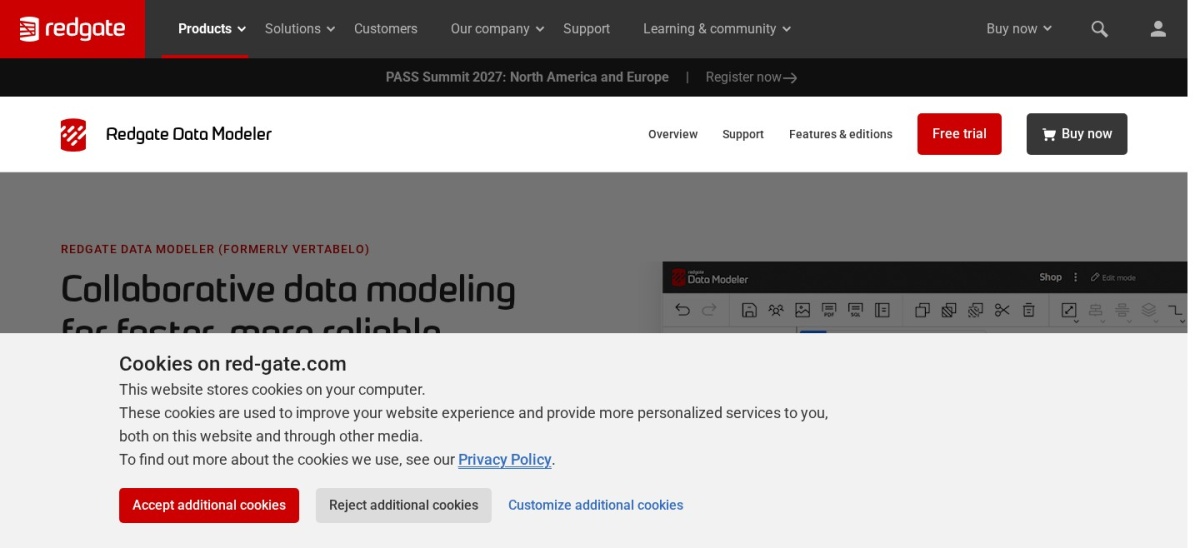
Redgate Data Modeler is the browser modeler formerly sold as Vertabelo, bought by Redgate in 2025 and relaunched under its own name. It handles logical and physical design, reverse engineering, SQL generation and real-time collaboration for PostgreSQL, MySQL, SQL Server and other engines.
The trade off is scope. The Standard plan caps models at 20, with up to 100 tables each, and logical design needs the Pro plan at $303 a year. It suits small teams that want governed browser modeling at a clear per-user price.
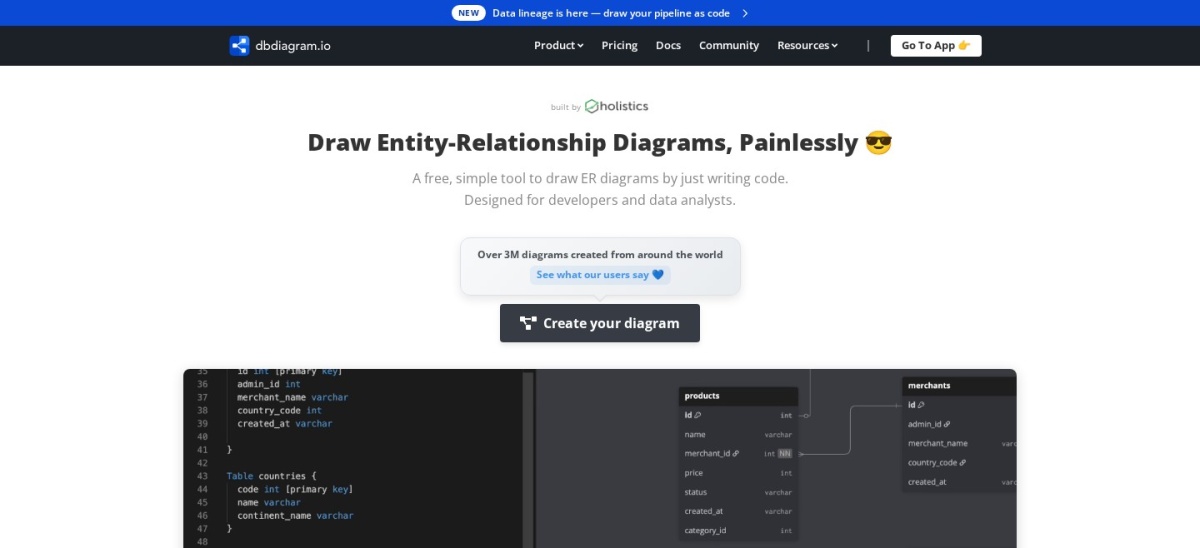
dbdiagram.io is a code-first ERD tool from Holistics that turns DBML, a short text schema language, into a database diagram as you type. The free plan covers 10 diagrams, and Pro adds unlimited diagrams, DDL export and version history for $8 a month.
The trade off is a thin review record. Only 4 G2 reviews back its 4.3 rating, and it is a diagrammer, not a governed modeler. It suits developers who sketch schemas in code and want the diagram to update itself.
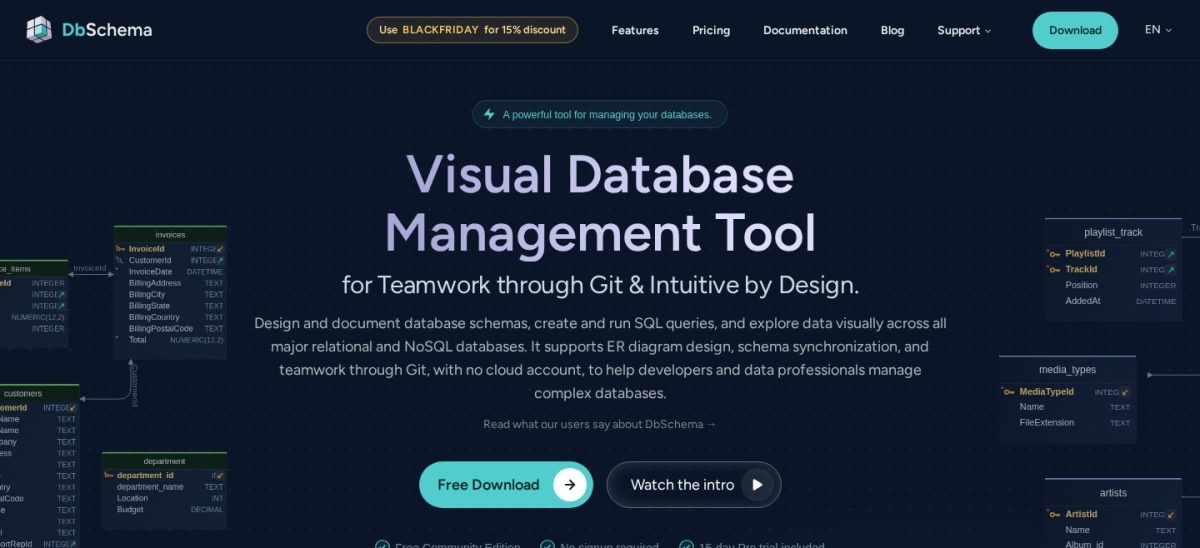
DbSchema is a desktop tool for designing, documenting and querying SQL and NoSQL databases, with visual modeling, schema comparison and HTML documentation. Model files are plain text and work with Git, so a schema change can be branched, diffed and merged like code.
The trade off is the review base. Only 2 G2 reviews back its 4.5 rating, and collaboration needs Git rather than a shared server. It suits developers who model offline and want a one-time licence instead of a subscription.
SAP PowerDesigner is the enterprise modeler for SAP-heavy estates, covering conceptual, logical and physical models plus enterprise architecture in one desktop tool. It handles large, governed models with a shared repository and links modeling to wider architecture work.
The trade off is fit and price. PowerDesigner is quote-only and built for large SAP estates, so smaller teams pay for scope they will not use. It suits enterprises already running SAP that need modeling tied to architecture governance.
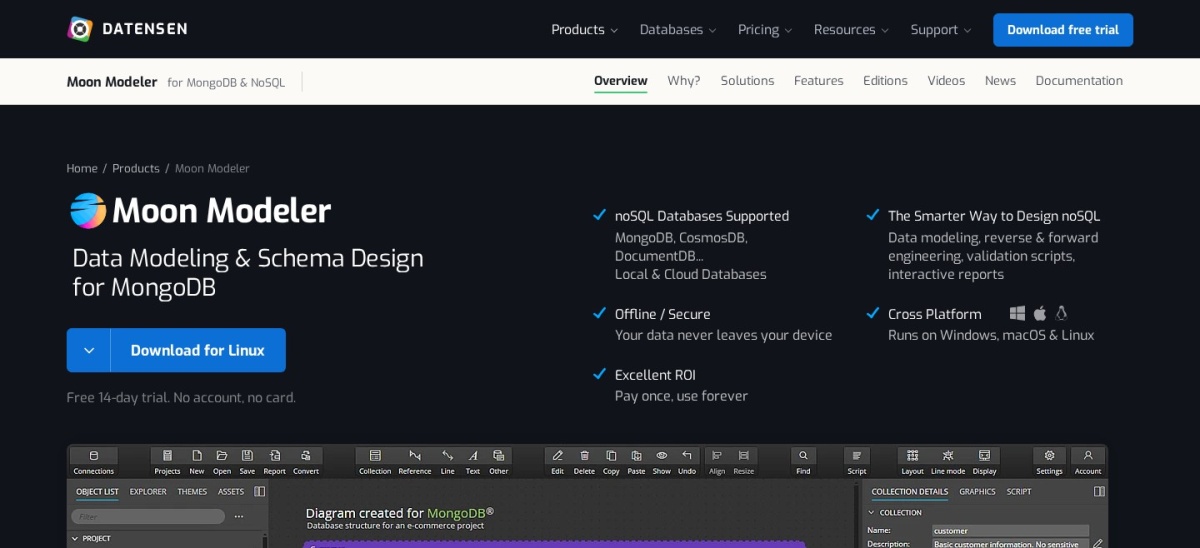
Moon Modeler is a desktop data modeling tool for document databases such as MongoDB, Azure Cosmos DB and Amazon DocumentDB, with PostgreSQL support too. It draws collections, fields, indexes and connections visually, reverse-engineers live databases and generates Mongoose schemas.
The trade off is collaboration. Moon Modeler works locally only, so there is no real-time shared editing, and its 3.9 rating is the lowest here. It suits solo developers who want cheap, offline NoSQL modeling with no subscription.
Free plans cover diagrams well. dbdiagram.io, Lucidchart and DbSchema Community all let you draw and share models without paying.
Paid plans mostly add governance and scale. You get shared repositories, version control, DDL generation and support for more databases.
Quote-only tools hide the price until you talk to sales. Ask for the per-user figure and the term in writing before you compare them with list prices.
For a small team, a one-time licence often costs less than one year of a per-user subscription, and it never renews.
How we chose
We started from the data modeling tools with a G2 listing and a current product page, then kept nine that cover enterprise governance, cloud warehouses, code-first diagrams and NoSQL.
Prices come from each vendor's pricing page, checked on 29 November 2026, with quote-only tools marked Custom. Ratings and review counts come from G2 on the same day.
We left out Hackolade, which has no verifiable rating on G2, Capterra or Trustpilot. No vendor paid for a place, and we do not claim hands-on testing for this list.
How to choose flexible data modeling software
Start with where your data lives, then match the tool to the team that will use it.
List your databases first. A tool that covers your warehouses, relational databases and document stores in one workspace beats three separate diagrammers.
Decide who edits the model. Browser tools with version control suit shared teams, while a desktop licence suits a solo architect.
Check DDL and reverse engineering. If the tool cannot generate clean SQL or rebuild a diagram from a live database, it will slow every migration.
Price the whole team, not one seat. Quote-only enterprise tools and per-user prices diverge fast once ten people need access.
FAQ
What are the top flexible data modeling software options in 2026?
SqlDBM is the best flexible option for most cloud teams, with browser modeling, version control and AI help in one plan. erwin suits governed enterprises, while Lucidchart is the cheapest route to shared diagrams.
How much does data modeling software cost?
Prices run from free diagrammers to $2,687 per user for ER/Studio, with erwin and SqlDBM sold by quote. One-time licences such as DbSchema at $294 and Moon Modeler at $99 suit teams that want no subscription.
Is there a free data modeling tool?
Yes. dbdiagram.io has a free plan for 10 diagrams, Lucidchart has a free tier, and DbSchema has a free Community edition for non-commercial use. Oracle SQL Developer Data Modeler is also free, though it is built for Oracle shops.
Which data modeling tool is best for NoSQL?
Moon Modeler is the cheapest dedicated NoSQL modeler at $99 one time, built for MongoDB and document stores. SqlDBM also covers NoSQL targets, and Hackolade specialises in polyglot schemas, though it has no verifiable public rating.
SqlDBM vs erwin: which should I pick?
Pick SqlDBM if your team models cloud warehouses together in a browser and wants Git versioning. Pick erwin if you need governed enterprise models, metadata management and a shared model mart across a large estate.
Do I need a data modeler or just a diagram tool?
A diagram tool such as Lucidchart is enough when you only need readable ERDs for discussion. A modeler earns its place when you generate DDL, reverse-engineer live databases or govern schemas across a team.
SaaS SEO and WordPress specialist with about 8 years of experience. Rakib compares WordPress plugins, themes, hosting and software using public pricing, documentation and user reviews. See how we rank.