Datadog is the best Site24x7 alternative for teams that want full-stack observability, with infrastructure monitoring from $15 per host a month and a 4.4 out of 5 G2 rating from 726 reviews. New Relic starts cheaper at $10 a month, while UptimeRobot covers simple uptime checks from $12 a month.
How we make this list: we compare pricing pages, product documentation and public user reviews, then re-check every price before each update. No product paid for a place. Disclosure.
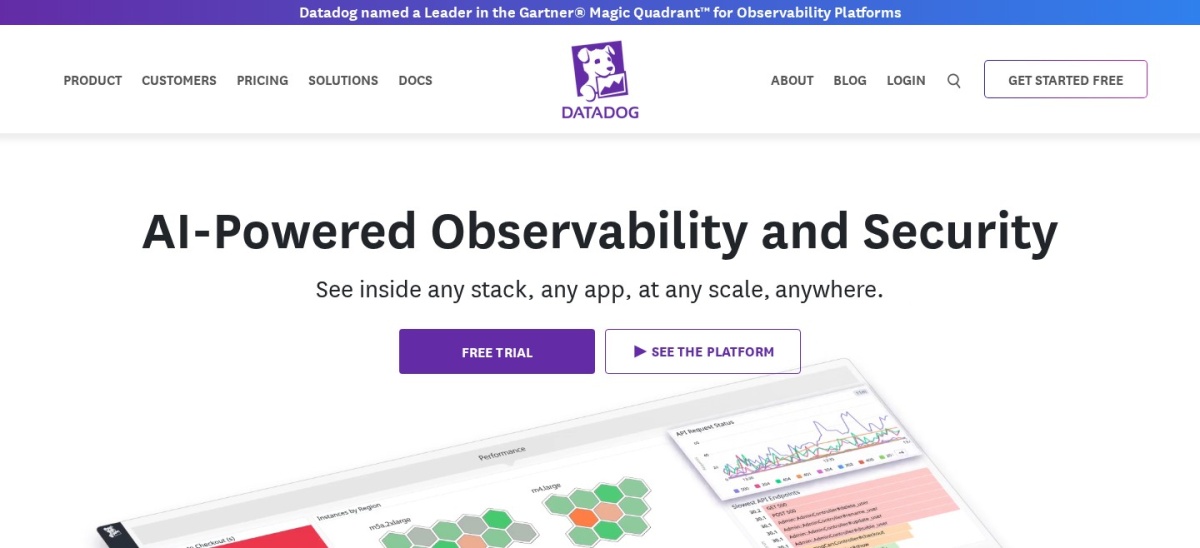
Datadog is the closest full-suite replacement for Site24x7, with infrastructure monitoring from $15 per host a month and more than 800 integrations.
New Relic charges no per-host fee and starts at $10 a month for the first full platform user, but a second user costs $99 a month on Standard.
Site24x7 itself starts at $9 a month, so only New Relic undercuts it on entry price; the rest charge more for a narrower or deeper focus.
UptimeRobot, Checkly and StatusCake cover the uptime half of Site24x7 from $12 to $24 a month, with free plans for small setups.
Dynatrace is the priciest start at $58 a month per 8 GiB host, and its bill scales with host memory rather than host count.
How do you choose the best Site24x7 alternative?
Start from what you actually monitor in Site24x7. A team that only watches websites and APIs can switch to an uptime tool, while a team that also tracks servers, logs and traces needs a full observability platform.
The billing unit decides the real cost. Datadog and Dynatrace charge per host, New Relic charges per user and per gigabyte, and UptimeRobot and StatusCake charge a flat monthly fee, so price each option on your own host and user counts.
A free tier is only useful if its limits match your traffic. UptimeRobot covers 50 monitors free, Grafana Cloud gives 10,000 metric series and 50 GB of logs, and New Relic gives 100 GB of ingest a month. Our guide on how to monitor a WordPress site shows the same idea at a smaller scale: one view of uptime, errors and changes beats three separate tools.
Check speed and coverage before you switch. Paid uptime checks run every 30 to 60 seconds against free checks at 3 to 5 minutes, and only the full platforms add server metrics, APM and real user monitoring in the same account. Our guide on what is uptime explains the percentages those checks produce.
Datadog is a cloud observability platform that covers infrastructure, APM, logs, real user monitoring and synthetics from one account, with more than 800 integrations. The free tier covers up to 5 hosts with 1-day metric retention, and Infrastructure Pro costs $15 per host a month on annual billing with 15-month retention.
The trade off is that every product has its own meter. APM adds $31 per host a month, logs bill per gigabyte ingested, and host counts are billed on a high-water mark, so a short spike can set the price for the month. It suits teams that want the deepest single replacement for Site24x7 and can budget per host.
New Relic is a usage-based observability platform with APM, distributed tracing, infrastructure monitoring, logs and synthetics in one account. The free tier includes 100 GB of data ingest a month, one full platform user and unlimited basic users, and there is no per-host, per-agent or per-container charge.
The trade off is user pricing. On Standard, the first full platform user costs $10 a month but each additional user costs $99 a month, up to five users, and Pro charges $349 per full platform user a month on an annual commitment. It suits teams with many hosts and few people who need full access.
What we like
No per-host charge, so host count does not set the bill
Free tier includes 100 GB of ingest a month
One free full platform user with all capabilities
500 synthetic checks included on the free tier
Watch out for
A second full platform user costs $99 a month on Standard
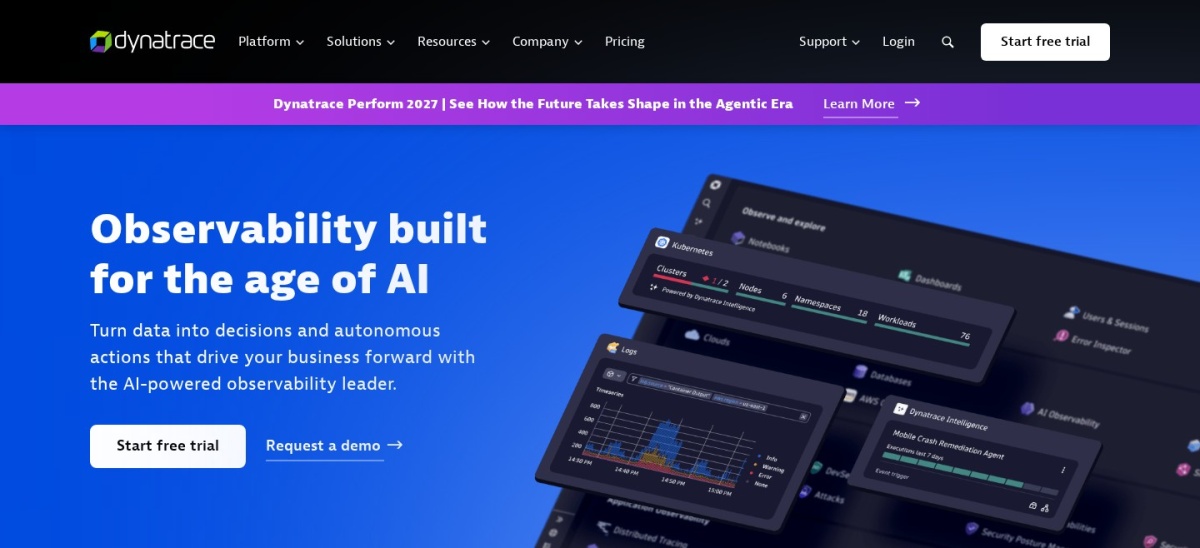
Dynatrace is an enterprise observability platform that pairs APM with automated root-cause analysis, so it points to the failing service instead of leaving you to read charts. Full-Stack Monitoring costs $58 a month per 8 GiB host, billed at $0.01 per memory-GiB-hour, and includes code-level profiling, Kubernetes monitoring and 67 GiB of trace volume.
The trade off is price and commitment. The bill scales with host memory, a 32 GiB host costs about four times an 8 GiB host, and Dynatrace sells through an annual commitment with a minimum spend it does not publish. It suits large teams that want the analysis done for them.
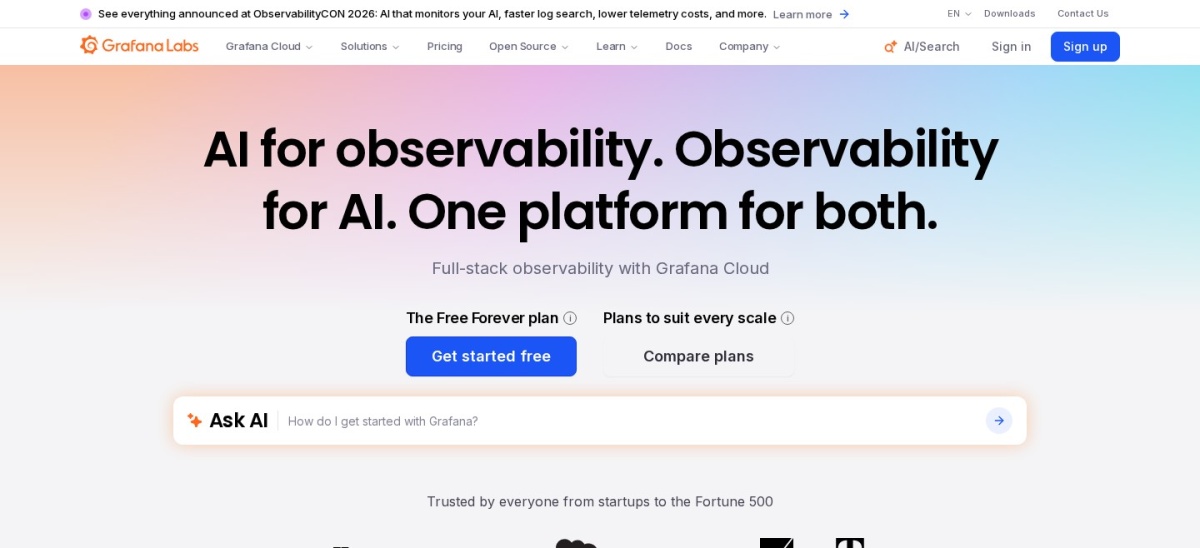
Grafana Cloud is the hosted version of the open-source Grafana stack, with managed metrics, logs, traces and profiles behind Grafana dashboards. The free tier includes 10,000 active metric series, 50 GB each of logs, traces and profiles, and 3 users with 14-day retention, and Pro starts at a $19 monthly platform fee plus usage.
The trade off is metering. Metrics cost $6.50 per 1,000 active series above the allowance, and logs and traces cost $0.05 per GB to process plus $0.40 per GB to write, so a busy app can pass the $19 fee fast. It suits teams that already know Grafana and want open standards.
What we like
Lowest paid start among the full platforms here
Free tier covers 10,000 series and 50 GB of logs
OpenTelemetry-native, so data stays portable
13-month retention for metrics on Pro
Watch out for
Usage above the allowance bills per series and per GB
APM-style tracing needs the Application Observability add-on
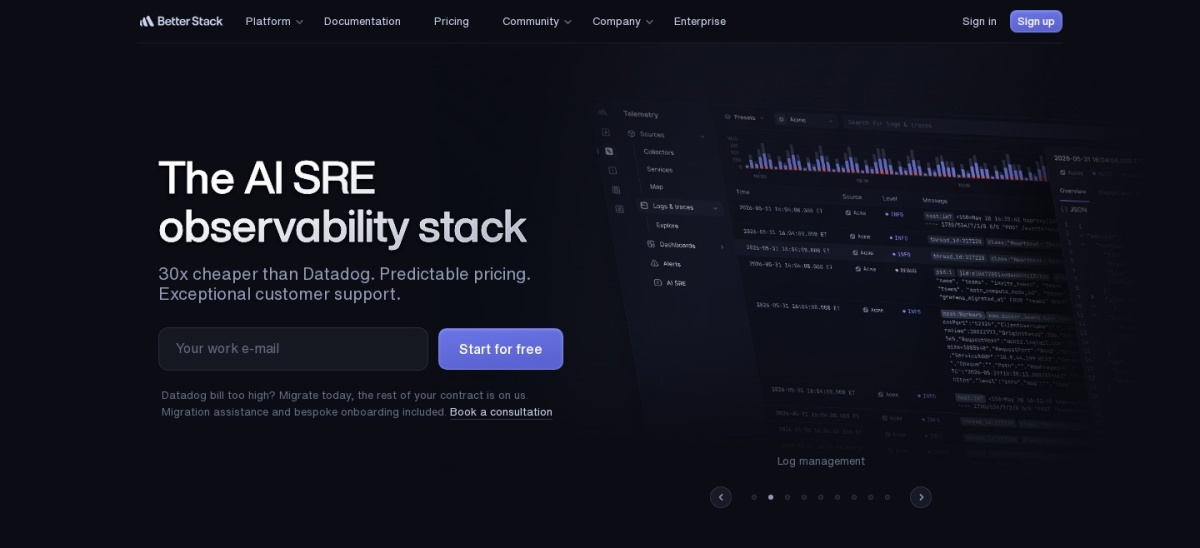
Better Stack is a cloud telemetry and incident response platform that combines structured log management with uptime monitoring and on-call alerting. Its free tier includes 3 GB of monthly logs with 3-day retention, 10 monitors and 10 heartbeats, Slack or email alerts and one status page, and paid responder plans start at $29 a month billed annually.
The trade off is modular add-on pricing once you scale beyond entry quotas, with paid responder plans starting at $29 a month billed annually ($34 a month monthly) and additional log ingestion at $0.10 per GB. It suits small teams that want logs, status pages and paging without buying three tools.
What we like
Highest G2 rating in this list at 4.8 out of 5
On-call paging and status pages built in
Logs, status pages and heartbeats in one platform
Free tier with 10 monitors and 3 GB of logs
Watch out for
Narrower APM depth than the full platforms
Responder licences are per seat, so paging costs grow
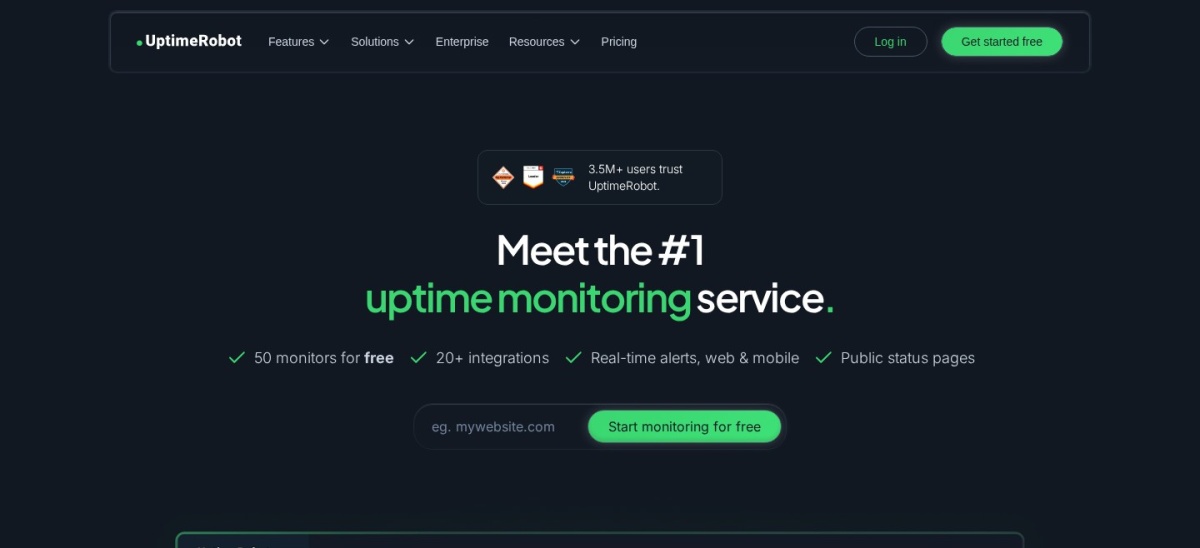
UptimeRobot is a straightforward uptime monitoring service for websites, APIs, ports, DNS, SSL certificates and cron jobs. The free plan covers 50 monitors at 5-minute intervals with one status page and no card required, and Solo costs $12 a month billed annually for 10 monitors at 60-second intervals.
The trade off is the monitor count. Solo covers fewer monitors than the free plan, so paying buys faster checks, more monitor types and 12 months of log retention rather than more coverage. It suits small sites that need simple uptime checks on a small budget.
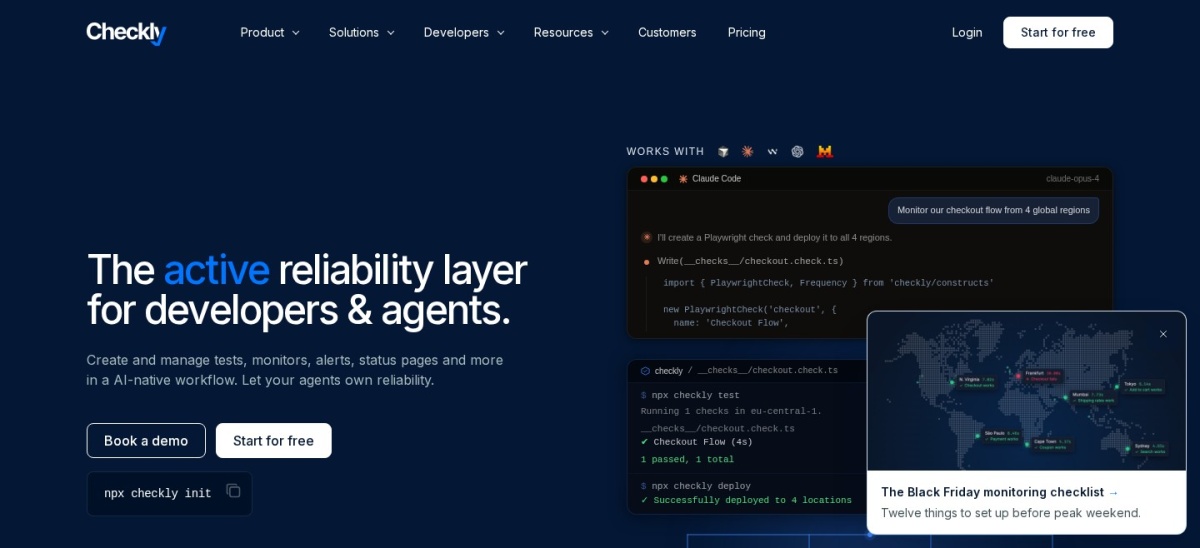
Checkly is a synthetic monitoring platform that treats checks as code. API checks are written in JavaScript or TypeScript, stored in Git and deployed through the normal pipeline, and Playwright browser checks run beside them. The free Hobby plan covers 10 uptime monitors, 10,000 API check runs and 1,000 browser runs a month.
The trade off is check-run billing. Starter costs $24 a month billed annually for 50 monitors, 25,000 API runs and 3,000 browser runs, and extra browser runs cost $6.50 per 1,000, so frequency and location count drive the bill. It suits development teams that already practice infrastructure as code.
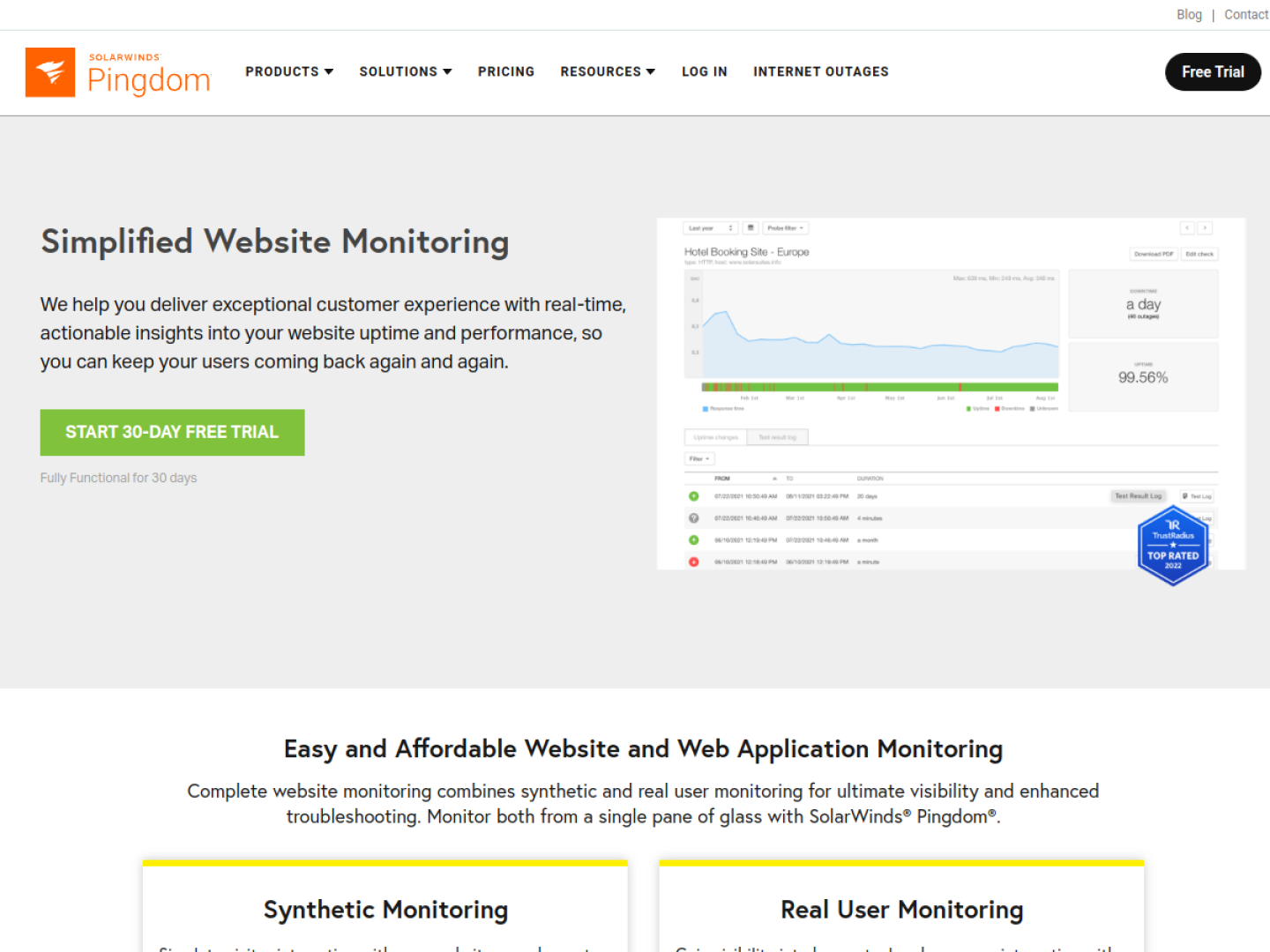
Pingdom is one of the oldest names in uptime monitoring, from SolarWinds, and it covers uptime checks, page speed monitoring and multi-step transaction checks from more than 100 probe locations. Synthetic Monitoring starts at $16.50 a month billed annually for 10 uptime checks, 1 advanced check and 50 SMS credits, with 1-minute checks and unlimited users.
The trade off is that the price is a calculator, not a plan. The product pages say synthetic monitoring starts at $10 a month, but the pricing calculator's smallest synthetic option is $16.50 a month billed annually, and real user monitoring is a second subscription priced by pageviews. It suits teams that want a long track record and simple uptime plus RUM.
What we like
Longest track record in this list
More than 100 probe locations worldwide
Transaction checks walk through logins and checkouts
StatusCake is a cloud monitoring platform for uptime, page speed, domain, SSL and server checks, with status pages sold separately. The free plan covers 10 uptime monitors at 5-minute intervals plus one page speed, domain and SSL monitor, and Superior costs $20.41 a month billed annually for 100 monitors at 1-minute intervals.
The trade off is a thin review base. StatusCake is rated 4.8 out of 5 on G2, but from only 15 reviews, so the rating is weak evidence next to the hundreds behind Datadog and Dynatrace. It suits small teams that want uptime and page speed checks in one cheap plan.
What we like
100 monitors on Superior for $20.41 a month
Page speed, domain and SSL checks included
Free plan covers uptime, page speed and SSL
75 free SMS credits a month on Superior
Watch out for
Only 15 G2 reviews, the thinnest base in this list
Free tiers in this list are real plans, not trials, for seven of the nine tools. UptimeRobot, Grafana Cloud, New Relic, Better Stack, Checkly and StatusCake all let you run a small setup without paying.
The limits that bite first are volume and speed. Free checks run every 3 to 5 minutes, while paid checks run every 30 to 60 seconds, and free log retention is 3 to 14 days against 30 days or more on paid plans.
Dynatrace and Pingdom have no free plan, only a trial of 15 or 30 days, so budget for a paid tier from the start if either is your pick.
If you only need uptime, a free plan may be enough for years. If you need server metrics, APM or logs, the free tiers of the full platforms are the place to start, and the paid step is $10 to $19 a month.
How we chose
We started from the platforms most often named as Site24x7 replacements, from full observability suites to uptime-only tools, then kept nine with a public rating, a published price and an active product in 2026.
Prices come from each vendor's pricing page, checked on 29 November 2026, with Pingdom and Better Stack prices cross-checked against secondary pricing guides that cite the official pages. Ratings and review counts come from G2 on the same day, except Pingdom, which uses Capterra. Where a vendor shows a sale, the list shows the regular price.
We left out Site24x7 itself, tools with no published price, and tools with no public rating. No vendor paid for a place, and we do not claim to have used these tools ourselves.
How to choose a Site24x7 alternative
Start with the coverage you use in Site24x7 today, then match the billing unit to your fleet.
List what you monitor in Site24x7. Count your websites, servers, networks and apps, and note whether you use APM, RUM or logs. Uptime-only tools replace only the website half.
Price each option on your own counts. Per-host tools grow with your fleet, per-user tools grow with your team, and flat-fee tools stay fixed. Run your host and user numbers through each price before you commit.
Run the free tier on real traffic for two weeks. A trial on test data hides volume limits. Send production checks and telemetry, and watch which limit you hit first.
Check the exit cost before you commit. OpenTelemetry-native tools let you move dashboards and agents, while a closed agent ties your alerts to one vendor. See how to check your hosting uptime for a baseline to compare against.
FAQ
What is the best Site24x7 alternative in 2026?
Datadog is the best Site24x7 alternative for most teams. It covers infrastructure, APM, logs, real user monitoring and synthetics in one account, from $15 per host a month, and is rated 4.4 out of 5 on G2 from 726 reviews.
What is the cheapest Site24x7 alternative?
New Relic is the cheapest paid start at $10 a month for the first full platform user on Standard, and UptimeRobot follows at $12 a month. Site24x7 itself starts at $9 a month, so most alternatives cost more at the entry level.
Is there a free alternative to Site24x7?
Yes. UptimeRobot covers 50 monitors free, Grafana Cloud gives 10,000 metric series and 50 GB of logs, and New Relic gives 100 GB of ingest a month. Dynatrace and Pingdom offer only a trial instead of a free plan.
Which Site24x7 alternative is best for small teams?
Better Stack suits small teams best, because it bundles logs, uptime monitoring, status pages and on-call paging from $29 a month. UptimeRobot is the better pick if the team only needs uptime checks and a status page.
Is Datadog or New Relic better than Site24x7?
Datadog is better if you want the deepest single replacement, with APM, logs and synthetics beside infrastructure monitoring. New Relic is better if you want no per-host billing, since it charges per user and per gigabyte instead.
Can I switch from Site24x7 without losing my monitors?
Partly. Uptime checks, alert rules and status pages usually need rebuilding in the new tool, but agents and integrations move faster on OpenTelemetry-native platforms such as Grafana Cloud. Export your monitor list first so nothing is missed.
SaaS SEO and WordPress specialist with about 8 years of experience. Rakib compares WordPress plugins, themes, hosting and software using public pricing, documentation and user reviews. See how we rank.