Playwright is the best of the Selenium alternatives for most teams: it is free, drives Chromium, Firefox and WebKit from one API, and holds a 4.8 out of 5 G2 rating. Cypress suits JavaScript teams that want time-travel debugging, while Puppeteer is the lightest pick for Chrome-only work.
How we make this list: we compare pricing pages, product documentation and public user reviews, then re-check every price before each update. No product paid for a place. Disclosure.
Playwright is free, covers three browsers from one API and leads on G2 at 4.8 out of 5 from 15 reviews.
Cypress adds time-travel debugging and a cloud dashboard; Team costs $67 a month billed annually.
Six of the nine tools have a free plan; BrowserStack, Sauce Labs and TestComplete do not.
Katalon is the only low-code pick that also covers API and mobile testing in one project.
mabl is quote-only at a reported $500 a month, and TestComplete Base lists at $3,598 a year.
What should you look for in Selenium alternatives?
Selenium is free, so any replacement has to earn its price. The usual reasons teams switch are flaky waits, driver setup and slow debugging, not the licence fee.
Frameworks and clouds solve different problems. Frameworks such as Playwright run on your own machines and cost nothing; clouds such as BrowserStack run your suite on real browsers and devices. If your suite is slow before it is flaky, our load-test guide shows how to measure it first.
Ratings in this list come from G2, checked on 29 November 2026. Read the review counts beside the scores: Puppeteer's 5.0 rests on one review and Playwright's 4.8 on 15, while BrowserStack's 4.4 rests on more than 3,300.
Price splits the list in two. Six tools have a free plan, the cheapest paid cloud starts at $39 a month, and the dearest picks, mabl and TestComplete, cost thousands a year.
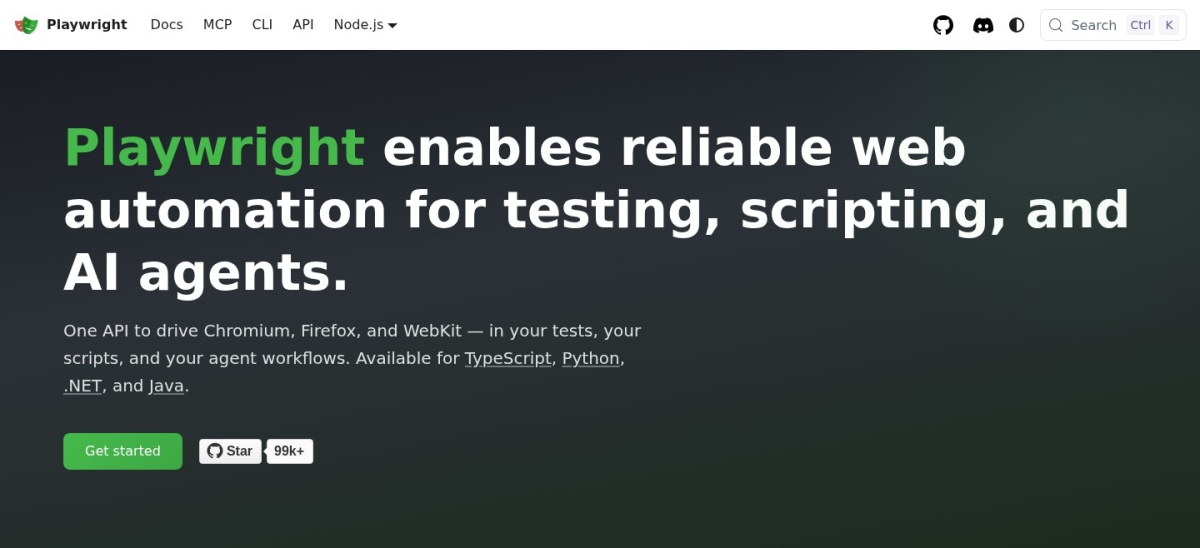
Playwright is Microsoft's free, open-source framework for driving Chromium, Firefox and WebKit from one API. It includes auto-waiting, a built-in test runner, code generation, tracing and parallel runs, and it holds a 4.8 out of 5 rating on G2 from 15 reviews.
The trade off is that it is code-first, so non-developers will find it harder to start than a low-code recorder, and there is no native mobile app support. It suits developers and QA teams who want one free framework for end-to-end web tests.
What we like
Free with no paid tier
Three browsers from one API
Auto-waiting cuts flaky tests
Tracing, codegen and parallel runs built in
Watch out for
Code-first, so a learning curve for non-developers
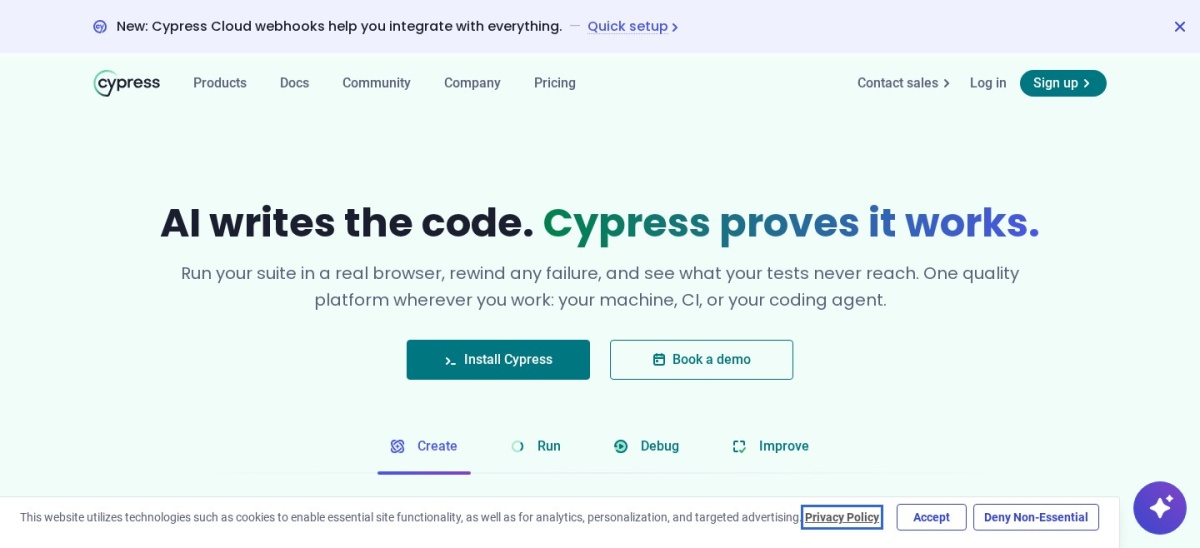
Cypress is an open-source test runner for modern web apps that runs inside the browser, with time travel, live reload and a readable JavaScript API. The free Cloud Starter plan covers 10 users and 500 test results a month, and the runner itself is free under the MIT licence.
The trade off is the cloud bill. Test Replay, flake detection and 120,000 test results a year come with Team at $67 a month billed annually, and it runs only in Chromium-based browsers plus Firefox and Edge. It suits JavaScript teams that want the best debugging experience.
What we like
Best-in-class time-travel debugging
Free runner and Starter cloud plan
Huge JavaScript community and docs
Watch out for
No WebKit or Safari support
Cloud pricing scales with test results
Multi-tab and multi-origin flows are limited
Team adds Test Replay, flake detection and 120,000 results a yearVisit cypress.io
03
Puppeteer
5/5on G2 (1 reviews, checked Nov 2026)
PriceFree
Best for Chrome-only scripting
BrowsersChrome, Firefox
ControlDevTools protocol, WebDriver BiDi
LanguagesJavaScript
Paid planNone, free
pptr.dev
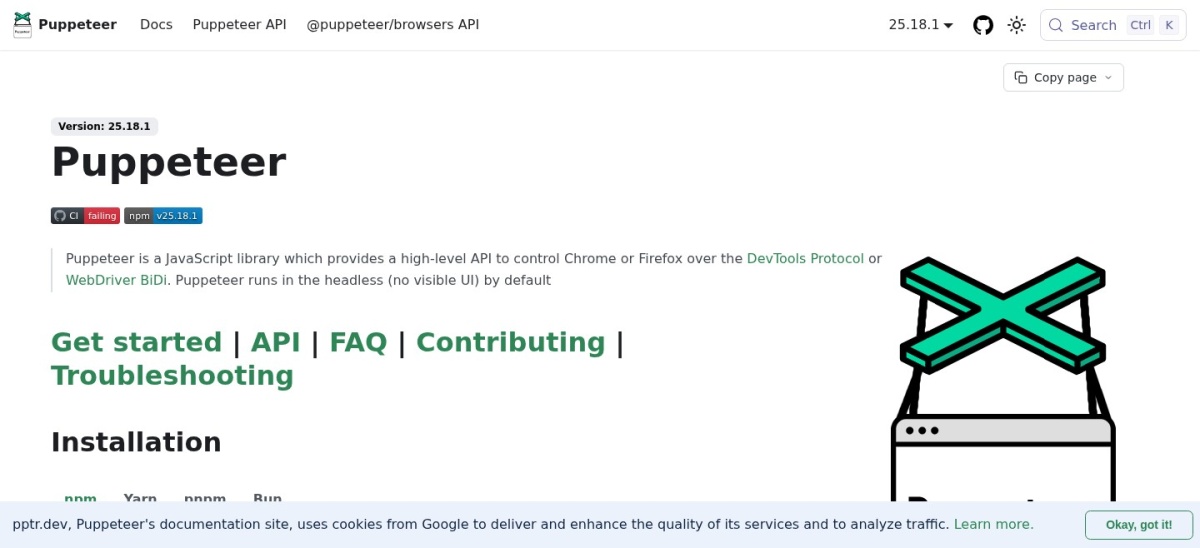
Puppeteer homepage, captured Nov 2026.
Puppeteer is Google's free JavaScript library for controlling Chrome or Firefox through the DevTools protocol or WebDriver BiDi. It has a small API, starts fast, and is a strong fit for screenshots, PDFs and scraping as well as tests.
The trade off is breadth. It covers Chrome and Firefox only, has no built-in test runner, and its 5.0 G2 rating rests on a single review. It suits developers who need light Chrome scripting rather than a full test framework.
What we like
Tiny API, fast to learn
Good for screenshots and PDFs
Free with no paid tier
Watch out for
No Safari or WebKit support
No built-in test runner or assertions
G2 rating rests on one review
No paid plan; the library is free and open sourceVisit pptr.dev
04
Katalon
4.4/5on G2 (226 reviews, checked Nov 2026)
Paid from$150/mo
Best low-code pick for QA teams
CoverageWeb, API, mobile, desktop
AuthoringLow-code recorder plus scripts
LanguagesGroovy, Java
Paid planProfessional, $150/seat/mo
katalon.com
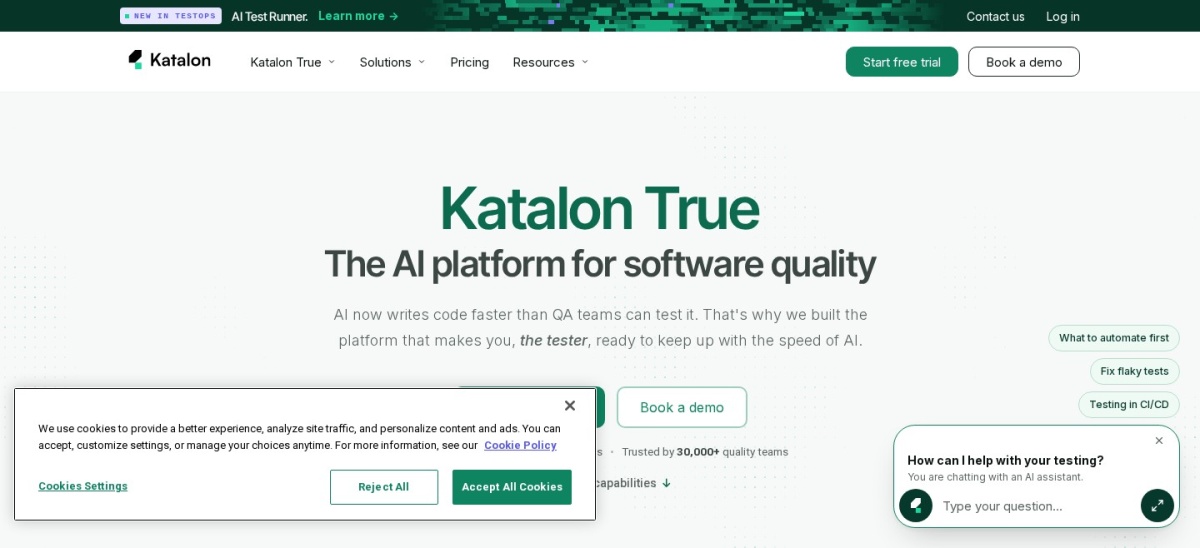
Katalon homepage, captured Nov 2026.
Katalon is a low-code test platform for web, API, mobile and desktop testing in one project. Its free Studio covers recording and playback, manual and script views, and local runs, and it holds a 4.4 out of 5 G2 rating from 226 reviews.
The trade off is price. Parallel runs, AI self-healing and script generation need Professional at $150 a seat a month billed annually, and CI runs need the Runtime Engine. It suits mixed-skill QA teams that want one tool for web, API and mobile.
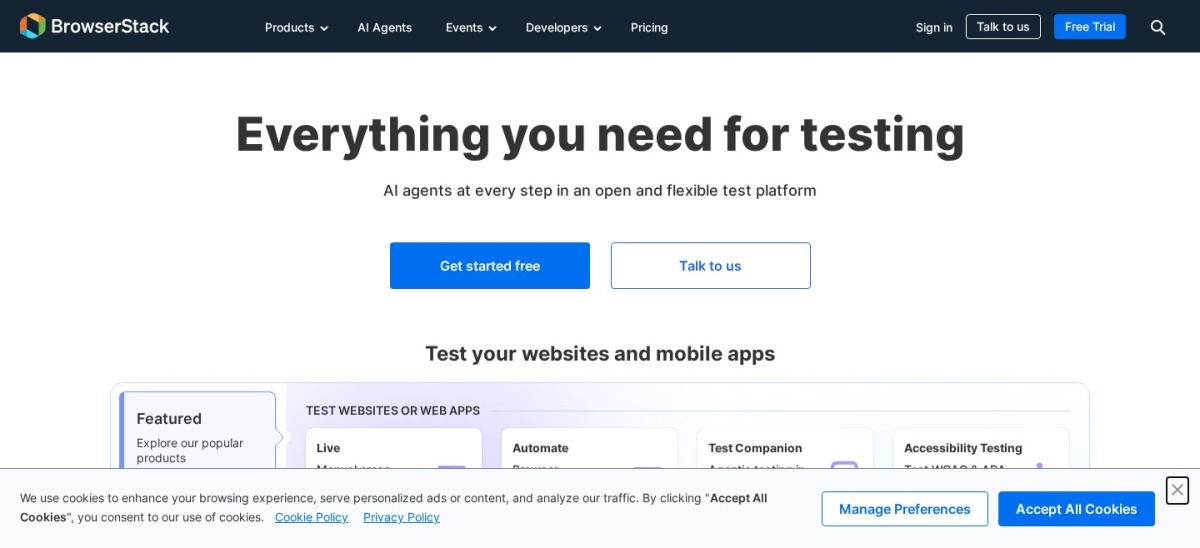
BrowserStack Automate homepage, captured Nov 2026.
BrowserStack Automate is a cloud grid that runs Selenium, Playwright, Cypress and Puppeteer suites across real browsers and devices. It removes the need to maintain your own grid, and it holds a 4.4 out of 5 G2 rating from 3,358 reviews.
The trade off is cost per parallel. Chrome-only runs start at $59 a month billed annually, desktop and mobile costs $175, and every extra parallel multiplies the bill. It suits teams that need real-device coverage without running a lab.
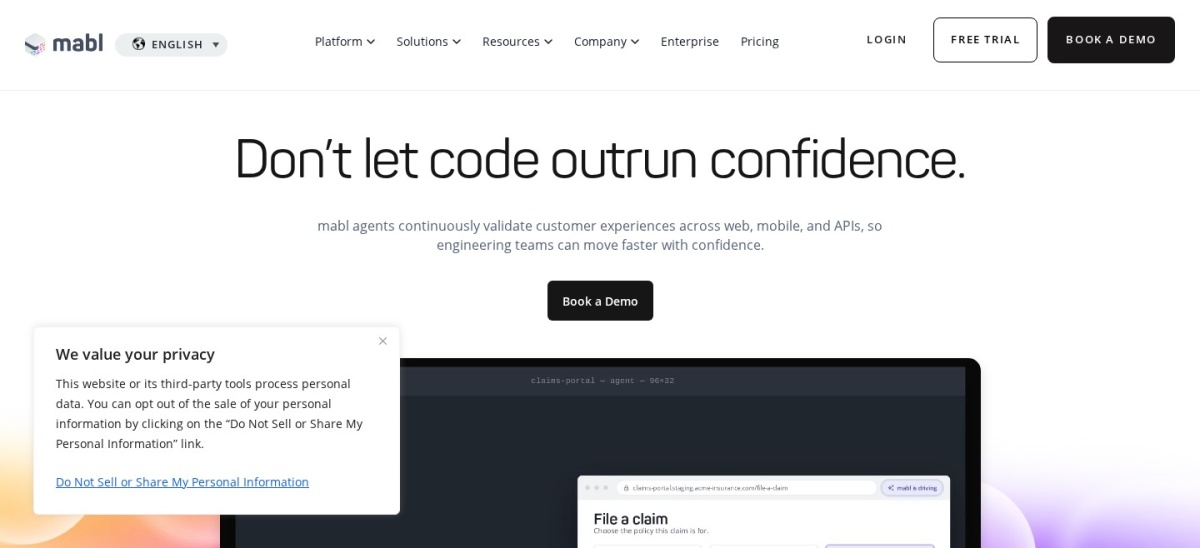
mabl is a low-code, AI-first test platform for web, mobile, API and performance testing. Its free plan covers one app, its machine-learning engine heals broken locators automatically, and it holds a 4.4 out of 5 G2 rating from 40 reviews.
The trade off is price opacity. mabl publishes no prices and sells through sales, with third-party reports putting the entry plan near $500 a month, and mobile testing costs extra. It suits teams that want low-code authoring with self-healing and can budget a sales cycle.
What we like
Auto-healing cuts test maintenance
Low-code authoring with AI agents
Covers web, mobile, API and performance
Watch out for
No published price; quote-only sales
Entry plan reported near $500 a month
No test export, so vendor lock-in
Paid plans add parallel runs and cloud creditsVisit mabl.com
07
Sauce Labs
4.3/5on G2 (178 reviews, checked Nov 2026)
Starts at$39/mo
Best for running Selenium suites in the cloud
GridReal devices and emulators
FrameworksSelenium, Playwright, Cypress
Parallel tests1 per plan, more cost extra
Paid planLive Testing, $39/mo
saucelabs.com
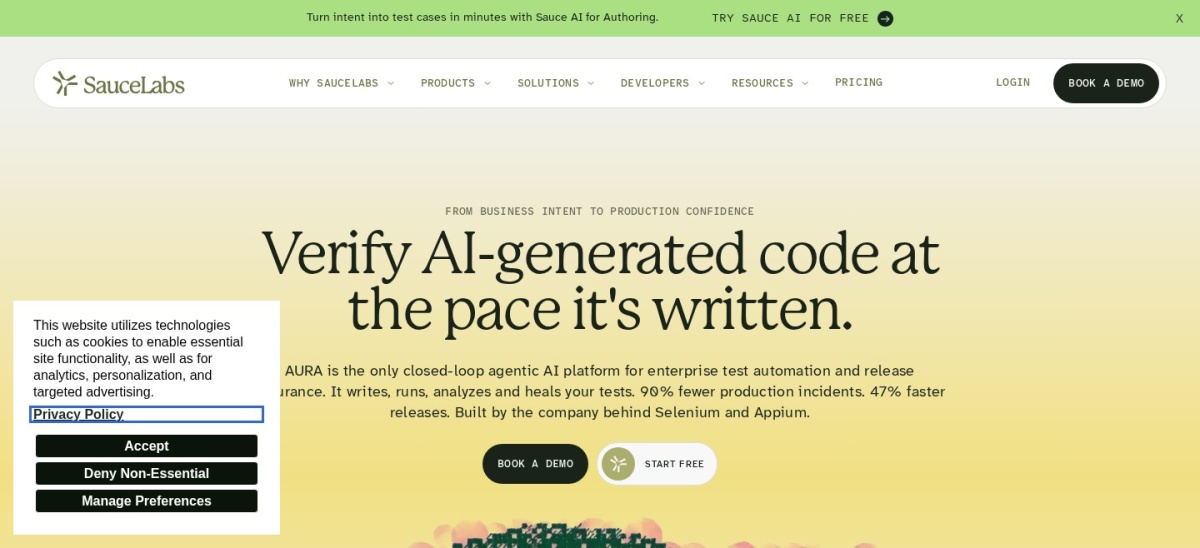
Sauce Labs homepage, captured Nov 2026.
Sauce Labs is a cloud platform for running automated tests across real devices, emulators and browsers. It runs Selenium, Playwright, Cypress and Appium suites, records video of every run, and holds a 4.3 out of 5 G2 rating from 178 reviews.
The trade off is that the entry plan is manual. Live Testing at $39 a month billed annually covers live cross-browser checks, while automated runs on virtual devices start at $149 a month. It suits enterprises with existing Selenium suites and broad device needs.
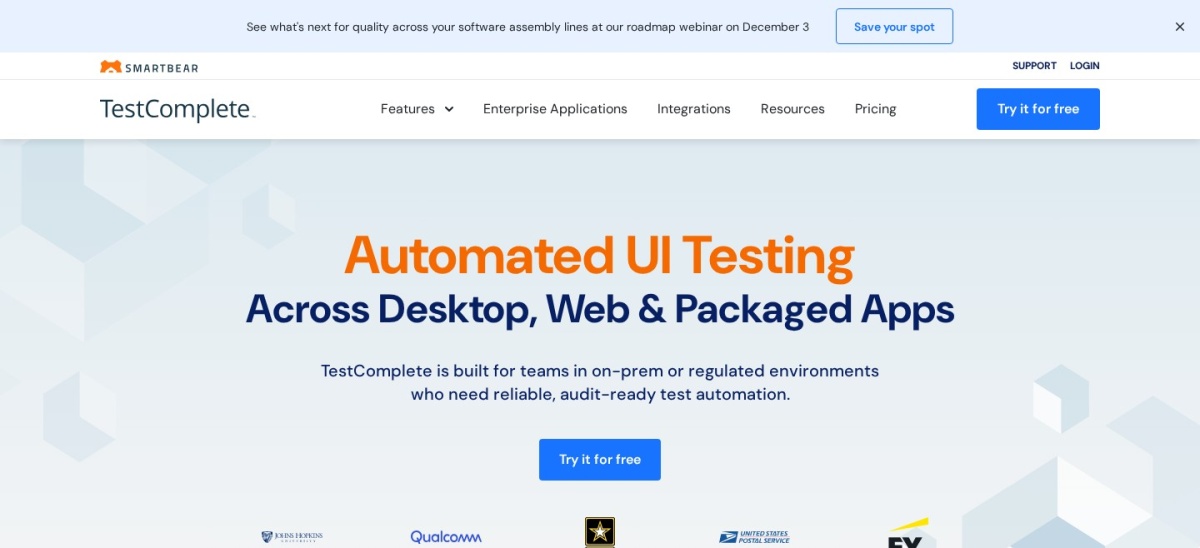
TestComplete is SmartBear's commercial tool for automated UI testing across desktop, web and mobile apps. It offers keyword-driven tests for non-programmers as well as scripted tests, with AI-powered object recognition and a 14-day trial.
The trade off is price. Base lists at $3,598 a year per fixed licence, other sources list a $4,318 fixed licence, and authoring runs on Windows only. It suits enterprise teams that test desktop apps beside the web.
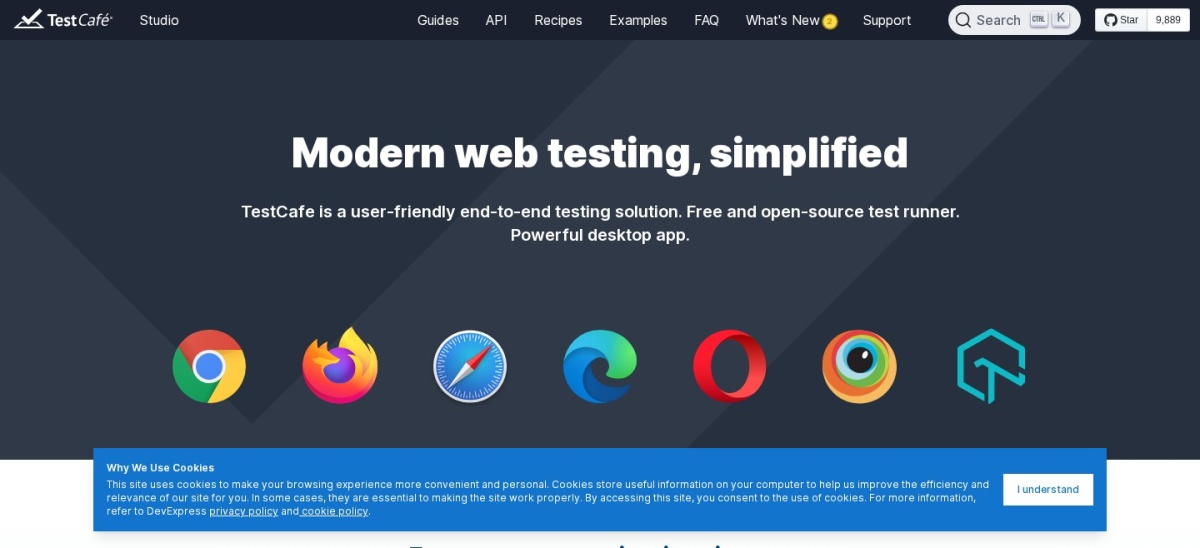
TestCafe is a free, open-source Node.js framework that runs end-to-end tests without installing browser drivers. It waits for elements on its own, runs tests in parallel, and works in any browser installed on the machine, including remote ones.
The trade off is a shrinking commercial side. DevExpress pulled TestCafe Studio from its pricing page in November 2026, so the free framework is the current offer, and the ecosystem is smaller than Playwright's. It suits JavaScript teams that want tests running with no driver setup.
What we like
No WebDriver or driver installs
Free and open source
Parallel runs built in
Watch out for
Commercial Studio IDE was pulled in Nov 2026
Smaller ecosystem than Playwright
No low-code recorder in the free framework
Studio IDE was pulled from DevExpress pricing in Nov 2026Visit testcafe.io
When to keep Selenium instead
Selenium is still the right call for polyglot teams. Its official bindings cover Java, Python, C#, Ruby, JavaScript and Kotlin, more languages than any tool in this list.
Selenium Grid is free, and large teams already run it. If your grid, drivers and page objects already work, switching frameworks means rewriting tests for a gain you may not feel.
The switch pays when flaky waits and driver setup eat your time. Playwright's auto-waiting and single API, or Katalon's recorder for non-developers, are the usual reasons teams move.
How we chose
We started from the frameworks and cloud platforms most often named as Selenium alternatives, then kept the nine with a published G2 rating and a verifiable price or free plan.
Prices come from each vendor's pricing page or G2's pricing data, checked on 29 November 2026, except mabl, which publishes no price, so the list shows the reported $500 a month and says so. Ratings and review counts come from G2 on the same day.
We left out WebdriverIO, which has no G2 or Capterra rating on a 1 to 5 scale, and LambdaTest, which rebranded to TestMu AI in January 2026 with conflicting ratings and automation prices. No vendor paid for a place, and we do not claim hands-on testing for this list.
How to choose a Selenium alternative
Start with what your team already writes, then pick the cheapest tool that covers your browsers.
Match the tool to your language. JavaScript and TypeScript teams get the most from Playwright, Cypress, Puppeteer or TestCafe. Java or C# teams should look at Katalon or TestComplete, or stay on Selenium.
Decide framework or cloud first. Frameworks run on your machines and cost nothing in licences; clouds run your suite on real browsers and devices, and charge per parallel session.
Count the browsers you must cover. Chrome-only work needs nothing more than Puppeteer. Add Firefox and Safari and Playwright or a cloud grid earns its place.
Trial the top two on your own suite. Run the same ten flaky tests in each tool for a week and compare failure rates before you commit a team to a rewrite.
FAQ
What is the best Selenium alternative in 2026?
Playwright is the best Selenium alternative for most teams in 2026. It is free, drives Chromium, Firefox and WebKit from one API, includes auto-waiting and tracing, and holds a 4.8 out of 5 G2 rating from 15 reviews.
Is there a free alternative to Selenium?
Yes. Playwright, Puppeteer and TestCafe are free and open source, Cypress has a free test runner and cloud Starter plan, and Katalon Studio is free for local runs. Only BrowserStack, Sauce Labs and TestComplete need a paid plan or trial to start.
Which Selenium alternative is best for beginners?
Katalon is the best pick for beginners. Its recorder builds tests without code, manual and script views sit side by side, and the free Studio covers web, API and mobile tests in one project.
Playwright vs Cypress: which should I choose?
Choose Playwright for cross-browser coverage, parallel runs and a free licence with no paid tier. Choose Cypress if your team writes JavaScript and values time-travel debugging, and can accept Chromium, Firefox and Edge only plus a cloud bill from $67 a month.
Do I still need Selenium Grid if I switch?
No, if you move to a cloud grid. BrowserStack Automate and Sauce Labs run your Selenium, Playwright or Cypress suites on real browsers and devices, so you can retire your own grid. Frameworks alone still need your own machines or CI runners.
What is the cheapest paid Selenium alternative?
Sauce Labs is the cheapest paid pick in this list at $39 a month billed annually for Live Testing, though automated runs start at $149 a month. BrowserStack Automate Chrome is next at $59 a month billed annually.
SaaS SEO and WordPress specialist with about 8 years of experience. Rakib compares WordPress plugins, themes, hosting and software using public pricing, documentation and user reviews. See how we rank.