Clio is the best legal workflow automation software for small law firms, with matter-stage triggers and document automation from 49 dollars per user each month. Pick MyCase when budget matters most or Smokeball when your firm lives in documents.
How we make this list: we compare pricing pages, product documentation and public user reviews, then re-check every price before each update. No product paid for a place. Disclosure.
Clio leads at $49 per user a month, with the largest integration ecosystem and 996 G2 reviews behind it.
Smokeball has the highest G2 rating here at 4.7 out of 5, built around automatic time capture and document automation.
MyCase, PracticePanther and CosmoLex all start at $49 to $50 per user a month with published tier prices.
Filevine, Smokeball and CARET Legal publish no price, so budget for a sales call before you commit.
Workflow automation often sits above the entry plan, so price the tier that actually includes the triggers you need.
How do you choose legal workflow automation software for small law firms?
A small law firm runs on workflows, even when nobody writes them down. Intake, conflict checks, document drafting, deadlines, billing and trust accounting all follow the same steps on every matter, and doing them by hand eats billable hours.
The tools here automate those steps. Clio triggers actions when a matter changes stage, Smokeball fills court forms from case data, and MyCase and PracticePanther move a file from intake to invoice without retyping it.
Price is mostly per user. Entry plans cluster at $49 to $50 a month, so a five-lawyer firm pays about $250 a month before add-ons, while quote-only tools need a sales call before you know the cost.
Automation depth is what separates the list. Entry plans cover the basics, but real workflow triggers, document generation and AI drafting usually sit on higher tiers, so check which tier the automation you need lives on.
The 9 best legal workflow automation software for small law firms
01
Clio Manage
4.6/5on G2 (996 reviews, checked Nov 2026)
Starts at$49/mo
Best legal workflow automation software overall
Integrations300+
AutomationMatter triggers (Advanced+)
Trust accountingIncluded every plan
Paid planStarter, $49/user/mo
clio.com
Clio Manage homepage, captured Nov 2026.
Clio Manage is the leading cloud practice management platform for law firms of every size, covering matters, documents, time, billing and payments in one system. Starter costs $49 per user a month, with legal accounting on every plan and more than 300 integrations including Microsoft 365, QuickBooks and DocuSign.
The trade off is that the automation costs more. Matter-stage triggers, document automation and customizable pipelines live on the Advanced tier and up, so budget above the entry plan. It suits a small firm that wants the broadest ecosystem and the strongest published data-safety story.
What we like
Largest integration ecosystem here
Legal accounting on every plan
Largest review base with 996 G2 reviews
Watch out for
Workflow automation needs the Advanced tier
Add-ons such as Clio Grow cost extra
Advanced adds workflow triggers and automationVisit clio.com
02
Smokeball
4.7/5on G2 (385 reviews, checked Nov 2026)
Starts at$49/mo
Best for document-heavy firms
Free trialYes
AutoTimeAutomatic time capture
Document automationPre-automated court forms
Paid plan$49/user/mo (reported)
smokeball.com
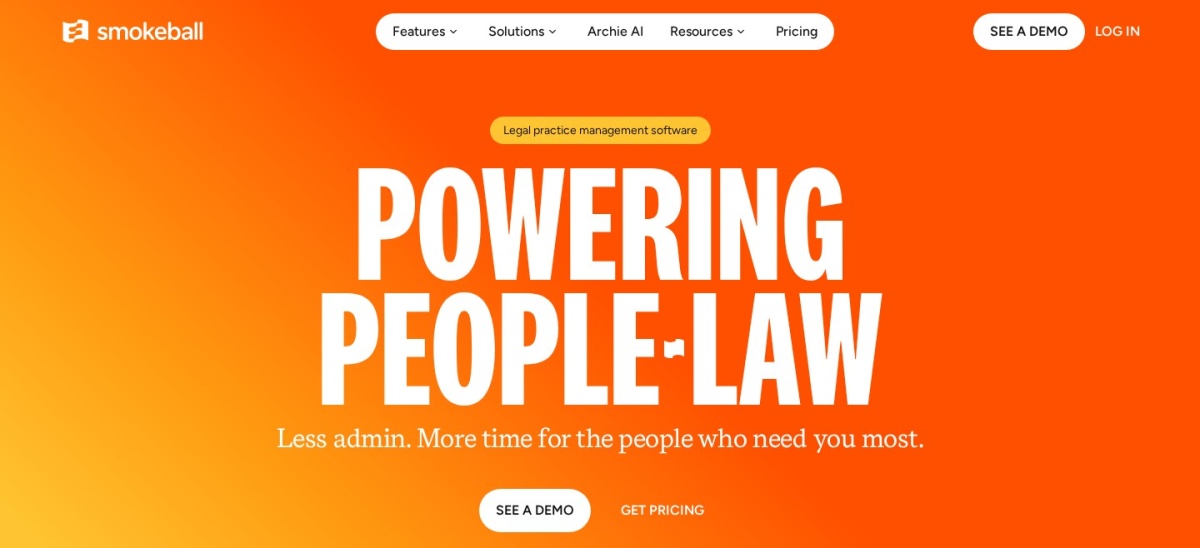
Smokeball homepage, captured Nov 2026.
Smokeball is a legal practice management platform built around documents, with automatic time capture and a deep library of legal forms. It combines matter and document management with AutoTime automatic time tracking, document automation, pre-automated court forms, trust accounting and the Archie AI assistant.
The trade off is pricing transparency. Smokeball publishes no prices on its own site, and reported entry prices range from $29 to $49 per user a month, so a firm must talk to sales. It suits document-heavy small firms that lose billable hours to manual time entry.
MyCase is a cloud practice management platform for solos and small firms, combining case management, billing, client texting and e-signature in one subscription. Basic costs $50 per user a month on annual billing and includes time entry, invoicing, online payments, unlimited document storage and a limited client portal.
The trade off is accounting depth. Full three-way trust reconciliation needs a $39 per user a month add-on on Pro and Advanced, and advanced automation sits on higher tiers. It suits a small firm that wants intake through invoicing in one login.
PracticePanther is a full practice suite with four published plans, from Solo at $49 per user a month billed yearly to Business Pro at $114. It includes a client portal, e-signature and workflow automation, with native texting and ePayments built in.
The trade off is accounting depth. Full legal accounting depends on the plan, with PantherAccounting Plus trust and operating accounting in Business Pro. It suits solos and small firms that want to see every tier price before talking to sales.
CosmoLex is the only tool here that builds full firm accounting into the same system as practice management. Launch costs $49 per user a month on annual billing and includes trust accounting and ledgers from the start, with a built-in general ledger and bank reconciliation.
The trade off is ecosystem size. It has a smaller integration ecosystem than Clio, and bank reconciliation and AI document summaries need the Core plan at $99. It suits a small firm that wants legal accounting and trust compliance without QuickBooks.
4.6/5on G2 (Not published reviews, checked Nov 2026)
PricingCustom/yr
Best for high-volume litigation
Free trialDemos only
WorkflowsConfigurable case projects
AI toolsSummaries and demands
Paid planCustom quote
filevine.com
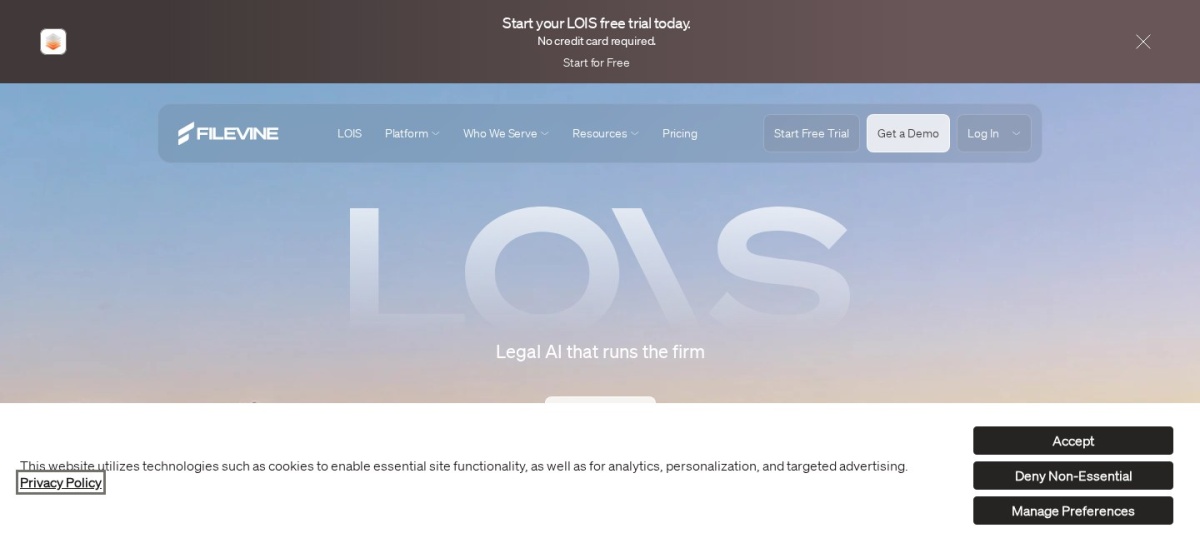
Filevine homepage, captured Nov 2026.
Filevine is a configurable case management platform for high-volume litigation and personal injury work. It ties documents, deadlines, tasks and reporting to each matter, with AI tools that summarise files and draft demands, and it holds a 4.6 out of 5 G2 rating.
The trade off is cost and setup. Filevine is quote-only, with reported prices from about $87 per user a month and implementation reported at $15,000 or more for a full build. It suits a litigation firm with complex, high-volume caseloads that needs deep configuration.
4.5/5on G2 (Not published reviews, checked Nov 2026)
Starts at$99/mo
Best for personal injury firms
Free trialNot listed
Best forPersonal injury firms
WorkflowsCase stages and tasks
Paid plan$99/user/mo
assemblysoftware.com
Assembly Neos homepage, captured Nov 2026.
Assembly Neos is a case management platform built for personal injury firms, with matter workflows, document automation and reporting tied to each case. It costs $99 per user a month and holds a 4.5 out of 5 G2 rating, sitting between the budget suites and the quote-only enterprise tools.
The trade off is focus. It is built for personal injury work, so a general practice may find its templates and workflows too narrow. It suits a small personal injury firm that wants structured case stages without an enterprise sales process.
LEAP is a legal practice management platform with matter management, document automation and billing in one subscription, sold by quote in the US and UK. It holds a 3.6 out of 5 G2 rating from only 40 reviews, the thinnest evidence in this list, with reported prices around $129 per user a month.
The trade off is the evidence base. It has the lowest G2 rating here and the fewest reviews, so the score rests on very few firms. It suits a small firm that lives on document automation and court forms and wants one subscription for everything.
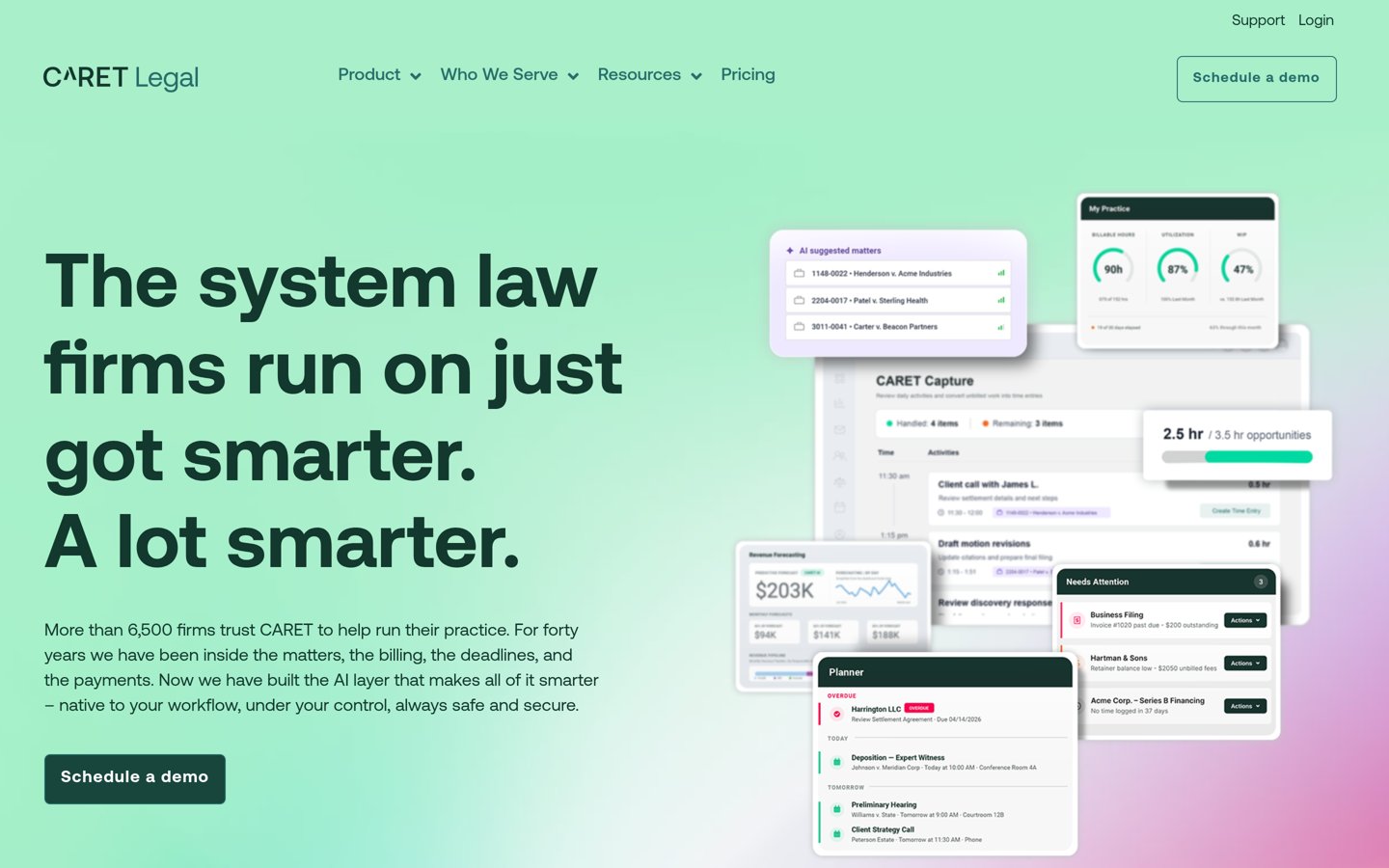
CARET Legal is a workflow and accounting-focused platform with case management and CRM for small and mid-size firms. It holds a 4.5 out of 5 G2 rating from 203 reviews, with workflow automation and legal accounting in one system, and it is sold on request rather than a published price.
The trade off is pricing transparency. There is no published price, so a firm must request a quote and a demo before it knows the cost. It suits a firm that wants workflow and accounting together and is happy with a sales-led deal.
Entry plans cover matters, documents, time and billing, but workflow triggers often cost more. Clio puts matter-stage triggers and document automation on Advanced and up, so budget above the $49 Starter plan if automation is the point.
MyCase keeps automated workflows on Pro at $100 a user a month, while PracticePanther includes workflow automation from Solo. Read the tier list before you buy, not after.
Smokeball automates from the start in a different way: AutoTime captures billable time passively, and its form library fills court documents from case data without a workflow builder.
How we chose
We started from the legal platforms that appear most often in November 2026 legal practice comparisons, then kept nine with public G2 ratings and published or reported pricing.
Prices come from each vendor's pricing page, checked on 30 November 2026, with several figures cross-checked against our own November 2026 legal guides. Ratings and review counts come from G2 on the same day.
We left out tools with no G2 rating and generic project tools that lack legal trust accounting. No vendor paid for a place, and we do not claim hands-on testing for this list.
How to choose legal workflow automation for a small firm
Start with the steps your firm repeats on every matter, then match the tool to those steps.
List the steps you repeat on every matter. Write down intake, conflict checks, document drafting, deadlines, billing and trust accounting. The tool must automate the steps that eat the most hours.
Check which tier the automation lives on. Entry plans cover matters and billing, but workflow triggers and document generation often sit on higher tiers. Price the tier you actually need.
Trial your top two picks on a real matter. Run one live matter through each tool, from intake to invoice, and see which one your team actually uses without prompting.
Confirm trust accounting before you sign. Ask the vendor to show three-way trust reconciliation on a call. A slide that lists it is not proof, and trust errors are expensive.
FAQ
What is the best legal workflow automation software for small law firms in 2026?
Clio is the best legal workflow automation software for small law firms. It covers matters, documents, time, billing and trust accounting from $49 per user a month, with the largest integration ecosystem and 996 G2 reviews behind it.
How much does legal workflow automation software cost for a small firm?
Entry plans cluster at $49 to $50 per user a month for Clio, MyCase, PracticePanther and CosmoLex. A five-lawyer firm pays about $250 a month, while quote-only tools such as Filevine and Smokeball need a sales call before you know the cost.
Does Clio automate legal workflows?
Yes. Clio Manage offers matter-stage triggers, document automation and customizable pipelines, but the workflow automation lives on the Advanced tier and up, so budget above the $49 Starter plan if automation is the point.
Is there free legal workflow software for small firms?
No. None of the nine tools here offers a permanent free plan. MyCase gives a 10-day free trial, Smokeball and PracticePanther offer trials or demos, and the cheapest paid entry is $49 per user a month.
Clio vs MyCase for a small law firm: which is better?
Pick Clio for the broadest ecosystem, with 300+ integrations and workflow automation from the Advanced tier. Pick MyCase for a lower learning curve and intake plus CRM in one login, with Basic at $50 per user a month.
Which legal software is best for document-heavy firms?
Smokeball is the best pick for document-heavy firms. It pairs automatic time capture with a deep library of pre-automated court forms and the Archie AI assistant, and it holds the highest G2 rating here at 4.7 out of 5.
SaaS SEO and WordPress specialist with about 8 years of experience. Rakib compares WordPress plugins, themes, hosting and software using public pricing, documentation and user reviews. See how we rank.