Connecteam is the best Homebase alternative for most small teams, because its Operations hub covers scheduling and a GPS time clock for a flat monthly rate for the first 30 users. Deputy suits compliance-heavy teams, while When I Work is the cheapest per-user scheduler in this list.
How we make this list: we compare pricing pages, product documentation and public user reviews, then re-check every price before each update. No product paid for a place. Disclosure.
Connecteam charges a flat $29 a month for the first 30 users, so the bill does not grow with every hire.
When I Work is the cheapest per-user scheduler here at $2.50 a user a month, with auto-scheduling on every plan.
Sling has the most generous free plan, covering scheduling and messaging for up to 30 users at no cost.
Buddy Punch is the highest rated here at 4.8 out of 5 on Capterra, but every plan adds a $19 monthly base fee.
7shifts is the pick for restaurants, with tip management and labour tools that general schedulers do not offer.
How do you choose the best Homebase alternative?
Most teams leave Homebase for one of three reasons: the free plan caps at 10 employees, a second location needs a higher plan, or they want a feature Homebase does not offer.
Start with your headcount and locations. A flat-rate tool such as Connecteam stays cheap as you hire, while a per-user tool such as When I Work wins for a single small site.
Check what the free plan really covers. Sling and ZoomShift give away scheduling for free, but the time clock usually sits on a paid plan.
Read the base fees before you compare headline prices. Buddy Punch and QuickBooks Time add a monthly base fee on top of the per-user rate, which changes the bill for tiny teams.
Pick the tool that matches your industry. Restaurants get more from 7shifts, field crews get more from Buddy Punch, and deskless teams get more from Connecteam.
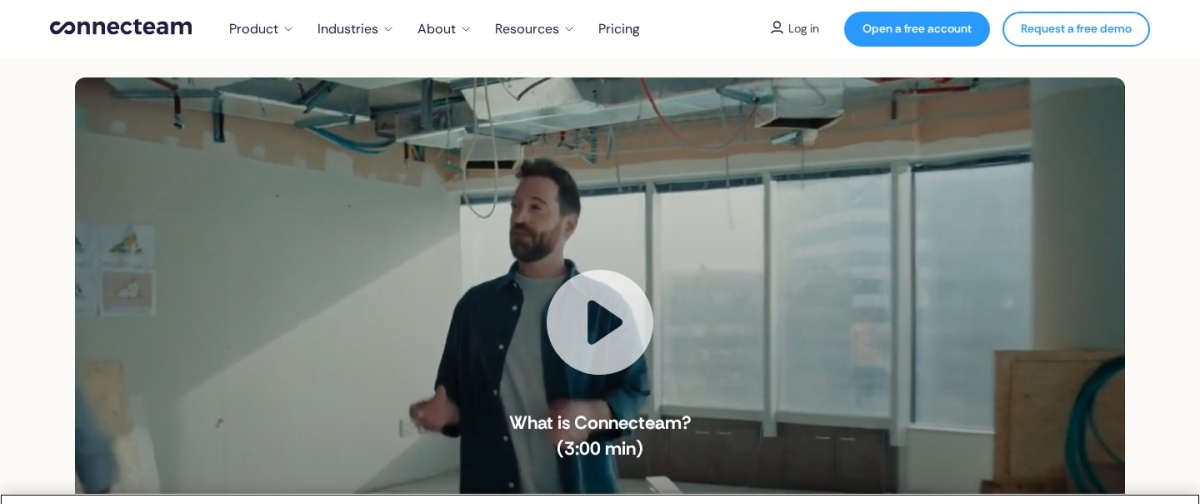
Connecteam is an all-in-one workforce app for deskless teams that covers scheduling, a GPS time clock, team chat, forms and training in one place. The free Small Business plan covers up to 10 users with full access to its Operations, Communications and HR hubs.
The trade off is hub pricing. Each hub is billed separately, so adding the Communications or HR hub on top of Operations raises the monthly bill. It suits multi-site teams that want one flat price for the first 30 users instead of paying per person.
What we like
Flat $29 a month for the first 30 users on each hub
Free plan covers 10 users with real features
GPS time clock, chat, forms and training in one app
Watch out for
Hubs are billed separately, so the full suite costs more
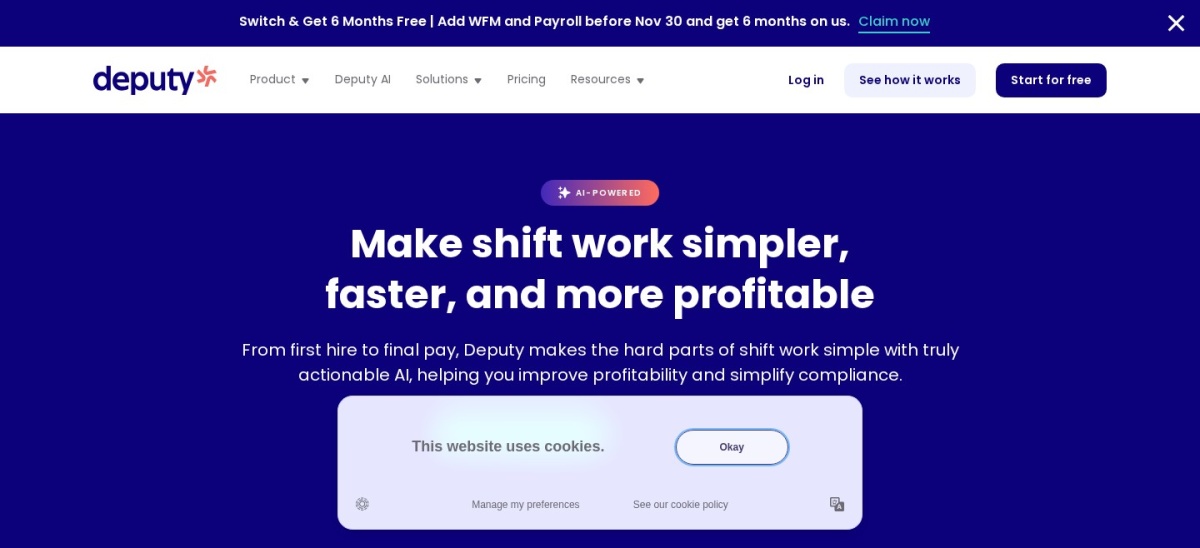
Deputy is a workforce management platform built around scheduling, time and attendance, and labour compliance for hourly teams. The Lite plan costs $5 per user a month and covers basic scheduling, timesheets, time clocking and payroll integrations.
The trade off is cost at scale. Pricing is per active user with a $30 monthly minimum, so the bill climbs with every hire. It suits restaurants, retail and healthcare teams that need overtime rules and compliance controls.
4.5/5on Capterra (1,300 reviews, checked Nov 2026)
Starts at$2.50/mo
Best for cheapest per-user scheduling
Free planNo, 14-day trial
Paid planEssentials, $2.50/user/mo
Time clockAdd-on, from $4/user/mo
SchedulingAuto-scheduling included
wheniwork.com
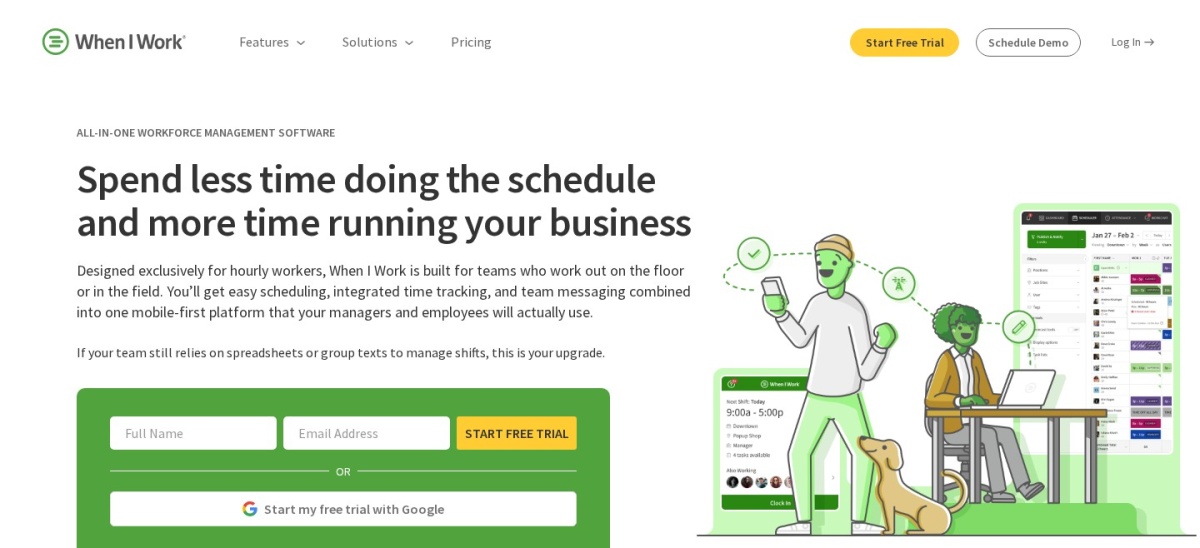
When I Work homepage, captured Nov 2026.
When I Work is a focused scheduler for shift-based teams in restaurants, retail and healthcare. Essentials costs $2.50 per user a month and includes auto-scheduling, shift swaps, availability requests, team messaging and standard labour reports.
The trade off is the time clock. Adding it lifts Essentials to $4 per user a month, and there is no free plan at any headcount. It suits single-location hourly teams that want the schedule built for them at the lowest per-user price.
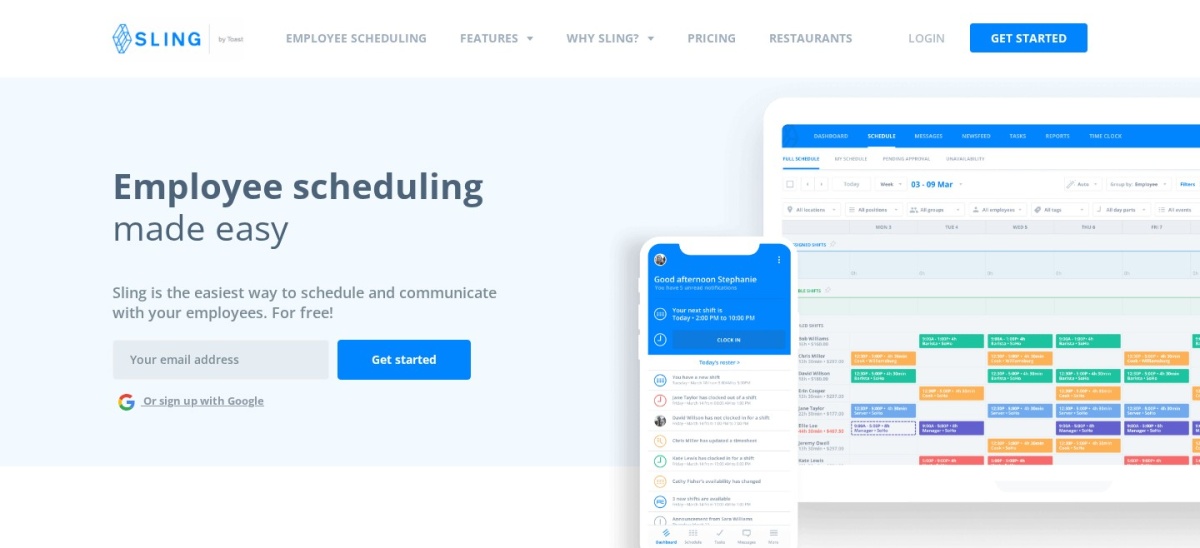
Sling is a shift scheduling and team messaging app with the most generous free plan here. The free tier covers up to 30 users with shift templates, open shifts, shift swaps, time-off approvals and private messaging, with no credit card needed.
The trade off is time tracking. Mobile clock-ins, geofencing and overtime alerts need Premium at $2 per user a month, while auto-assigning shifts sits on Business at $4. It suits small teams that mainly need a free rota and chat.
4.8/5on Capterra (1,127 reviews, checked Nov 2026)
Starts at$4.99/mo
Best for GPS-verified time tracking
Free planNo, 14-day trial
Paid planStarter, $4.99/user/mo
Time clockGPS and photo verification
Scheduling$1/user/mo add-on, Starter
buddypunch.com
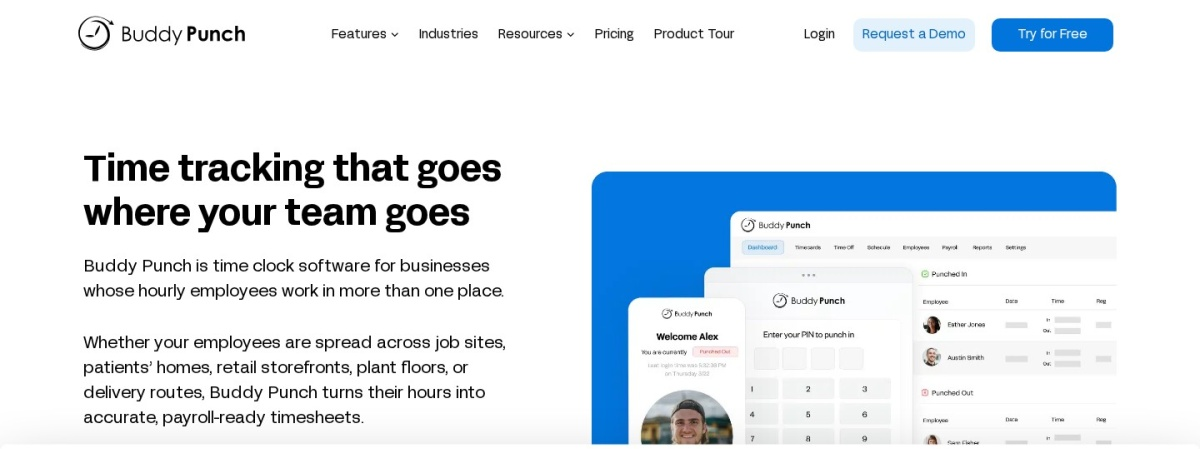
Buddy Punch homepage, captured Nov 2026.
Buddy Punch is a cloud time clock built for hourly staff who work across job sites, shops and homes. Starter costs $4.99 per user a month on annual billing and includes GPS punch locations, photo verification, time off and overtime calculations.
The trade off is the base fee. Every plan adds $19 a month on top of the per-user price, and scheduling is a $1 per user add-on on Starter. It suits field crews and clinics where accurate, verified punches matter more than scheduling depth.
4.7/5on Capterra (1,212 reviews, checked Nov 2026)
Paid from$39.99/mo
Best for restaurants and tip pools
Free plan1 location, 15 staff
Paid planEssentials, $39.99/location/mo
Time clockYes, on Essentials
SchedulingLabour cost and forecasting
7shifts.com
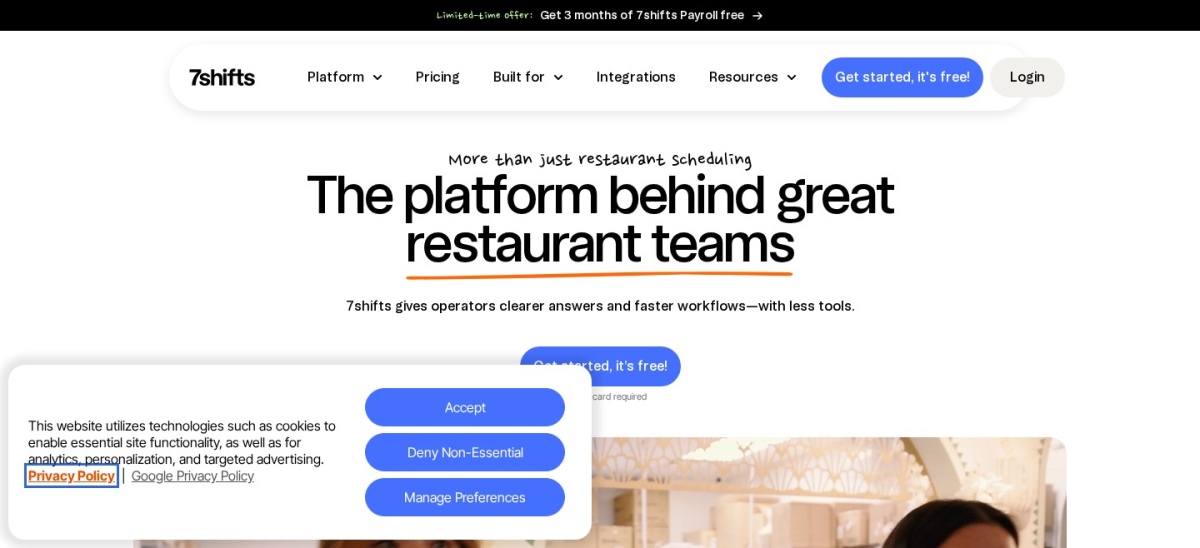
7shifts homepage, captured Nov 2026.
7shifts is a restaurant workforce platform covering hiring, scheduling, time tracking, payroll, tips and team communication. The free Comp plan covers one location with up to 15 employees, while Essentials costs $39.99 per location a month on annual billing.
The trade off is the pricing model. Plans are priced per location and capped by headcount, so multi-site groups pay for every site. It suits restaurants that want labour cost controls, tip pooling and POS links built for food service.
What we like
Built for restaurants, with tip and labour tools
Free plan for one location with 15 staff
Strong POS and payroll integrations
Watch out for
Priced per location, so multi-site costs add up
Premium features sit on the priciest tiers
Pro adds labour compliance at $79.99 a location a monthVisit 7shifts.com
07
ZoomShift
4.8/5on G2 (46 reviews, checked Nov 2026)
Paid from$2/mo
Best for plain low-cost scheduling
Free planUp to 20 users
Paid planStarter, $2/user/mo
Time clockStarter plan up
SchedulingDrag-and-drop, templates
zoomshift.com
ZoomShift homepage, captured Nov 2026.
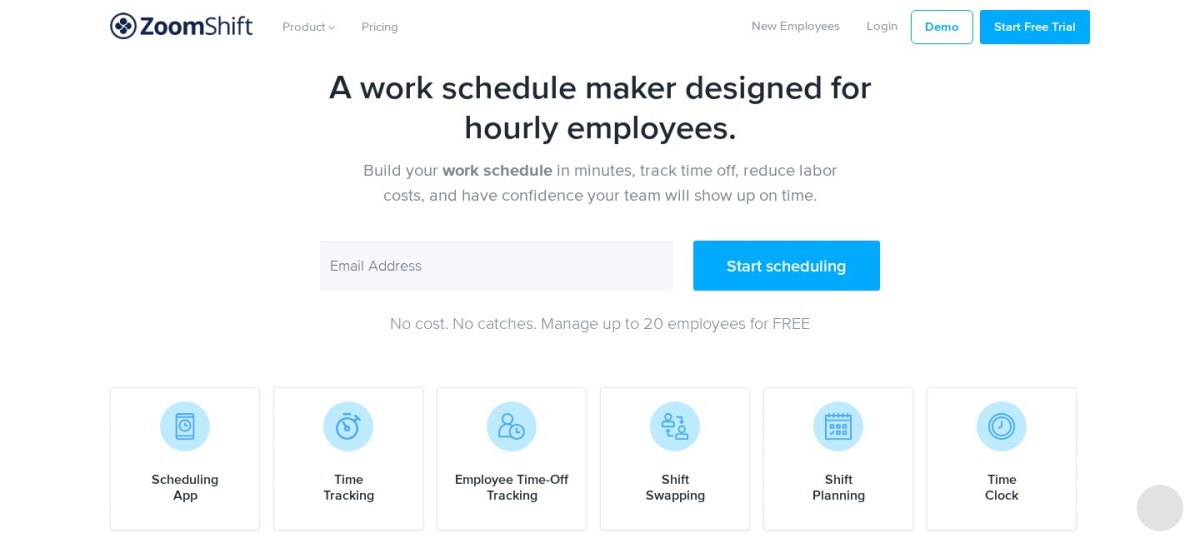
ZoomShift is a plain web scheduler for hourly teams, with drag-and-drop rotas, templates, time-off requests and a time clock. The free Essentials plan covers up to 20 users at one location with scheduling up to two weeks ahead.
The trade off is depth. Starter costs $2 per active member a month billed yearly and adds swaps, timesheets and unlimited locations, but the G2 review base is only 46 reviews. It suits small shops that want simple scheduling without extra modules.
QuickBooks Time is a time tracking and timesheet app, formerly TSheets, that feeds hours straight into QuickBooks payroll. Premium costs $8 per user a month plus a $20 monthly base fee, and covers GPS tracking, mobile apps, scheduling and time-off management.
The trade off is the ecosystem lock-in. It makes most sense inside QuickBooks, and the base fee plus per-user price adds up for small teams. It suits businesses already running QuickBooks payroll that want accurate hours with no re-keying.
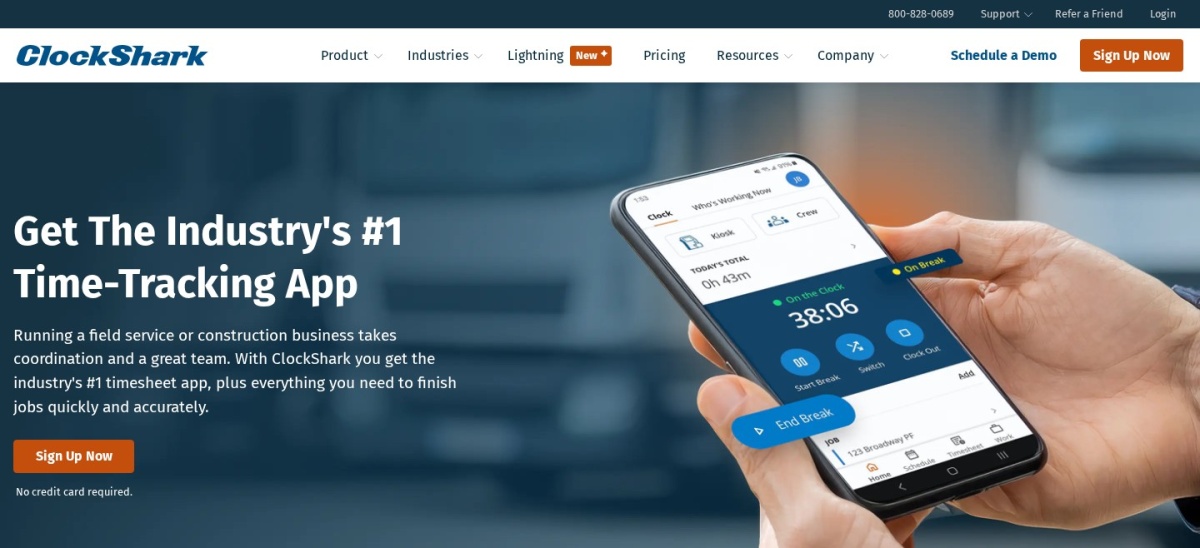
ClockShark is a mobile time tracking tool for field teams in construction, HVAC, landscaping and similar trades. Plans start at about $9 per user a month plus a monthly base fee, and cover GPS clock-in, job costing, crew tracking by work site and scheduling.
The trade off is price for office teams. The base fee and per-user rate cost more than a plain scheduler, and the tool is built for job sites first. It suits field crews that need to prove where and when each worker clocked in.
Free plans cover scheduling and messaging well. Sling, ZoomShift and 7shifts all give away a usable rota at no cost.
Paid plans mostly add the time clock. GPS punches, geofencing and overtime alerts sit behind the first paid tier almost everywhere.
Base fees are the hidden cost. Buddy Punch, QuickBooks Time and ClockShark add a monthly base fee, so a team of three pays far more per person than the headline rate.
If you run one small site, start free and upgrade only when the clock matters. Multi-site teams should compare flat-rate plans first.
How we chose
We started from the scheduling tools most often named as Homebase replacements in 2026 round-ups, then kept those with a verifiable G2 or Capterra rating and a published price.
Prices come from each vendor pricing page or G2 pricing data, checked on 29 November 2026. Ratings and review counts come from G2 or Capterra on the same day. Where a vendor page did not render its figures in a text read, the price is corroborated from secondary sources and flagged in our notes.
We left out tools with no verifiable rating and enterprise-only suites priced by quote. No vendor paid for a place, and we do not claim hands-on testing for this list.
How to choose a Homebase alternative
Start with your headcount, locations and whether you need a time clock, then compare the real monthly bill.
Count heads and locations. Flat-rate tools win past 15 staff, while per-user tools win for one small site. Multi-site teams should check per-location pricing first.
Decide if the time clock matters. If you only need a rota, a free plan may be enough. GPS punches and geofencing need a paid plan almost everywhere.
Add up base fees. Some tools add a monthly base fee on top of the per-user rate. Work out the total for your team size before you compare headline prices.
Trial the top two with real staff. Run a two-week rota with the people who will use it daily, then keep the tool they actually open.
FAQ
What is the best Homebase alternative in 2026?
Connecteam is the best Homebase alternative for most small teams. Its Operations hub covers scheduling and a GPS time clock for a flat $29 a month for the first 30 users, with a free plan for up to 10 users.
What is the cheapest Homebase alternative?
When I Work is the cheapest per-user option at $2.50 a user a month, while Sling and ZoomShift offer free scheduling for up to 30 and 20 users. Connecteam is cheapest for larger teams because its $29 flat rate does not rise per hire.
Is there a free Homebase alternative?
Yes. Sling is free for up to 30 users, ZoomShift is free for up to 20 users, 7shifts is free for one location with 15 staff, and Connecteam is free for up to 10 users. Free plans cover scheduling but usually exclude the time clock.
Which Homebase alternative is best for restaurants?
7shifts is the best pick for restaurants. It adds tip management, labour cost forecasting and POS links that general schedulers do not offer, with a free plan for one location with up to 15 employees.
Which Homebase alternative is best for small teams?
Sling suits the smallest teams because its free plan covers 30 users, while When I Work suits small teams that want auto-scheduling at $2.50 a user a month. Deputy suits small teams that need compliance controls.
Connecteam vs Deputy: which is better?
Connecteam wins on price for growing teams because it charges a flat $29 a month for the first 30 users. Deputy wins on compliance, with stronger overtime rules, demand forecasting and payroll links, but it costs $5 per user a month with no free plan.
SaaS SEO and WordPress specialist with about 8 years of experience. Rakib compares WordPress plugins, themes, hosting and software using public pricing, documentation and user reviews. See how we rank.