HackerRank is the best of the HackerEarth alternatives for most hiring teams, with a Starter plan at $79 a month billed annually covering 60 candidate attempts a year and an AI interviewer, while CodeSignal suits AI-led interviews and Codility fits high-volume screening.
How we make this list: we compare pricing pages, product documentation and public user reviews, then re-check every price before each update. No product paid for a place. Disclosure.
HackerRank leads for most teams: Starter is $79 a month billed annually with 60 attempts and an AI interviewer.
CodeSignal matches HackerRank on price and adds certified assessments with ID verification.
Codility now starts at $4,800 a year, the highest entry price here, for agent-ready coding tasks.
TestGorilla is the only broad screening tool with a free plan and 350-plus tests.
TestDome is the cheapest way in at $100 for 5 candidates, with no subscription at all.
How do you choose the best HackerEarth alternative?
Price is the first split. HackerRank and CodeSignal both start at $79 a month billed annually, while Codility starts at $4,800 a year and TestGorilla at $215 a month, so the shortlist depends on how many candidates you screen.
Attempt and credit limits decide the real cost. HackerRank gives 60 attempts a year on Starter, CodeSignal gives 5 credits a month, and TestGorilla charges per account, so count your hiring volume before you compare headline prices.
AI changes what a test measures. HackerRank and CodeSignal put an AI interviewer in the loop, while Codility lets candidates code with Claude Code and Codex, so pick the tool whose AI matches how your team actually works.
Free plans are thin in this category. TestGorilla and CoderPad offer usable free tiers, but most tools here sell on quote or trial only, so budget for a paid plan from the start.
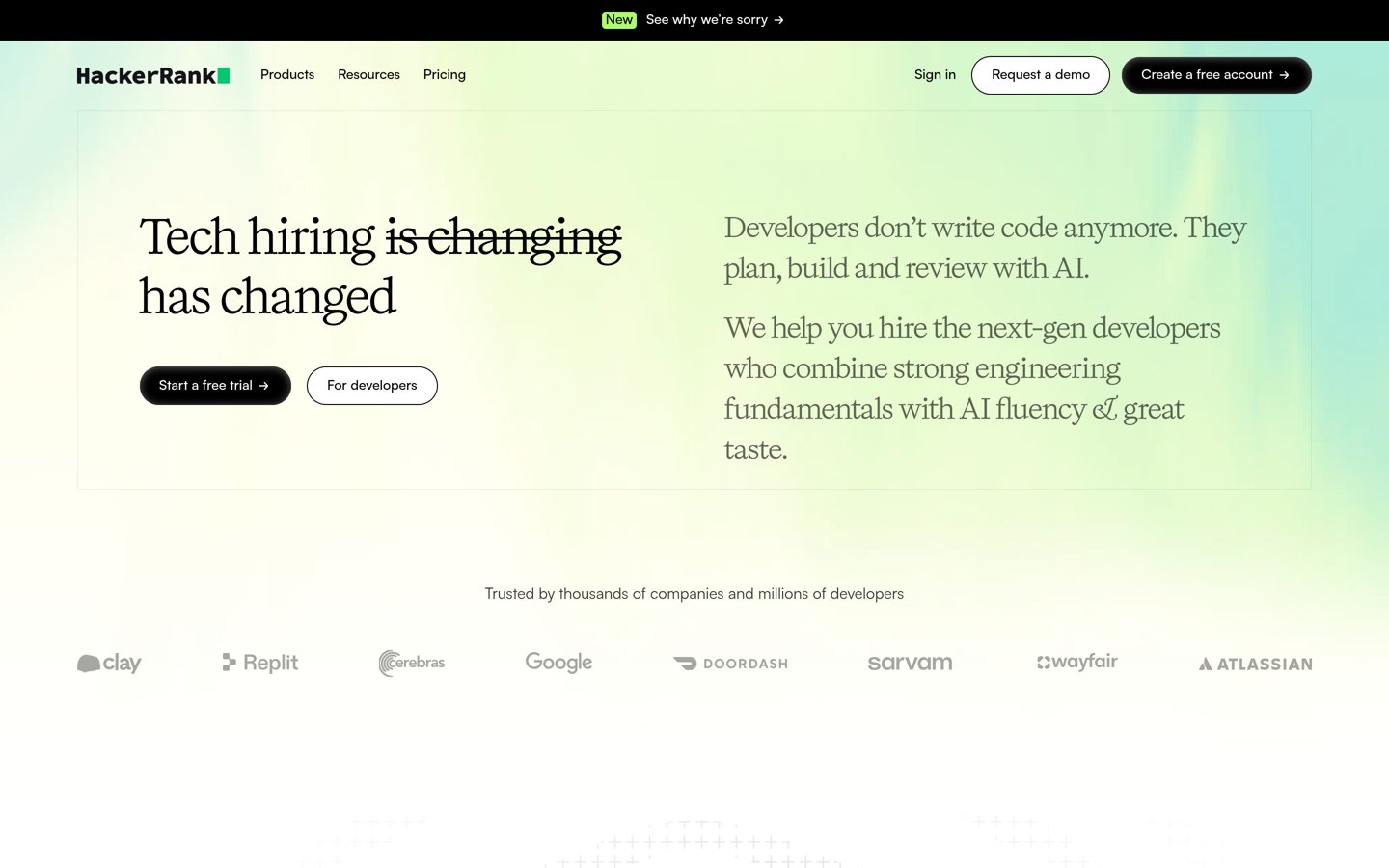
HackerRank is a coding assessment platform with screening tests, live interviews and Chakra, its AI interviewer. The Starter plan covers 60 candidate attempts a year, unlimited users and a library of more than 2,000 questions, and developers can practise free on the same platform.
The trade off is the attempt meter. Once the 60 Starter attempts run out, each extra attempt costs $20, so high-volume hiring pushes teams to Pro at $419 a month billed annually. It suits teams that hire steadily through the year and want the largest ready-made question library.
CodeSignal is an AI-native skills assessment platform for hiring and development, built around realistic coding tasks and structured interviews. The Build plan includes 5 monthly credits, universal and core tech assessments, agentic assessments, AI interviewers and AI proctoring with ID verification.
The trade off is the credit meter. Five credits a month covers only a handful of candidates, so busy teams move to Grow at $599 a month, and the top Pro tier is quoted by sales. It suits teams that want certified assessments and an AI interviewer across engineering and business roles.
Codility is a technical assessment platform for screening and interviewing engineers, with tasks that let candidates work alongside Claude Code and Codex. Online plans start from $4,800 a year for 200 invites, with 5 platform users, one standard integration and the full task library from 1,000 invites.
The trade off is price and the missing interviewer. There is no AI interviewer by design, and the entry price is far above HackerRank or CodeSignal, while Enterprise is quoted. It suits teams that need a defensible technical decision and want candidates coding with agents inside the task.
TestGorilla is a talent assessment platform that screens candidates with skills, personality and cognitive tests instead of resumes. The free plan covers 5 essential tests with 10 credits a month, while Core unlocks the full library of more than 350 tests, AI scoring and analytics.
The trade off is the price jump. Core starts at $215 a month per account on annual billing, and ATS integrations and AI video interviews need Plus from $520 a month. It suits teams that screen many roles beyond coding and want one library for every hire.
CoderPad is a live coding interview platform with a real collaborative IDE, code playback and support for more than 99 languages. The free tier covers core interviews with unlimited users, while Starter at $80 a month adds role-based permissions, 400 ready-made questions and 60 tests or interviews a year.
The trade off is scope. CoderPad is built for live interviews, not broad skills screening, and ATS integrations and single sign-on sit on the custom Enterprise tier. It suits teams that interview live and want a clean, distraction-free coding environment.
TestDome is a skills assessment platform built on work-sample questions across more than 130 skills, with automated scoring and webcam proctoring. It sells one-time candidate packs instead of subscriptions, starting with a Starter pack of 5 candidates at $20 each, so teams pay only when they hire.
The trade off is volume cost. The per-candidate price falls to $7 only on the 600-candidate pack at $4,200, so heavy screening gets expensive fast, and there is no free plan. It suits small teams that hire in bursts and want no monthly subscription.
DevSkiller is a technical skills assessment platform built around real-world coding tasks, detailed code review scorecards and GitHub integration. Its library covers more than 5,000 tasks across many stacks, and assessments are fully customisable for each role and seniority level.
The trade off is price transparency. Pricing comes from a calculator and a sales conversation rather than a published rate card, and reviewers call it expensive for smaller teams. It suits mid to large teams that want realistic tasks and a close look at real code.
Mercer Mettl is an online talent assessment and proctoring platform from Mercer, covering psychometric, aptitude and coding tests in more than 20 languages. It adds a live coding interview tool with AI and human proctoring, and it is built for campus drives and high-volume screening.
The trade off is price and flexibility. There is no published price, only a customised plan on request, and reviewers call it expensive for small teams and frequent tests. It suits large employers running supervised tests at scale.
iMocha is a skills assessment and skills intelligence platform that tests candidates and maps the skills of existing staff. Its library covers more than 10,000 skills across 300 job roles, with coding tests on 30-plus compilers, AI proctoring and live coding interviews.
The trade off is the sales-led route. iMocha publishes no price, so every deal starts with a demo and a quote, and G2 reviewers report about 2 months to set up. It suits large companies that want hiring tests and workforce skills mapping in one platform.
HackerEarth still suits teams that run large coding contests and campus drives in one place, with its own assessment and interview tools. Switch only when you need a bigger question library, a lower entry price, or an AI interviewer on every plan.
How we chose
We started from the coding assessment tools hiring teams compare with HackerEarth most often, then kept only those with a public rating on G2 and a published price or a clear quote-only model.
Prices come from each vendor's pricing page, checked on 29 November 2026, with G2 ratings and review counts read the same day. Where a vendor shows a sale, the list shows the regular price.
We left out tools with no verifiable rating on G2, Capterra or Trustpilot. No vendor paid for a place, and we do not claim hands-on testing for this list.
How to choose a HackerEarth alternative
Start with your hiring volume, then match the test format to the roles you fill most.
Count your candidate attempts. Add up last year's screens and interviews. A 60-attempt Starter plan fits steady hiring, while volume hiring needs a bigger allowance or a pay-per-candidate pack.
Pick the test format first. Live interviews suit final rounds, work-sample tests suit screening, and broad libraries suit mixed roles. Do not buy a coding-only tool for general hiring.
Check the AI rules. Ask whether candidates may use coding agents, how proctoring flags are reviewed, and who sees the AI scores before you shortlist anyone.
Trial the candidate experience. Take the test yourself. A confusing editor or harsh timer will cost you good candidates before a human ever sees them.
FAQ
What is the best HackerEarth alternative in 2026?
HackerRank is the best HackerEarth alternative for most hiring teams. Its Starter plan costs $79 a month billed annually, covers 60 candidate attempts a year, and includes the Chakra AI interviewer and a library of more than 2,000 questions.
How much does HackerRank cost?
HackerRank Starter costs $79 a month billed annually, or $948 a year, and covers 60 candidate attempts with unlimited users. Pro costs $419 a month billed annually with 360 attempts, and extra attempts cost $20 each.
Which HackerEarth alternative has a free plan?
TestGorilla has the most useful free plan, with 10 credits a month and 5 essential tests. CoderPad also offers a free tier for core interviews, and CodeSignal has a free Learn tier for individual developers.
Is Codility better than HackerRank?
Codility suits teams that want candidates coding with Claude Code and Codex inside the task, while HackerRank suits teams that want a bigger library and an AI interviewer. Codility starts at $4,800 a year, far above HackerRank Starter at $948 a year.
Which HackerEarth alternative is best for small teams?
TestDome is the best fit for small teams that hire in bursts, because it sells one-time candidate packs from $100 for 5 candidates with no subscription. CoderPad also works well, with a free tier and Starter at $80 a month.
HackerRank vs CodeSignal: which should I pick?
Pick HackerRank for the largest question library and 60 attempts a year on Starter. Pick CodeSignal for certified assessments with ID verification and AI interviewers across engineering and business roles.
SaaS SEO and WordPress specialist with about 8 years of experience. Rakib compares WordPress plugins, themes, hosting and software using public pricing, documentation and user reviews. See how we rank.