Zapier is the best way to create Google Calendar events from a spreadsheet for most people, with a Google Sheets trigger and a detailed event action, rated 4.5 out of 5 on G2 from 2,079 reviews. Pick Make if you want the same flow for $12 a month, and Sheetgo if your events already live in a sheet.
How we make this list: we compare pricing pages, product documentation and public user reviews, then re-check every price before each update. No product paid for a place. Disclosure.
Zapier is the simplest route: a new-row trigger in Google Sheets creates a detailed Google Calendar event.
Make is the cheapest serious plan, with Core at $12 a month billed annually for 10,000 credits.
IFTTT is the cheapest paid plan of all, at $2.99 a month on Starter, but only for one simple rule.
Sheetgo is the only spreadsheet-native tool here, with a free Google Sheets add-on and Pro at $35 a month.
Paid plans in this list run from $2.99 to $35 a month, or $35.88 to $420 a year.
How do you create Google Calendar events from a spreadsheet?
Every tool in this list follows the same pattern: a row in a spreadsheet becomes one event on a calendar. The sheet needs separate columns for the title, start date and time, end date and time, and ideally a description and guests.
A new-row trigger is the usual starting point. Zapier, Make, Integrately, Pabbly Connect and n8n all watch Google Sheets for a new row, then run a Create Event action in Google Calendar with the row's columns mapped to the event fields.
Date formatting is where most flows break. Sheets store dates as text or serial numbers, so check that the start and end columns parse as real dates before you turn the automation on, and test it with one row first. Our guide on how to schedule posts in WordPress shows the same test-one-first habit.
Free plans are enough for short lists. Zapier's free plan covers 100 tasks a month, Make's covers 1,000 credits and Pabbly Connect's covers 100 tasks, so a weekly list of events costs nothing until the volume grows.
Paid plans are priced by volume, not by calendars. The cheapest paid plan that fits depends on how many events you create a month, not on how many calendars you own.
The 9 best ways to create Google Calendar events from a spreadsheet
01
Zapier
4.5/5on G2 (2,079 reviews, checked Nov 2026)
Paid from$19.99/mo
Best way to create Google Calendar events from a spreadsheet overall
Google Sheets triggerNew spreadsheet row
Calendar actionCreate Detailed Event
Free plan100 tasks a month
Paid planProfessional, $19.99/mo
zapier.com
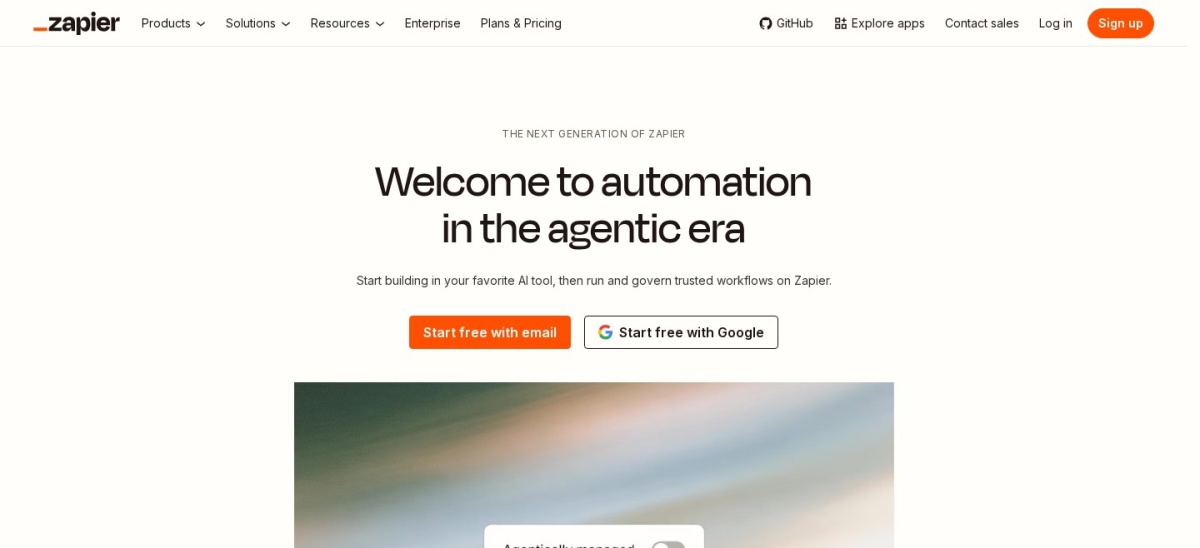
Zapier homepage, captured Nov 2026.
Zapier is a no-code automation platform that turns a new row in Google Sheets into a Google Calendar event. Its published guide uses a New Spreadsheet Row trigger and a Create Detailed Event action, with sheet columns mapped to the title, start, end, description and guests.
The trade off is task pricing. The free plan covers 100 tasks a month, and Professional starts at $19.99 a month billed annually for 750 tasks, so a busy sheet can outgrow the cheapest paid plan. It suits most people who want the simplest no-code route.
What we like
Ready-made Google Sheets to Google Calendar template
Maps sheet columns to every event field
Connects more than 9,000 apps
Free plan covers short lists
Watch out for
Task limits rise fast with large sheets
Cheapest paid plan covers only 750 tasks a month
Professional adds multi-step Zaps, webhooks and live chat supportVisit zapier.com
02
Make
4.6/5on G2 (376 reviews, checked Nov 2026)
Paid from$12/mo
Best value for high-volume sheet-to-calendar flows
Google Sheets triggerWatch new rows
Calendar actionCreate an event
Free plan1,000 credits a month
Paid planCore, $12/mo billed annually
make.com
Make homepage, captured Nov 2026.
Make is a visual automation platform, formerly Integromat, that watches a Google Sheet for new rows and creates a Google Calendar event for each one. Its drag-and-drop scenario builder adds routers, filters and data formatting between the sheet and the calendar.
The trade off is the learning curve. Core costs $12 a month billed annually for 10,000 credits, or $16 billed monthly, and building a branched scenario takes longer than a one-step Zap. It suits teams that run the same flow hundreds of times a month.
What we like
Core gives 10,000 credits for $12 a month billed annually
Visual builder with routers, filters and error handling
Unlimited active scenarios on Core
Free plan includes 1,000 credits a month
Watch out for
Harder to learn than Zapier
Credit use grows with every extra step
Pro adds priority execution, custom variables and full log searchVisit make.com
03
Integrately
4.7/5on G2 (713 reviews, checked Nov 2026)
Paid from$19.99/mo
Best one-click setup for beginners
Ready-made automationsOne-click Google Sheets to Calendar
Free plan100 tasks a month
Paid planStarter, $19.99/mo
Starter tasks2,000 tasks a month
integrately.com
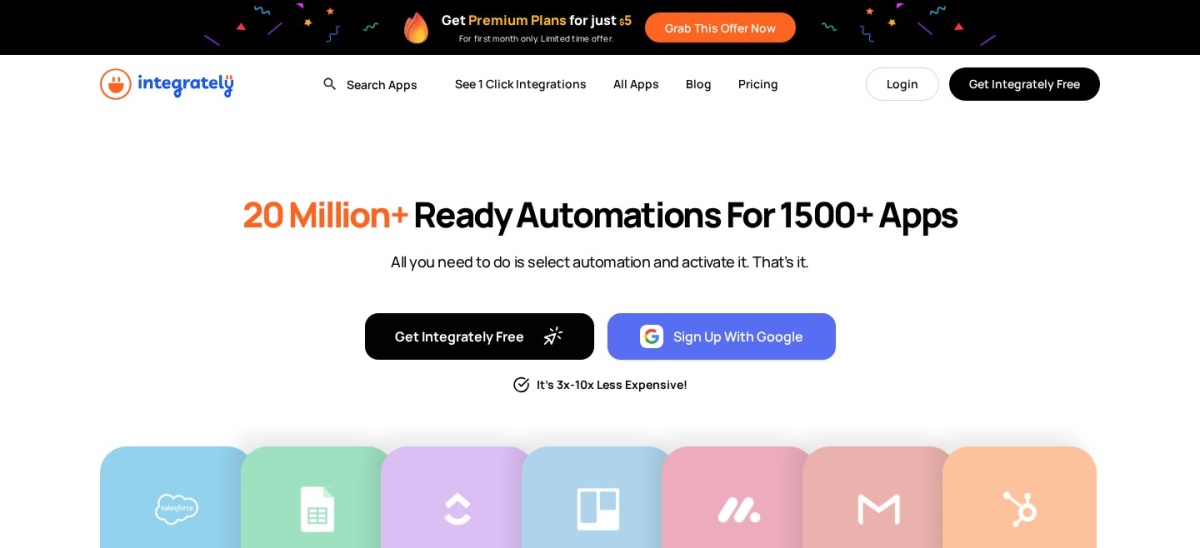
Integrately homepage, captured Nov 2026.
Integrately is a no-code automation platform built around one-click, ready-made automations between popular apps. A Google Sheets to Google Calendar automation can be switched on without building the trigger and action from scratch, and Starter adds branching and webhooks.
The trade off is depth. Starter costs $19.99 a month billed annually for 2,000 tasks and 20 automations, and complex logic is weaker than in Zapier or Make. It suits beginners who want a working flow in minutes.
What we like
One-click automations, no builder needed from scratch
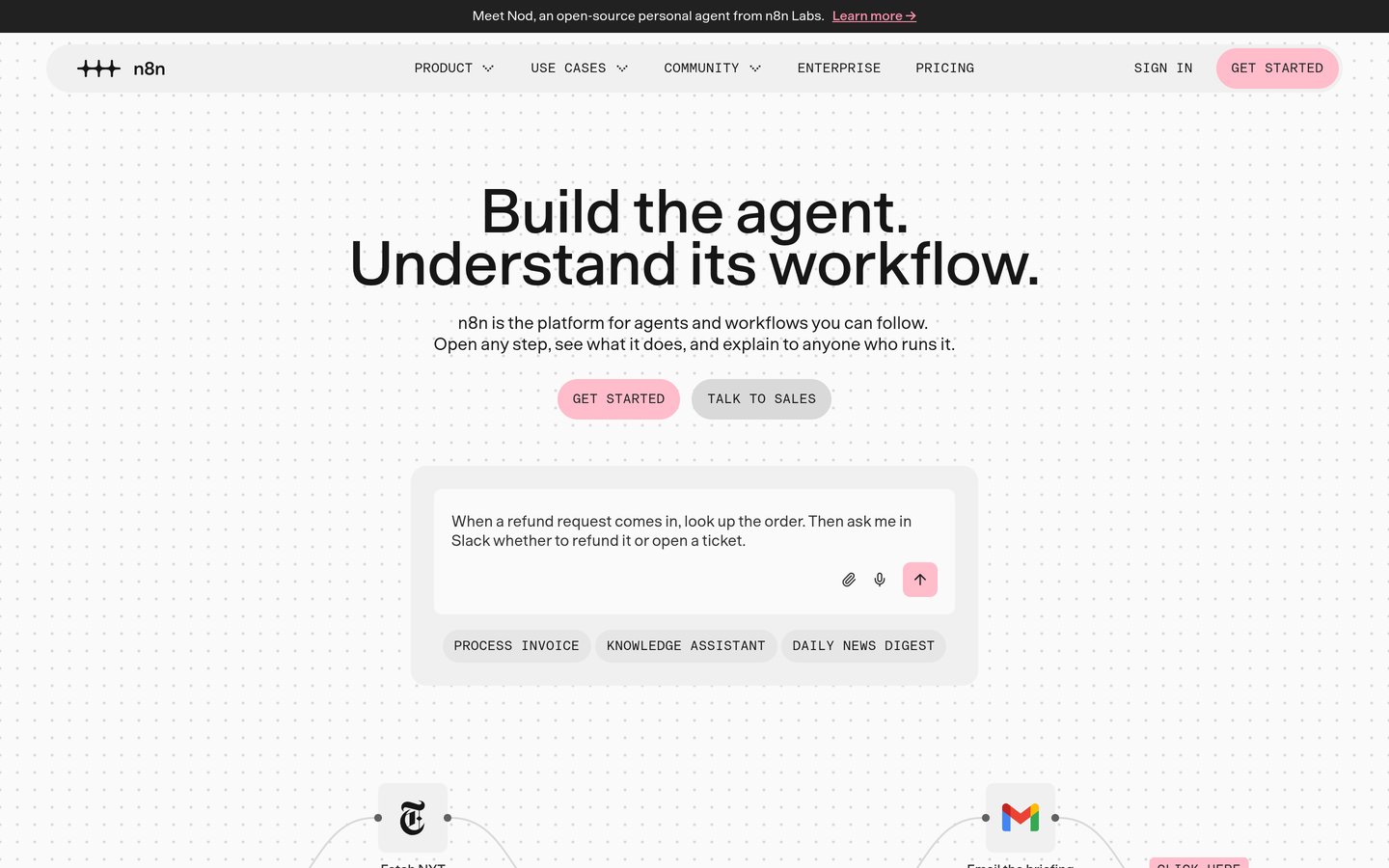
n8n is a workflow automation platform with a visual node editor, code nodes and AI agent nodes. A Google Sheets node can feed rows into a Google Calendar node, and the free self-hosted Community edition runs the same flow with no execution cap from n8n itself.
The trade off is setup. Cloud Starter costs $20 a month billed annually for 2,500 executions, and self-hosting needs a server you run yourself. It suits technical teams that want full control over the flow.
What we like
Free self-hosted edition with unlimited runs
Code nodes for date and text formatting
Counts whole workflow runs, not steps
Highest G2 rating in this list at 4.7 out of 5
Watch out for
Steepest learning curve here
Self-hosting adds server work and updates
Pro adds 10,000 executions a month for $50Visit n8n.io
05
Sheetgo
4.3/5on G2 (23 reviews, checked Nov 2026)
Paid from$35/mo
Best spreadsheet-native option
Spreadsheet focusGoogle Sheets and Excel
Calendar connectionGoogle Calendar listed as a connection
Free planFree add-on, 1 connection
Paid planAutomations Pro, $35/mo billed annually
sheetgo.com
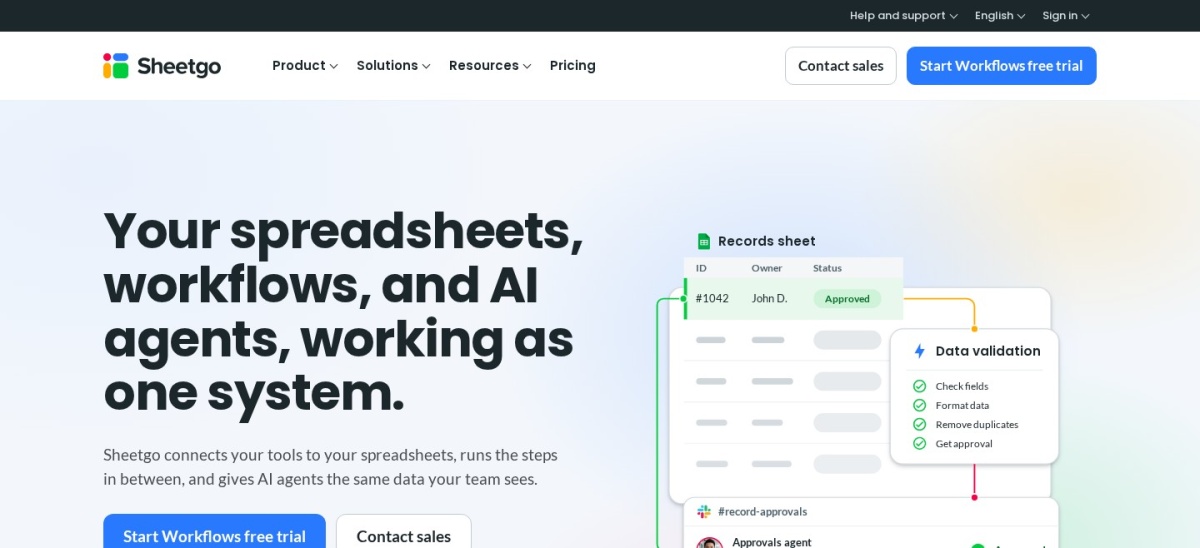
Sheetgo homepage, captured Nov 2026.
Sheetgo is a spreadsheet automation tool that installs as a Google Sheets add-on and connects sheets to other tools, including Google Calendar. It is built for teams whose work already lives in spreadsheets, with scheduled transfers and templates for common sheet workflows.
The trade off is price and scope. Automations Pro costs $35 a month billed annually, or $50 billed monthly, for 50 automations and 2,000 automation credits a month, and it cannot reach CRMs or other SaaS APIs. It suits sheet-first teams, not general automation.
What we like
Built for Google Sheets, not bolted on
Free add-on to start
Scheduled automations and templates
50 automations on Automations Pro
Watch out for
Priciest entry plan in this list at $35 a month
Narrower app range than Zapier or Make
Only 23 G2 reviews, the smallest base here
Workflows plans add team features from $88 a month billed annuallyVisit sheetgo.com
06
Pabbly Connect
4.5/5on Capterra (86 reviews, checked Nov 2026)
Paid from$19/mo
Best budget pick for 10,000 tasks
Google Sheets triggerNew row
Calendar actionCreate a Google Calendar event
Free plan100 tasks a month
Paid planStandard, $19/mo, 10,000 tasks
pabbly.com
Pabbly Connect homepage, captured Nov 2026.
Pabbly Connect is a no-code automation platform that links Google Sheets to Google Calendar through multi-step workflows, with filters, routers, formatters and webhooks. Only action steps in other apps count as tasks, so a sheet-to-calendar flow uses one task per event.
The trade off is support. Standard costs $19 a month, or $16 a month billed annually, for 10,000 tasks, and Capterra reviewers rate customer service 4.2 out of 5, below its 4.6 value score. It suits small businesses that want volume for little money.
Airtable is a spreadsheet-style database that stores each event as a record, shows the same records as a calendar, and runs automations that can create Google Calendar events. The free plan covers 1,000 records per base and 100 automation runs a month.
The trade off is per-seat pricing. Team costs $20 per user a month billed annually for 50,000 records per base and 25,000 automation runs, so every editor adds to the bill. It suits teams that already plan work in Airtable.
What we like
Calendar, grid, kanban and gallery views of one base
25,000 automation runs on Team
Largest review base here after Smartsheet
Free plan covers a small real project
Watch out for
Every editor costs $20 a month on Team
Google Calendar events need an automation, not a direct sync
Business adds 125,000 records per base for $45 per user a monthVisit airtable.com
08
Smartsheet
4.4/5on G2 (23,251 reviews, checked Nov 2026)
Starts at$9/user/mo
Best spreadsheet view for project schedules
Sheet viewsGrid, Gantt, board and calendar
Automations250 a month on Pro
Free planNo free plan, 30-day trial
Paid planPro, $9/user/mo billed annually
smartsheet.com
Smartsheet homepage, captured Nov 2026.
Smartsheet is a spreadsheet-style work platform where each row is a task or milestone and the same sheet can be shown as a grid, Gantt chart or calendar. Pro includes 250 automations a month, which can notify owners and keep a schedule in step with the sheet.
The trade off is that it is not a Google Calendar creator. Pro costs $9 per user a month billed annually, or $12 billed monthly, and there is no free plan, only a 30-day trial. It suits teams that plan in sheets and need a calendar view of the plan.
What we like
Calendar view over the same sheet data
Lowest paid entry here at $9 per user a month
Largest G2 review base in this list, 23,251 reviews
IFTTT is a simple automation service that connects Google Sheets to Google Calendar through applets: when a row changes, an applet creates the calendar event. It is the simplest tool in this list, with no builder to learn and the cheapest paid plan here.
The trade off is simplicity. Starter costs $2.99 a month and Pro $7.99 a month, but applets are single-trigger, single-action flows with little formatting or error handling. It suits one simple sheet-to-calendar rule, not a branched workflow.
What we like
Cheapest paid plan in this list at $2.99 a month
No builder to learn
Good for one simple rule
Free plan to try the idea
Watch out for
Single-trigger applets only
Little date formatting or error handling
Smallest feature set in this list
Pro adds multi-step applets and faster checks for $7.99 a monthVisit ifttt.com
Free vs paid: what you give up
Free plans cover short lists well. Zapier, Make, Pabbly Connect, Integrately, n8n and IFTTT all let you try a sheet-to-calendar flow without paying, and Sheetgo's free add-on covers one connection.
Paid plans mostly add volume and speed. Higher tiers raise the task, credit or execution cap, add multi-step flows, webhooks and faster checks, and remove the free-plan limits on automations.
If your sheet adds a few events a week, a free plan is enough. Pay when the monthly event count passes the free cap, or when you need branching, formatting and error handling that a single applet cannot do.
How we chose
We started from automation platforms and spreadsheet tools with a published Google Sheets trigger and a Google Calendar action, then kept those with a public rating and a public price.
Prices come from each vendor's pricing page or G2 pricing data, checked on 29 November 2026. Ratings and review counts come from G2 or Capterra on the same day. Where a vendor shows a sale, the list shows the regular price.
We left out Google Apps Script, which has no public rating, and calendar-sync tools such as CalendarBridge, which sync calendars rather than create events from a spreadsheet. No vendor paid for a place, and we do not claim hands-on testing for this list.
How to choose a spreadsheet-to-calendar tool
Start with your sheet, then match the tool to how many events it creates each month.
Count your events per month. A free plan covers 100 tasks on Zapier and Pabbly Connect and 1,000 credits on Make, so a weekly list costs nothing and a daily list needs a paid plan.
Check the date columns first. Make sure start and end dates parse as real dates, with separate columns for date and time, before you build the flow.
Test with one row. Create one event from one row, check the title, time and guests on the calendar, then turn the automation on for the whole sheet.
Pick the simplest tool that fits. Use IFTTT for one simple rule, Zapier for the easiest setup, Make for volume, and Sheetgo or Airtable when the sheet itself is where the work lives.
FAQ
What is the best way to create Google Calendar events from a spreadsheet?
Zapier is the best way for most people. Its Google Sheets trigger watches for a new row and its detailed event action creates the calendar event, and it is rated 4.5 out of 5 on G2 from 2,079 reviews, with a free plan for 100 tasks a month.
How much does it cost to create Google Calendar events from a spreadsheet?
It can cost nothing on a free plan for a short list. The cheapest paid plans are IFTTT Starter at $2.99 a month and Make Core at $12 a month billed annually, while Zapier Professional starts at $19.99 a month.
Is there a free way to create Google Calendar events from a spreadsheet?
Yes. Zapier, Make, Integrately, n8n, Pabbly Connect, Airtable and IFTTT all have free plans, and Sheetgo has a free Google Sheets add-on. Google Apps Script is also free, but it needs code and has no public rating.
Which tool is best for beginners?
Integrately is the easiest to start, with one-click automations and a 4.7 out of 5 G2 rating from 713 reviews. Zapier is the next easiest, with a ready-made Google Sheets to Google Calendar template.
Which is cheaper, Zapier or Make?
Make is cheaper for volume. Make Core costs $12 a month billed annually for 10,000 credits, while Zapier Professional costs $19.99 a month for 750 tasks. Zapier is simpler to set up, and Make gives more runs per dollar.
Can Smartsheet create Google Calendar events from a spreadsheet?
Not directly. Smartsheet shows a sheet as a calendar and runs 250 automations a month on Pro, but it does not create Google Calendar events the way Zapier or Make do. Pick it to plan in a sheet, not to feed Google Calendar.
SaaS SEO and WordPress specialist with about 8 years of experience. Rakib compares WordPress plugins, themes, hosting and software using public pricing, documentation and user reviews. See how we rank.