Best Web Monitoring Software in 2026: 8 Tools Compared
WLWPLegible EditorsLast verified 22 Nov 2026How we rank10 min read
★ Short answer
UptimeRobot is the best web monitoring software for most teams, offering 50 free monitors with 5-minute checks and paid plans starting at $144/yr billed annually. Better Stack suits engineering teams needing built-in on-call incident routing, while Visualping is ideal for tracking visual and text changes on competitor webpages.
How we make this list: we compare pricing pages, product documentation and public user reviews, then re-check every price before each update. No product paid for a place. Disclosure.
UptimeRobot includes 50 free monitors at 5-minute intervals, with paid Solo plans starting at $144/yr ($12/mo billed annually).
Better Stack pairs 30-second uptime checks with on-call scheduling and logs, starting at $348/yr per responder license.
Site24x7 bundles 1-minute website monitoring from 130+ locations with full-stack visibility starting at $108/yr billed annually.
Uptime.com provides 1-minute checks, 10 basic monitors, and 1 advanced transaction check starting at $84/yr ($7/mo billed annually).
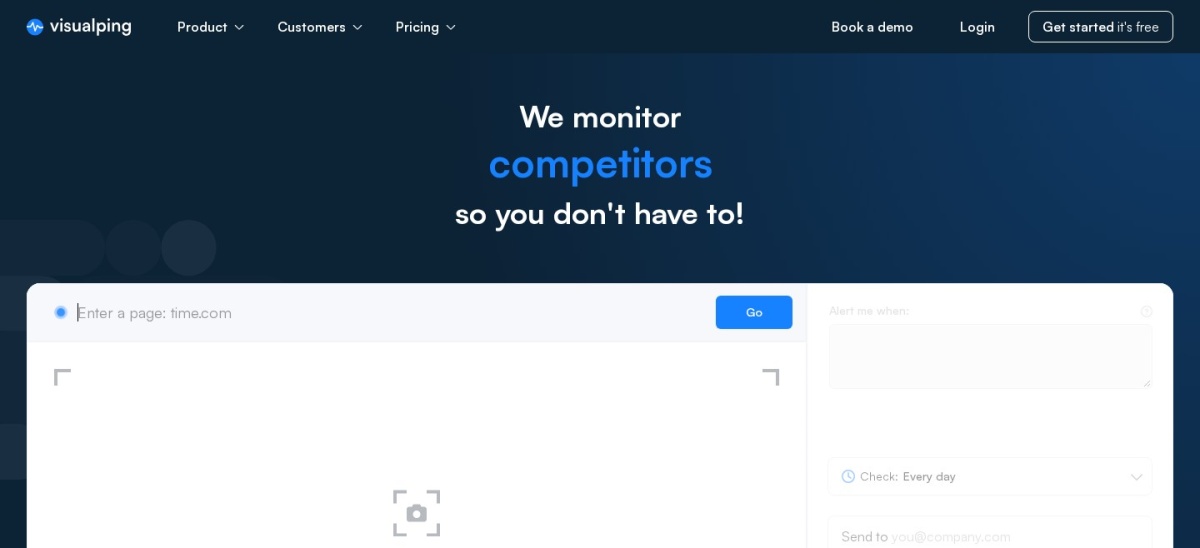
Visualping focuses on visual and AI-summarized content change detection across webpages, with a 5-page free tier and paid plans from $120/yr.
What to look for in web monitoring software
Web monitoring software tracks two distinct jobs: availability monitoring (checking whether your server, API, or checkout flow responds quickly) and page change detection (alerting you when competitor prices, compliance notices, or front-end elements change). Choosing the right platform starts with deciding whether you need infrastructure uptime alerts, synthetic browser transactions, or visual webpage tracking.
Check intervals and multi-location verification determine how fast you catch real outages without waking up to false alarms. Free plans typically poll every 5 minutes from a single region, whereas paid tiers drop intervals to 60 or 30 seconds and verify downtime from a second probe location before firing alerts.
Pay close attention to how pricing scales beyond the entry tier. Some vendors charge flat rates for generous monitor bundles, while others bill per responder seat, per transaction script, or lock public status pages and SMS credits behind separate add-ons.
For bundling uptime, page speed, and domain alerts
$244.92/yr
Free plan
4.8/5
Price ladder: cheapest paid plan per year
List prices, USD, checked Nov 2026
Uptime.com$84
Site24x7FREE$108
VisualpingFREE$120
UptimeRobotFREE$144
Oh Dear$170
Pingdom$198
StatusCakeFREE$245
Better StackFREE$348
The 8 best web monitoring software
01
UptimeRobot
4.7/5on G2 (334 reviews, checked Nov 2026)
Paid from$144/yr
Best for free and budget uptime monitoring
Free plan50 monitors, 5-min checks
Fastest check15 seconds (Scale)
Monitor typesHTTP, ping, port, keyword, SSL
Status pages1 free, 3 on Solo
uptimerobot.com
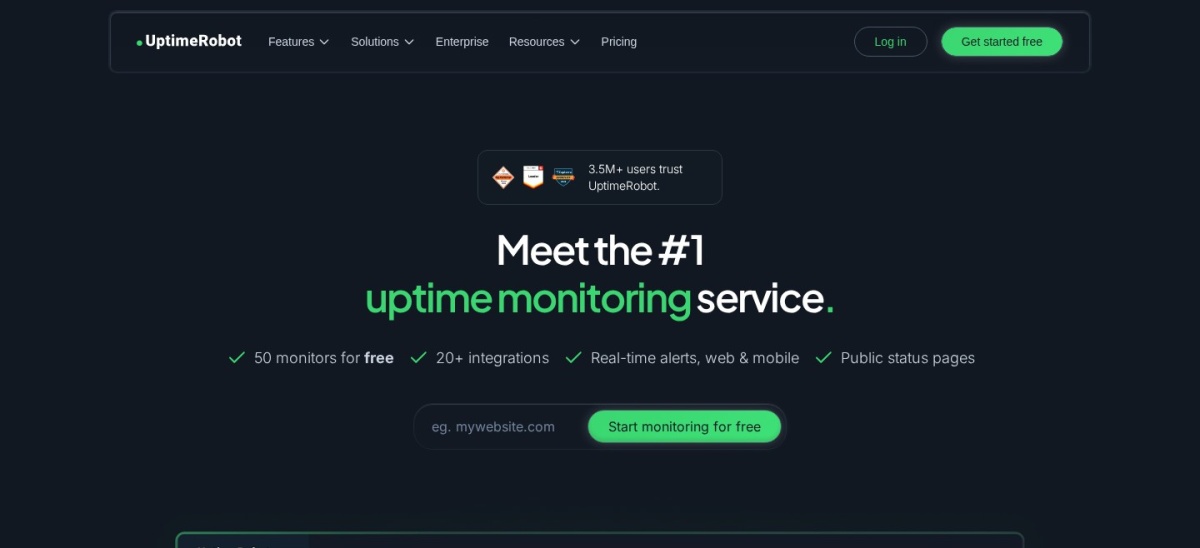
UptimeRobot homepage, captured Nov 2026.
UptimeRobot is a cloud uptime monitor that watches websites, ports, pings, keywords, and cron heartbeats from global nodes. Its forever-free plan covers 50 monitors checked every 5 minutes with email alerts and 1 public status page, while the Solo plan ($12/mo billed annually, or $13/mo monthly) upgrades intervals to 60 seconds and adds SSL, domain expiry, and DNS monitoring.
The trade off is that UptimeRobot lacks scripted browser transactions and real user monitoring, and SMS or voice call credits cost extra starting at $3 for 10 credits. It suits freelancers, agencies, and small businesses that want dependable availability alerts across dozens of sites without high recurring bills.
What we like
Generous 50-monitor free plan for personal and commercial sites
Supports HTTP, keyword, ping, port, DNS, SSL, and heartbeat checks
Clean dashboard with mobile apps for iOS and Android
Watch out for
No multi-step browser transaction or real user monitoring
SMS and voice call alerts require separate credit packs
30-second checks require upgrading to the $468/yr Team tier
Solo ($144/yr) unlocks 60-second checks, SSL/domain alerts, and 3 custom-domain status pages.Visit uptimerobot.com
02
Better Stack
4.8/5on G2 (344 reviews, checked Nov 2026)
Paid from$348/yr
Best for incident management and on-call teams
Free plan10 monitors & heartbeats
Fastest check30 seconds
AlertingUnlimited phone & SMS on paid
ExtrasLogs, traces, Playwright checks
betterstack.com
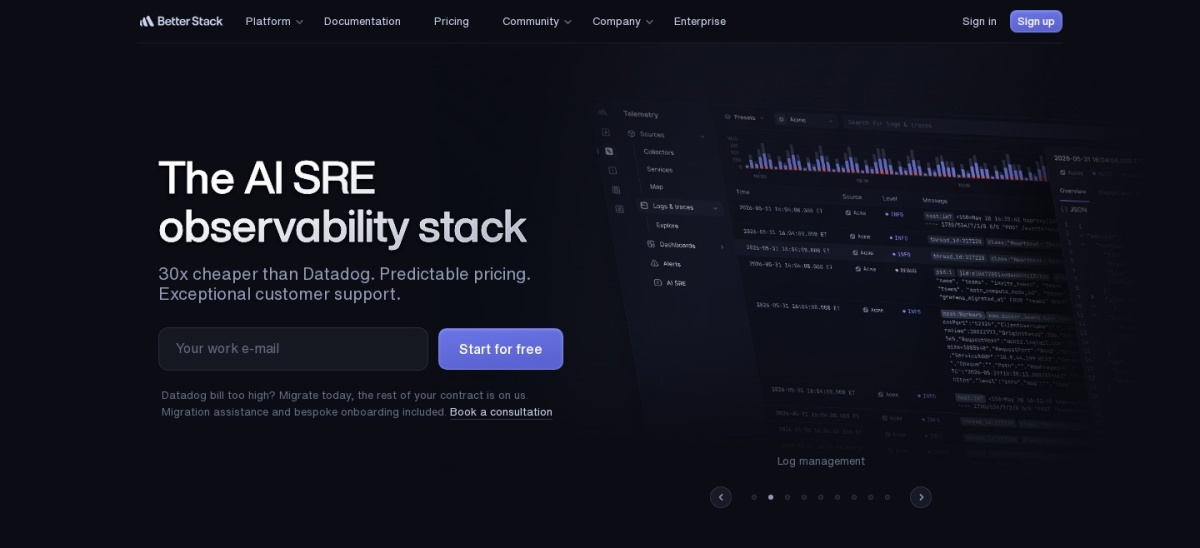
Better Stack homepage, captured Nov 2026.
Better Stack is an observability and uptime platform combining synthetic website checks, cron heartbeats, status pages, and on-call incident routing. The free tier includes 10 monitors and heartbeats at 3-minute intervals, 1 status page, Slack and email alerts, and 3 GB of log retention, while paid Responder licenses start at $29/mo billed annually ($34/mo monthly).
The trade off is per-responder pricing plus add-on fees ($21/mo per 50 extra monitors billed annually), which gets expensive quickly for larger portfolios. It suits DevOps and engineering teams that want uptime alerts tied directly to on-call schedules, phone escalations, and structured logs.
What we like
Includes unlimited phone call and SMS alerts on paid responder plans
Combines uptime monitoring, status pages, logs, and error tracking
Supports Playwright transaction checks and second-location verification
Modern status page design with custom domain support
Watch out for
Steep entry price at $348/yr per responder license
Extra monitor packs and white-label status pages add recurring costs
Responder ($348/yr per seat) adds 30-second checks, on-call routing, and unlimited phone/SMS alerts.Visit betterstack.com
03
Site24x7
4.6/5on G2 (486 reviews, checked Nov 2026)
Paid from$108/yr
Best for all-in-one website and server monitoring
Free planUp to 50 sites (5-min checks)
Global probes130+ locations worldwide
Fastest check10 seconds
Suite scopeWeb, RUM, servers, cloud, APM
site24x7.com
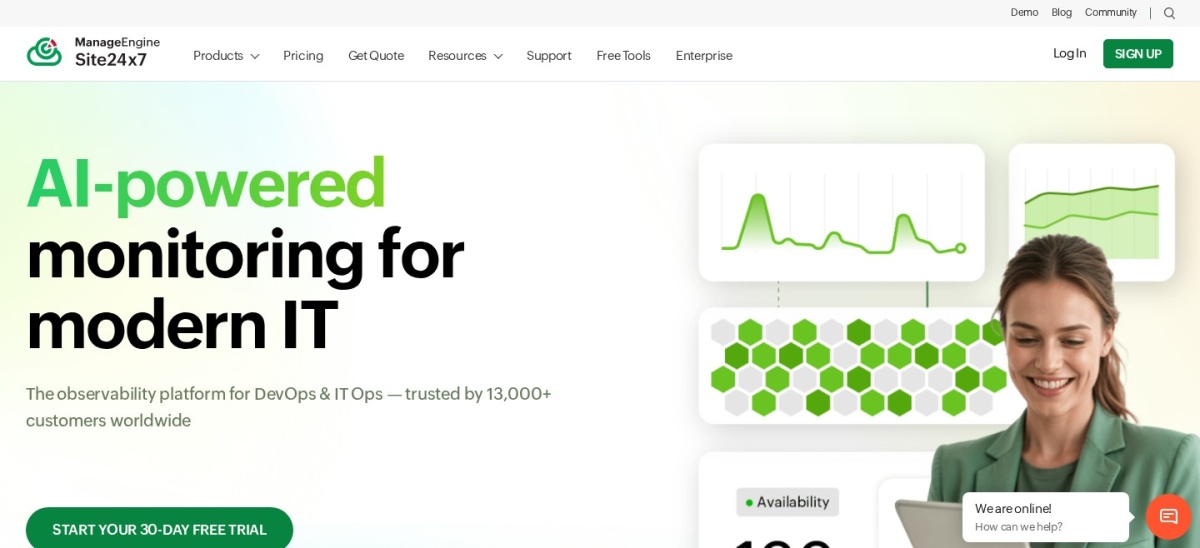
Site24x7 homepage, captured Nov 2026.
Site24x7 is Zoho's full-stack monitoring suite covering website availability, SSL certificates, DNS, real user monitoring, and server infrastructure from over 130 global locations. Its forever-free website plan covers 5-minute checks with email alerts, while paid Web Uptime and Lite plans start at $9/mo billed annually ($10/mo monthly).
The trade off is a dense administrative console and modular add-on pricing once you need synthetic browser transactions or higher real-user pageview quotas. It suits IT administrators and operations teams that want website uptime, server health, and cloud metrics inside one vendor dashboard.
What we like
Low $108/yr starting price with checks from 130+ global locations
Scales seamlessly into server, cloud, network, and APM monitoring
Supports check intervals as fast as 10 seconds on higher tiers
Watch out for
Interface feels crowded if you only need simple uptime alerts
Synthetic transactions and RUM require higher tiers or add-on packs
Web Uptime ($108/yr) unlocks 1-minute checks, multi-location testing, and Slack/SMS alerts.Visit site24x7.com
04
Uptime.com
4.6/5on G2 (412 reviews, checked Nov 2026)
Starts at$84/yr
Best for budget synthetic transaction checks
Free planNone (30-day guarantee)
Entry quota10 basic + 1 advanced check
Check interval1 minute on all plans
Team seatsUnlimited users included
uptime.com
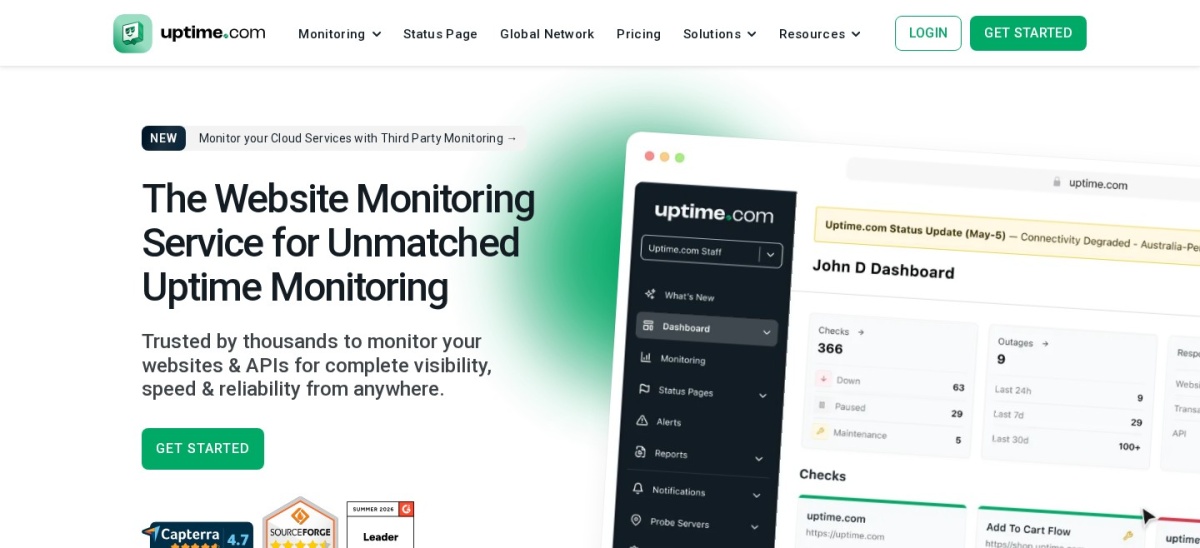
Uptime.com homepage, captured Nov 2026.
Uptime.com is a web performance and availability platform that bundles HTTP, DNS, SSL, malware, and API checks with multi-step browser transaction monitoring. There is no permanent free tier, and paid plans start at $7/mo billed annually ($84/yr) for 10 basic checks, 1 advanced transaction or page speed check, 25 SMS alerts, and unlimited user logins.
The trade off is that check volume steps up quickly in cost as your monitor count grows, and public status pages or real user monitoring cost extra. It suits small businesses and ecommerce operators that want to test a critical login or checkout flow alongside basic uptime checks for under $100 a year.
What we like
Includes 1 advanced browser transaction or page speed check at $84/yr
1-minute check intervals and 25 monthly SMS credits on the entry tier
Unlimited user accounts across every subscription level
Watch out for
No forever-free plan available
Public status pages and RUM are billed as separate add-ons
Entry plan ($84/yr) provides 10 basic checks at 1-minute intervals, 1 advanced check, and 25 SMS alerts.Visit uptime.com
05
Visualping
4.6/5on G2 (523 reviews, checked Nov 2026)
Paid from$120/yr
Best for visual and text webpage change alerts
Free plan5 pages, 150 checks/mo
Entry quota10 pages, 1,000 checks/mo
Fastest check2 minutes (Personal 10K+)
DetectionVisual pixels, HTML, text, AI
visualping.io
Visualping homepage, captured Nov 2026.
Visualping is a website change detection tool that screenshots and parses webpages to alert you when specific text, prices, or visual elements change. Its free plan includes 5 monitored pages and 150 checks per month at hourly intervals, while Personal 1K starts at $10/mo billed annually ($14/mo monthly) for 10 pages, 1,000 monthly checks, and 15-minute intervals.
The trade off is that Visualping is built for content and competitive intelligence rather than sub-minute server outage response or incident management. It suits marketers, compliance teams, and ecommerce sellers tracking competitor pricing pages, regulatory updates, or visual site defacement.
What we like
Highlights visual pixel and text diffs with plain-language AI summaries
Monitors specific page elements without writing scraper scripts
Forever-free tier covers 5 pages and 150 monthly checks
Watch out for
Not designed for server, port, or sub-minute uptime alerting
Slack, Microsoft Teams, and Google Sheets alerts require Business tiers
Personal 1K ($120/yr) increases capacity to 10 pages, 1,000 checks per month, and 15-minute intervals.Visit visualping.io
06
Oh Dear
4.9/5on Capterra (75 reviews, checked Nov 2026)
Starts at$170/yr
Best for agencies and site-wide health audits
Free planNone (free trial available)
Check interval1 minute (second-node verified)
Site auditsBroken links, Lighthouse, sitemap
Data hostingEU-hosted with GDPR DPA
ohdear.app
Oh Dear homepage, captured Nov 2026.
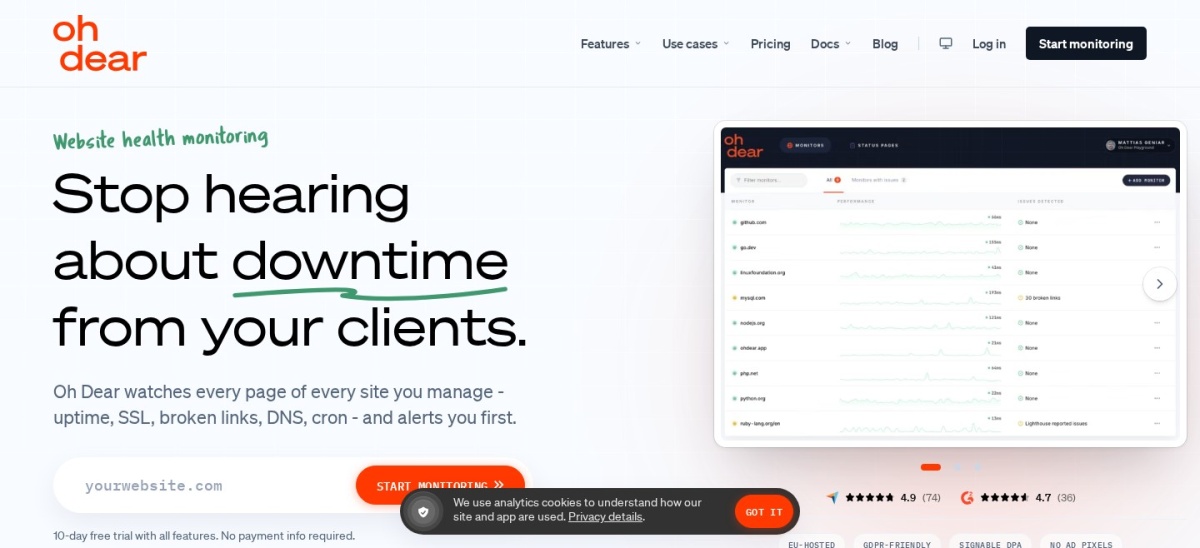
Oh Dear is an all-in-one website monitoring service that checks 1-minute uptime alongside broken links, mixed content, SSL certificate chains, DNS records, cron jobs, and daily Lighthouse SEO scores. Every plan unlocks the full feature set, unlimited team members, and branded status pages, with pricing starting around $14.17/mo billed annually ($170/yr).
The trade off is that there is no permanent free tier, and its crawler does not execute heavy client-side JavaScript when scanning for broken links. It suits web agencies, Laravel or WordPress developers, and SaaS teams that want deep site-health hygiene plus client-ready status pages in one subscription.
What we like
Every plan includes broken link crawls, Lighthouse audits, and status pages
Confirms downtime from a second geographic location before alerting
Unlimited team members and EU-hosted data residency included
Watch out for
No forever-free plan for hobby sites
Site crawler does not render single-page JavaScript apps
Entry plan (~$170/yr) includes 1-minute uptime, broken link crawls, Lighthouse reports, and status pages.Visit ohdear.app
07
Pingdom
4.5/5on Capterra (150 reviews, checked Nov 2026)
Starts at$198/yr
Best for combining synthetic checks with RUM
Free planNone (14-day free trial)
Entry quota10 uptime + 1 advanced check
SMS included50 SMS alerts per month
Data retention13 months
pingdom.com
Pingdom homepage, captured Nov 2026.
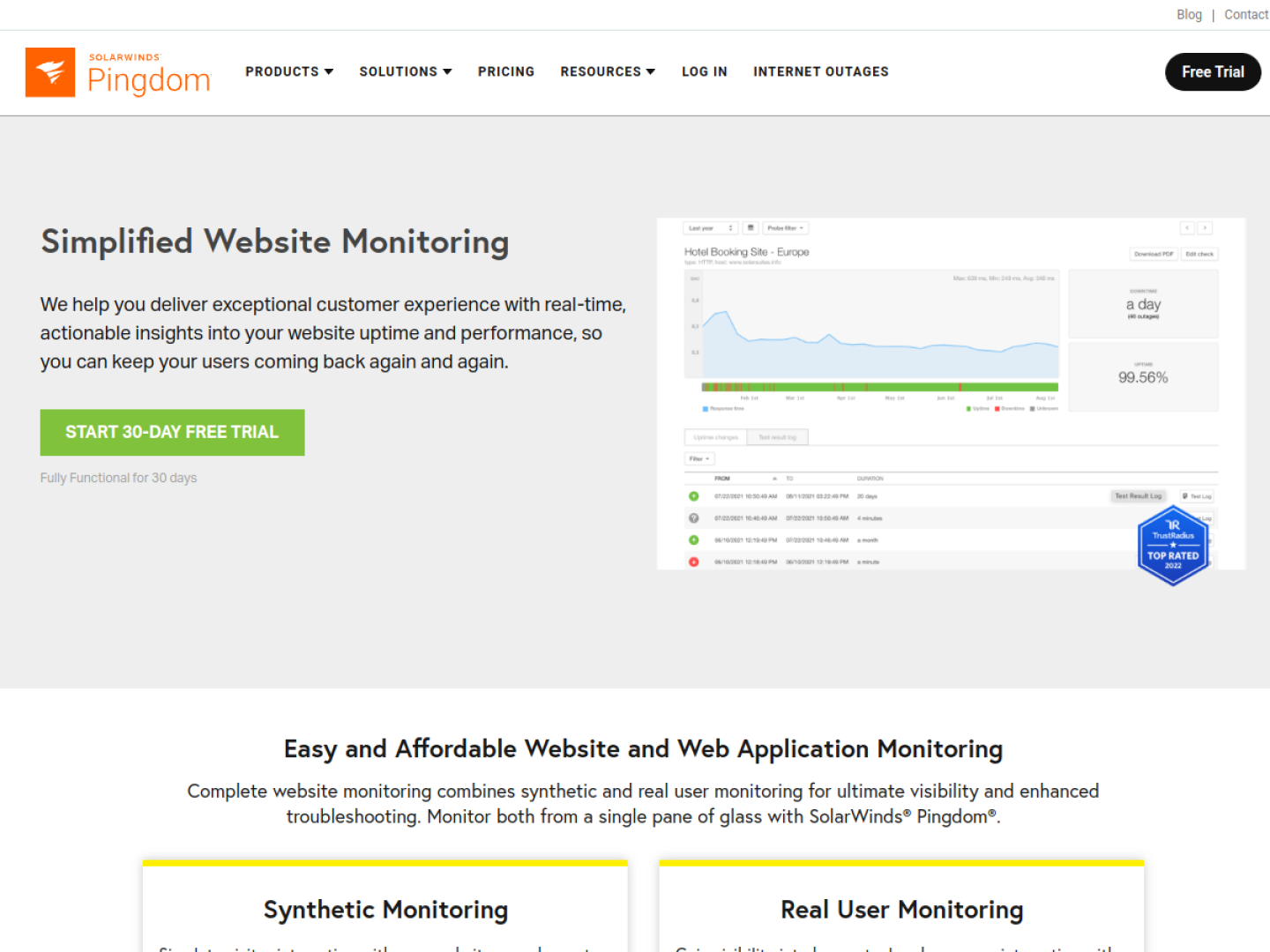
Pingdom is SolarWinds' established website performance platform offering synthetic uptime, page speed waterfalls, multi-step transaction monitoring, and real user monitoring (RUM). There is no free tier, and Synthetic Monitoring starts at $16.50/mo billed annually ($198/yr) for 10 uptime checks, 1 advanced transaction or speed check, 50 SMS alerts, and unlimited users.
The trade off is steep tier jumps once you exceed 10 uptime checks, plus RUM requires a separate subscription starting at another $16.50/mo billed annually. It suits mid-market teams and digital businesses that need detailed waterfall diagnostics, 13-month data retention, and SLA reporting.
What we like
Detailed page load waterfalls and root-cause diagnostics
Includes 50 SMS credits per month and unlimited user seats
13-month historical data retention on all paid subscriptions
Watch out for
No free plan and steep price jumps beyond 10 monitors
Real user monitoring is billed as a separate subscription
Best for bundling uptime, page speed, and domain alerts
Free planUp to 10 uptime monitors
Superior quota100 monitors at 1-min checks
Alerting75 SMS credits/mo on Superior
Extra checksPage speed, SSL, domain, virus
statuscake.com
StatusCake homepage, captured Nov 2026.
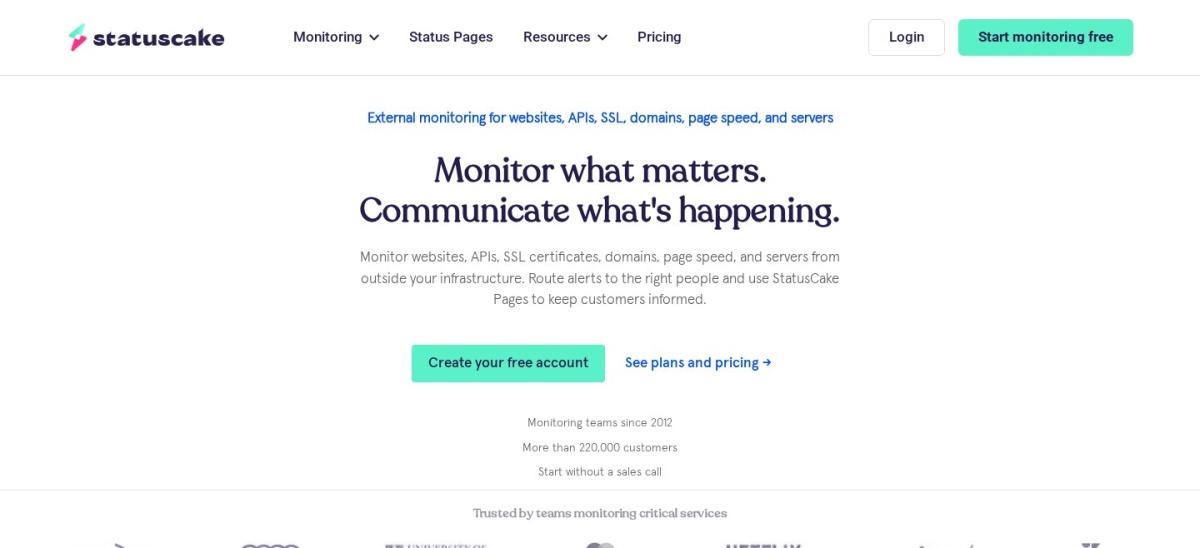
StatusCake is a veteran monitoring suite serving over 220,000 customers with uptime, page speed, SSL certificate, domain expiry, and server checks. Its free account covers personal monitoring at 5-to-15-minute intervals, while the Superior plan costs $20.41/mo billed annually ($244.92/yr, or $24.49/mo monthly) for 100 uptime monitors at 1-minute intervals and 75 monthly SMS credits.
The trade off is that public status pages are sold separately under StatusCake Pages (from $12.46/mo billed annually) and 30-second intervals require the $799.92/yr Business tier. It suits small businesses managing 20 to 100 domains that want uptime, SSL, domain, and page speed checks in one flat package.
What we like
100 uptime monitors at 1-minute intervals on the $244.92/yr Superior plan
Includes 75 free SMS credits per month plus SSL and domain checks
Supports 15+ alert integrations including Slack, Teams, and PagerDuty
Watch out for
Public status pages require a separate paid subscription
Dashboard interface looks dated compared to modern competitors
Superior ($244.92/yr) unlocks 100 monitors at 1-minute intervals, 15 page speed monitors, and 75 SMS credits.Visit statuscake.com
Uptime monitoring vs. webpage change detection
Traditional uptime monitors such as UptimeRobot, Better Stack, and Site24x7 send lightweight HTTP, ping, or API requests every 10 to 60 seconds. Their goal is to verify that your server responds with an expected status code and fast time-to-first-byte, immediately paging your team if an outage occurs.
Webpage change monitors like Visualping render the visual page or DOM tree to detect content updates, price drops, or missing checkout buttons. Because rendering full browsers takes more compute, change detection tools price by monthly check credits rather than unlimited 60-second polling.
How we chose
We evaluated web monitoring platforms across two primary categories: synthetic availability and performance monitoring (HTTP, API, SSL, and browser transactions) and automated webpage change detection. Candidates were shortlisted based on public G2 and Capterra user ratings, active maintenance, and transparent self-serve pricing.
All prices, monitor quotas, check intervals, and review counts were verified directly against official vendor pricing pages and review profiles on 22 Nov 2026. Where vendors offer annual billing discounts, we listed the regular annualized rate and noted the standard month-to-month rate.
We excluded enterprise-only observability suites without self-serve entry pricing, tools that hide all plan rates behind sales quotes, and services with fewer than 15 public reviews. No vendor paid for a place, and we do not claim testing for this list.
How to choose web monitoring software
Match your monitoring tool to the exact failure mode that costs your business money or leads.
Count your endpoints and required check frequency. If you watch fewer than 50 URLs and can tolerate 5-minute polling, UptimeRobot's free tier covers you at zero cost. For revenue-critical checkouts or APIs, pick a paid plan with 30-to-60-second intervals.
Verify multi-location failure confirmation. Single-probe monitors frequently trigger false alarms due to transient network blips. Choose tools like UptimeRobot, Better Stack, or Oh Dear that re-check from a second region before sending alerts.
Calculate hidden add-on costs before subscribing. Entry prices often exclude SMS credits, extra team seats, or custom-domain status pages. Compare the total yearly bill for your actual team size and alert channels rather than the base headline number.
Separate server uptime from visual content tracking. An HTTP 200 status code does not guarantee a working Add to Cart button or accurate competitor pricing. Pair an uptime monitor with synthetic transactions (Uptime.com, Pingdom) or visual diffing (Visualping) when front-end accuracy matters.
FAQ
What is the best free web monitoring software?
UptimeRobot offers the most generous free plan for uptime monitoring, covering 50 monitors with 5-minute check intervals and 1 status page for both personal and commercial sites. For tracking visual or text changes on external webpages, Visualping provides 5 free pages and 150 monthly checks.
How fast should website uptime check intervals be?
Five-minute intervals are sufficient for personal blogs and low-traffic brochure sites. Ecommerce stores, SaaS applications, and client websites should use 60-second or 30-second intervals so teams learn about outages before customers flood support channels.
What is synthetic transaction monitoring?
Synthetic transaction monitoring uses scripted headless browsers to simulate real user actions such as logging in, searching, or completing a checkout. Tools like Uptime.com, Pingdom, and Better Stack run these multi-step flows on a schedule to catch broken scripts that basic ping checks miss.
Do uptime monitors send false alerts?
Single-location monitors can fire false alerts when a local ISP route hiccups. Most modern tools prevent false positives by automatically re-checking a failed URL from one or two secondary global locations before sending an email, Slack message, or SMS alert.
Can one tool monitor both website uptime and SSL certificates?
Yes. Platforms including Site24x7, Oh Dear, Uptime.com, StatusCake, and UptimeRobot's paid Solo plan track SSL certificate expiration dates and chain validity alongside standard HTTP uptime checks.