WLWPLegible EditorsLast verified 22 Nov 2026How we rank10 min read
★ Short answer
Zoho Inventory is the strongest overall warehouse software for small teams, pairing a 4.5-star Capterra rating with a free plan and $29/mo annual billing. Growing multichannel operations should consider Cin7 Core for unlimited locations, while Odoo suits teams wanting an open-core ERP with a free single-app tier.
How we make this list: we compare pricing pages, product documentation and public user reviews, then re-check every price before each update. No product paid for a place. Disclosure.
Zoho Inventory starts at $0 for 50 monthly orders and $29/mo billed annually ($39/mo monthly) for 500 orders and 2 locations.
Odoo offers one app free for unlimited users, with full-suite Standard plans at $38.90/user/mo regular ($31.10/user/mo first-year promo).
Sortly covers visual barcode and QR tracking from $0 for 100 items, with paid plans starting at $49/mo regular ($24/mo annual promo).
Sumtracker syncs multi-warehouse stock from $59/mo monthly ($50/mo billed annually) for up to 5,000 yearly orders and 10 warehouses.
inFlow Inventory tracks stockrooms and sublocations starting at $129/mo billed monthly ($99/mo billed annually) for 2 team members.
Mid-market multichannel platforms like SKULabs ($299/mo), Ordoro ($349/mo), and Cin7 Core ($349/mo) step up order and carrier automation.
What to look for in warehouse software
Warehouse management software tracks stock from receiving and bin put-away through picking, packing, and shipping. Unlike basic spreadsheets, a warehouse system updates counts in real time across shelves, locations, and sales channels so teams stop overselling or losing stock in transit.
Pricing models vary sharply across vendors. Entry tools like Zoho Inventory and Sumtracker meter plans by monthly or yearly order volume, while Odoo charges per user and Cin7 Core or SKULabs bundle fixed user seats and order caps into higher monthly tiers.
Before choosing a platform, check whether barcode scanning, bin locations, and purchase orders sit in the base plan or behind paid upgrades. Some vendors include mobile scanning at entry level, whereas others lock bin-level routing or multi-warehouse transfers into higher tiers.
Warehouse limits2 locations on Standard; 4 on Premium
Barcode & binsBin locations & barcode gen on Premium
zoho.com
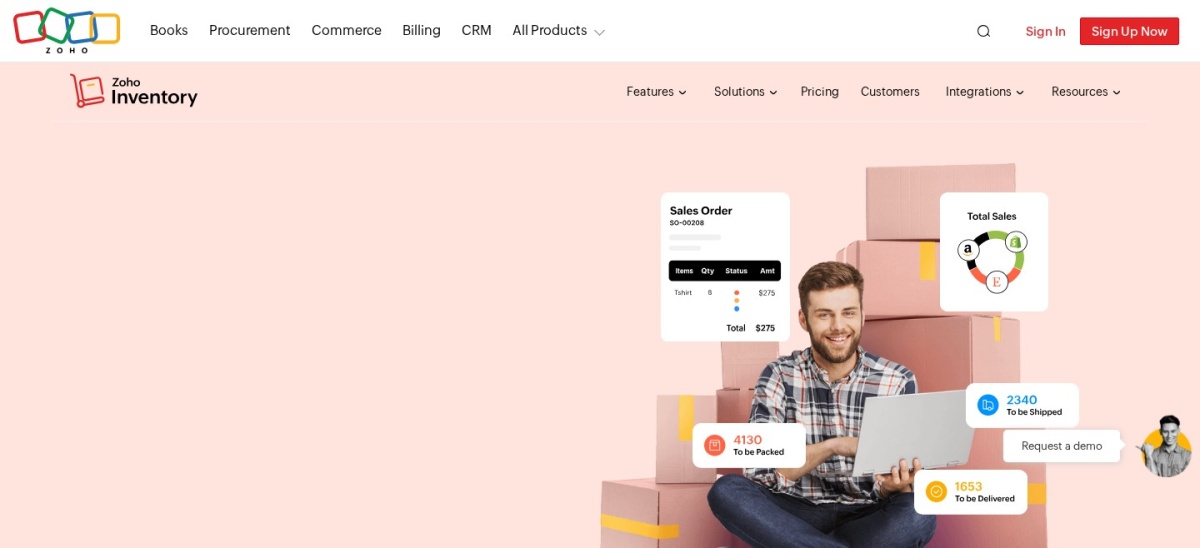
Zoho Inventory homepage, captured Nov 2026.
Zoho Inventory is a cloud inventory and warehouse application built for small businesses managing purchasing, orders, and multi-warehouse stock. Its free plan includes 50 orders per month, 1 user, and 1 location, while the Standard plan ($29/mo billed annually or $39/mo billed monthly) raises limits to 500 orders, 3 users, and 2 locations.
The trade off is that bin locations, barcode generation, stock counting, and serial or batch tracking require upgrading to Premium at $79/mo billed annually ($99/mo monthly). Extra users ($7.50/mo) and extra locations ($10/mo) also add cost, so it suits small teams already using Zoho Books or Zoho CRM.
What we like
Free plan available for up to 50 orders per month
Lowest entry paid price among multichannel warehouse apps
Direct integration with Zoho Books, Zoho CRM, and major marketplaces
Supports dropshipping, backorders, and composite items on entry plans
Watch out for
Bin locations and barcode generation require the $79/mo Premium tier
Strict monthly order caps require paid add-on blocks or tier upgrades
Paid plans raise monthly order limits from 50 to 500+ and unlock multi-warehouse transfers and bin tracking.Visit zoho.com
02
Cin7 Core
4.3/5on Capterra (604 reviews, checked Nov 2026)
Starts at$349/mo
Best for high-volume multichannel warehousing
Free tierNone (14-day free trial)
Entry paid plan$349/mo (Standard)
Warehouse limitsUnlimited inventory locations
Order allowance6,000 sales orders/yr, 5 users
cin7.com
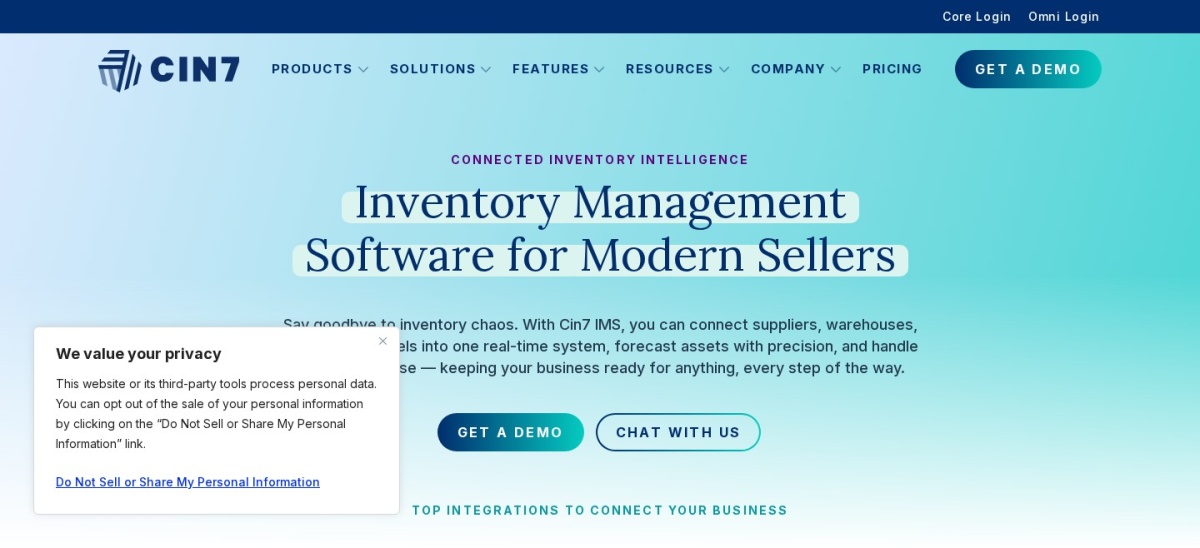
Cin7 Core homepage, captured Nov 2026.
Cin7 Core is a cloud inventory and warehouse platform designed for wholesale, retail, and ecommerce brands selling across multiple channels. Its $349/mo Standard plan includes 5 users, 6,000 annual sales orders, unlimited inventory locations, standard assembly manufacturing, and a mobile warehouse app with barcode scanning for one warehouse.
The trade off is the $349/mo starting price and add-on structure, as multi-warehouse mobile WMS, FIFO/FEFO enforcement, and ForesightAI forecasting require higher plans or paid modules. It suits established multichannel sellers that need unlimited locations and native EDI or 3PL connections.
What we like
Unlimited inventory locations included on the entry Standard plan
Combines warehouse picking, light assembly BOMs, and B2B wholesale
High annual order allowance of 6,000 orders at entry level
Watch out for
No free plan and high $349/mo entry price for small operations
Advanced multi-location WMS and forecasting are locked behind upgrades
Standard starts at $349/mo for 5 users and 6,000 orders/yr; Pro ($599/mo) and Advanced ($1,199/mo) expand volume and WMS tools.Visit cin7.com
03
Odoo
4.2/5on Capterra (1,341 reviews, checked Nov 2026)
CustomizationOdoo Studio & API on Custom ($76.20/mo)
odoo.com
Odoo homepage, captured Nov 2026.
Odoo is a modular ERP suite whose Inventory app handles double-entry stock moves, barcode scanning, drop-shipping, and multi-warehouse routing. Its One App Free plan covers the Inventory module for unlimited users on Odoo Online, while the Standard plan unlocks all Odoo apps at $38.90/user/mo regular ($31.10/user/mo first-year promotional rate).
The trade off is per-user pricing once you connect Accounting, Sales, or Manufacturing, and external API access requires the Custom tier at $76.20/user/mo regular ($61.00 promo). It suits technical teams and growing companies that want an integrated ERP without per-order caps.
What we like
One App Free tier supports unlimited users on the Inventory module
No order volume caps or SKU limits across cloud plans
Upgrading to Standard unlocks full accounting, purchasing, and MRP apps
Watch out for
Connecting a second app converts all users to paid per-seat billing
External API and Odoo Studio require the higher Custom plan
Paid plans unlock the full suite of Odoo business apps alongside Inventory, with Custom adding external API access.Visit odoo.com
inFlow Inventory is a warehouse and order management system built for wholesalers, distributors, and light manufacturers. Its entry Lite plan costs $129/mo billed monthly ($99/mo billed annually) for 2 team members and 1 location, covering purchasing, sales orders, barcode scanning, and real-time stock tracking.
The trade off is that multi-location tracking across 5 warehouses with unlimited sublocations requires jumping to Core at $379/mo monthly ($299/mo annually), plus a $499 one-time onboarding fee on higher tiers. It suits B2B product teams that want straightforward stock control and an optional B2B portal.
What we like
Highest Capterra rating (4.6 across 504 reviews) among mid-market tools
Tracks unlimited sublocations (aisles, shelves, bins) on Core and above
Optional B2B Showroom portal and serial or lot tracking add-ons
Watch out for
Steep price jump from Lite ($129/mo) to Core ($379/mo) for multi-warehouse
Core and above require a $499 one-time onboarding package
Core ($299/mo annual) expands capacity to 5 users, 5 locations, and unlimited sublocations.Visit inflowinventory.com
Sumtracker is a multi-location inventory sync platform built for ecommerce sellers operating across Shopify, Amazon, eBay, and Etsy. Its Manage plan starts at $59/mo billed monthly ($50/mo billed annually) for up to 5,000 annual orders, supporting up to 10 warehouses, 1 million SKUs, bundles, barcode cycle counts, and API access.
The trade off is that purchase orders, stock transfers, label printing, and warehouse-level user permissions require the Replenish plan at $119/mo monthly ($100/mo annually). It suits online retailers that need real-time stock sync across multiple warehouses without paying enterprise rates.
What we like
Includes up to 10 warehouses and 1 million SKUs on the $59/mo entry plan
Real-time bundle and component stock sync across 10 sales channels
Public API access and barcode stocktake included at entry level
Watch out for
Purchase orders and inter-warehouse stock transfers require Replenish
Order allowance1,000 orders/mo (+$0.20/order overage)
skulabs.com
SKULabs homepage, captured Nov 2026.
SKULabs is an all-in-one warehouse, order fulfillment, and shipping platform built to prevent picking errors. Its $299/mo Starter plan includes 1,000 monthly orders, 3 users, 2 warehouses, 10,000 SKUs, barcode scanning, and $0 per-label fees across connected USPS, UPS, and FedEx carrier accounts.
The trade off is the $299/mo entry cost and $0.20 per-order overage fee, while multi-location transfers, returns workflows, and API calls require stepping up to Basic ($499/mo) or Growth ($799/mo). It suits ecommerce fulfillment teams that want strict barcode verification and native shipping labels in one tool.
What we like
Charges $0 per-label fees on direct USPS, UPS, and FedEx accounts
Includes 2 warehouses and barcode pack verification on Starter
All core software features unlocked across tiers without feature gating
Watch out for
High $299/mo starting price with $120/mo per additional user on Starter
API access is excluded from the Starter tier
Basic ($499/mo) increases capacity to 2,500 monthly orders, 3 warehouses, 4 users, and 2,500 API calls.Visit skulabs.com
Mobile scanningBuilt-in phone camera QR/barcode scanner
sortly.com
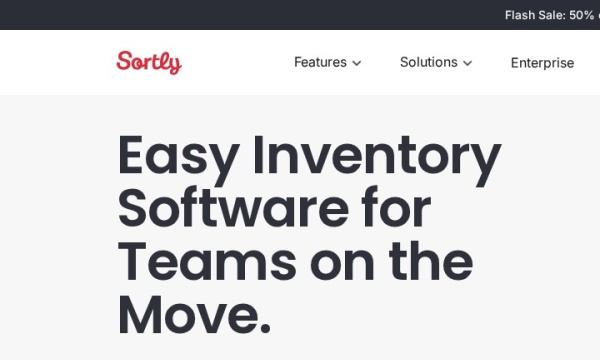
Sortly homepage, captured Nov 2026.
Sortly is a visual inventory and stockroom tracking app designed for teams managing supplies, parts, tools, and warehouse bins from phones or tablets. Its Free plan covers 100 unique items and 1 user, while the Advanced plan ($49/mo regular or $24/mo billed annually at $288/yr) expands capacity to 500 items, 2 users, and unlimited QR label creation.
The trade off is that Sortly lacks multichannel ecommerce order sync and shipping carrier integrations, and purchase orders or QuickBooks Online sync require the Ultra plan ($149/mo regular, $74/mo annual promo). It suits internal supply rooms, field depots, and teams replacing paper clipboards.
What we like
Photo-rich folder hierarchy makes locating warehouse bins simple
Built-in smartphone camera scanning eliminates dedicated hardware
Free plan and low $49/mo regular entry tier for small supply rooms
Watch out for
No native Shopify, Amazon, or shipping carrier fulfillment workflows
Purchase orders and pick lists require upgrading to Ultra ($149/mo regular)
Ultra ($149/mo regular) adds purchase orders, pick lists, custom user roles, and QuickBooks Online sync.Visit sortly.com
How warehouse software pricing scales
Entry-level warehouse apps generally meter usage by monthly order volume or item count. Zoho Inventory caps its free plan at 50 orders per month and its $29/mo annual Standard plan at 500 orders, while Sortly caps plans by unique SKU count starting at 100 items on Free and 500 items on Advanced.
Mid-market warehouse platforms bundle fixed user seats, warehouse locations, and annual or monthly order allowances into flat tiers. Cin7 Core starts at $349/mo for 5 users and 6,000 yearly orders, while SKULabs starts at $299/mo for 3 users and 1,000 monthly orders with $0.20 per-order overages.
How we chose
We selected seven established warehouse and inventory management platforms spanning free stockroom trackers, budget multichannel tools, and mid-market warehouse suites. Each candidate was evaluated on documented warehouse features including receiving, bin or sublocation tracking, barcode scanning, order fulfillment, and multi-location stock control.
All pricing tiers, regular monthly rates, annual discounts, user limits, and Capterra user ratings were verified directly against official vendor pricing pages and Capterra product profiles on 22 Nov 2026.
We excluded enterprise ERP systems that hide entry pricing behind custom sales quotes—such as NetSuite WMS, SAP EWM, and ShipHero—as well as legacy tools that lacked recent public review activity or clear self-serve tier breakdowns. No vendor paid for a place, and we do not claim testing for this list.
How to choose the right warehouse software
Follow four practical checks before committing to an annual warehouse software contract.
Count your monthly orders and active SKUs. Match your peak monthly order volume and SKU catalog against each tier's hard limits so overage fees or forced upgrades do not erase an attractive entry price.
Verify where barcode scanning and bins live. Confirm whether mobile barcode receiving, pick lists, and bin-level locations are included in the entry tier or locked behind higher plans and paid modules.
Check warehouse and user seat limits. Calculate the total cost for every warehouse location and every floor picker who needs a login, since per-seat fees add up quickly on per-user systems.
Test accounting and sales channel integrations. Use a free tier or 14-day trial to confirm that your ecommerce storefront, marketplaces, and accounting ledger sync stock and cost of goods without manual CSV imports.
FAQ
What is the best free warehouse software?
Odoo offers the most generous free warehouse tier through its One App Free plan, which covers the Inventory module for unlimited users with no order caps. Zoho Inventory also provides a free plan for 1 user, 1 location, and up to 50 orders per month.
How much does warehouse management software cost?
Small-business warehouse software ranges from $29/mo billed annually for Zoho Inventory Standard and $49/mo regular for Sortly Advanced up to $349/mo for mid-market platforms like Cin7 Core. Costs scale based on monthly order volume, active user seats, and warehouse locations.
What is the difference between inventory software and a WMS?
Inventory management software tracks stock quantities, purchase orders, and sales across channels. A warehouse management system (WMS) adds physical floor execution, including bin-level put-away, directed pick paths, barcode pack verification, and carrier label printing.
Can I use smartphone cameras instead of dedicated barcode scanners?
Yes, tools like Sortly, Odoo, inFlow Inventory, and Cin7 Core provide iOS and Android apps that scan barcodes and QR codes using a phone or tablet camera. Dedicated Bluetooth or rugged Android scanners remain faster for high-volume daily picking.
Which warehouse software works best for multiple locations?
Sumtracker supports up to 10 warehouses starting at $59/mo monthly, while Cin7 Core includes unlimited inventory locations on its $349/mo Standard plan. Zoho Inventory supports 2 locations on Standard ($29/mo annual) and 4 locations on Premium ($79/mo annual).