WLWPLegible EditorsLast verified 24 Nov 2026How we rank13 min read
★ Short answer
DBeaver is the best SQL software for most developers. The Community edition is free and connects to over 100 databases. Pick DataGrip for heavy SQL work, and TablePlus for speed.
How we make this list: we compare pricing pages, product documentation and public user reviews, then re-check every price before each update. No product paid for a place. Disclosure.
DBeaver Community is free with a 4.4/5 G2 rating from 172 reviews, connecting to over 100 databases.
DataGrip costs $109 a year for individuals with a 4.6/5 G2 rating from 127 reviews, the strongest SQL editor here.
HeidiSQL is free with a 4.7/5 G2 rating from only 3 reviews, the lightest client here for MySQL, MariaDB and PostgreSQL work.
TablePlus costs $99 once with a 4.3/5 G2 rating from 31 reviews, the fastest native client with no subscription.
MySQL Workbench and pgAdmin are free official tools, with G2 ratings of 4.5 from 49 reviews and 4.1 from 73 reviews.
What SQL software should cover
SQL software splits in two: universal clients that connect to many engines, and official single-engine tools that do one database deeply. DBeaver, DataGrip and Navicat cover the first group, while MySQL Workbench and pgAdmin cover the second.
The features that matter most are the SQL editor, schema compare and the free tier's limits. A smart editor with context-aware completion saves more time than any other feature, and a free tier that drops schema compare is a trial for serious work.
Pricing runs from free for DBeaver Community, MySQL Workbench and pgAdmin to $749.99 a year for Navicat Premium Standard. One-time licences such as TablePlus at $99 beat subscriptions over three years for developers on one machine.
Azure Data Studio is gone from this list. Microsoft retired it on 28 February 2026 and points administrators to SSMS and Visual Studio Code with the MSSQL extension instead, so a SQL Server shop should start with SSMS.
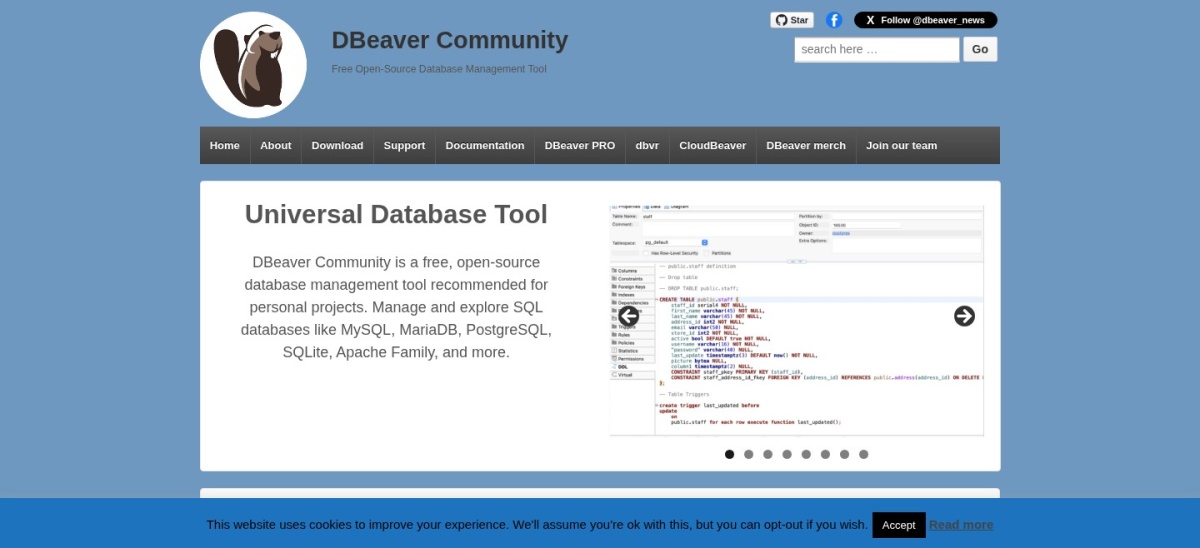
DBeaver Community is the default free SQL client for good reason: open source, cross-platform, and able to connect to over 100 databases from MySQL and PostgreSQL to cloud warehouses and NoSQL stores. The SQL editor, data grid, ER diagrams and task management cover daily database work well, and recent versions added AI chat assistance. Paid editions start at Lite for $113 a year.
The trade off is the Java interface. The UI feels dated next to native clients, and large result sets get sluggish above 500,000 rows. NoSQL support, cloud databases, schema compare and the PostgreSQL debugger wait for paid editions. It suits developers who work across many engines and want one free client for all of them.
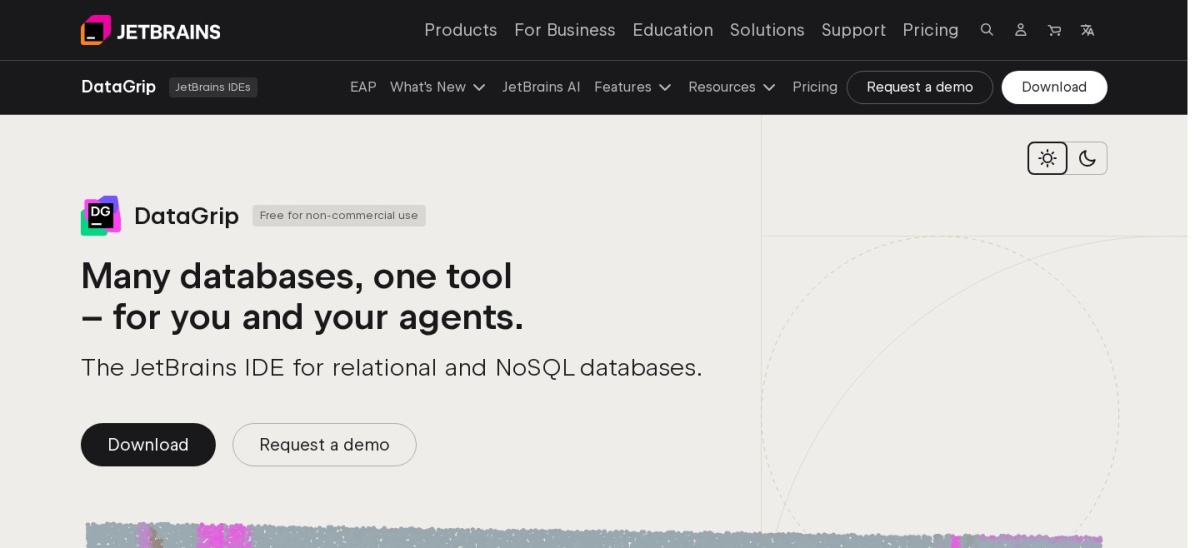
DataGrip is the premier paid database IDE for developers who write SQL all day, with context-aware code completion, on-the-fly analysis with quick fixes, intelligent query consoles and version control integration. The schema-aware AI assistance writes queries, fixes errors and converts between SQL dialects. Individuals pay $109 a year in year one, and it is free for non-commercial use.
The trade off is the subscription and the weight. Commercial use starts at $109 a year for individuals and $259 per user a year for organizations, and it wants to stay connected for activation. It is overkill for occasional queries and heavier than TablePlus. It suits developers who write and refactor SQL all day and want the strongest code intelligence.
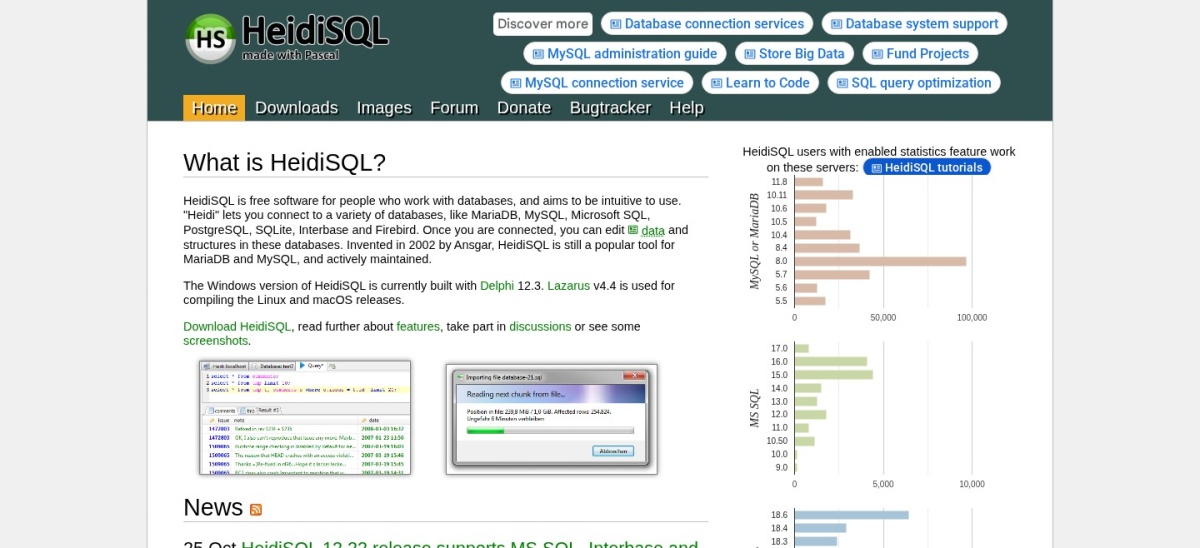
HeidiSQL is the lightest free SQL client here, a fast open-source tool for MariaDB, MySQL, SQL Server, PostgreSQL, SQLite and more. It keeps an intuitive interface for browsing tables, running queries, editing data and managing connections without unnecessary complexity, with syntax highlighting, auto-completion and multiple tabs. It is entirely free under the GPL-2.0 licence.
The trade off is the thin review base and the missing engines. G2 shows a 4.7 rating from only three reviews, so the score is a hint rather than proof. HeidiSQL lists no Oracle, MongoDB or Redis support, and has no visual schema design or query optimization suggestions. It suits developers who want a free, fast client for MySQL-family and PostgreSQL work.
Navicat Premium is the all-in-one commercial suite for teams managing many database engines, connecting MySQL, PostgreSQL, SQL Server, Oracle, SQLite, MariaDB, MongoDB, Redis and Snowflake in one client. It adds visual modeling, code refactoring, data synchronization, backup and automation on top of the SQL editor. Standard costs $749.99 a year, or $1,499 perpetual.
The trade off is the price. At $749.99 a year it is the most expensive tool here, and the monthly subscription at $79.99 per user is worse value still. Premium Lite is free for up to five users but drops modelling, data transfer and automation. It suits enterprises managing many database engines that need modelling and automation in one suite.
Oracle SQL Developer is the official free IDE for Oracle Database, and the obvious choice for any Oracle shop. It covers browsing, querying, reporting and administration with deep native integration, including data dictionary views, PL/SQL editing and migration tools. It is free to download and use on Windows, macOS and Linux.
The trade off is the Oracle-only scope and the Java interface. SQL Developer works with Oracle Database only, so multi-engine teams need DBeaver or Navicat beside it. The Java-based interface can be resource-intensive and prone to lagging or freezing on large result sets. It suits Oracle teams that want the official free tool for direct database work.
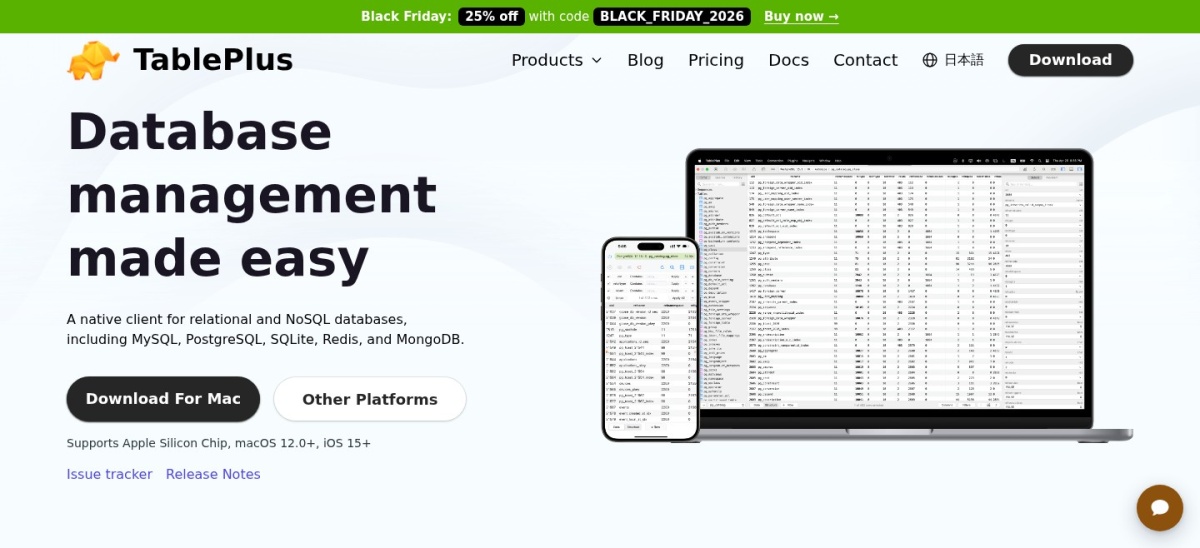
TablePlus is the speed pick: a truly native app that launches instantly and feels at home on each platform, with inline editing, advanced filters, safe mode for production, and a smart query editor with streaming results. Licenses are perpetual per device rather than subscriptions, which many users prefer. Basic costs $99 one-time for one device.
The trade off is the per-device licence and the free limits. A developer with a laptop and a desktop needs two licences, and updates and support stop after one year unless renewed at $59 per device. The free version caps at two tabs, two windows and two advanced filters. It suits Mac-first teams that want the fastest native client for daily lookups.
Beekeeper Studio is the lightest client here, and that is its appeal. It opens fast and covers the daily work of querying, browsing and editing tables without a learning curve, with autocomplete and spreadsheet-style table editing. The Community edition is free under the GPLv3 licence, and Indie costs $9 per user per month billed yearly.
The trade off is the thin feature set. Import, export, backup and restore are paid features, and Oracle, MongoDB and Snowflake need a priced plan. The AI Shell needs Professional or higher, and larger companies are asked to buy a paid plan instead of using Community. It suits developers who want a clean, lightweight client for everyday querying.
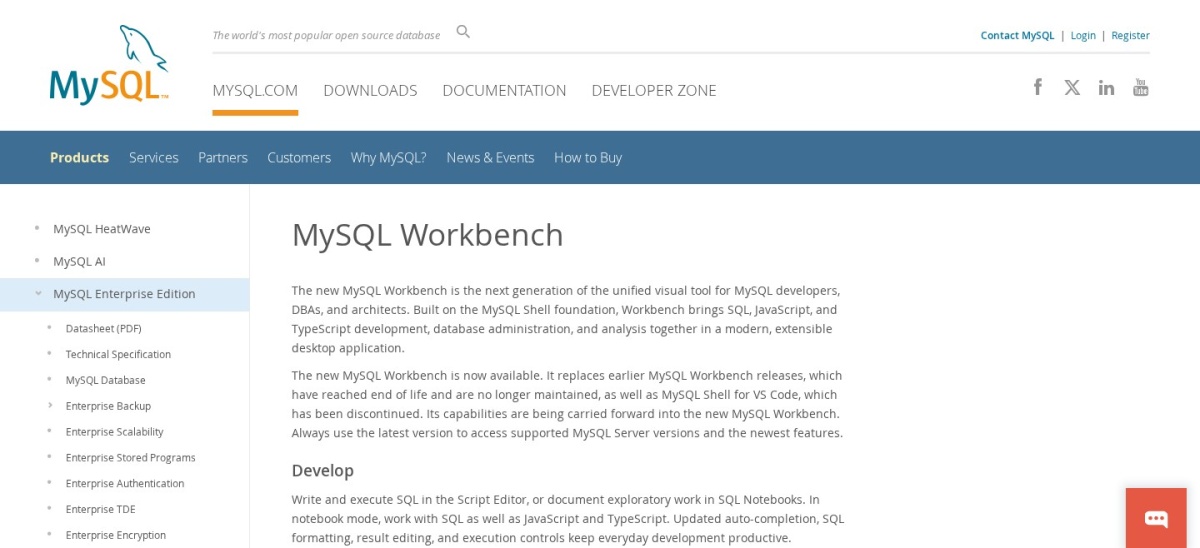
MySQL Workbench is the official free visual tool for MySQL, rebuilt in version 26 in July 2026 on the MySQL Shell foundation with SQL, JavaScript and TypeScript support. It covers database design, development and administration in one application, with visual modeling, user management, backup and performance reports. The Community Edition is free under the GPL.
The trade off is the single-engine limit. MySQL Workbench works with MySQL only, so a team running PostgreSQL or SQL Server needs another client beside it. Some enterprise integrations are tied to commercial MySQL products, and earlier releases have reached end of life. It suits MySQL teams that want the official tool for design and administration.
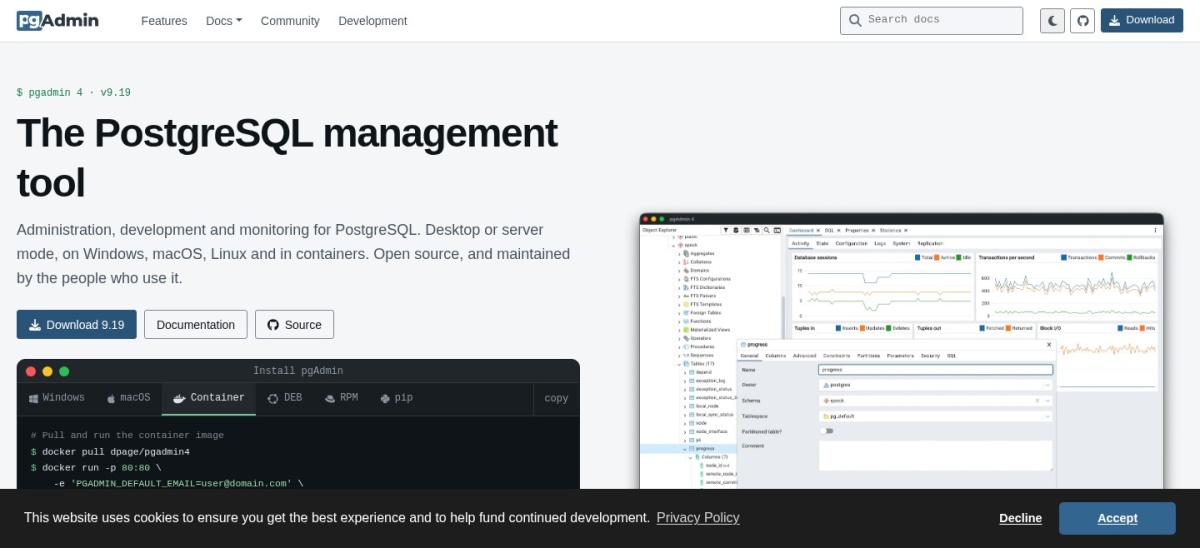
pgAdmin is the standard free management tool for PostgreSQL: cross-platform, open source, with full object management, a serious query tool with graphical EXPLAIN, and schema diff. It is the official administration tool for PostgreSQL, covering server dashboards, roles, backups, restores and maintenance. It is free under the PostgreSQL licence.
The trade off is the PostgreSQL-only scope and the dated interface. pgAdmin works with PostgreSQL and nothing else, so multi-engine teams need DBeaver or Navicat beside it. The interface is functional rather than polished, and the G2 rating rests on 73 reviews. It suits Postgres teams that want the official administration tool for free.
Most developers never need to pay. DBeaver Community covers over 100 databases for free, MySQL Workbench and pgAdmin cover their engines for free, and DataGrip is free for non-commercial use.
Pay when the free tier blocks real work. DBeaver Lite at $113 a year adds NoSQL and cloud databases, DataGrip at $109 a year adds the smartest SQL editor, and TablePlus at $99 once adds speed with no subscription.
How we chose
We started from the SQL tools most often named in 2026 database comparisons, then kept those with a real SQL editor, schema tools and database coverage for developers, DBAs and analysts.
Prices come from each vendor's pricing page and vendor-supplied listings, checked on 24 November 2026. Ratings and review counts come from G2 and Capterra on the same day. Where a vendor shows a sale, the list shows the regular price.
We left out tools with no verifiable rating, tools built only for one engine with no SQL editor, and Azure Data Studio, which Microsoft retired in February 2026. No vendor paid for a place, and we do not claim hands-on testing for this list.
How to choose SQL software
Start with your database engines, then check the SQL editor, the free tier and the real yearly cost.
List your database engines. A universal client suits multi-engine work, while the official tool suits one engine. DBeaver covers 100+ databases, MySQL Workbench covers MySQL only.
Test the SQL editor first. Context-aware completion, error detection and refactoring save more time than any other feature, so write real queries before you buy.
Check the free tier's limits. Schema compare, NoSQL support and cloud databases often wait for paid editions, so confirm the free tier covers your daily work.
Compare the three-year cost. TablePlus at $99 once beats a subscription over three years for one machine, while DataGrip at $109 a year suits heavy daily SQL work.
FAQ
What is the best SQL software?
DBeaver is the best pick for most developers. The Community edition is free and connects to over 100 databases, with paid editions from $113 a year.
How much does SQL software cost?
DBeaver Community, MySQL Workbench and pgAdmin are free. Beekeeper Studio costs $9 a user a month, TablePlus $99 once, DataGrip $109 a year, and Navicat Premium $749.99 a year.
What is the best free SQL client?
DBeaver Community is the best free SQL client. It is open source, cross-platform and connects to over 100 databases, with a SQL editor, data grid and ER diagrams included.
Is DataGrip worth it?
DataGrip is worth it for developers who write and refactor SQL all day. Its schema-aware completion, refactoring and visual EXPLAIN pay back the $109 a year quickly, and it is free for non-commercial use.
What is the fastest SQL client?
TablePlus is the fastest SQL client. It is a native app that launches instantly, with inline editing and safe mode for production, at $99 once for a Basic licence.
Is Azure Data Studio still available?
No. Microsoft retired Azure Data Studio on 28 February 2026. It no longer receives security fixes, and Microsoft recommends SSMS and Visual Studio Code with the MSSQL extension instead.