Best Usage-Based Billing Software in 2026: 7 Tools Compared
WLWPLegible EditorsLast verified 22 Nov 2026How we rank10 min read
★ Short answer
Billsby is our top usage-based billing software pick for smaller subscription businesses, with metered billing starting at $45 per month plus applicable revenue fees. Zoho Billing is a good alternative for businesses combining subscriptions and invoicing, while Recurly offers subscription billing with multiple payment gateways and churn management.
How we make this list: we compare pricing pages, product documentation and public user reviews, then re-check every price before each update. No product paid for a place. Disclosure.
Billsby Core costs $45 per month, includes 5 users and supports metered billing, with a 0.4% fee on monthly revenue above $15,000.
Zoho Billing Premium costs $79 per month billed annually and adds usage-based subscription billing, proration and dunning.
Recurly Starter costs $249 per month plus 0.9% of billing volume, with the first $40,000 in monthly billings excluded from the percentage fee.
Maxio Grow costs $599 per month and covers businesses with up to $100,000 in monthly billings.
Zenskar has a 4.8/5 G2 rating from 92 reviews and offers custom-priced plans for metered and hybrid billing.
Ordway and LogiSense both support complex consumption pricing, but buyers must request commercial terms directly.
What matters in usage-based billing software
Usage-based billing software charges customers according to consumption rather than only a fixed subscription fee. Common billable metrics include API requests, processing volume, storage, transactions and other measurable product activity.
The foundation is metering: recording usage events accurately and assigning them to the correct customers. A billing platform then applies pricing rules, calculates charges and generates invoices.
Pricing flexibility matters when businesses combine subscriptions with consumption fees. Look for tiered pricing, volume discounts, prepaid credits, minimum commitments and overage charges that match your business model.
Check whether the system handles the full billing cycle or only part of it. Some platforms manage invoices, payment collection, failed-payment recovery and revenue reporting, while others specialize in usage measurement and rating.
Finally, compare platform subscriptions with revenue-based fees. A low fixed price does not necessarily mean a lower total cost when the vendor charges a percentage of billings or additional fees for usage processing.
Best for affordable usage-based subscription billing
Entry planCore
Users5
Usage billingIncluded
Additional fee0.4% above $15K/mo
billsby.com
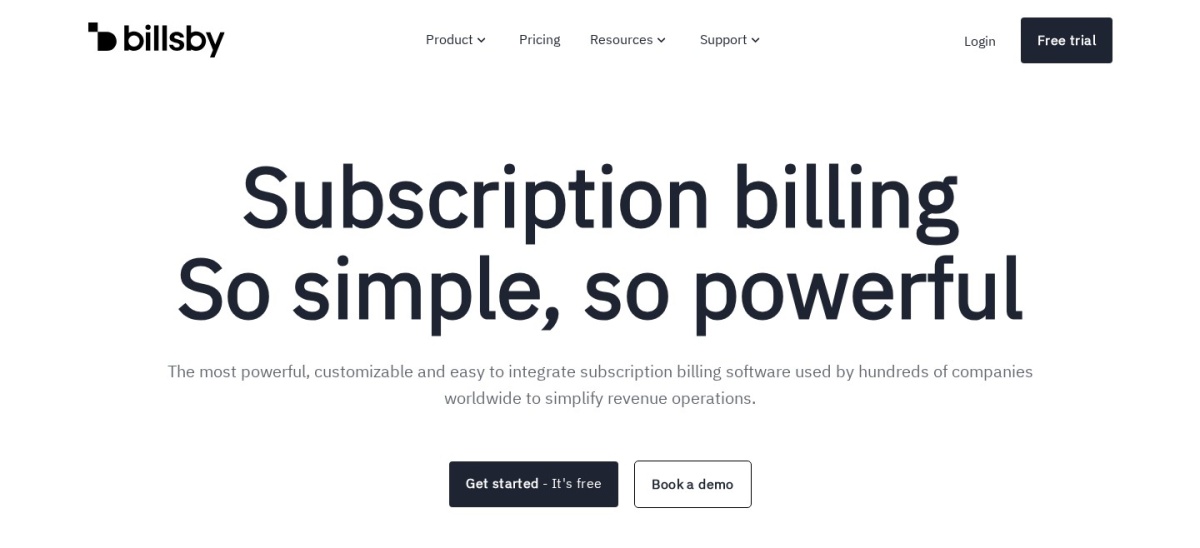
Billsby homepage, captured Nov 2026.
Billsby is a subscription billing platform that supports recurring charges, metered usage and automated customer payments. Its free setup option allows unlimited testing before launch, while the $45 monthly Core plan includes usage-based billing, five users, automated dunning, customer checkout and QuickBooks integration.
The trade off is the additional 0.4% fee on monthly revenue exceeding $15,000, making total costs dependent on business volume. Core also limits businesses to one payment gateway, with broader payment options reserved for Pro. It suits smaller subscription companies that need metered billing without an expensive enterprise contract.
What we like
Metered billing included in the entry paid plan
Free setup environment with unlimited testing
Automated payment recovery and customer checkout
Supports subscription, unit and usage charges
Watch out for
Revenue-based fees apply above the Core threshold
Core supports one payment gateway
Advanced reporting requires Pro
Smaller public review sample than established competitors
Core enables live billing, metered charges and automated payment recoveryVisit billsby.com
02
Zoho Billing
4.4/5on G2 (45 reviews, checked Nov 2026)
Starts at$79/mo
Best for small businesses combining subscriptions and usage
Metered planPremium
UsersUp to 10
BillingAnnual subscription
Annual cost$948
zoho.com
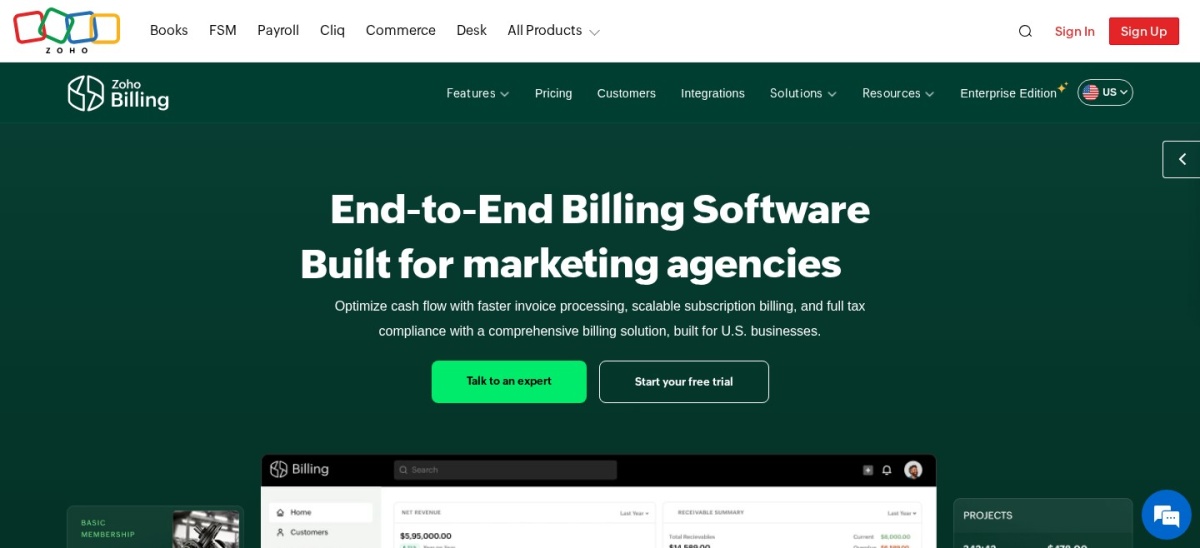
Zoho Billing homepage, captured Nov 2026.
Zoho Billing is a billing and subscription management application for businesses handling recurring and usage-based charges. Its Premium plan supports automated usage-based billing, subscription management, hosted payment pages, proration, dunning and access for up to 10 users, alongside invoicing and reporting features.
The trade off is that metered subscription billing requires Premium rather than the cheaper Standard plan. Premium costs $79 per month billed annually, totaling $948 per year, and organizations requiring more advanced configurations may need additional tools. It suits smaller companies that want invoicing, subscriptions and usage charges together.
What we like
Combines invoicing and subscription management
Premium includes usage-based billing
Supports proration and payment recovery
Customer portal and reporting features
Watch out for
Usage billing is excluded from Standard
Premium user allowance may restrict larger teams
Specialized consumption pricing may require more configuration
Premium adds metered subscriptions, proration, hosted payments and dunningVisit zoho.com
03
Recurly
4.1/5on G2 (227 reviews, checked Nov 2026)
Starts at$249/mo
Best for subscription businesses adding variable charges
Entry planStarter
Base subscription$249/mo
Variable fee0.9% of eligible billings
Payment gateways20+
recurly.com
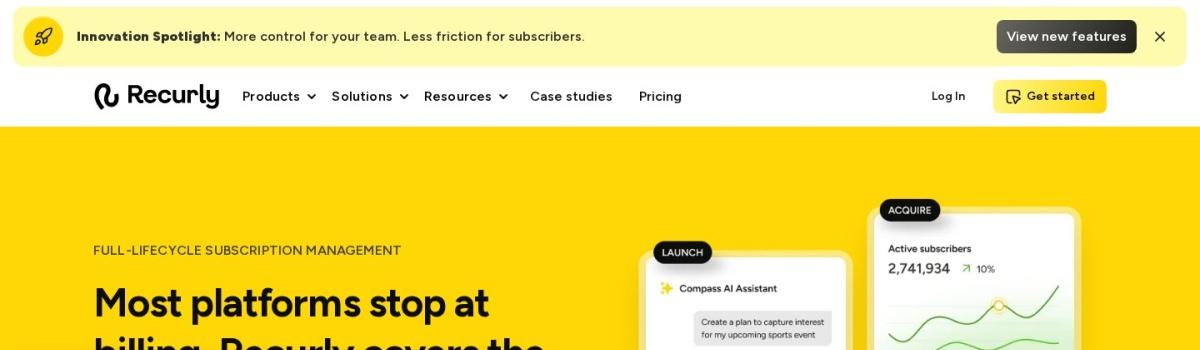
Recurly homepage, captured Nov 2026.
Recurly is a subscription billing and revenue management platform offering automated recurring billing and flexible pricing configurations. Its Starter plan includes subscription management, one dunning campaign, more than 10 payment methods and access to more than 20 payment gateways.
The trade off is its combined platform fee and volume-based pricing. Starter costs $249 per month plus 0.9% of billing volume, excluding the first $40,000 in monthly billings from that percentage charge. It suits subscription companies that prioritize billing automation and customer retention alongside variable pricing.
What we like
Broad payment gateway support
Automated recurring billing
Built-in payment recovery tools
Flexible subscription pricing configurations
Watch out for
Additional percentage fee increases with billing volume
Advanced retention tools require higher plans
Not primarily a dedicated usage-event metering engine
All-Access expands analytics, retention automation and payment orchestrationVisit recurly.com
04
Maxio
4.3/5on G2 (831 reviews, checked Nov 2026)
Starts at$599/mo
Best for finance-led SaaS billing operations
Entry planGrow
Monthly billingsUp to $100,000
Payment gateways20+
Annual base cost$7,188
maxio.com
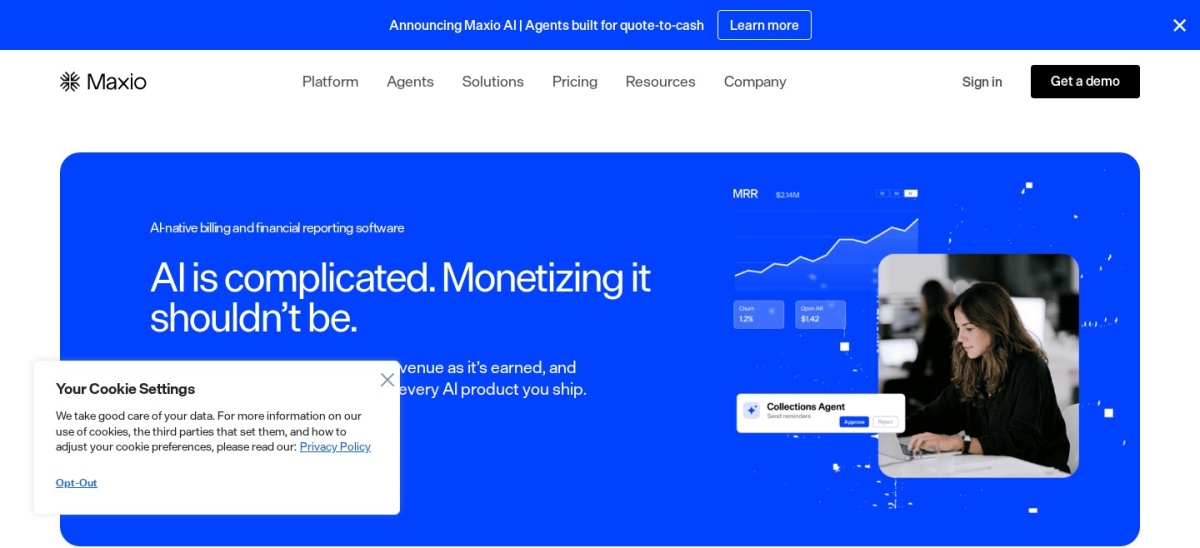
Maxio homepage, captured Nov 2026.
Maxio is a billing and financial operations platform for subscription and usage-based businesses. Its Grow plan includes usage-based billing, subscription management, recurring invoicing, collections, dunning and integrations with more than 20 payment gateways.
The trade off is the higher entry price and a monthly billing-volume threshold. Grow costs $599 per month for businesses processing up to $100,000 in monthly billings, while Scale requires a quote. It suits established SaaS companies that want billing, accounts receivable and financial reporting managed together.
What we like
Usage-based and subscription billing in one platform
Finance reporting and revenue management features
Collections and dunning included
Multiple payment gateway integrations
Watch out for
Higher minimum subscription commitment
Grow has a monthly billings threshold
Advanced configurations may require implementation support
Scale adds advanced finance capabilities and higher-volume arrangementsVisit maxio.com
05
Zenskar
4.8/5on G2 (92 reviews, checked Nov 2026)
PricingCustom pricing
Best for flexible SaaS and AI product monetization
Entry planStarter
MeteringAPI and data integrations
Pricing modelsUsage, hybrid, contract
Subscription priceCustom quote
zenskar.com
Zenskar homepage, captured Nov 2026.
Zenskar is an order-to-cash platform that combines consumption metering, subscription billing, contracts and revenue operations. Its Starter plan offers basic support and integrations, while its published feature catalog includes API usage ingestion, metered billing, hybrid pricing, overages and customer-facing billing workflows.
The trade off is pricing transparency. Zenskar publishes custom pricing for Starter, Standard and Enterprise, so companies must request a quote covering their intended volume and implementation requirements. It suits SaaS and AI businesses that need flexible contracts alongside consumption-based charges.
What we like
Supports metered, subscription and hybrid pricing
API ingestion and data integrations
Contract and payment automation features
Strong public G2 rating
Watch out for
No publicly fixed subscription price
Implementation requirements depend on workflow complexity
Comparing total costs requires a sales quote
Standard adds premium support, broader integrations and implementation assistanceVisit zenskar.com
06
Ordway
4.6/5on G2 (79 reviews, checked Nov 2026)
PricingCustom pricing
Best for complex B2B contracts and metered billing
Billing modelsSubscription and usage
Usage rulesTiered, prepaid, overages
InvoicesAutomated
PricingCustom proposal
ordwaylabs.com
Ordway homepage, captured Nov 2026.
Ordway is a quote-to-cash billing platform designed for recurring subscriptions and complex consumption-based contracts. Its published capabilities include metered charges, tiered pricing, prepaid credits, minimum commitments, usage allowances, true-ups and automated invoice generation.
The trade off is the absence of a published subscription price. Ordway asks prospective customers to request a proposal reflecting billing complexity, volume and integration requirements. It suits B2B businesses with negotiated customer contracts that cannot be represented by simple subscription tiers.
What we like
Detailed usage-rating and pricing controls
Supports prepaid credits and minimum commitments
Automated invoices for contract-specific charges
Combines billing and financial operations
Watch out for
Quote-only commercial pricing
More configuration than basic subscription billing
Commercial packages are tailored to billing volume and operational requirementsVisit ordwaylabs.com
07
LogiSense
4.6/5on G2 (38 reviews, checked Nov 2026)
PricingCustom pricing
Best for complex consumption and service billing
RatingReal-time usage
PricingVolume and contract
BillingRecurring and metered
Subscription costRequest quote
logisense.com
LogiSense homepage, captured Nov 2026.
LogiSense is a cloud-based usage-rating and billing platform for businesses selling consumption-based products and services. Its published capabilities include real-time rating, usage-based charges, shared-use plans, packaged bundles, volume pricing, contract commitments and recurring subscriptions.
The trade off is its sales-led pricing and configuration process. LogiSense does not publish a standard subscription amount on its pricing information page, directing buyers to discuss their needs with representatives. It suits service providers and enterprises managing complex usage records and negotiated billing arrangements.
What we like
Real-time usage rating
Supports shared-use and volume pricing
Handles subscriptions alongside consumption
Flexible contract and product configurations
Watch out for
No public subscription price
Requires a consultation to establish commercial terms
May be excessive for simple recurring subscriptions
Commercial packages are configured around metering and billing requirementsVisit logisense.com
Common usage-based billing models explained
Pay-as-you-go billing charges customers for measured consumption during each billing period. It is common when demand changes significantly from month to month.
Tiered pricing applies different unit rates to defined consumption ranges. Volume pricing can instead apply a rate based on the total quantity consumed. The distinction matters when calculating customer invoices.
Prepaid credits let customers purchase consumption capacity before using the product. The billing system must track credit balances, deductions, expiration rules and any additional charges.
Hybrid billing combines a fixed subscription or minimum commitment with consumption charges. It can provide more predictable baseline revenue while allowing customers to pay for additional use.
Different platforms support different combinations of these models. Before purchasing, confirm that the product can represent actual customer contracts without relying on repeated manual adjustments.
How much does usage-based billing software really cost?
Usage-based billing products can charge fixed subscriptions, percentages of processed billings, usage-event fees or custom enterprise commitments. Comparing only advertised monthly prices can hide substantial differences.
Billsby Core has a $45 monthly platform fee plus a percentage charge above its revenue threshold. Recurly Starter also combines a fixed subscription with a volume-based fee. These amounts should be estimated against expected revenue.
Maxio offers a fixed starting subscription tied to a billing-volume threshold, while Zenskar, Ordway and LogiSense require commercial proposals. Their final costs depend on the contract rather than a public standard rate.
Request a complete cost estimate that includes ingestion, rating, invoicing, payment integrations, implementation, support and any extra services. A realistic projected billing volume provides a more useful comparison than the starting subscription alone.
How we chose
We shortlisted established subscription billing, metering and revenue management platforms with documented usage-based billing capabilities. The selection combines businesses with published subscription prices and specialist platforms offering advanced consumption rating, contract management and invoicing.
For the article's 22 Nov 2026 editorial reference date, we compared official vendor pricing information, public feature documentation and third-party reviews. The pages were checked again on 24 Nov 2026. Review ratings come from G2 or Capterra, while published subscription fees come from vendor pages; variable revenue fees are explained separately from fixed annualized costs.
We excluded platforms without sufficient verifiable adoption or review evidence and vendors whose pricing or core usage-billing capabilities could not be established. Quote-only providers are included only where their commercial model is disclosed, and they are ranked below fixed-price options. No vendor paid for a place, and we do not claim testing for this list.
How to choose usage-based billing software
Map your customer billing model before comparing vendors, then evaluate metering accuracy, pricing flexibility, integrations and total recurring costs.
Define exactly what you meter. Identify the billable unit, whether it is API requests, transactions, storage, processed records or another activity. Confirm how usage events are collected, assigned to customers, aggregated and converted into charges.
Match the pricing engine to your contracts. List your subscription fees, consumption rates, tiers, prepaid credits, discounts, overages and minimum commitments. Choose software that represents these terms without extensive manual invoice corrections.
Evaluate the full billing workflow. Check how the platform handles payments, invoicing, taxes, failed-payment recovery, customer portals, credit notes and accounting integrations. Decide whether you need an end-to-end billing platform or a specialized metering component.
Estimate costs at realistic volume. Calculate the base subscription and any percentage or event-processing fees using your expected activity. Consider higher usage, integration work, support costs and the vendor's approach to moving between plans.
FAQ
What is the best usage-based billing software in 2026?
Billsby is our top choice for smaller businesses needing affordable metered subscription billing. Its Core plan includes usage billing for $45 per month, with additional fees above a revenue threshold. Zoho Billing is a useful alternative for invoicing and subscriptions, while Maxio suits finance-led SaaS operations.
What is usage-based billing software?
Usage-based billing software measures customer consumption and calculates charges according to pricing rules. Businesses can bill for API requests, transactions, storage, processed data or other measurable activities. Most platforms also help manage invoices, customer accounts, pricing plans and recurring billing cycles.
How much does usage-based billing software cost?
Public entry prices range from Billsby Core at $45 per month to Maxio Grow at $599 per month among the fixed-price products compared here. Billsby and Recurly also apply volume-based fees. Specialist enterprise platforms frequently require custom proposals based on customer volume and billing complexity.
What is the difference between metered billing and usage-based billing?
The terms are closely related. Metered billing emphasizes recording and charging for measured product consumption, while usage-based billing describes the broader pricing model. Both commonly involve collecting usage events, applying rates and generating invoices based on actual activity.
Can usage-based billing work with subscriptions?
Yes. Hybrid billing combines a recurring subscription with variable consumption charges. A business might include a usage allowance in its subscription and charge extra for consumption above that allowance. Billsby, Zoho Billing, Maxio, Ordway and other platforms support combinations of recurring and usage charges.
Which usage-based billing software is best for SaaS companies?
The best fit depends on the SaaS business model. Billsby works for simpler recurring and metered billing, Zoho Billing combines subscriptions and invoicing, and Maxio adds finance operations. Zenskar and Ordway are worth considering when customer contracts contain more elaborate consumption rules.
Do I need a separate metering system?
Not always. Some billing platforms include usage ingestion, aggregation and rating, reducing the need for a separate service. However, high-volume products or businesses with unusual measurement rules may need specialized metering infrastructure. Confirm supported event volumes, data delivery methods and reconciliation procedures before choosing.
What should I check before migrating billing systems?
Review active subscriptions, customer payment methods, historical usage records, pricing rules, prepaid balances and outstanding invoices. Confirm how the new platform handles migration, recurring schedules, tax records and accounting integrations. A parallel billing comparison can help identify differences before production migration.
Is usage-based billing better than fixed subscription pricing?
Neither model is universally better. Usage billing connects charges to consumption but can make customer invoices and revenue less predictable. Fixed subscriptions simplify forecasting but may not reflect differences in product use. Hybrid pricing can balance predictable commitments with consumption-based growth.