Best Tax Provision Software in 2026: 7 Tools Compared
WLWPLegible EditorsLast verified 22 Nov 2026How we rank6 min read
★ Short answer
ONESOURCE Tax Provision leads for large corporate tax departments with broad direct tax and compliance coverage across global entities, holding a 3.8 out of 5 rating across 30 G2 reviews. Corptax fits teams wanting unified provision and corporate return workflows, while Workiva suits financial reporting and footnote disclosures with a 4.5 rating across 2,269 G2 reviews.
How we make this list: we compare pricing pages, product documentation and public user reviews, then re-check every price before each update. No product paid for a place. Disclosure.
ONESOURCE Tax Provision supports both ASC 740 and IAS 12 across a suite used by 21,000 businesses and more than 100,000 users.
Corptax delivers web-based provision calculations alongside corporate tax compliance and Pillar Two workflows.
Longview Tax holds a 4.6 out of 5 rating across 8 Capterra reviews and supports ASC 740, IAS 12, and Pillar Two reporting.
Workiva holds a 4.5 out of 5 rating across 2,269 G2 reviews for linked financial reporting and audit trails.
OneStream holds a 4.6 out of 5 rating across 161 G2 reviews and links tax provision directly to financial close data.
CCH Tagetik holds a 4.3 out of 5 rating across 74 G2 reviews and connects consolidation with group tax reporting.
What to look for in tax provision software
Tax provision software calculates current and deferred income tax expense for financial statements under standards such as ASC 740 and IAS 12. Corporate finance teams use these systems to track temporary differences, valuation allowances, effective tax rates, and return-to-provision adjustments before filing final returns.
Spreadsheet-heavy workbooks often create version-control errors and slow down quarterly or annual close cycles. Dedicated provision tools centralize trial balance inputs, enforce review permissions, and keep audit trails tied to underlying figures.
When comparing options, check how the tool connects with your general ledger or consolidation system and whether it supports Excel workpapers. Also verify how it handles multi-currency entities, jurisdiction rate changes, and newer global minimum tax rules.
Public list prices are rarely published for enterprise tax provision suites, so quotes depend on entity count, user seats, modules, and implementation scope. Confirm implementation effort and training requirements before locking in a contract.
ONESOURCE Tax Provision homepage, captured Nov 2026.
ONESOURCE Tax Provision is corporate tax provision software from Thomson Reuters that automates current and deferred tax calculations under IAS 12 and ASC 740. It connects with Microsoft Excel Workpapers and broader ONESOURCE direct tax tools across a suite used by 21,000 businesses.
The trade off is quote-based enterprise pricing with no published self-serve rate and notable implementation effort. It suits large tax departments managing multi-entity structures and direct tax compliance in one system.
What we like
Supports both ASC 740 and IAS 12 provision workflows
Pushes and pulls data with Microsoft Excel Workpapers
Connects provision data with broader direct tax compliance
Provides group-to-detail reporting and audit trails
Watch out for
Pricing requires a custom quote rather than a published rate
Module-specific setup can require significant implementation work
Lower G2 rating than several focused alternatives
Custom quotes scale by modules, jurisdictions, users, and implementation scope.Visit thomsonreuters.com
02
Corptax
4/5on G2 (19 reviews, checked Nov 2026)
PricingCustom quote
Best for unified provision and compliance
DeliveryWeb-based platform
Core scopeProvision and compliance
Pricing modelCustom quote
G2 rating4.0/5 (19 reviews)
cscglobal.com
Corptax homepage, captured Nov 2026.
Corptax is corporate tax software from CSC that calculates current and deferred taxes under ASC 740 and other standards on a web-based platform. It supports effective tax rate tracking, return-to-provision adjustments, and corporate tax compliance in one system.
The trade off is quote-based licensing with no public pricing tier and occasional data-processing slowdowns reported in user reviews. It suits corporate tax teams that want provision and return workflows connected under one vendor.
What we like
Combines tax provision with corporate tax compliance workflows
Tracks effective tax rates and return-to-provision adjustments
Some G2 reviewers report slower processing during heavy loads
Initial setup and rules can take time to learn
Custom quotes depend on scope, entities, and compliance modules.Visit cscglobal.com
03
Longview Tax
4.6/5on Capterra (8 reviews, checked Nov 2026)
PricingCustom quote
Best for Excel-driven global consolidation
StandardsASC 740 and IAS 12
Spreadsheet syncExcel add-ins
Pricing modelCustom quote
Capterra rating4.6/5 (8 reviews)
insightsoftware.com
Longview Tax homepage, captured Nov 2026.
Longview Tax is corporate tax software from insightsoftware that automates current and deferred tax provisioning under ASC 740 and IAS 12 across legal entities. It includes Excel add-ins for data refresh and supports transfer pricing and Pillar Two reporting.
The trade off is custom enterprise pricing with user costs that reviewers note can limit seat counts and require training on formulas. It suits finance and tax teams that rely on Excel working papers across multinational entities.
What we like
Supports ASC 740, IAS 12, and Pillar Two reporting workflows
Offers Excel add-ins to pull, refresh, and write back data
Consolidates figures across entities, currencies, and systems
Watch out for
Custom quote pricing with high per-user cost noted by reviewers
Small review count on Capterra compared with broader suites
Excel formulas and reporting can require user training
Custom quotes reflect entity count, jurisdictions, integrations, and user seats.Visit insightsoftware.com
04
Workiva
4.5/5on G2 (2,269 reviews, checked Nov 2026)
PricingCustom quote
Best for linked financial reporting and disclosures
StrengthLinked reporting & audit
CollaborationVersion history & approvals
Pricing modelCustom quote
G2 rating4.5/5 (2,269 reviews)
workiva.com
Workiva homepage, captured Nov 2026.
Workiva is a cloud reporting and compliance platform used by finance teams to connect data across financial statements, disclosures, and audit workflows. Its linked data and approval controls help teams keep tax footnotes and schedules aligned across 2,269 G2 reviews.
The trade off is custom quote pricing and a broader scope focused on reporting and disclosure rather than standalone tax calculation. It suits reporting teams that want tight data linking, version control, and review workflows.
What we like
Strong G2 rating across 2,269 verified user reviews
Links figures across reports so updates stay consistent
Tracks approvals, version history, and audit trails
Watch out for
Custom quote pricing with no public plan rates
Focused on reporting and controls rather than full provision modeling
Large documents or broad feature sets can feel slow or complex
Custom packaging is tailored to organization usage, scale, and reporting needs.Visit workiva.com
05
OneStream
4.6/5on G2 (161 reviews, checked Nov 2026)
PricingCustom quote
Best for unified close and provision data
Data modelUnified close & tax
Spreadsheet syncExcel & Office integration
Pricing modelCustom quote
G2 rating4.6/5 (161 reviews)
onestream.com
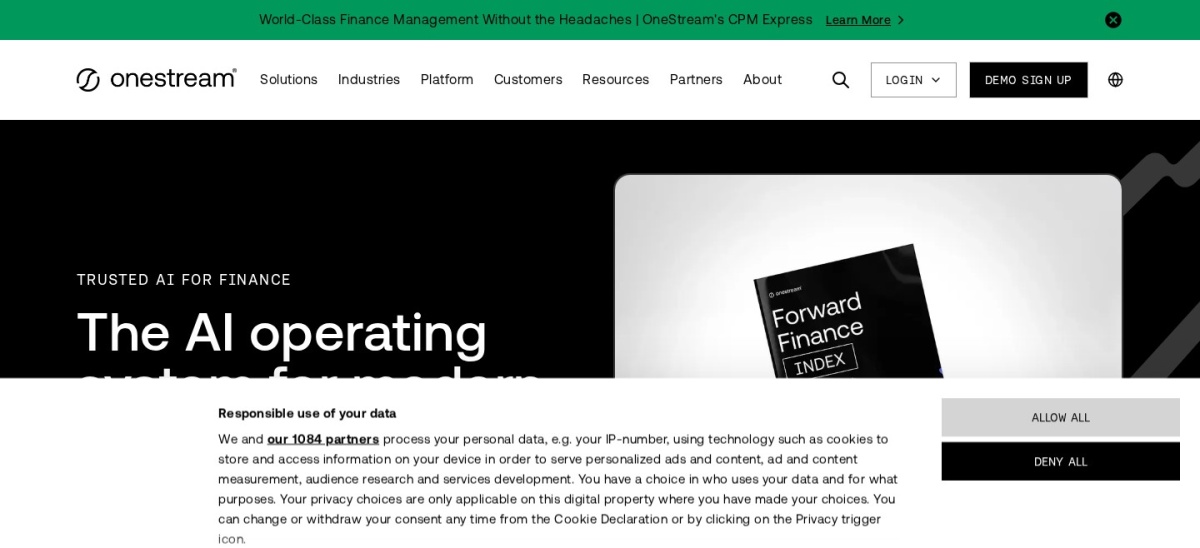
OneStream homepage, captured Nov 2026.
OneStream is a corporate finance platform that offers a tax provision solution built on the same trial balance and close data used for financial reporting. It supports current and deferred tax calculations, effective tax rate reporting, and Excel analysis across 1,900+ organizations.
The trade off is custom quote pricing and a steeper learning curve during initial setup and configuration. It suits finance teams consolidating close, reporting, and tax provision on one platform.
What we like
Reuses trial balance data from financial close and consolidation
Supports Excel analysis and Microsoft Office reporting packs
Holds a 4.6 out of 5 rating across 161 G2 reviews
Watch out for
Pricing is quote-based with no published rates
Steep learning curve and multi-month implementation timelines
Can feel heavy if you only need standalone tax provision
Custom quotes depend on organization size, users, and selected modules.Visit onestream.com
06
CCH Tagetik
4.3/5on G2 (74 reviews, checked Nov 2026)
PricingCustom quote
Best for consolidation-linked group tax reporting
Core focusConsolidation & tax reporting
Tax scopeTax provision & Pillar Two
Pricing modelCustom quote
G2 rating4.3/5 (74 reviews)
wolterskluwer.com
CCH Tagetik homepage, captured Nov 2026.
CCH Tagetik is a performance management platform from Wolters Kluwer that connects financial consolidation with group tax provision and Pillar Two reporting. It helps finance teams manage current and deferred tax workflows alongside close and regulatory reporting across 74 G2 reviews.
The trade off is custom quote pricing and a learning curve for new users adapting to its structure. It suits finance teams tying group tax reporting directly into close and consolidation.
What we like
Connects financial consolidation directly with group tax workflows
Covers tax provision, statutory reporting, and Pillar Two concepts
Praised in reviews for responsive technical and customer support
Watch out for
Quote-based pricing with costs driven by modules, entities, and users
New users can face a learning curve on the interface
Implementation requires clear scoping of reporting needs
Custom quotes vary by modules, entities, user count, and implementation scope.Visit wolterskluwer.com
07
Lucanet
4.6/5on Capterra (107 reviews, checked Nov 2026)
PricingCustom quote
Best for straightforward consolidation workflows
Core focusConsolidation & tax reporting
Tax scopeTax reporting & Pillar Two
Pricing modelCustom quote
Capterra rating4.6/5 (107 reviews)
lucanet.com
Lucanet homepage, captured Nov 2026.
Lucanet is a financial consolidation and reporting platform that offers tax compliance and reporting workflows, including Pillar Two and cross-border tax reporting. It holds a 4.6 out of 5 rating across 107 Capterra reviews for group close and standardized reporting.
The trade off is custom quote pricing without public price figures and a narrower focus than dedicated enterprise tax suites. It suits finance teams seeking accessible consolidation and structured tax reporting.
What we like
Holds a 4.6 out of 5 rating across 107 Capterra reviews
Supports Pillar Two, cross-border tax reporting, and financial consolidation
Centralizes group figures with audit-ready reporting controls
Watch out for
No public pricing published on its pricing page
Less specialized for complex corporate tax provision than dedicated tax suites
Implementation and training scope can affect total cost
Custom quotes depend on selected modules, entities, users, and services.Visit lucanet.com
Why teams move off spreadsheets for tax provision
Many tax teams start with Excel models for current and deferred tax schedules because formulas feel familiar and flexible. As entity counts, jurisdictions, and tax adjustments grow, manual links and copy-paste steps increase the risk of formula errors and version mix-ups.
Dedicated provision and close platforms keep trial balance inputs, tax calculations, and review history in a controlled environment. Most still let teams export or sync with Excel so analysts can inspect numbers without losing auditability.
How we chose
We built this list from established corporate tax provision and financial close platforms widely evaluated by finance and tax teams across ASC 740, IAS 12, and group reporting workflows.
All ratings, review counts, and vendor offerings were checked on 22 Nov 2026 from vendor pages and review directories. Because these products rely on custom enterprise quotes rather than public self-serve prices, we noted quote-based pricing and set price_year to 0 rather than guessing unverified figures.
We excluded consumer tax filing tools, indirect-only sales tax engines, and products lacking verifiable current product details or public review data. No vendor paid for a place, and we do not claim testing for this list.
How to choose tax provision software
Follow four practical steps to narrow down the right tax provision platform for your team.
Map your accounting standards and entity complexity first. List whether you need ASC 740, IAS 12, multi-currency consolidation, or global minimum tax support across legal entities.
Check how data flows from your general ledger and Excel. Verify whether the tool connects cleanly to your ERP or consolidation system and supports your preferred Excel workpaper workflow.
Compare audit trails, permissions, and review workflows. Look for clear change history, role-based access, and sign-off controls that support quarterly and annual audit reviews.
Request itemized quotes covering licensing and implementation. Ask vendors to break out subscription fees by users, entities, and modules alongside implementation and training costs.
FAQ
What does tax provision software do?
Tax provision software calculates current and deferred income tax expense for financial statements under accounting standards such as ASC 740 and IAS 12. It helps finance and tax teams track temporary differences, valuation allowances, effective tax rates, and audit trails during close cycles.
Why do most tax provision tools use custom quotes?
Enterprise tax provision software is priced around organization complexity, including legal entity count, jurisdictions, active users, modules, and implementation scope. Vendors typically scope a quote after reviewing your reporting structure and integration needs.
Can we still use Excel with tax provision software?
Yes, several platforms offer Excel add-ins or workpaper integrations to import trial balance figures, refresh schedules, or export reports. The main difference from standalone spreadsheets is centralized version control, permissions, and auditability.
Should we pick a dedicated tax suite or a close platform?
Dedicated tax suites fit teams that need deep tax calculations, return workflows, or specialized tax rules across many entities. Unified close and performance platforms fit teams that want tax provision tied directly to financial consolidation and reporting.
How long does implementation typically take?
Implementation timelines depend on data complexity, entity count, custom integrations, and how much process redesign your team needs. Broader enterprise platforms can take months to roll out, so factor setup time into your close schedule.