Best Software for Real Estate Developers in 2026: 9 Tools Compared
WLWPLegible EditorsLast verified 24 Nov 2026How we rank13 min read
★ Short answer
Northspyre is the best software for real estate developers, built for budgets, draws and lender reporting from acquisition to stabilization. Procore runs the construction phase, and JobTread is the best-priced all-in-one at $199 a month.
How we make this list: we compare pricing pages, product documentation and public user reviews, then re-check every price before each update. No product paid for a place. Disclosure.
Northspyre is the only tool built for the developer's side: budgets, draws, forecasting and lender reporting, at 4.4 out of 5 on G2 from 30 reviews.
Procore is the construction standard at 4.6 out of 5 on G2 from 4,357 reviews, but it publishes no price and quotes by annual construction volume.
JobTread is the best-priced all-in-one at $199 a month, with the highest rating here at 4.9 out of 5 on G2 from 118 reviews.
Four of the nine tools publish no price, so a quote-only tool cannot be compared on price alone.
Mastt is the cheapest serious option: the first project is free, then $165 a project a month.
What real estate developer software should cover
Real estate development is two jobs in one: the money side and the build side. The money side is underwriting, budgets, draws and lender reporting. The build side is scheduling, RFIs and punch lists. Most tools here do one side well and the other badly.
Northspyre is the only tool built for the developer's side of the table. Procore, Buildertrend, JobTread, Fieldwire and Buildxact are construction tools that developers use once ground is broken, and TestFit covers the feasibility work before a deal is even signed.
Pricing is mostly hidden in this category. Four of the nine tools publish no price and quote by project size or annual construction volume, so a quote-only tool cannot be compared on price alone. Our guide on the best project management software compares general tools if you want a priced alternative.
One gap to check before you sign: none of the construction tools here covers the pro forma or investor reporting, so developers usually pair a build tool with a capital tool such as Juniper Square or ARGUS EstateMaster.
The 9 best software tools for real estate developers
01
Northspyre
4.4/5on G2 (30 reviews, checked Nov 2026)
PricingCustom/yr
Best for developer-side budgets and draws
PricingBy quote only
DrawsYes, with lender reporting
Free trialDemo only
Paid planCustom quote
northspyre.com
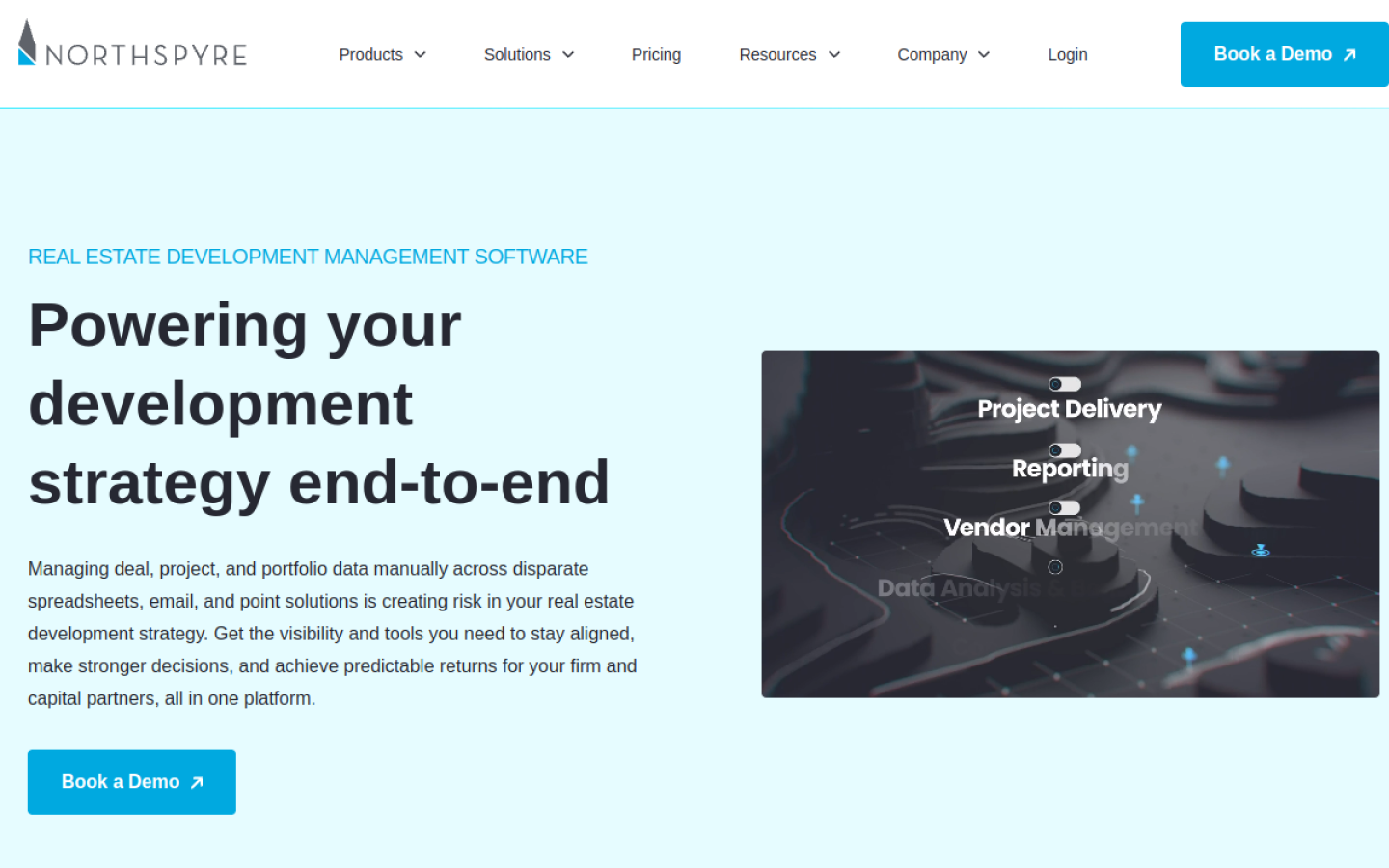
Northspyre homepage, captured Nov 2026.
Northspyre is project management software built for real estate developers rather than contractors. It covers budgets built from historical cost data, commitments, change orders, draw requests and forecasting, with reporting built for lenders and equity partners across a whole portfolio.
The trade off is price and proof. Northspyre publishes no price and quotes annual contracts by portfolio, and its G2 base is thin at 30 reviews, with several reviews labelled seller-invited or incentivised. It suits development firms managing several projects from acquisition to stabilization.
What we like
Only tool built for developers, not contractors
Draws, budgets and forecasting in one place
Lender-ready reporting across a portfolio
Watch out for
No published price; annual contracts by quote
Thin review base: 30 G2 reviews
Several G2 reviews are seller-invited or incentivised
Procore is the construction management standard for mid-size and large developers. It covers preconstruction through closeout: drawings, RFIs, submittals, daily logs, punch lists, budgets, change orders and reporting, with unlimited users on one paid contract.
The trade off is cost and commitment. Procore publishes no price; the annual fee is based on annual construction volume, and third-party estimates put it from around $375 a month. Implementation is a real project, not a signup. It suits large developments where the build is complex and many trades are involved.
Buildertrend is built for custom home builders and remodelers. It covers scheduling, budgeting, change orders, selections, warranty management and a client portal where homeowners approve selections, sign change orders and pay invoices.
The trade off is pricing transparency. Buildertrend stopped publishing prices in early 2025 and now quotes a custom price based on annual construction volume; the $499 to $1,099 a month figures still floating on affiliate sites are the December 2024 plans and are not current. It suits residential developers running several jobs at once with active homeowner communication.
Best-priced all-in-one for small and mid-size teams
Base price$199/mo, 1 user
Annual price$159/mo billed annually
Free trialNo; 30-day money-back
Paid plan$199/mo
jobtread.com
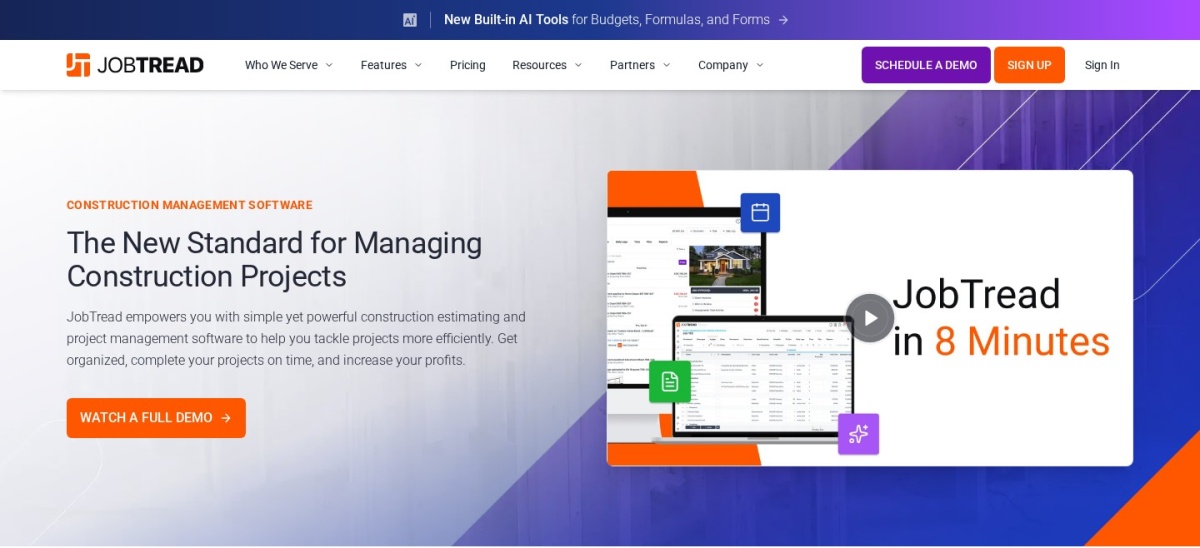
JobTread homepage, captured Nov 2026.
JobTread is construction management software for residential and remodel builders that want every feature for one flat price. It covers estimating, proposals, scheduling, CRM, job costing, invoicing and a client portal, with unlimited jobs, files and portal users. The base price is $199 a month for the first internal user, or $159 a month billed annually, with extra users at $20 each a month ($16 on annual).
The trade off is the lack of a free plan or trial. There is a 30-day money-back guarantee instead, and field crew who only log notes and photos are free. It suits growing residential builders that want estimating to invoicing in one tool without tier upgrades.
Fieldwire is field management software for teams that live on drawings, tasks and punch lists. Pro costs $39 a user a month billed annually ($54 month to month) and covers plan viewing, tasks, inspections, daily reports and photos, with strong offline use on site. Fieldwire is now owned by Hilti.
The trade off is scope. Fieldwire has no budgets, job costing or billing, so it usually sits next to Procore or an accounting tool. It suits superintendents, foremen and specialty trades whose core work is plans and punch lists.
Buildxact is built for residential builders and remodelers who spend most of their admin time estimating. Foundation costs $199 a month ($169 a month billed annually) and covers estimating, takeoffs, scheduling and job costing, with a free Go plan for small jobs.
The trade off is the thin review base: 4.3 out of 5 on G2 from only 66 reviews. It is also residential-only, so commercial developers should look at Procore or Autodesk Forma Build instead. It suits small residential builders that estimate from plans every day.
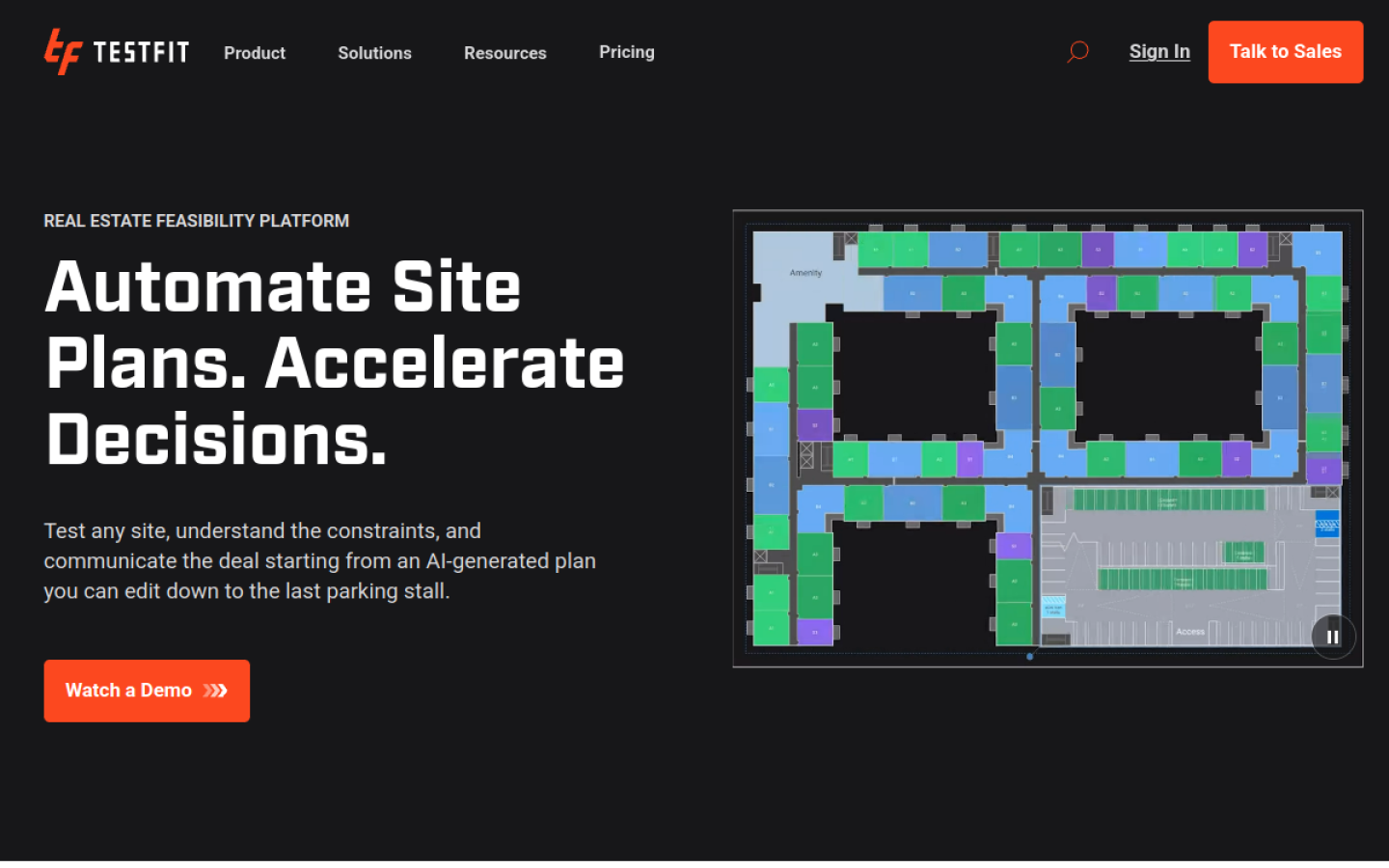
TestFit is feasibility software for developers testing what a site can hold. It models massing, parking and unit mixes in hours instead of weeks, and it is the only tool here besides the priced construction tools with a published price: $195 a month.
The trade off is scope and proof. TestFit answers the feasibility question and nothing else, and its G2 base is thin at 22 reviews. It suits developers underwriting deals who need a fast answer on a site before they spend on design.
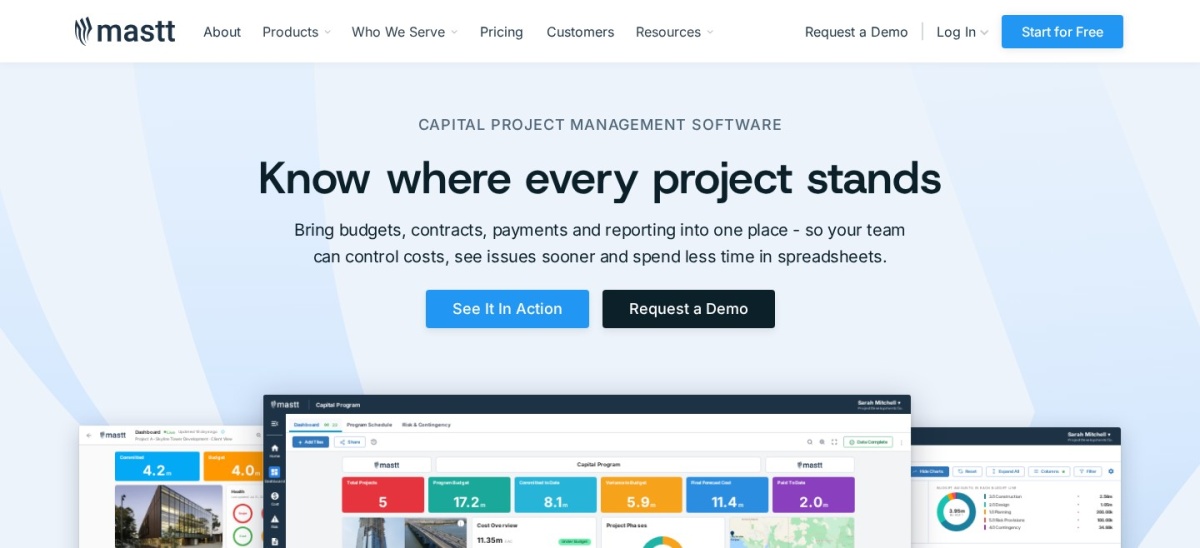
Mastt is cost-control software for developers on a budget. The first project is free, then it costs $165 a project a month, covering budgets, cost tracking, variations and reporting from pre-development to closeout.
The trade off is the thin review base. Mastt holds 4.9 out of 5 on Capterra from 30 reviews, while G2 shows 4.4 from only 10, and another roundup lists $150 a project a month, so confirm the current per-project price before you sign. It suits small developers that want cost control without an enterprise contract.
Autodesk Forma Build, formerly Autodesk Build, is the construction-phase tool for BIM-led commercial teams. It covers model coordination, clash detection, RFIs, submittals and Revit sync, taking designs from model to field in one system.
The trade off is price and complexity. Autodesk publishes no price for Forma Build; third-party trackers report around $45 a user a month, with modules priced separately, and the G2 review count varies between sources. It suits commercial developers and owners whose projects run on BIM and Revit.
TestFit is the only feasibility tool here, at $195 a month, and it answers the first question a developer asks: what can this site hold, and what is it worth? It models massing, parking and unit mixes in hours instead of weeks.
Once the deal is signed, Northspyre takes over the money: budgets built from historical costs, draw requests, change orders and lender-ready reporting. Procore and the other construction tools only become useful after ground is broken.
The practical stack is therefore two tools, not one: TestFit or ARGUS for the pro forma, Northspyre for development finance, and Procore or JobTread for construction. Budget for all three before you compare headline prices.
How we chose
We started from the development and construction tools most often recommended for real estate developers, then kept those with a verifiable rating on G2 or Capterra and a published price or a confirmed quote-only status.
Prices come from each vendor's pricing page or from November 2026 roundups that read the vendor's page that day. Northspyre, Procore, Buildertrend and Autodesk Forma Build publish no price, which we state rather than guessing. Ratings come from the review site named on each tool.
We left out tools with no verifiable rating and capital-side tools such as Juniper Square that do not manage projects. No vendor paid for a place, and we do not claim hands-on testing for this list.
How to choose software for real estate developers
Start with which side of the deal you own, then check the price model and the lender reporting.
Decide which side you own first. If you own the money, start with Northspyre or Mastt. If you own the build, start with Procore, Buildertrend or JobTread. See the best CRM software list if deal tracking is the gap.
Ask for a written quote early. Northspyre, Procore, Buildertrend and Autodesk Forma Build publish no price, so get a quote in writing before you compare them with the priced tools.
Check the lender reporting. Draw requests, lien waivers and lender-ready reports are the developer's daily work. Ask each vendor to show a draw workflow on a real project, not a slide.
Run the trial on a live project. Fieldwire, Buildxact and Mastt have free plans. Put a real budget and a real draw through the trial before you pay for a year.
FAQ
What is the best software for real estate developers?
Northspyre is the best pick for developers, because it is built for budgets, draws, forecasting and lender reporting from acquisition to stabilization. It is quote-only, and it holds 4.4 out of 5 on G2 from 30 reviews.
How much does real estate developer software cost?
Published prices run from $39 a user a month for Fieldwire Pro to $199 a month for JobTread and Buildxact. Northspyre, Procore, Buildertrend and Autodesk Forma Build publish no price and quote by project size or annual construction volume.
Is Procore or Northspyre better for developers?
Northspyre is better for the developer's money work: budgets, draws and lender reporting. Procore is better for the construction phase: drawings, RFIs, submittals and daily logs. Most large developers run both.
Which tool is cheapest for a small developer?
Mastt is the cheapest serious option: the first project is free, then $165 a project a month. Fieldwire's free Basic plan covers 5 users and 3 projects for field work, and Buildxact has a free Go plan for estimating.
Can I start free?
Yes. Mastt is free for the first project, Fieldwire has a free Basic plan, and Buildxact has a free Go plan. Northspyre, Procore, Buildertrend and Autodesk Forma Build offer demos, not free plans.
Does Buildertrend publish its pricing?
No. Buildertrend stopped publishing prices in early 2025 and now quotes a custom price based on annual construction volume. The $499 to $1,099 a month figures still floating on affiliate sites are the December 2024 plans and are not current.