HubSpot Marketing Hub is the best predictive analytics option for most marketing teams, putting lead scoring inside the CRM they already run. 6sense suits B2B teams doing account-based marketing, and Pecan AI suits analysts who build churn and lifetime value models without a data scientist.
How we make this list: we compare pricing pages, product documentation and public user reviews, then re-check every price before each update. No product paid for a place. Disclosure.
HubSpot Marketing Hub is the best overall pick, with lead scoring inside the CRM from $800 a month.
6sense is the account-based pick, but paid plans are quote-only with a median contract near $55,000 a year.
Pecan AI holds the highest G2 rating here at 4.7 out of 5 and builds models without a data scientist.
Most of these tools are quote-only, so only five of the nine publish a starting price.
Power BI Pro at $14 a user a month is the cheapest way into governed dashboards with predictions.
Three kinds of predictive analytics for marketing
Predictive analytics for marketing means one thing: ranking who is likely to buy, churn or spend more, before it happens. The tools split into three camps: platforms with predictions built in, account-based suites, and no-code model builders.
Built-in predictions are the easiest start. HubSpot scores leads inside the CRM, so the marketing team sees the prediction where it already works. Our guide on best lead scoring software covers the scoring side in more depth.
Account platforms suit B2B teams with long sales cycles. 6sense and Demandbase score whole companies and buying committees, which fits account-based marketing but needs a five-figure budget and a dedicated owner.
No-code builders suit analysts without a data science team. Pecan AI, Akkio and MadKudu build churn, lifetime value and demand models from a spreadsheet or CRM export, with no Python needed.
The 9 best predictive analytics software for marketing teams
01
HubSpot Marketing Hub
4.4/5on G2 (16,001 reviews, checked Nov 2026)
Starts at$800/mo
Best overall for predictions inside the CRM
Entry planProfessional, $800/mo
Lead scoresUp to 5 on Professional
AI-built scoresEnterprise only
G2 rating4.4/5 (16,001 reviews)
hubspot.com
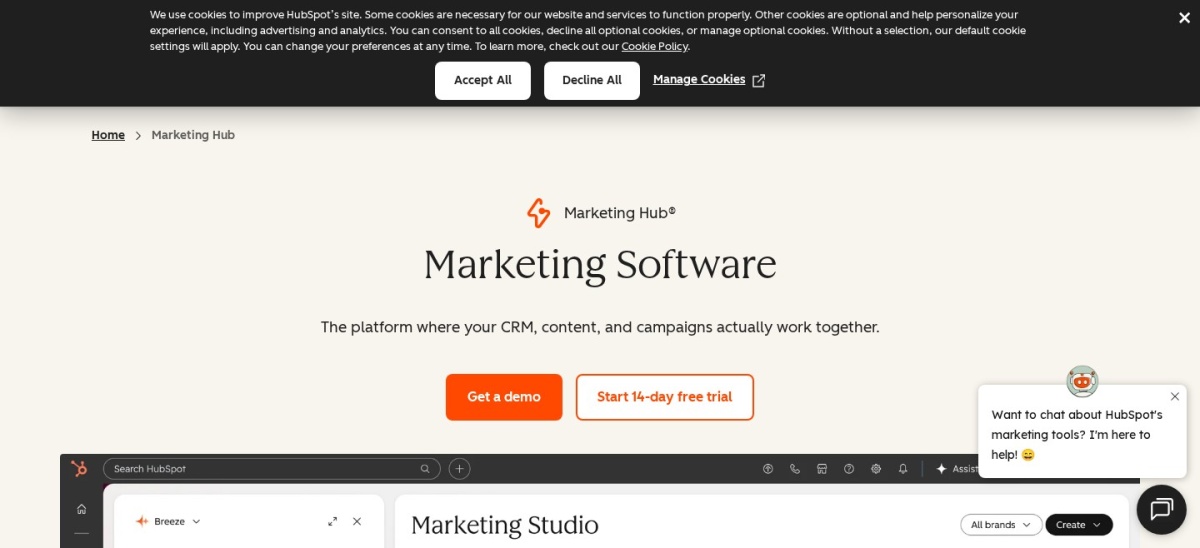
HubSpot Marketing Hub homepage, captured Nov 2026.
HubSpot Marketing Hub is the marketing platform most teams already run, and its predictive features sit inside the CRM rather than in a separate tool. Professional at $800 a month includes lead scoring with up to 5 scores, workflows, email marketing and reporting, while Enterprise at $3,600 a month adds AI-built scores, custom objects and attribution.
The trade off is the price jump to real predictions. AI-built lead scores need Enterprise, and mandatory onboarding costs $3,000 to $7,000 on top. It suits marketing teams already running on HubSpot that want predictions without a second platform.
What we like
Predictions live inside the CRM the team already uses
Largest review base here at about 16,000 G2 reviews
Strong workflows, email and reporting in one place
Watch out for
AI-built lead scores need Enterprise at $3,600 a month
Mandatory onboarding costs $3,000 to $7,000
Professional is $800 a month, not a small-team price
6sense is an AI-driven account-based marketing platform that predicts which companies are in market and scores the whole buying committee. It scores accounts from 0 to 100 across five buying stages, identifies website visitors through its Company Graph, and buys display, native, video and connected TV ads to those accounts.
The trade off is cost and complexity. Paid plans are quote-only, buyer-reported data puts the median contract near $55,000 a year, and reviewers cite a steep learning curve. It suits B2B marketing teams running account-based marketing at mid-market or enterprise scale.
What we like
Scores whole accounts, not just single leads
Native B2B ad buying built into the platform
Free tier with 50 credits a month
Watch out for
Quote-only pricing with a median near $55,000 a year
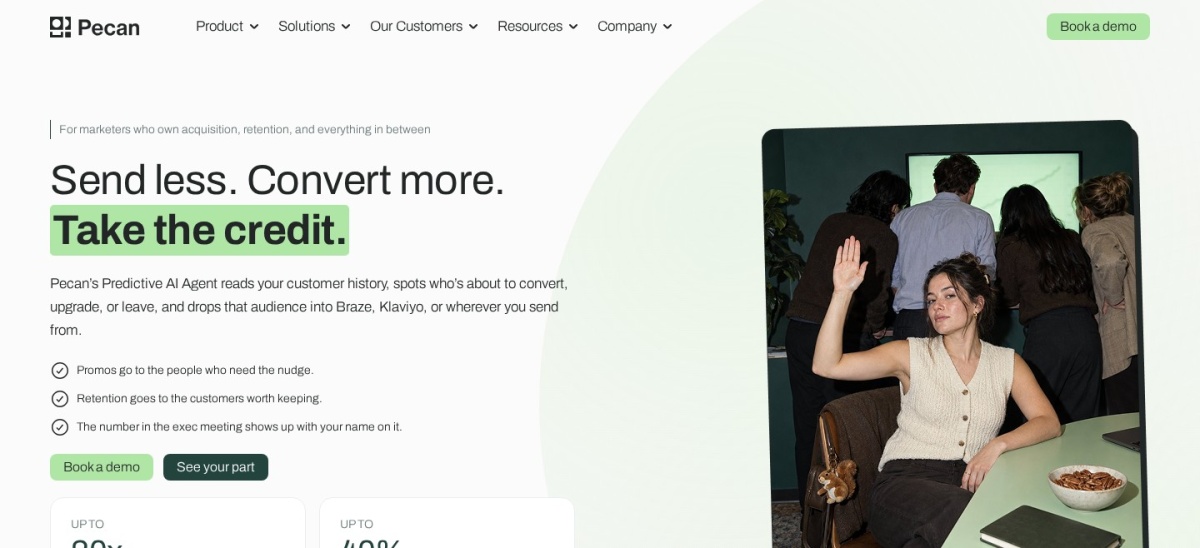
Pecan AI is a predictive analytics platform for business teams that have data but no data science department. A guided workflow takes a prediction question, churn, lifetime value or demand, through data prep, modelling and validation, then writes predictions back to the CRM or warehouse with monitoring for drift and overfitting.
The trade off is price and a thin review base. Starter is $950 a month on G2 vendor-provided pricing, with other reads at $760 a month, and only 48 G2 reviews sit behind its 4.7 rating. It suits marketing and CRM teams that want production predictions without hiring a data scientist.
Best for predictive lead scoring from sales history
PricingBy quote only
ScoresFit and engagement
CRM syncSalesforce and HubSpot
G2 rating4.5/5 (46 reviews)
hginsights.com
MadKudu homepage, captured Nov 2026.
MadKudu is a predictive lead scoring tool that learns from closed-won history which traits preceded a deal, then pushes a fit score and an engagement score into the CRM. It combines CRM data with product usage and marketing signals, and reviewers praise predictions that concentrate revenue in a small share of leads.
The trade off is the acquisition. HG Insights bought MadKudu in August 2025, and the engine now sells as HG Insights Data Studio, with pricing by quote and a median contract near $32,288 a year in buyer-reported data. It suits B2B revenue teams that want scoring built on their own won deals.
What we like
Scores built on your own closed-won history
Fit and engagement scores written into the CRM
Reviewers praise prediction accuracy
Watch out for
Now sold as HG Insights Data Studio after acquisition
Akkio is a no-code AI platform that lets business users build predictive models by describing the prediction in chat, then connecting a spreadsheet or data source. It covers forecasting, lead scoring, churn prediction and demand planning, with templates for the common marketing use cases and a chat layer for asking questions of the data.
The trade off is pricing opacity and a tiny review base. The vendor pricing page now lists custom pricing only, and only 14 G2 reviews sit behind its 4.5 rating. It suits small teams that want a first prediction fast with no data science staff.
Alteryx is the analyst standard for visual data preparation, with a drag-and-build canvas for blending, cleaning and modelling data. Designer at $5,195 per user per year covers multi-source blending, fuzzy matching, geospatial analysis and predictive modelling as visual pipelines that run on schedule.
The trade off is cost per analyst. At $5,195 a user a year, three analysts cost more than many BI platforms, and the cloud Starter edition at $250 a user a month is a separate path. It suits teams that automate recurring data preparation before any prediction work.
What we like
Highest-rated data prep workflow here at 4.6 out of 5
Tableau is the visualization-first analytics platform, and its Pulse feature turns data changes into plain-English summaries with a root cause attached. Standard at $15 per user per month covers dashboards and sharing, while Creator at $75 a user a month adds data prep, and Pulse is priced separately from about $5,000 a year.
The trade off is the add-on stack. Predictions and AI summaries need Pulse or the Tableau Plus bundle, and the full price is hard to pin down without a sales conversation. It suits teams that want to explore predictions visually rather than read a score table.
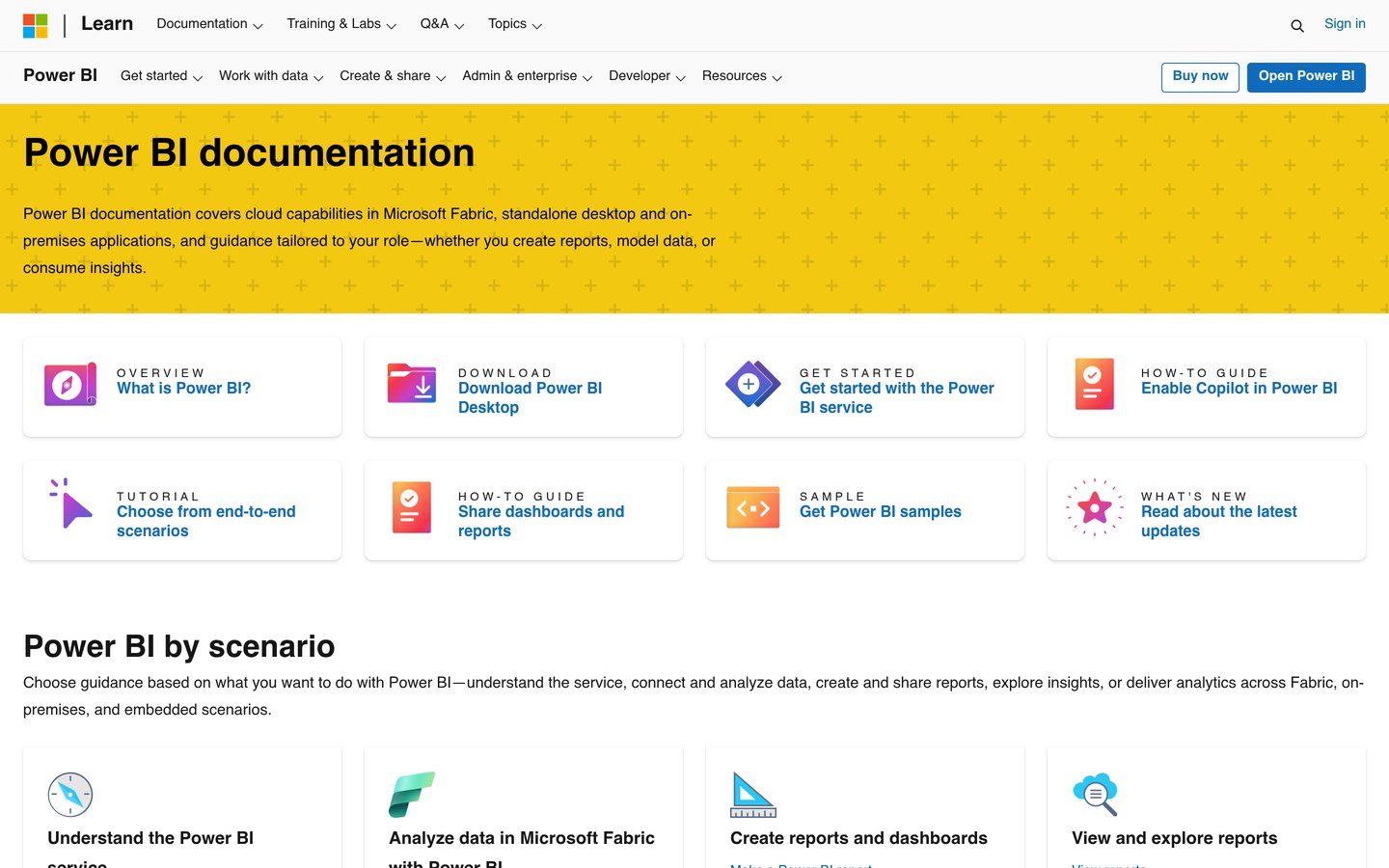
Microsoft Power BI is the default analytics platform for teams already inside Microsoft 365. Desktop is free for building reports, Pro at $14 per user per month adds sharing and collaboration, and Premium Per User at $24 a user a month adds the Copilot AI features that summarise and explain dashboards.
The trade off is the Microsoft lock-in. Copilot features need the higher tier, and the best experience assumes the team already lives in Microsoft 365. It suits marketing teams that want governed dashboards with AI summaries at the lowest published price here.
What we like
Cheapest paid plan in this list at $14 a user a month
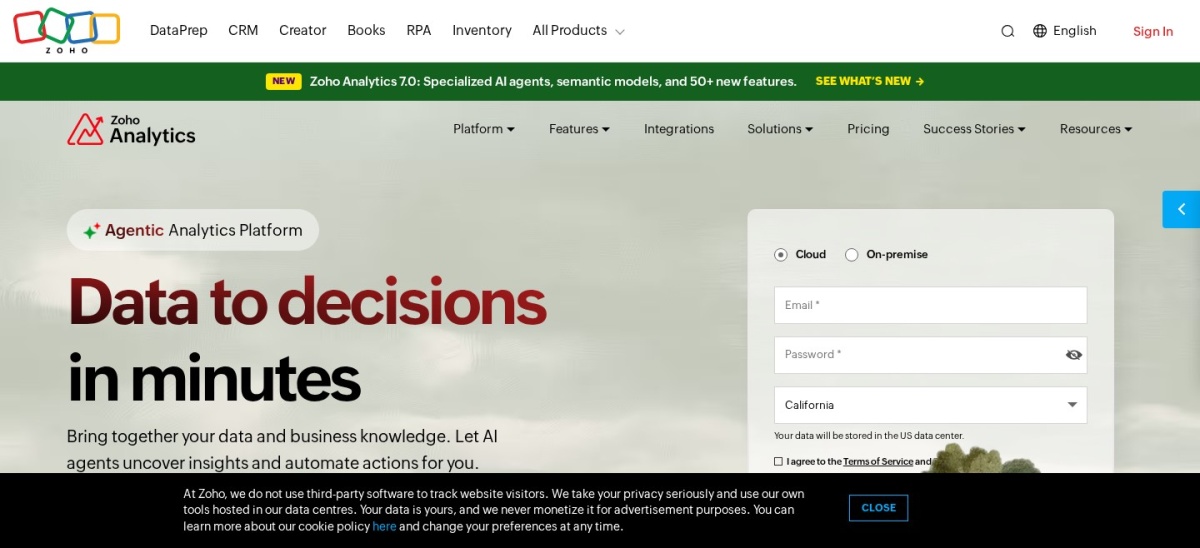
Zoho Analytics is a self-service BI tool for small teams that want dashboards, data preparation and an AI assistant in one place. The free plan covers 2 users and 10,000 rows, while Basic at $24 a month on annual billing adds more users and rows, with prebuilt connectors for Zoho CRM, Books and Projects plus database and spreadsheet imports.
The trade off is scale and price clarity. The vendor pricing page shows plan limits but no price figures in some checks, and the G2 base is small at about 280 reviews. It suits small marketing teams already in the Zoho ecosystem that want cheap dashboards.
Free plans cover the basics well. 6sense offers a free tier with 50 credits a month, and Power BI Desktop is free for building reports.
Paid plans mostly add predictions and scale. Scoring models, account intent data and scheduled refreshes sit behind the paywall.
Most of these tools are quote-only enterprise contracts. Only HubSpot, Pecan AI, Tableau, Power BI and Zoho Analytics publish a starting price.
For a marketing team, the first year of a published plan often costs less than one month of an enterprise contract negotiated blind.
How we chose
We started from the predictive analytics tools most often compared for marketing teams, then kept those with a verifiable G2 rating and a real prediction feature set.
Prices come from each vendor's pricing page or vendor-provided G2 listings, checked on 26 November 2026, with HubSpot Marketing Hub Professional at $800 a month corroborated by several November 2026 sources. Ratings and review counts come from G2 on the same day. Where a vendor shows a sale, the list shows the regular price.
We left out tools with no verifiable rating and Obviously AI, which rebranded to Zams in 2025 and archived its prediction tool. No vendor paid for a place, and we do not claim hands-on testing for this list.
How to choose predictive analytics software for marketing
Start with the prediction question, then match the tool to the data you already have.
Write down the prediction question. Churn, lifetime value, lead conversion and demand need different models and different data.
Check the data you already have. A model needs clean history, so confirm the CRM or warehouse holds enough past outcomes.
Test with a free tier or trial. Run one model on real data during the trial and check whether the scores match what sales already knows.
Confirm who owns the model. Prediction tools need someone to check accuracy and retrain, so name an owner before signing.
FAQ
What is the best predictive analytics software for marketing?
HubSpot Marketing Hub is the best overall pick for most marketing teams. Lead scoring sits inside the CRM, Professional costs $800 a month, and it holds a 4.4 out of 5 G2 rating across about 16,000 reviews.
Is there free predictive analytics software?
Yes, with limits. 6sense offers a free tier with 50 credits a month, Power BI Desktop is free for building reports, and Zoho Analytics has a free plan for 2 users and 10,000 rows.
How much does 6sense cost?
6sense does not publish prices for paid plans. Buyer-reported data puts the median contract at about $55,000 a year, and a free tier with 50 credits a month is the only published price.
What is Pecan AI used for?
Pecan AI builds churn, lifetime value and demand models for marketing and CRM teams without a data scientist. A guided workflow takes a prediction question through data prep and modelling, then writes predictions back to the CRM.
Do I need a data scientist for predictive analytics?
Not with no-code tools. Pecan AI, Akkio and MadKudu build models from a spreadsheet or CRM export with no code, though someone still needs to define the prediction question and check the results.
Which tool is best for account-based marketing?
6sense is the best pick for account-based marketing at mid-market and enterprise scale. It scores accounts from 0 to 100 across five buying stages and runs display, native and video ads to those accounts.
SaaS SEO and WordPress specialist with about 8 years of experience. Rakib compares WordPress plugins, themes, hosting and software using public pricing, documentation and user reviews. See how we rank.