Best Lead Scoring Software in 2026: 9 Tools Compared
WLWPLegible EditorsLast verified 23 Nov 2026How we rank13 min read
★ Short answer
HubSpot is the best lead scoring software for most teams, because its scoring, CRM and marketing data live in one system, and it is rated 4.4 out of 5 by 13,909 reviewers on G2. Pick MadKudu for custom predictive models and ActiveCampaign for the cheapest scoring with automation at $49 a month.
How we make this list: we compare pricing pages, product documentation and public user reviews, then re-check every price before each update. No product paid for a place. Disclosure.
HubSpot scores leads where your CRM data already lives, but advanced scoring needs Marketing Hub Professional at $800 a month.
MadKudu builds custom predictive models on CRM, product usage and firmographic data, rated 4.5 out of 5 by 46 reviewers on G2.
ActiveCampaign Plus at $49 a month is the cheapest scoring with automation in this list, for 1,000 contacts on annual billing.
Zoho CRM offers scoring rules from $14 a user a month, the lowest entry price among the CRMs here.
Predictive scoring needs history: Salesforce Einstein needs 1,000 leads and 120 conversions in six months before it switches on.
What lead scoring software should do
Lead scoring answers one question: which leads deserve a salesperson's time right now? Without it, reps work the list in order and hot buyers wait behind cold ones.
Scores come in two kinds. Rules-based scoring adds points for actions you choose, such as a pricing page visit or a demo request. Predictive scoring trains a model on your past wins and scores new leads by resemblance.
Predictive models need history to learn from. Our guide to the best CRM software covers the systems that hold that history.
Most small teams should start with scoring inside their CRM. Dedicated predictive tools earn their keep once lead volume passes what rules can handle.
HubSpot is a CRM and marketing platform with lead scoring built in. The advanced lead scoring app with behavioral tracking sits in Marketing Hub Professional at $800 a month, which includes 3 seats and 2,000 marketing contacts, and manual scoring is available from Sales Hub Professional at $90 a seat a month.
The trade off is the price cliff. Scoring is a platform purchase, not a feature add-on, and Marketing Hub Professional also carries a $3,000 one-time onboarding fee. It suits teams whose marketing already runs on HubSpot and who want scoring, automation and CRM in one database.
MadKudu is a predictive scoring platform that builds custom machine-learning models on your CRM, product usage and firmographic data. It scores leads in real time through an API that can route, enrich and trigger workflows anywhere, and it explains why each lead scored high or low.
The trade off is price and data. The last published plans were $999 a month for Growth and $2,499 for Pro, and pricing is now quote-only since the HG Insights acquisition in August 2025. It suits mid-market SaaS teams with clean conversion history and product-led motions.
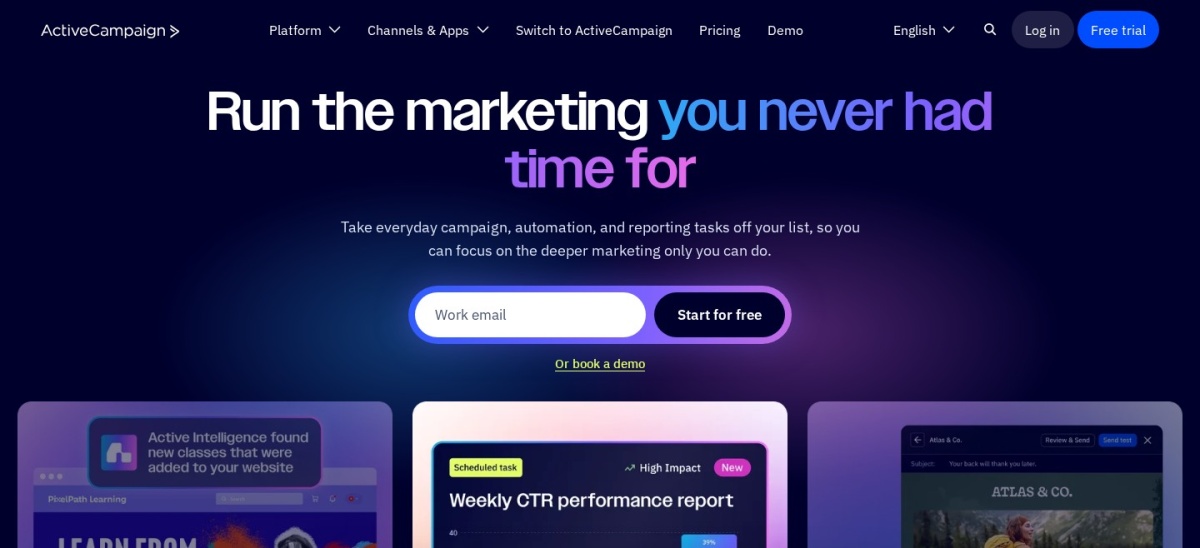
ActiveCampaign is a marketing automation platform with lead scoring from the Plus plan at $49 a month for 1,000 contacts on annual billing. Scores update from email opens, clicks, site visits and form submissions, and a score threshold can trigger an automation, a task or a deal in the built-in CRM.
The trade off is contact-based pricing. Plus costs $49 a month at 1,000 contacts but climbs as your list grows, reaching about $145 a month at 5,000 contacts. It suits inbound-led small businesses where email is the main lead source.
6sense is a revenue platform that scores accounts, not just leads, using intent data that shows which companies are researching solutions like yours. It combines predictive scoring with third-party intent, then orchestrates ads, sales plays and web personalization against the hottest accounts.
The trade off is scale and price. Pricing is quote-only, with median observed contracts past $60,000 a year, and there is no free trial or self-serve tier. It suits enterprise teams running account-based motions with long cycles and thousands of target accounts.
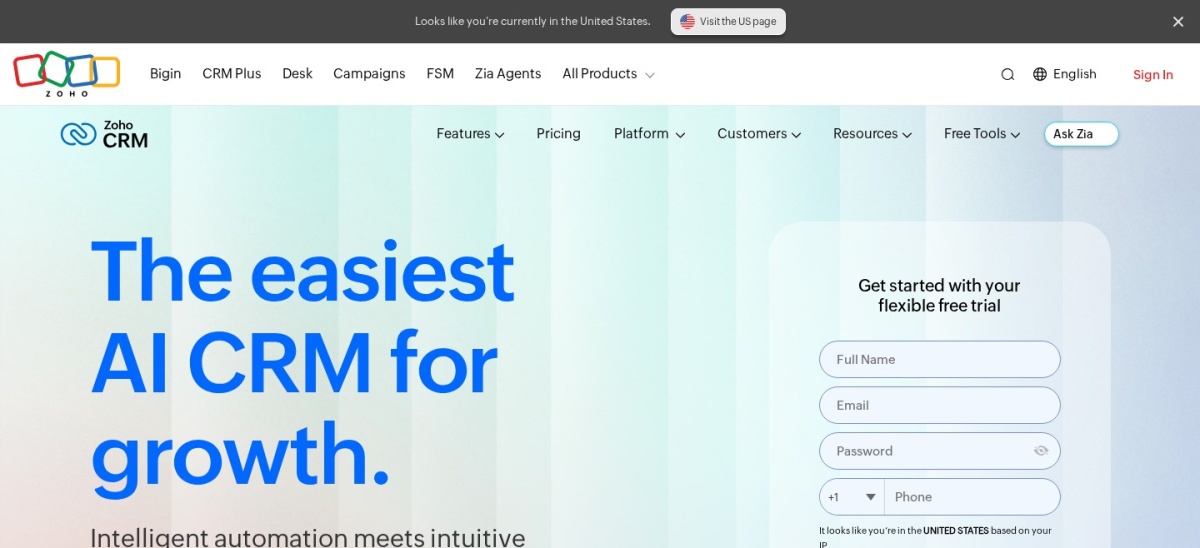
Zoho CRM puts lead scoring within reach of the smallest budgets. Scoring rules are available from Standard at $14 a user a month billed annually, and the free plan covers three users for teams validating their pipeline.
The trade off is predictive depth. Zia AI predictions arrive on Enterprise at $40 a user a month, still cheap by category standards, but the lower tiers only score by rules you write. It suits price-sensitive teams already on Zoho who want scoring without a second subscription.
What we like
Cheapest scoring entry in this list
Free plan for up to 3 users
2,947 G2 reviews at 4.1 out of 5
Watch out for
Predictive scoring needs Enterprise
Interface takes time to learn
Zia only sees what gets logged in the CRM
Enterprise adds Zia predictive scoring at $40 a user a monthVisit zoho.com
06
Salesforce Einstein
4.4/5on G2 (25,876 reviews, checked Nov 2026)
Starts at$195/user/mo
Best Salesforce-native scoring
ScoringPredictive, 1 to 99 scale
Data minimum1,000 leads, 120 conversions
CRMNative to Sales Cloud
Paid planAgentforce Core, $195/user/mo
salesforce.com
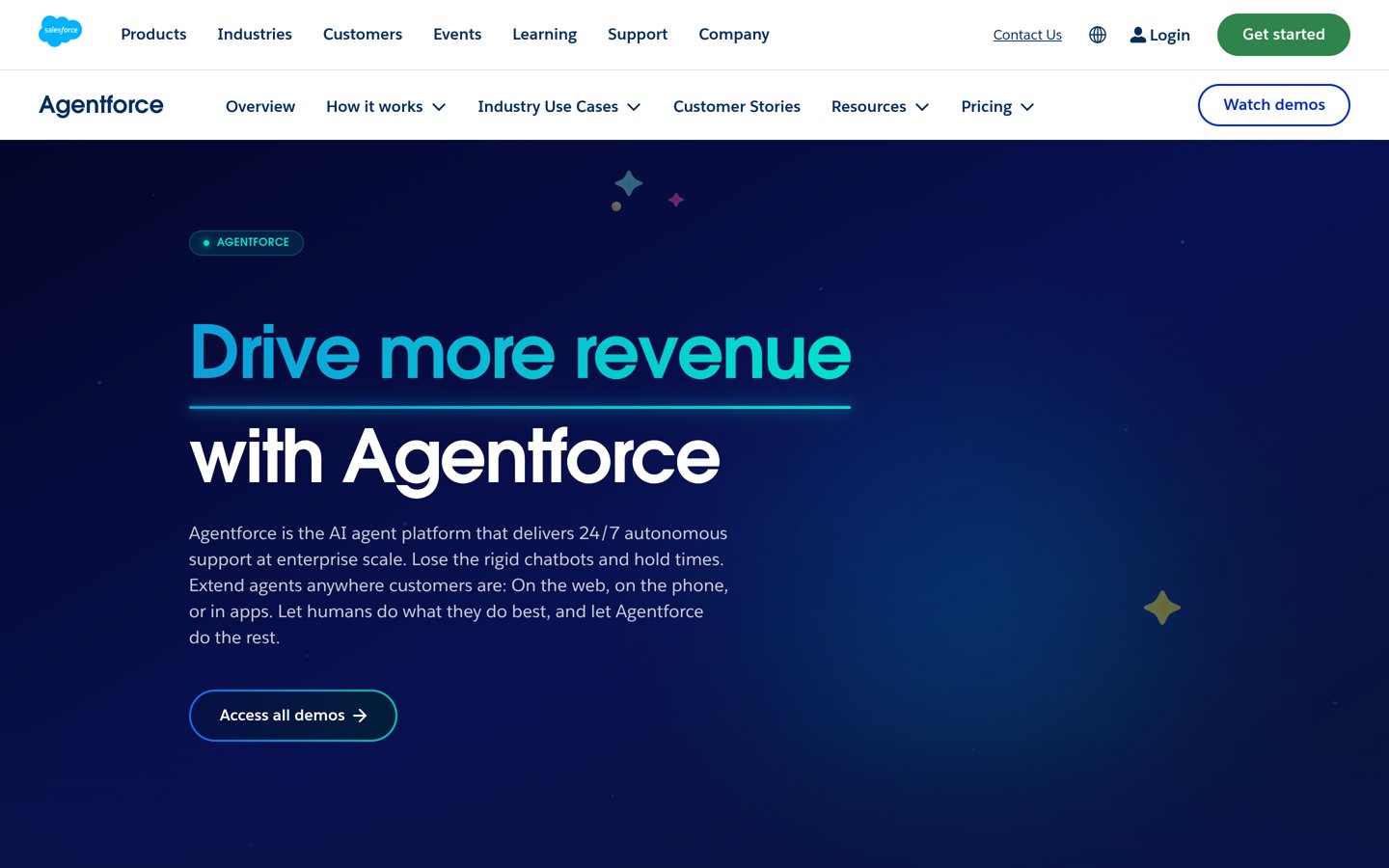
Salesforce Einstein homepage, captured Nov 2026.
Salesforce Einstein Lead Scoring analyzes your historical conversion data inside Sales Cloud and scores new leads from 1 to 99, showing the top three factors behind each score. Since September 2026 it starts with Agentforce Sales Core at $195 a user a month billed annually.
The trade off is the data minimum. Einstein needs at least 1,000 leads created and 120 converted in the past six months before it will switch on, so smaller funnels pay for a model they cannot use. It suits Salesforce teams of 10 or more reps with the volume to feed it.
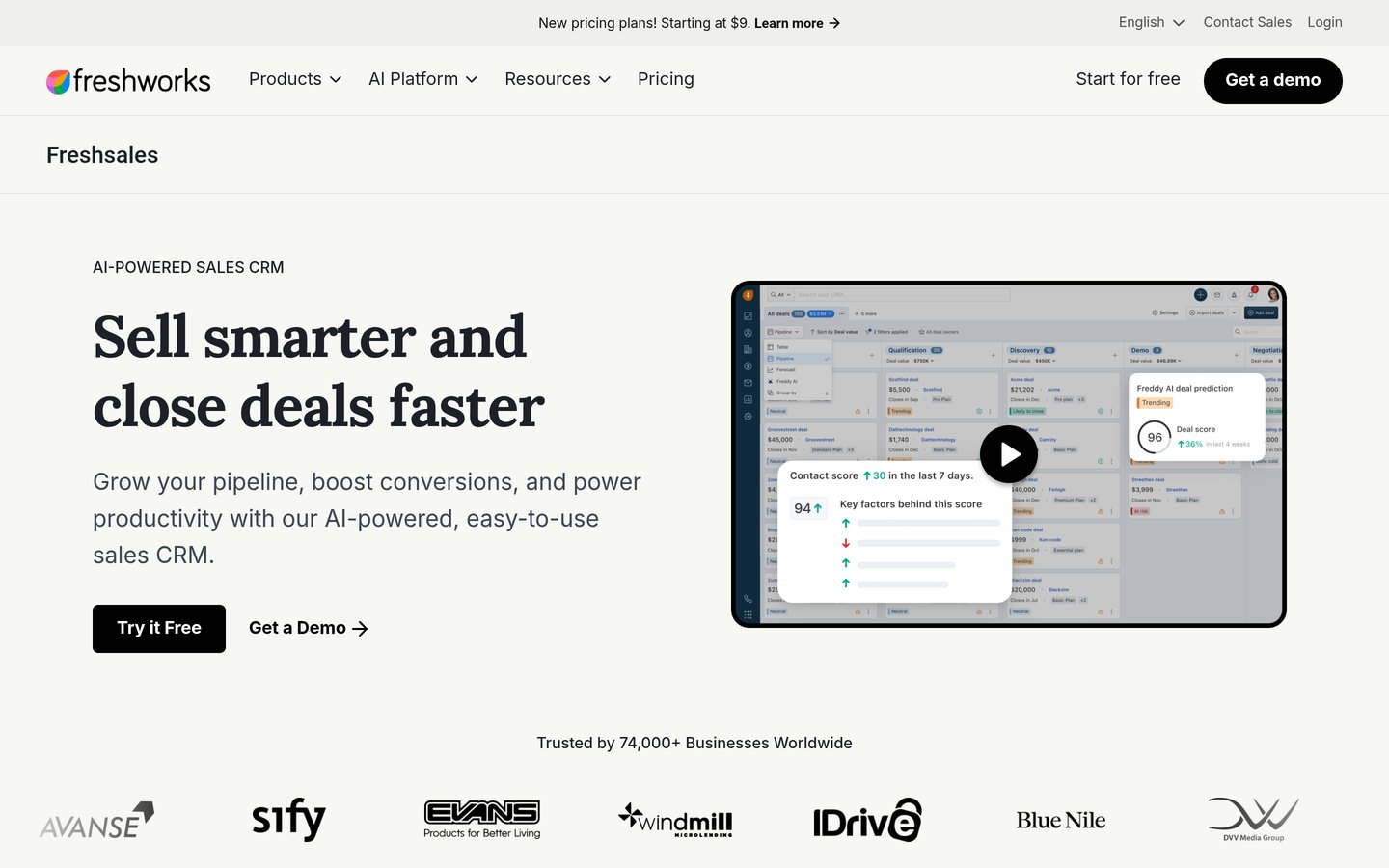
Freshsales pairs a straightforward CRM with Freddy AI predictive scoring on the Pro plan at $39 a user a month billed annually. It analyzes engagement patterns to rank contacts by conversion likelihood, and the same tier adds the built-in phone, sales sequences and email.
The trade off is the jump from Growth. Growth at $9 a user a month looks tempting but excludes scoring, sequences and API access, so budget for Pro from the start. It suits small sales teams that live on the phone and want AI prioritization without enterprise budgets.
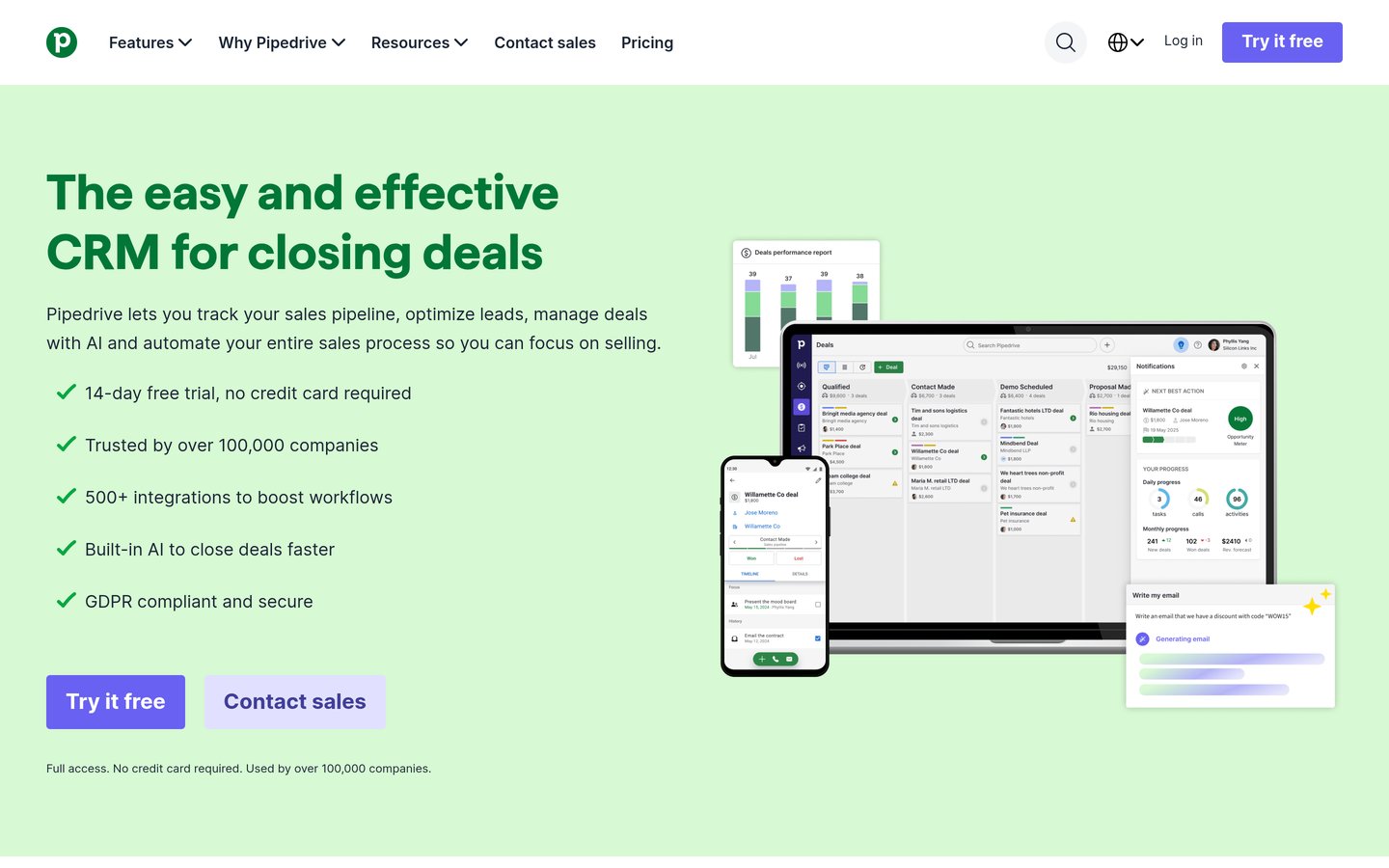
Pipedrive is a pipeline-first CRM with lead scoring that ranks prospects by engagement and deal history, and lets you add custom scoring criteria. Scoring unlocks on Premium at $49 a seat a month on annual billing, after the November 2025 plan rename.
The trade off is model depth. Pipedrive counts activities and engagement rather than learning from conversions, so it will not find patterns your rules missed. It suits teams of 2 to 15 reps that want a score on the deal board without a second tool.
What we like
Score sits where reps already work
Simple setup, fast to adopt
3,109 G2 reviews at 4.3 out of 5
Watch out for
Counts activities, does not learn from conversions
Apollo.io is a sales intelligence and engagement platform that pairs a database of more than 240 million contacts with AI lead scoring, sequencing and a built-in dialer. Its Professional plan at $79 a user a month billed annually adds AI-powered lead scoring that ranks prospects by engagement, firmographic fit and buying signals.
The trade off is that scoring sits on the paid tiers, and the data is not perfect. AI lead scoring needs the Professional plan, and G2 reviewers flag inaccurate data and weak mobile-number accuracy outside the US. It suits prospecting teams that want scoring, enrichment and outreach in one subscription.
What we like
AI lead scoring on the Professional plan
240M-contact database with 98% email accuracy
Free tier with 900 credits a year
Watch out for
Scoring needs the $79 Professional plan
Reviewers flag inaccurate data in places
Mobile-number accuracy is weaker outside the US
Basic at $49 a user a month lacks AI lead scoring; Professional adds it at $79Visit apollo.io
Rules-based or predictive: which do you need?
Rules-based scoring assigns points for things you decide matter: a VP title gets 10 points, a pricing page visit gets 15, an unsubscribe loses 20. It is transparent, fast to set up, and available in Zoho, ActiveCampaign and HubSpot.
Predictive scoring uses machine learning on your historical wins and losses to find patterns humans miss. It is more accurate at volume but needs data, typically hundreds of past conversions to train on, plus clean CRM fields.
The practical rule: under a few hundred leads a month, rules-based scoring in your CRM wins on simplicity and cost. Past a thousand leads a month with real conversion history, predictive models earn their keep.
How we chose
We started from the tools that appear most often in lead scoring roundups and G2's lead scoring category, then kept the nine with a clear scoring feature and a public G2 rating.
Prices come from the vendor's pricing page or, where the vendor publishes no price, from G2 pricing data and vendor pricing guides, checked 23 November 2026. Freshsales predictive scoring sits on the Pro plan at $39 a user a month, not the $11 Growth tier. MadKudu pricing is quote-only since the HG Insights acquisition, so we show its last published $999 a month price.
Ratings and review counts come from G2 on the same day. We left out tools with no public G2 rating and tools that only score anonymous website visitors. No vendor paid for a place, and this list is based on pricing, docs and reviews, not on using the tools ourselves.
How to choose lead scoring software
Start with your lead volume and your CRM, then pick the scoring type that fits.
Count your monthly leads first. Under a few hundred leads a month, rules-based scoring in your CRM is enough. Past a thousand a month with conversion history, a predictive model earns its keep.
Check the plan gate. Scoring is often locked behind a higher tier: HubSpot's advanced scoring needs Marketing Hub Professional at $800 a month, and Freshsales predictive scoring needs Pro at $39 a user a month.
Match the scoring type to your data. Rules work with any data. Predictive models need hundreds of past conversions, and Salesforce Einstein needs 1,000 leads and 120 conversions in six months before it switches on.
Test with negative scores too. Give points away for competitor domains, existing customers and job applicants, or your hottest leads will be people who were never going to buy.
FAQ
What is the best lead scoring software?
HubSpot is the best pick for most teams, because scoring, CRM and marketing data share one database, and it is rated 4.4 out of 5 by 13,909 reviewers on G2. MadKudu is better for custom predictive models, and ActiveCampaign is the cheapest scoring option.
How much does lead scoring software cost?
CRM scoring starts at $14 a user a month with Zoho CRM and $49 a month with ActiveCampaign Plus. HubSpot's advanced scoring sits in Marketing Hub Professional at $800 a month, and dedicated tools such as MadKudu start at $999 a month.
What is the difference between rules-based and predictive lead scoring?
Rules-based scoring adds points for actions you choose, such as email opens or page visits. Predictive scoring trains a machine-learning model on your past conversions and scores new leads by how closely they resemble past buyers.
Does HubSpot have lead scoring?
Yes. HubSpot offers manual scoring from Sales Hub Professional at $90 a seat a month, and the advanced lead scoring app with behavioral tracking in Marketing Hub Professional at $800 a month. Predictive scoring needs Enterprise.
Do you need a lot of data for predictive lead scoring?
Yes. Salesforce is the only vendor that publishes the threshold: Einstein Lead Scoring needs at least 1,000 leads created and 120 converted in the past six months before it will switch on. Below that, rules-based scoring is the better choice.
Is MadKudu still available after the HG Insights acquisition?
Yes, MadKudu is now sold through HG Insights after the August 2025 acquisition, and pricing is quote-only. The last published plans were $999 a month for Growth and $2,499 for Pro.