Epic is the best population health software for large health systems, with Healthy Planet on the strongest G2 rating in this list. athenahealth is the best fit for ambulatory groups that want population health inside one cloud platform.
How we make this list: we compare pricing pages, product documentation and public user reviews, then re-check every price before each update. No product paid for a place. Disclosure.
Epic leads for large health systems, with Healthy Planet and a 4.2 G2 rating from 940 reviews, the largest base here.
athenahealth fits ambulatory groups, with population health inside athenaOne and 140,000-plus providers on the platform.
Every tool here is quote-only, so budget for an enterprise sales cycle rather than a published price.
HealthEC holds the highest rating here at 4.3 out of 5, but from only 18 G2 reviews.
Pure-play vendors such as Arcadia, Innovaccer and Lightbeam have no usable G2 rating, so they are not in this list.
What population health software should cover
Population health software pulls clinical, claims and social-determinants data into one view, then finds at-risk patients, closes care gaps and measures outcomes across a defined group.
The market splits into two kinds of vendor. Epic, Oracle Health, athenahealth, eClinicalWorks, NextGen and MEDITECH sell population health as a module inside an electronic health record, while HealthEC is a standalone analytics and care management platform.
Every tool in this list is priced by quote, with no published price and no free plan. Expect an enterprise sales cycle, an implementation project and a contract priced on lives covered or providers.
Ratings here are each platform's G2 rating, because the pure-play population health vendors publish almost no public reviews. Arcadia, Innovaccer, Lightbeam, ZeOmega and Azara have no usable G2 rating between them.
Epic is the system large health systems standardise on when they want one record for everything, and Healthy Planet is its population health module. It runs registries, risk stratification, care gap closure and quality reporting on the same database as the clinical record, with Care Everywhere connecting records across organisations.
The trade off is scale and cost. Epic fits large hospitals and multi-hospital systems, with multi-year implementations and enterprise pricing, so smaller practices should look at athenahealth or eClinicalWorks. It suits health systems already running Epic.
What we like
Largest review base here at 940 G2 reviews
Highest rating among the EHR platforms here
One record for clinical, billing and population health
Care Everywhere connects records across organisations
athenahealth is the cloud platform for ambulatory groups that want population health without running a hospital record. Its Population Health module aggregates clinical, financial and payer data into one view, flags care gaps and runs automated outreach, inside athenaOne alongside the EHR and billing.
The trade off is the pricing model. Fees follow a percentage of collections rather than a per-seat rate, so the bill moves with revenue, and the G2 rating is 3.4 from just over 100 reviews. It suits ambulatory groups and physician practices.
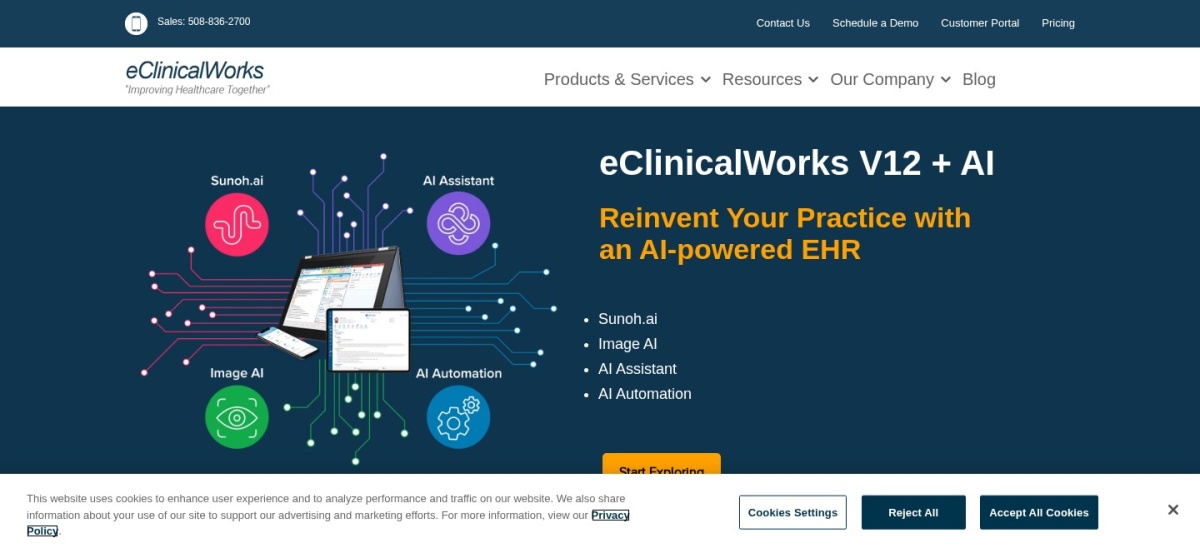
eClinicalWorks is the all-in-one platform for ambulatory practices, with an EHR, practice management, population health tools and the healow patient engagement suite in one system. Its population health module tracks registries and care gaps, and Sunoh.ai adds ambient documentation on top.
The trade off is cost creep. G2 reviewers describe it as expensive as features are added, and pricing is quoted per practice. It suits ambulatory practices that want one vendor for the whole workflow.
Oracle Health is the former Cerner, now rebuilt inside Oracle's cloud, and HealtheIntent is its population health platform. It aggregates and normalises data from many sources into a longitudinal record for each member, then layers stratification, registries and analytics on top for health systems and payers.
The trade off is the migration. Existing Cerner customers should check the roadmap for their version, and Oracle publishes no price. It suits health systems already invested in Oracle's cloud and applications.
NextGen Healthcare is the ambulatory EHR for specialty groups that want templates and workflows bent to their practice rather than the other way round. Its population health tools sit beside the EHR, practice management and revenue cycle, making it a full-suite option for groups that have outgrown simpler tools.
The trade off is breadth. NextGen is an ambulatory platform, so hospital systems need Epic or Oracle Health instead, and pricing is quoted. It suits multi-location specialty groups.
HealthEC is the standalone population health platform in this list, built for organisations that run several different EHRs. Its PopulationManager analytics module, CareConnect care management and 3D Analytics sit on one data platform, and G2 users praise its ease of use and data management.
The trade off is proof. HealthEC holds the highest rating here at 4.3 out of 5, but from only 18 G2 reviews, and pricing is quoted. It suits multi-EHR networks that need one analytics layer.
MEDITECH Expanse is the web-based EHR for community and regional hospitals, with population health tools inside the same record as inpatient, outpatient and emergency care. It is marketed as a cost-effective route for smaller hospitals, and a cloud-hosted MaaS subscription bundles hosting, implementation and support.
The trade off is the rating. Expanse holds the lowest G2 rating here at 3.1 out of 5, with reviewers citing dated navigation, and pricing is quoted. It suits community hospitals that want one record at a lower cost.
Why Arcadia, Innovaccer and Lightbeam are not listed
Arcadia, Innovaccer and Lightbeam are the names buyers hear first in population health, and all three win analyst recognition: Arcadia holds Best in KLAS value-based care awards, Innovaccer holds Best in KLAS 2026 in three categories, and Lightbeam holds Best in KLAS remote patient monitoring awards.
None of them has a usable public review rating. Arcadia shows no rating on its G2 page, Innovaccer's G2 rating rests on 3 reviews of a different product, and the G2 listing named Lightbeam is a data-security product, not the health platform. ZeOmega's Jiva has only Gartner Peer Insights reviews, and Azara's G2 rating rests on a single review.
This list only includes tools with a verifiable G2 rating, so the pure-play vendors are out. If you are buying for a value-based care program, shortlist Arcadia, Innovaccer and Lightbeam beside the tools above and ask each for reference customers of your size.
How we chose
We started from the population health platforms health systems shortlist most, then kept the seven with a verifiable G2 rating and a real population health module, whether inside an EHR or standalone.
Prices come from each vendor's site and buyer guides, checked on 26 November 2026. Every tool here is quote-only, so the list shows Custom rather than a number. Ratings come from G2 on the same day.
We left out the pure-play vendors Arcadia, Innovaccer, Lightbeam, ZeOmega and Azara because none has a usable G2 rating. No vendor paid for a place, and we do not claim hands-on testing for this list.
How to choose population health software
Start with the record system you already run, then match the tool to the population.
Start with your EHR. Epic and Oracle Health systems should use Healthy Planet or HealtheIntent, while athenahealth and eClinicalWorks practices should use the built-in population health tools.
Count the lives you manage. A small ambulatory panel fits athenahealth or eClinicalWorks, while an ACO or health plan needs Epic, Oracle Health or HealthEC.
Ask for reference customers your size. Pure-play vendors and EHR modules alike should show you a customer with a similar population and contract type.
Budget for the implementation. Data aggregation and interface work dominate the first year, so ask for the full project price before you sign.
FAQ
What is the best population health software?
Epic is the strongest pick for large health systems, with Healthy Planet and a 4.2 out of 5 G2 rating from 940 reviews. athenahealth fits ambulatory groups, and HealthEC suits organisations that want a standalone analytics platform.
How much does population health software cost?
Every tool in this list is priced by quote, with no published price and no free plan. Contracts are priced on lives covered, providers or modules, so expect an enterprise sales cycle and a negotiated figure.
What is the difference between Epic Healthy Planet and Oracle HealtheIntent?
Healthy Planet is Epic's population health module inside the Epic record, while HealtheIntent is Oracle Health's cloud platform that aggregates data from many sources. Epic fits systems already on Epic; HealtheIntent fits mixed-record environments.
Is Arcadia good population health software?
Arcadia is one of the most recognised population health platforms, with Best in KLAS value-based care awards and more than 150 million patient records on its platform. It is not in this list because it shows no rating on its G2 page.
Do I need a separate tool if I already have an EHR?
Usually not. Epic, Oracle Health, athenahealth, eClinicalWorks, NextGen and MEDITECH all include population health tools inside the record. A standalone platform such as HealthEC makes sense when you run several different EHRs.
What is value-based care software?
Value-based care software is the same category under another name: tools that track quality, cost and outcomes across a population so providers can be paid for results rather than visits.
SaaS SEO and WordPress specialist with about 8 years of experience. Rakib compares WordPress plugins, themes, hosting and software using public pricing, documentation and user reviews. See how we rank.