Segment is the best platform to analyze customer data for most teams, with the broadest integration catalog and the only published CDP price in this list. Pick Hightouch if your data lives in a warehouse, Amplitude for deep product analysis, and Mixpanel for self-serve funnels.
How we make this list: we compare pricing pages, product documentation and public user reviews, then re-check every price before each update. No product paid for a place. Disclosure.
Segment is the only CDP here with a published price: Team costs $120 a month for up to 10,000 tracked users, with a free plan to 1,000.
Hightouch has the highest CDP rating with a large base at 4.6 out of 5 from 399 reviews, but it needs a cloud warehouse to work.
Six of the nine tools publish no price at all, so budget for a sales call before you shortlist them.
RudderStack has the highest rating in the list at 4.7 out of 5, but it rests on only 52 reviews.
Amplitude and Mixpanel are the analytics half of this list: both have free plans, and Mixpanel Growth is listed at $25 a month.
What a customer data platform should do
Customer data work splits into two jobs. CDPs collect, unify and route customer data to other tools, while analytics tools answer what customers actually do once the data arrives.
Identity resolution is the core test. A platform that cannot join anonymous and known behaviour into one profile will double-count customers and misfire campaigns. Our guide to the best CRM software covers where unified profiles land once they leave the CDP.
Pricing is the biggest split in this list. CDPs mostly sell by quote on tracked users or event volume, while analytics tools offer free tiers with usage-based paid plans, so compare the billing unit, not just the headline rate.
Ratings need a second look here. RudderStack rests on only 52 G2 reviews, so a high score from a small sample is weaker evidence than Segment at 567 reviews.
Twilio Segment is a customer data platform that helps every team access clean and reliable customer data to make real-time decisions, accelerate growth and personalise experiences. It leads on market share and developer experience, with the broadest integration catalog in this list at more than 300 tools, and it is the only CDP here with a published price.
The trade off is cost at scale. Team costs $120 a month for up to 10,000 monthly tracked users, billed with overages beyond that, and Business pricing above 10,000 MTUs needs a sales conversation. It suits mid-market teams that want one pipeline feeding analytics, marketing and product tools.
Hightouch is a warehouse-native composable CDP that syncs customer data from the warehouse to sales and marketing tools, so the warehouse stays the source of truth instead of a second database. Reviewers rate it 4.6 out of 5 from 399 reviews, the highest CDP rating in this list with a large base, and praise its reverse ETL capabilities.
The trade off is that it assumes a warehouse. Teams without a cloud warehouse get little from Hightouch, and paid pricing is by quote with only a free tier published. It suits data teams that already centralise customer data in a warehouse and want to activate it everywhere.
Amplitude is a digital analytics platform for product teams that combines deep funnels, lifecycle analysis, cohorts, paths and connections into one suite. The free Starter plan covers 2 million events a month with no credit card, Plus scales pay-as-you-go to 70 million events, and experimentation, journeys and session replay sit beside the core analytics.
The trade off is that the advanced features sit on Growth. Growth and Enterprise are priced by contact, and the Accounts add-on for B2B reporting costs extra. It suits teams that want deep behavioural analysis and user journey mapping at scale.
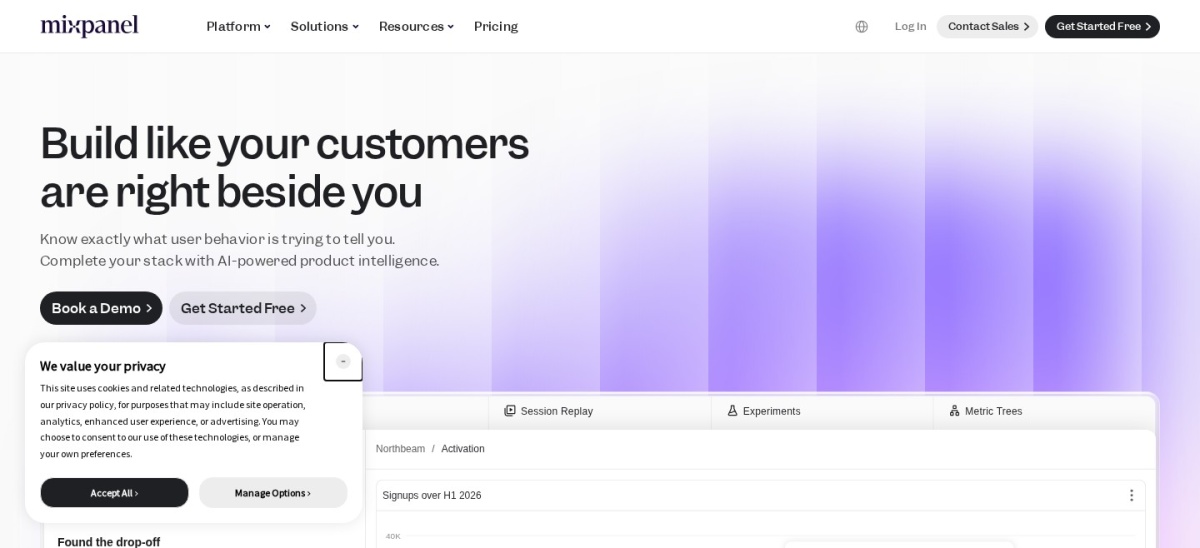
Mixpanel is an event analytics tool priced by event volume, built for self-serve funnels and retention analysis. Product managers build funnels, retention curves and flow reports without engineering help for every question, and the free tier covers 1 million events a month with unlimited seats and 10,000 session replays.
The trade off is the usage model. Growth starts at $0 with the first 1 million events each month free, then you pay per event above that, and G2 lists Growth at $25 a month, so the bill tracks what you send. It suits product teams that want approachable, everyday funnel and retention reports.
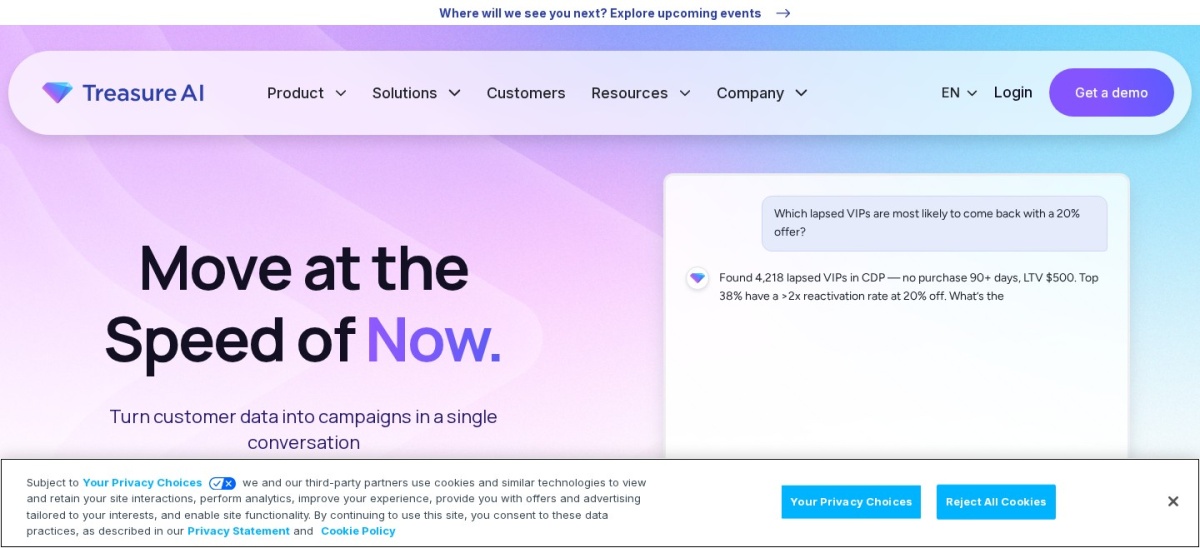
Treasure Data is an enterprise customer data platform built for Fortune 1000 manufacturing and retail companies with large data estates. Reviewers rate it 4.5 out of 5 and cite integrations and support as its strengths, with stronger ease of setup scores than its closest enterprise rivals.
The trade off is price and fit. Pricing is by quote and reviewers say it can be complex and high for small businesses, and there is no free plan, only a proof-of-concept engagement. It suits large enterprises that need a CDP for big, messy customer data.
What we like
4.5 out of 5 from enterprise reviewers
Strongest integration scores among enterprise CDPs
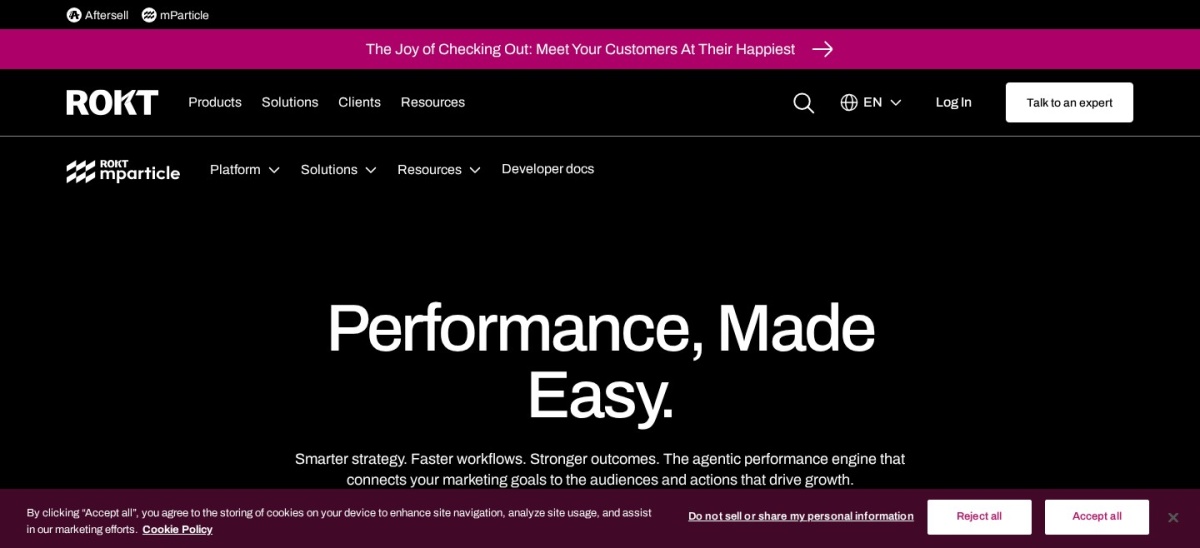
mParticle by Rokt is a customer data platform for mobile-heavy and multi-platform consumer products, leading on mobile-first data quality and B2B2C identity resolution. It unifies customer data into a single pipeline for analytics, personalisation and marketing activation, and reviewers rate it 4.4 out of 5 with support scores slightly above Segment.
The trade off is pricing opacity. mParticle publishes no pricing and every deployment needs a sales conversation, priced on event volume and tracked users, and reviewers cite pricing as a concern for startups and small businesses. It suits enterprise teams with mobile-first products.
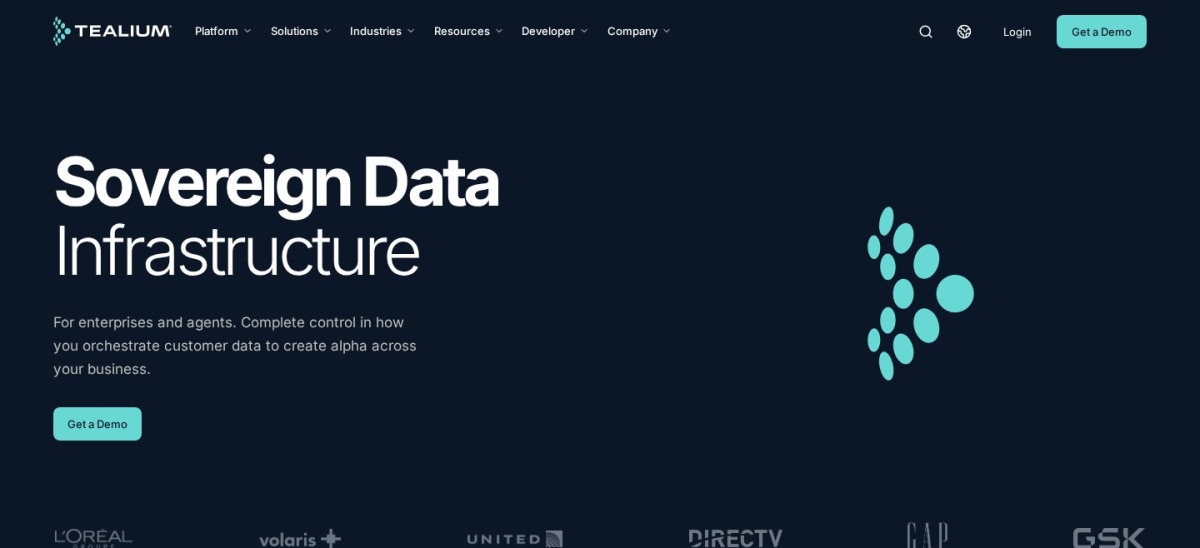
Tealium is an enterprise customer data platform with the largest integration ecosystem in this list at more than 1,300 connections, built on its tag-management heritage. Its AudienceStream CDP combines robust audience management and data enrichment, with real-time data unification, flexible identity resolution and enterprise data governance.
The trade off is cost. Tealium publishes no pricing anywhere and sells only through custom enterprise contracts, and reviewers say it is slower to reach return on investment than its rivals. It suits large enterprises that need governance and integration breadth above all.
RudderStack is a warehouse-first customer data platform with an open-source core you can self-host, and the cost-effective alternative to Segment that reviewers keep naming. It holds the highest G2 rating in this list at 4.7 out of 5, G2 lists a Growth plan at $265 a month flat, and reviewers consistently cite its cost-effectiveness against Segment.
The trade off is evidence. Its 4.7 rating rests on only 52 G2 reviews, the smallest base in this list, so treat the score as weaker evidence than Segment at 567 reviews. It suits data teams that want a warehouse-first CDP with an open-source option.
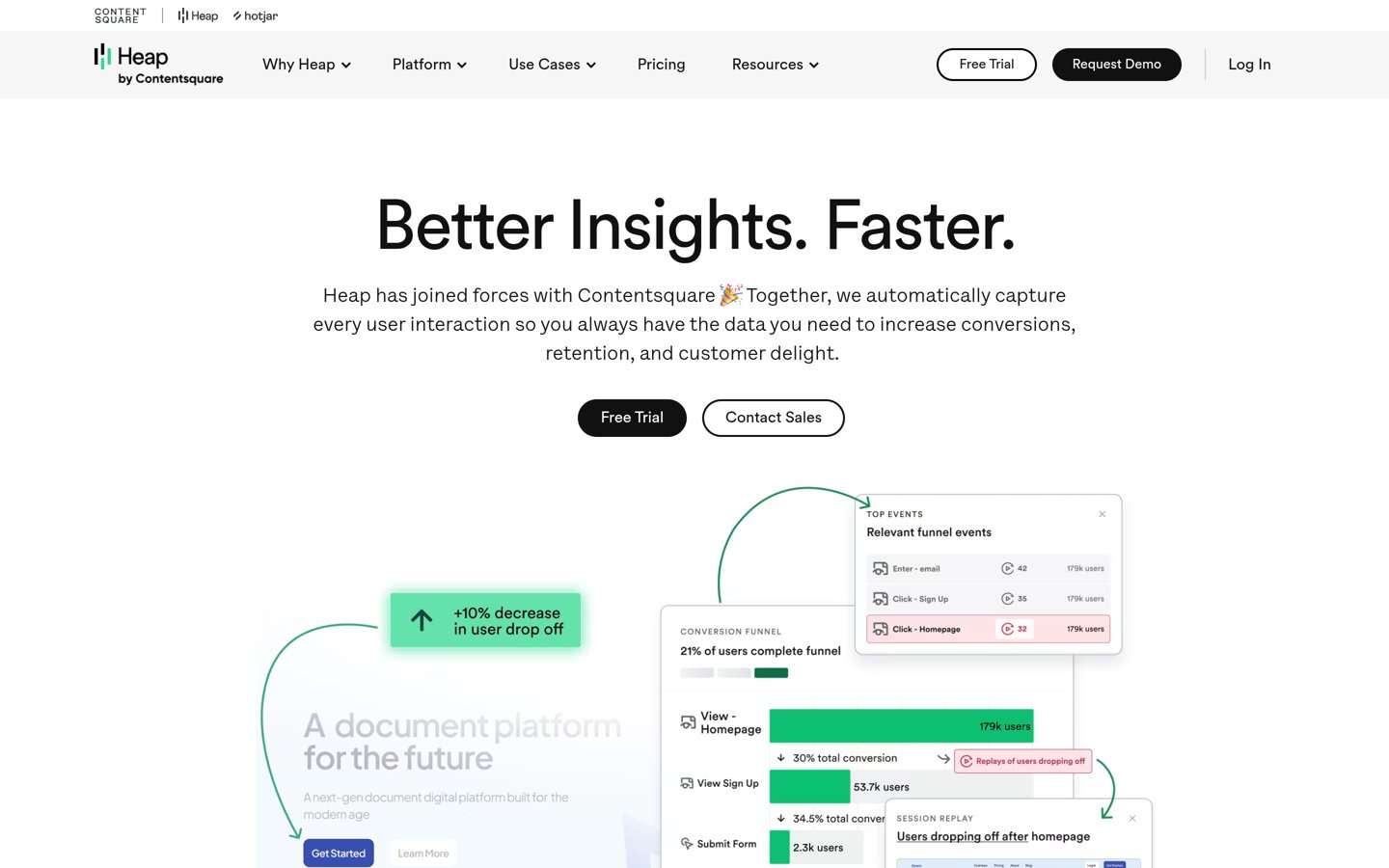
Heap is an analytics platform by Contentsquare that automatically records clicks, page views and form activity, so you can define events after the fact instead of planning them up front. Its pitch is retroactive analysis: because it captures interactions automatically, you can define an event today and see its history from the day you installed it, with funnels, heatmaps, segments and AI CoPilot beside it.
The trade off is pricing opacity. The free tier covers up to 10,000 sessions a month with 6 months of history, Growth pricing is not published and is estimated after you install the snippet, and session replay is an add-on on Pro and Premier. It suits analysts who need to explore behaviour they never tagged.
What we like
Only autocapture tool in this list
Define events today, see their full history
Free tier up to 10,000 sessions a month
1,097 G2 reviews at 4.4 out of 5
Watch out for
Growth pricing is not published
Session replay is a paid add-on
Free plan keeps only 6 months of history
G2 and Capterra list an entry plan at $24,000 a yearVisit heap.io
CDP vs analytics: pick the right half first
If the problem is messy, scattered customer data, start with Segment, Hightouch, Treasure Data, mParticle, Tealium or RudderStack. They collect, clean and route data so every other tool works from the same profile.
If the problem is understanding behaviour, start with Amplitude, Mixpanel or Heap. They turn events into funnels, retention curves and cohorts without a data pipeline project.
Most growing teams end up with one of each. A CDP feeds clean data into an analytics tool, and buying the analytics half first leaves you analysing dirty data.
How we chose
We started from the customer data platforms and product analytics tools with a G2 profile and a published product, then kept those with a verifiable G2 rating and review count.
Prices come from G2 vendor-supplied listings and comparison pages checked on 26 November 2026. Six of the nine tools publish no price, so the list shows Custom for them. Ratings come from G2 on the same day.
We left out tools with no verifiable G2, Capterra or Trustpilot rating, including BlueConic at 19 reviews and ActionIQ at 45. No vendor paid for a place, and we do not claim hands-on testing for this list.
How to choose a customer data platform
Start with where your customer data lives today, then check the billing unit before you book a demo.
Name the data home first. If data lives in a warehouse, buy Hightouch or RudderStack. If it lives in apps and websites, buy Segment, Tealium or mParticle.
Check the billing unit. CDPs bill on tracked users or event volume, analytics tools bill on events or sessions. Estimate your monthly volume before you compare prices.
Check the review base, not just the score. A 4.7 from 52 reviews is weaker evidence than a 4.5 from 567. Ask vendors for reference customers in your industry.
Plan the destinations. A CDP is only useful if it connects to the tools you use. Confirm the integrations with your analytics, CRM and marketing stack before you sign.
FAQ
What is the best platform to analyze customer data?
Segment is the best pick for most teams. It has the broadest integration catalog in this list at more than 300 tools, a 4.5 out of 5 rating from 567 G2 reviews, and a published Team price of $120 a month.
What is a customer data platform?
It is software that collects customer data from websites, apps and other tools, unifies it into one profile per customer, and routes it to analytics, marketing and product tools.
How much do customer data platforms cost?
Most CDPs sell by quote on tracked users or event volume. The only published CDP prices here are Segment Team at $120 a month and RudderStack Growth at $265 a month flat.
What is the difference between a CDP and product analytics?
A CDP collects and unifies customer data and routes it to other tools. Product analytics tools such as Amplitude and Mixpanel analyse that data into funnels, retention curves and cohorts.
Is there a free customer data platform?
Yes. Segment is free up to 1,000 tracked users a month, Hightouch has a free tier, and RudderStack has a free tier plus a free open-source core. Amplitude, Mixpanel and Heap also have free plans.
Which CDP is best for a warehouse-first team?
Hightouch is the best pick for warehouse-first teams, with a 4.6 out of 5 rating from 399 G2 reviews and reverse ETL that syncs data from the warehouse to sales and marketing tools.
SaaS SEO and WordPress specialist with about 8 years of experience. Rakib compares WordPress plugins, themes, hosting and software using public pricing, documentation and user reviews. See how we rank.