Make is our top pick for no code data integration in 2026 with a 4.6 out of 5 rating across 514 G2 reviews and a Core plan starting at $12 per month billed annually. For broad app reach choose Zapier, while Skyvia fits teams moving structured records between databases and cloud apps.
How we make this list: we compare pricing pages, product documentation and public user reviews, then re-check every price before each update. No product paid for a place. Disclosure.
Make starts at $12 per month billed annually for 10,000 monthly credits and holds a 4.6/5 rating across 514 G2 reviews.
Zapier connects 8,000+ apps and starts at $19.99 per month on its Professional plan, with 4.5/5 across 2,170 G2 reviews.
Skyvia offers a free tier with 10,000 records per month and paid ingestion plans starting at $79 per month billed annually.
Coupler.io starts at $24 per month billed annually for reporting syncs into spreadsheets, BI tools, and warehouses, rated 4.8/5 on G2.
n8n prices its cloud Starter plan at EUR 20 per month billed annually (about $22), with unlimited steps per workflow execution.
What to look for in a no code data integration platform
No code data integration tools range from lightweight app-to-app workflow builders to dedicated data pipelines that load warehouses and reporting sheets. Start by separating event-driven app automation from bulk record syncs and analytics ingestion.
Metering models vary widely across vendors. Some platforms bill per task or module credit, while others bill per workflow run, synced record, data connection, or monthly event volume.
Check refresh intervals, error handling, and transformation options before committing. A tool that charges per step or per event can get expensive fast if a workflow loops through large batches or runs every minute.
Also confirm where your data needs to land. App automation tools shine when updating CRMs and chat channels, whereas reporting and warehouse tools handle scheduled table pulls, joins, and schema mapping more cleanly.
For automated warehouse pipelines and dbt workflows
$3,180/yr
Free plan
4.4/5
Price ladder: cheapest paid plan per year
List prices, USD, checked Nov 2026
MakeFREE$144
AlbatoFREE$180
ZapierFREE$240
n8n$263
Coupler.ioFREE$288
SkyviaFREE$948
HevoFREE$3,180
The 7 best no code data integration platforms
01
Make
4.6/5on G2 (514 reviews, checked Nov 2026)
Paid from$144/yr
Best for visual multi-step workflows and budget value
Entry planCore at $12/mo (annual)
Free tier1,000 credits/mo
App catalog3,500+ apps
Min interval1 min on paid plans
make.com
Make homepage, captured Nov 2026.
Make is a visual scenario builder that connects over 3,500 apps with routers, filters, iterators, and aggregators on a drag-and-drop canvas. Its free plan includes $0 pricing, 1,000 monthly credits, and runs every 15 minutes.
The trade off is that module operations consume credits, so large loops use allowance quickly compared to simple linear flows at $12 per month billed annually ($144 per year) on Core. It suits teams building multi-branch workflows who want visual clarity without paying high entry fees.
What we like
Visual canvas makes multi-branch logic and array handling easy to follow
Core plan starts at $12 per month billed annually with 10,000 monthly credits
Free plan includes 1,000 credits per month and routers or filters
Watch out for
Credit-based billing per module can rise on heavy batch loops
Steeper learning curve than basic linear workflow tools
Core at $12/mo billed annually ($144/yr) adds unlimited active scenarios, 1-minute scheduling, and Make API access.Visit make.com
02
Zapier
4.5/5on G2 (2,170 reviews, checked Nov 2026)
Paid from$240/yr
Best for the widest third-party app directory
Entry planProfessional from $19.99/mo
Free tier100 tasks/mo
App catalog8,000+ apps
WorkflowsZaps, Tables, and Forms
zapier.com
Zapier homepage, captured Nov 2026.
Zapier is a cloud automation platform that links more than 8,000 apps using trigger-and-action workflows alongside built-in Tables and Forms. Its free plan includes $0 pricing, 100 tasks per month, and two-step Zaps.
The trade off is that task volume and multi-step flows become costly as usage scales from its $19.99 per month starting paid rate ($240 per year). It suits small and growing teams that need broad app coverage and fast setup.
What we like
Integrates with 8,000+ apps across sales, marketing, support, and operations
Straightforward setup for non-technical users
Includes built-in Tables and Forms alongside workflow automation
Watch out for
Task limits on the free plan are tight at 100 tasks per month
Costs climb quickly as task counts and multi-step logic grow
Professional starting at $19.99/mo ($240/yr) unlocks multi-step Zaps, webhooks, and unlimited premium apps.Visit zapier.com
03
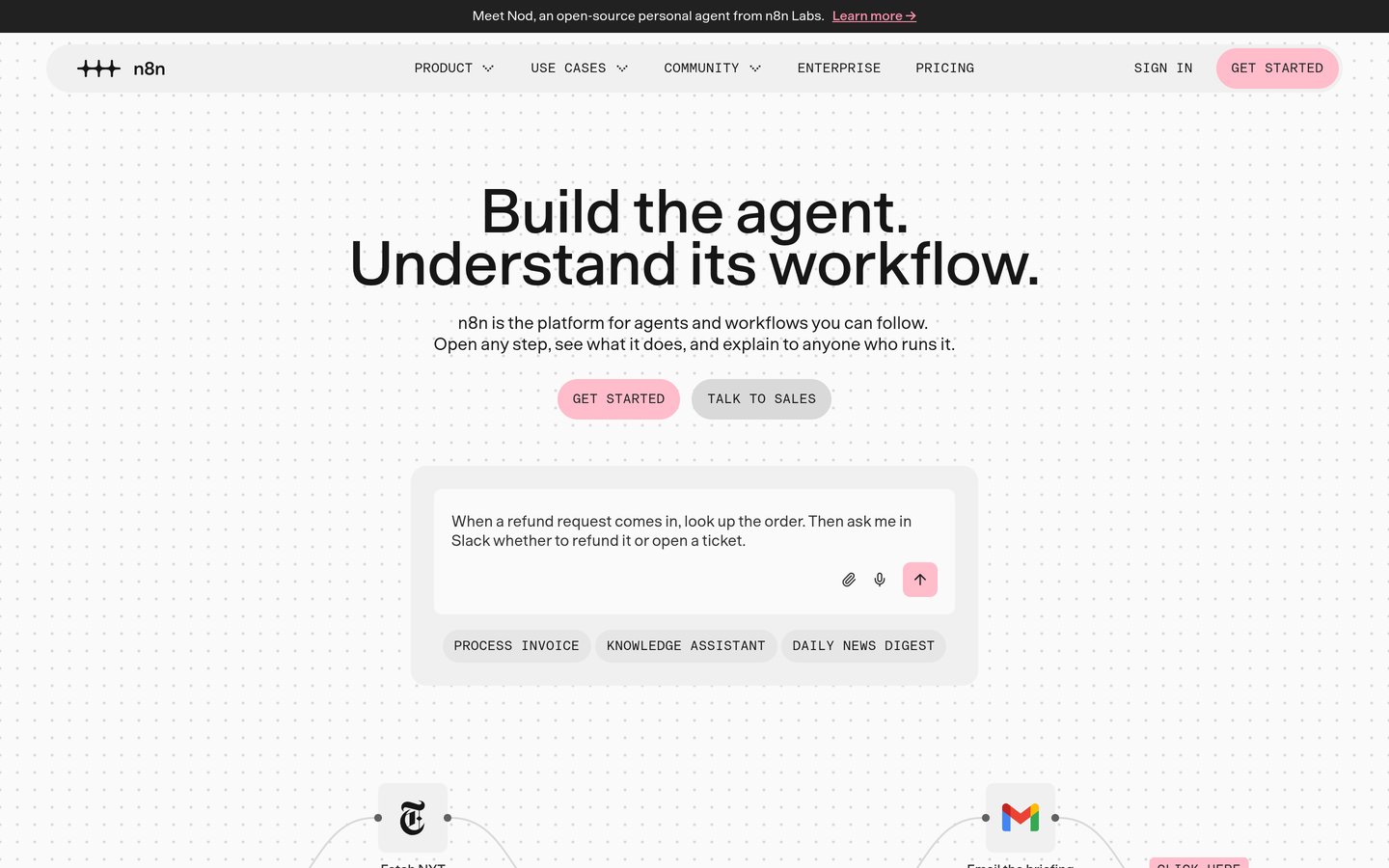
n8n
4.7/5on G2 (328 reviews, checked Nov 2026)
Starts at$263/yr
Best for execution-based pricing and AI workflows
Entry planStarter at EUR 20/mo (~$22)
Metering2.5K workflow executions/mo
Steps per runUnlimited steps per execution
AI nodesAgents, MCP, and AI nodes
n8n.io
n8n homepage, captured Nov 2026.
n8n is a node-based workflow platform that bills per full workflow execution rather than per individual step, including AI agent and MCP nodes. Its hosted Starter plan starts at EUR 20 per month billed annually (about $22/mo, or around $263/yr at EUR 1 = $1.0967) for 2,500 executions.
The trade off is that complex branching or HTTP and custom node setups require more technical comfort than basic app connectors. It suits builders running multi-step or AI-heavy automations who want step count not to inflate every run.
What we like
Counts a full workflow run as one execution regardless of step count
Includes native AI nodes, agents, and MCP support
Offers up to 5 concurrent executions on the hosted Starter tier
Watch out for
Priced in euros, so dollar totals vary with exchange rates
Some custom API and data shaping steps suit technical users better
Starter at EUR 20/mo billed annually (about $22/mo, ~$263/yr) provides 2,500 executions, 1 shared project, and 1,600 Assistant credits.Visit n8n.io
04
Coupler.io
4.8/5on G2 (104 reviews, checked Nov 2026)
Paid from$288/yr
Best for automated reporting into sheets and BI tools
Entry planStarter at $24/mo (annual)
Free tier1 source, 1 destination, manual
Data sources400+ sources
DestinationsSheets, BI, and SQL warehouses
coupler.io
Coupler.io homepage, captured Nov 2026.
Coupler.io is a no code reporting and data sync platform that pulls data from 400+ sources into spreadsheets, BI tools, and data warehouses. Its free plan includes $0 pricing, 1 data source, 1 destination, and manual refreshes.
The trade off is that the Starter plan at $24 per month billed annually ($288 per year) caps accounts, destinations, and daily refresh frequency. It suits analysts and operators automating recurring dashboards without setting up a complex ETL stack.
What we like
Connects 400+ sources to Google Sheets, Excel, BI tools, and warehouses
Supports filtering, formula transformations, and joining data before load
Includes a free tier with manual refresh and a 7-day trial
Watch out for
Starter limits usage to 1 user, 3 accounts, 1 destination, and 5,000 rows per run
Daily refresh on Starter requires upgrading to Pro for hourly refresh
Starter at $24/mo billed annually ($288/yr) adds daily automated refreshes, 3 accounts, 1 destination, and 5,000 rows per run.Visit coupler.io
05
Albato
4.6/5on G2 (510 reviews, checked Nov 2026)
Paid from$180/yr
Best for low-cost app automation and embedded workflows
Entry planPro at $15/mo (annual)
Free tier100 transactions/mo
App catalog1,000+ apps
Update speed5-min interval on Pro
albato.com
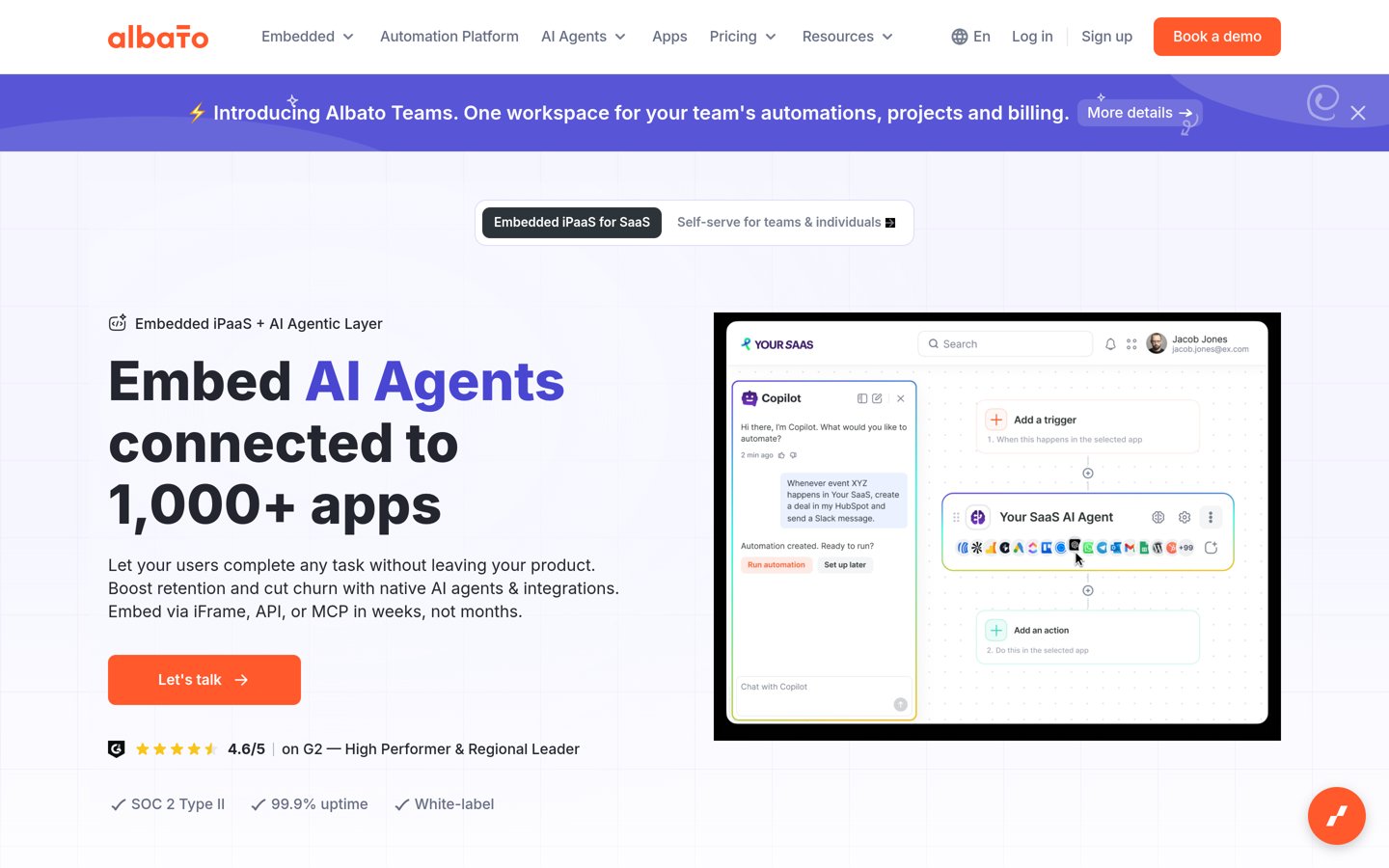
Albato homepage, captured Nov 2026.
Albato is a no code integration platform supporting 1,000+ apps, custom webhooks, and white-label embedded workflows for SaaS products. Its free plan includes $0 pricing, 5 active automations, 2 steps per automation, and 100 monthly transactions.
The trade off is that some niche apps or custom field mappings need workarounds compared to larger directories at $15 per month billed annually ($180 per year) on Pro. It suits small businesses and product teams wanting affordable automation and embedded options.
What we like
Pro plan starts at $15 per month billed annually with unlimited automations and steps
Supports 1,000+ app integrations plus custom webhooks and APIs
Offers embedded integration features for software vendors
Watch out for
Free plan caps automations at 2 steps and 100 transactions per month
Occasional field or connector gaps on less common apps
Pro at $15/mo billed annually ($180/yr) unlocks unlimited automations and steps, 5-minute updates, and 30-day logs.Visit albato.com
06
Skyvia
4.8/5on G2 (326 reviews, checked Nov 2026)
Paid from$948/yr
Best for cloud-to-database sync and ELT on a budget
Entry planData Integration from $79/mo
Free tier10K records/mo, daily sync
Core focusData ingestion, ELT, and sync
SchedulingDaily on free tier
skyvia.com
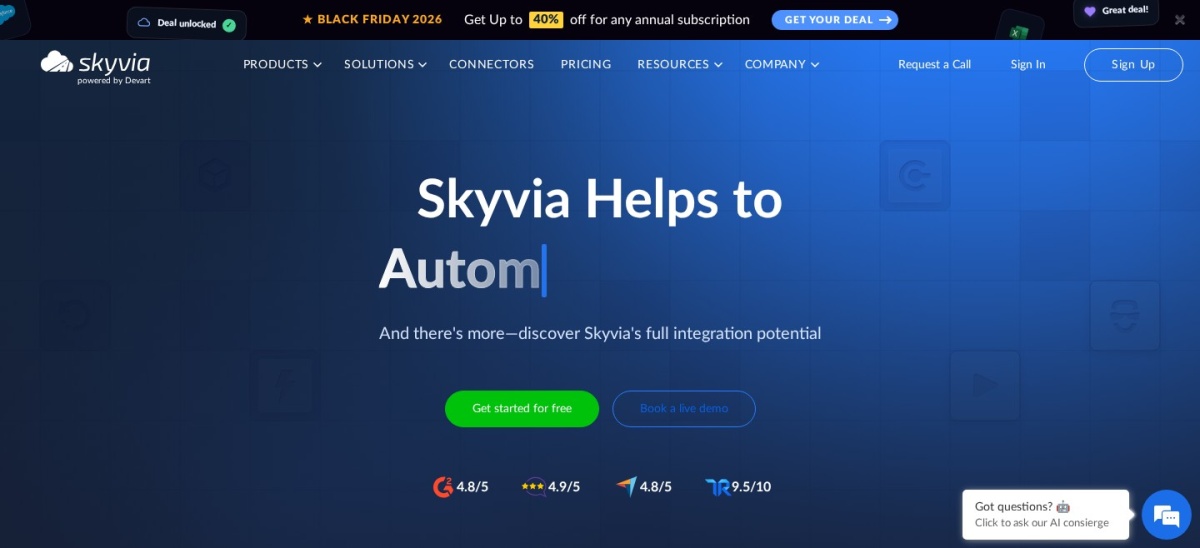
Skyvia homepage, captured Nov 2026.
Skyvia is a cloud data platform for no code ingestion, ELT, replication, and synchronization between cloud apps, databases, and warehouses. Its free tier includes $0 pricing, 10,000 records per month, and once-a-day scheduling.
The trade off is that paid data integration plans start at $79 per month billed annually ($948 per year), which is higher than basic task automators. It suits teams syncing CRM, database, and warehouse records without writing ETL code.
What we like
Handles cloud-to-database sync, ELT, and data integration in one interface
Includes a free tier with 10,000 monthly records and daily scheduling
Avoids per-task automation limits for structured record transfers
Watch out for
Higher starting price than lightweight app-to-app workflow tools
Advanced mapping and sync rules take time to configure
Paid data integration plans start at $79/mo billed annually ($948/yr) for higher record volumes and ingestion pipelines.Visit skyvia.com
07
Hevo
4.4/5on G2 (297 reviews, checked Nov 2026)
Paid from$3,180/yr
Best for automated warehouse pipelines and dbt workflows
Entry planStarter from $265/mo (annual)
Free tier1M events/mo, free sources
Connectors170+ data sources
Featuresdbt integration and SSH/SSL
hevodata.com
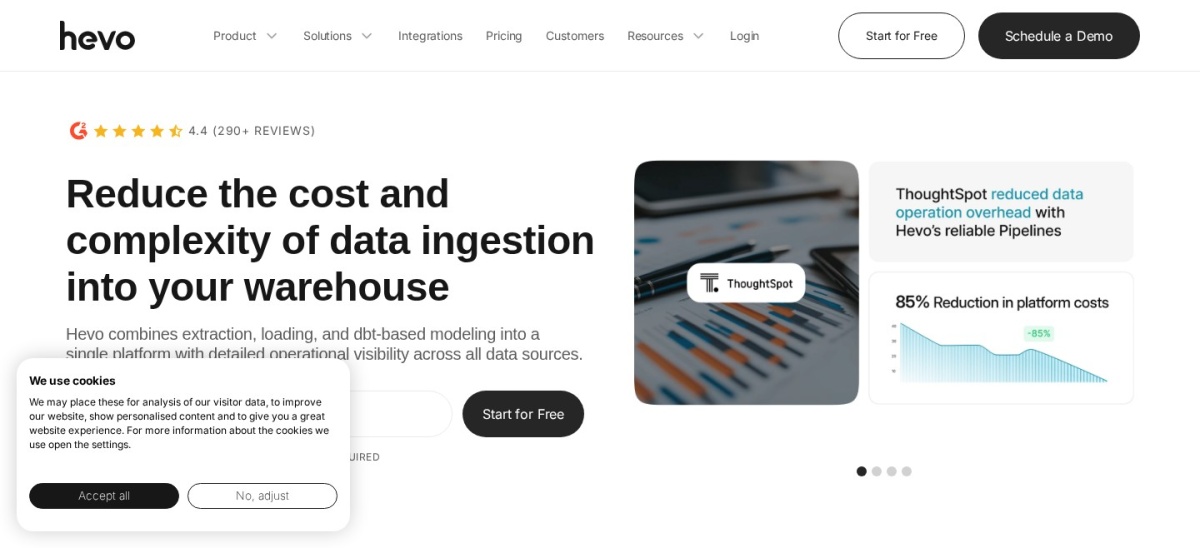
Hevo homepage, captured Nov 2026.
Hevo is a no code data pipeline platform built to move data from 170+ sources into data warehouses and databases with dbt integration. Its free tier includes $0 pricing and up to 1 million events per month using free sources.
The trade off is that Starter begins at $265 per month billed annually ($3,180 per year) and event-based billing can rise with frequent syncs. It suits data and analytics teams feeding warehouses rather than connecting everyday SaaS apps.
What we like
Purpose-built for warehouse pipelines with dbt integration and SSH/SSL security
Free tier covers up to 1 million events per month on supported free sources
Paid Starter pricing starts at $265 per month billed annually
Event-based pricing can grow if frequent reloads increase event volume
Starter from $265/mo billed annually ($3,180/yr) adds 170+ connectors, 1-hour scheduling, dbt integration, and up to 10 users.Visit hevodata.com
Workflow tools vs. data pipelines
Tools like Make, Zapier, n8n, and Albato focus on moving events and records between business apps when something happens, such as a new lead, order, or form submission.
Platforms like Coupler.io, Skyvia, and Hevo focus on structured data movement into spreadsheets, databases, and warehouses for reporting and analysis. Picking the wrong category often leads to awkward workarounds or high usage bills.
How we chose
We built this shortlist by reviewing established no code data integration platforms across workflow automation, reporting connectors, and warehouse ingestion tools, checking G2 ratings and review counts alongside vendor pricing pages.
Prices, ratings, and plan details were checked on 22 Nov 2026 using official vendor pricing pages and public G2 listings, converting euro pricing to US dollars at EUR 1 = $1.0967.
We excluded tools without public entry pricing or clear no code integration positioning, and we dropped any option where pricing could not be verified directly. No vendor paid for a place, and we do not claim testing for this list.
How to choose a no code data integration platform
Follow four practical steps to match a tool to your data volume and destination.
Define your source and destination first. List the apps, databases, spreadsheets, or warehouses you need to connect so you pick an app automation tool or a data pipeline platform accordingly.
Estimate your real monthly volume and refresh speed. Count how many tasks, records, events, or workflow runs occur each month, and note whether you need minute-level triggers or daily batch updates.
Check how the vendor meters usage. Compare per-task, per-module, per-execution, per-connection, and per-event billing so batch loops or frequent syncs do not surprise your budget.
Start on a free tier or trial with one workflow. Build a representative sync or scenario first to verify field mapping, error alerts, and scheduling limits before buying an annual plan.
FAQ
What is the best no code data integration platform overall?
Make is our top pick overall with a 4.6/5 G2 rating across 514 reviews and a Core plan starting at $12 per month billed annually, offering strong visual branching and a 1,000-credit free tier.
Which platform is best for connecting the widest range of apps?
Zapier stands out for app breadth with 8,000+ integrations and a 4.5/5 G2 rating across 2,170 reviews, making it easy to wire up common SaaS tools quickly.
When should I pick a data pipeline tool instead of an automation tool?
Choose a pipeline tool like Coupler.io, Skyvia, or Hevo when moving structured tables, analytics records, or warehouse data on a schedule rather than triggering real-time app actions.
How does n8n pricing compare to task-based tools?
n8n bills per full workflow execution rather than per step, starting at EUR 20 per month billed annually (about $22/mo) on Starter for 2,500 executions with unlimited steps per run.
Are there free plans available in this category?
Yes, Make, Zapier, Coupler.io, Albato, Skyvia, and Hevo all offer free tiers or free entry allowances, though each limits monthly volume, active flows, or refresh frequency.
Why do usage bills sometimes spike on no code integration tools?
Bills often rise when workflows iterate over large record sets, run on short intervals, or use event and credit meters that charge per step or per synced row.
SaaS SEO and WordPress specialist with about 8 years of experience. Rakib compares WordPress plugins, themes, hosting and software using public pricing, documentation and user reviews. See how we rank.