Best Kubernetes Security Platforms for Cloud in 2026: 7 Tools Compared
WLWPLegible EditorsLast verified 22 Nov 2026How we rank6 min read
★ Short answer
Wiz leads for cloud Kubernetes security with a 4.7 G2 rating across 945 reviews and agentless attack path analysis starting around $24,000 per year. Snyk fits developer CI/CD workflows from $25 per developer per month, while Portainer starts at $1,045 per year for cluster governance.
How we make this list: we compare pricing pages, product documentation and public user reviews, then re-check every price before each update. No product paid for a place. Disclosure.
Wiz holds a 4.7/5 G2 rating across 945 reviews and starts near $24,000/yr for 100 workloads.
Snyk starts at $25/dev/mo on the Team plan with 1,000 monthly Code and Open Source tests.
Portainer Business starts at $1,045/yr for 5 to 15 nodes after a 3-node free tier.
Sysdig Secure holds a 4.8/5 G2 rating across 111 reviews for runtime detection and Falco lineage.
Orca Security scores 4.7/5 across 313 G2 reviews with agentless SideScanning and custom pricing.
What to look for in a cloud Kubernetes security platform
Cloud Kubernetes environments mix managed clusters, ephemeral pods, container images, and identity permissions that change constantly. A strong platform connects cluster misconfigurations and image vulnerabilities to real network exposure so teams fix exploitable risks first.
Deployment model is the primary architectural split. Agentless scanners connect to cloud APIs and disk snapshots for rapid multi-cloud coverage, while sensor or eBPF agents inspect system calls and network traffic inside running nodes for deeper runtime enforcement.
Pricing models vary sharply across vendors. Some charge per workload or node tier with public entry rates, while enterprise CNAPP suites quote custom annual contracts based on workload volume, log ingestion, or developer seats.
Before committing to a platform, check how it handles CI/CD shift-left checks, admission controls, and compliance reporting across AWS, Azure, and Google Cloud.
The 7 best kubernetes security platforms for cloud
01
Wiz
4.7/5on G2 (945 reviews, checked Nov 2026)
Starts at$24,000/yr
Best for agentless multi-cloud Kubernetes risk graphs
DeploymentAgentless + Sensor
Rating4.7/5 (945)
Entry cost~$24,000/yr
CloudsAWS, Azure, GCP
wiz.io
Wiz homepage, captured Nov 2026.
Wiz is a cloud security platform that inventories Kubernetes clusters, correlates vulnerabilities with permissions and exposure, and highlights exploitable attack paths without requiring upfront node agents. Entry coverage is reported around $24,000 per year for up to 100 workloads on Wiz Essential.
The trade off is high starting cost around $24,000 per year and snapshot-based latency when catching fast runtime events without sensors. It suits mid-market and enterprise teams standardizing multi-cloud Kubernetes posture management.
What we like
Fast agentless cloud and cluster onboarding
Correlates exposure, identity, and cluster risks
Rated 4.7/5 across 945 G2 reviews
Watch out for
High entry price compared to lightweight tools
Agentless snapshots lack real-time syscall depth
Higher tiers and add-ons add runtime sensors, log ingestion, and code scanning.Visit wiz.io
02
Snyk
4.5/5on G2 (136 reviews, checked Nov 2026)
Paid from$25/mo
Best for developer CI/CD container and IaC checks
Free tierYes (capped)
Rating4.5/5 (136)
Team plan$25/dev/mo
FocusCode, IaC, images
snyk.io
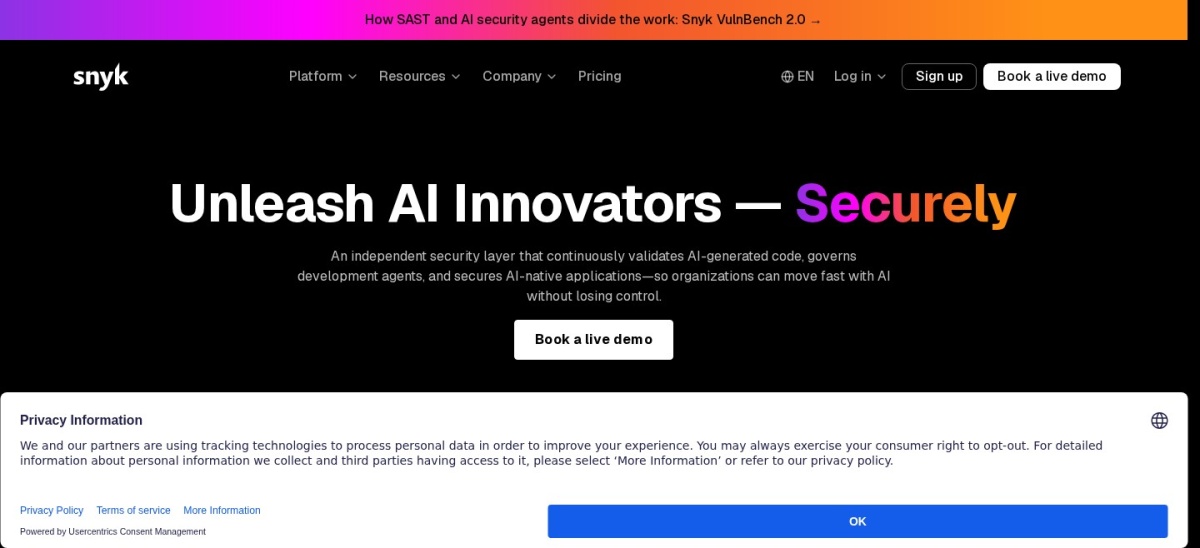
Snyk homepage, captured Nov 2026.
Snyk is a developer security platform that scans container images, Kubernetes manifests, and infrastructure as code in repositories and pipelines, with a free plan offering 100 container and 300 IaC tests per month. Paid Team plans start at $25 per contributing developer per month.
The trade off is a $25 per developer per month starting rate that scales with team headcount and higher tiers for larger teams. It suits engineering teams catching container and manifest issues before deployment.
What we like
Free plan includes container and IaC tests
Fits IDE, Git, and CI/CD developer workflows
Clear published starting price at $25/dev/mo
Watch out for
Costs rise as contributing developer count grows
Focused on build/pipeline rather than full runtime
Paid Team and enterprise plans raise scan limits and add collaboration and governance controls.Visit snyk.io
03
Portainer
4.8/5on G2 (307 reviews, checked Nov 2026)
Paid from$1,045/yr
Best for cluster access governance and RBAC policies
Free tierUp to 3 nodes
Rating4.8/5 (307)
Starter plan$1,045/yr
Node capUp to 16 vCPUs
portainer.io
Portainer homepage, captured Nov 2026.
Portainer is a container and Kubernetes management platform that centralizes role-based access control, audit logs, and policy enforcement across clusters, with a free Business tier for up to 3 nodes. Paid Starter licensing starts at $1,045 per year for 5, 10, or 15 nodes.
The trade off is a $1,045 per year Starter entry price with a 16 vCPU per node limit and no reseller support on Starter. It suits platform teams wanting visual cluster governance and access control without heavy enterprise overhead.
What we like
Highest G2 rating on this list at 4.8/5
Free Business option covers up to 3 nodes
Transparent annual Starter pricing at $1,045/yr
Watch out for
Starter caps nodes at 16 vCPUs and online purchase
Less deep on specialized CNAPP runtime forensics
Scale and Enterprise plans expand node counts, vCPU limits, and formal support tiers.Visit portainer.io
04
Sysdig Secure
4.8/5on G2 (111 reviews, checked Nov 2026)
PricingCustom/yr
Best for real-time Kubernetes runtime threat detection
Rating4.8/5 (111)
PricingCustom quote
Core focusRuntime & CNAPP
BasisHosts & events
sysdig.com
Sysdig Secure homepage, captured Nov 2026.
Sysdig Secure is a cloud and container security platform built around Falco runtime detection to monitor live Kubernetes workloads, vulnerabilities, and cloud posture. It holds a 4.8/5 rating across 111 G2 reviews.
The trade off is custom quote-based pricing tied to hosts, compute instances, and log events rather than a published self-serve rate. It suits security teams needing live runtime visibility and response inside active clusters.
What we like
4.8/5 rating across 111 G2 reviews
Strong runtime detection rooted in Falco
Covers vulnerability, posture, and runtime workflows
Watch out for
Requires custom sales quote for pricing
Initial setup can be complex for smaller teams
Commercial subscriptions scale across hosts, compute instances, and cloud event volumes.Visit sysdig.com
05
Orca Security
4.7/5on G2 (313 reviews, checked Nov 2026)
PricingCustom/yr
Best for unified agentless cloud, container, and data risk
Rating4.7/5 (313)
PricingCustom quote
ScanningAgentless + Sensor
ScopeCNAPP & data risk
orca.security
Orca Security homepage, captured Nov 2026.
Orca Security is a cloud-native application protection platform using agentless SideScanning to inspect Kubernetes workloads, cloud posture, identities, and sensitive data exposure. It holds a 4.7/5 rating across 313 G2 reviews.
The trade off is custom quote-based pricing that scales with workload counts and enterprise contract terms rather than self-serve tiers. It suits multi-cloud teams prioritizing attack path visibility and data risk without deploying agents everywhere.
Maps attack paths across workloads and sensitive data
Watch out for
Custom pricing only with no public starter tier
Attack path graphs need scoping in large estates
Commercial contracts scale by workload count with optional runtime sensor capabilities.Visit orca.security
06
CrowdStrike Falcon Cloud Security
4.5/5on G2 (255 reviews, checked Nov 2026)
PricingCustom/yr
Best for unified SOC threat detection across cloud and hosts
Rating4.5/5 (255)
PricingCustom quote
ArchitectureSensor + agentless
FocusDetection & CSPM
crowdstrike.com
CrowdStrike Falcon Cloud Security homepage, captured Nov 2026.
CrowdStrike Falcon Cloud Security combines posture management, container image assessment, and runtime threat detection within the Falcon platform using lightweight sensors and cloud integrations. It holds a 4.5/5 rating across 255 G2 reviews.
The trade off is quote-based enterprise pricing and modular packaging that can feel complex to budget or learn at first. It suits organizations already standardizing SOC workflows on CrowdStrike across endpoints and cloud clusters.
What we like
4.5/5 rating across 255 G2 reviews
Combines CSPM and runtime threat detection in one console
Lightweight sensor footprint reported by reviewers
Watch out for
No public self-serve pricing on vendor pages
Modular options add budgeting complexity
Enterprise licensing depends on selected modules, workloads, and contract scope.Visit crowdstrike.com
07
Tenable Cloud Security
4.5/5on G2 (44 reviews, checked Nov 2026)
PricingCustom/yr
Best for exposure management and cloud IAM permissions
Rating4.5/5 (44)
PricingCustom quote
CoverageCSPM, CIEM & risk
CloudsAWS, Azure, GCP
tenable.com
Tenable Cloud Security homepage, captured Nov 2026.
Tenable Cloud Security provides agentless posture management, cloud entitlement analysis, and exposure prioritization across AWS, Azure, and GCP environments. It holds a 4.5/5 rating across 44 G2 reviews.
The trade off is custom quote-based pricing tied to billable cloud resources rather than a transparent self-serve plan. It suits teams tying Kubernetes and cloud exposure into broader Tenable vulnerability programs.
What we like
4.5/5 rating across 44 G2 reviews
Strong posture and cloud entitlement visibility
Aligns with existing Tenable vulnerability workflows
Watch out for
Requires custom quote based on resource count
Smaller G2 review count than top rivals
Commercial pricing scales with billable cloud resources and enterprise suite add-ons.Visit tenable.com
Agentless scanning vs. runtime enforcement in Kubernetes
Agentless platforms connect to cloud APIs and snapshots to map configurations, container images, and cloud identities quickly without touching running nodes. That speeds up initial audits across large multi-cloud estates and keeps cluster overhead low.
Runtime and sensor-based approaches observe live container activity, network connections, and system calls inside clusters. Many teams pair posture visibility with admission controls or runtime sensors so known issues are caught early and active threats are spotted in flight.
How we chose
We selected established cloud and Kubernetes security platforms actively maintained in 2026 across posture management, developer scanning, cluster governance, and runtime protection.
Public ratings and review counts were checked on G2 on 22 Nov 2026 alongside official pricing and licensing details.
We excluded unmaintained tools, products without verifiable public ratings or pricing evidence, and single-purpose open-source projects lacking commercial vendor pricing pages. No vendor paid for a place, and we do not claim testing for this list.
How to choose a Kubernetes security platform in 4 steps
Follow these four steps to match a Kubernetes security platform to your cloud stack and budget.
Map your cluster and cloud footprint. List managed Kubernetes services, node counts, container registries, and cloud accounts that need visibility or policy control.
Decide between agentless speed and runtime depth. Choose agentless scanning for rapid multi-cloud posture and attack path mapping, or add sensors for deeper live workload monitoring.
Check where developers need feedback. Verify whether your team needs manifest, IaC, and container image checks inside code and CI/CD pipelines before deployment.
Model how pricing scales with growth. Compare per-node, per-developer, and custom workload or log-volume quotes against expected cluster and team expansion.
FAQ
Which cloud Kubernetes security platform is best overall?
Wiz ranks first for cloud Kubernetes security with a 4.7/5 G2 rating across 945 reviews and agentless attack path analysis. Teams wanting lower entry pricing or developer CI/CD integration often start with Snyk or Portainer.
Do Kubernetes security platforms require an agent on every node?
Not always. Agentless tools scan cloud APIs, configurations, and snapshots without node agents, while runtime tools use sensors or eBPF agents for deeper live workload inspection.
Can I start with a free plan for Kubernetes security?
Yes. Snyk offers a free plan with monthly container and IaC test limits, and Portainer Business offers a free tier for up to 3 nodes.
Why do many enterprise Kubernetes platforms use custom pricing?
Enterprise platforms often price around workload counts, cluster nodes, log ingestion volume, or custom module bundles rather than fixed self-serve tiers. Requesting a quote helps clarify volume and renewal terms.
What is the difference between posture scanning and runtime security?
Posture and image scanning find misconfigurations and vulnerabilities before or outside active attacks, while runtime security monitors live container behavior and network activity during execution.
Should small teams buy a full CNAPP suite right away?
Usually not. Smaller teams often get faster value from targeted pipeline scanning or cluster governance tools before paying for broad enterprise cloud security suites.