Cake Equity is the best equity management software for startups that want a free cap table and published prices, with a free plan for 5 stakeholders and paid plans from $1,000 a year. Pick Ledgy for multi-country equity, Qapita for companies across Asia, or Carta if your investors expect the industry standard.
How we make this list: we compare pricing pages, product documentation and public user reviews, then re-check every price before each update. No product paid for a place. Disclosure.
Cake Equity leads, rated 4.8 out of 5 on G2 from 143 reviews, with a free plan for 5 stakeholders, Build from $1,000 a year and free migration from Carta or Pulley.
Ledgy is the multi-country pick, rated 4.7 out of 5 from 84 reviews, with Scale from about 5,000 euros a year and 70-plus HRIS integrations.
Qapita publishes its prices, with Surge at $1,600 a year for 40 stakeholders, and is strongest for companies across Singapore, India and Indonesia.
Vestd is the UK pick for EMI and CSOP schemes, from 25 pounds a month for the cap table, but schemes open only on Guided from about 420 pounds a month.
Carta remains the industry standard, rated 4.3 out of 5 from 232 reviews, but paid plans are quote-only and Vendr puts median spend near $14,725 a year.
Pulley is shutting down on 8 December 2026, so do not buy it; its customers are being moved to Carta.
What equity management software covers
Equity management software, also called cap table software, tracks who owns a company: shares, option grants, vesting schedules, SAFEs and convertible notes, plus the valuations and filings that go with them. A clean cap table is what investors and acquirers ask for first, and a spreadsheet stops being enough once grants and rounds pile up.
The tools split by stage and country. Startup cap tables such as Cake Equity, Qapita, Carta and Eqvista compete on free tiers and published prices, while Ledgy and Vestd serve European and UK share schemes, and Certent serves public companies with SEC reporting.
Pricing is mostly per stakeholder, so the bill grows with every hire. Free plans end at 5 to 25 stakeholders or 1 million dollars raised, and a 409A valuation is often a separate charge. Our guide on accounting software covers the finance stack these tools sit beside.
One name is missing on purpose: Pulley is shutting down on 8 December 2026 and moving its customers to Carta, so no new buyer should start with it. Check the review base too: a 4.2 from 10 reviews means far less than a 4.3 from 232.
List prices in each vendor's currency, checked Nov 2026
LedgyFREE€5,000
Vestd£25
CertentCustom
CartaFREECustom
EqvistaFREE$2
CakeFREE$1,000
Astrella$1,200
QapitaFREE$1,600
The 8 best equity management software tools
01
Cake Equity
4.8/5on G2 (143 reviews, checked Nov 2026)
Paid from$1,000/yr
Best overall for startups
Free plan5 stakeholders
Build$1,000/yr, 25 stakeholders
Team$2,750/yr, 2x 409A
MigrationFree, about 48 hours
cakeequity.com
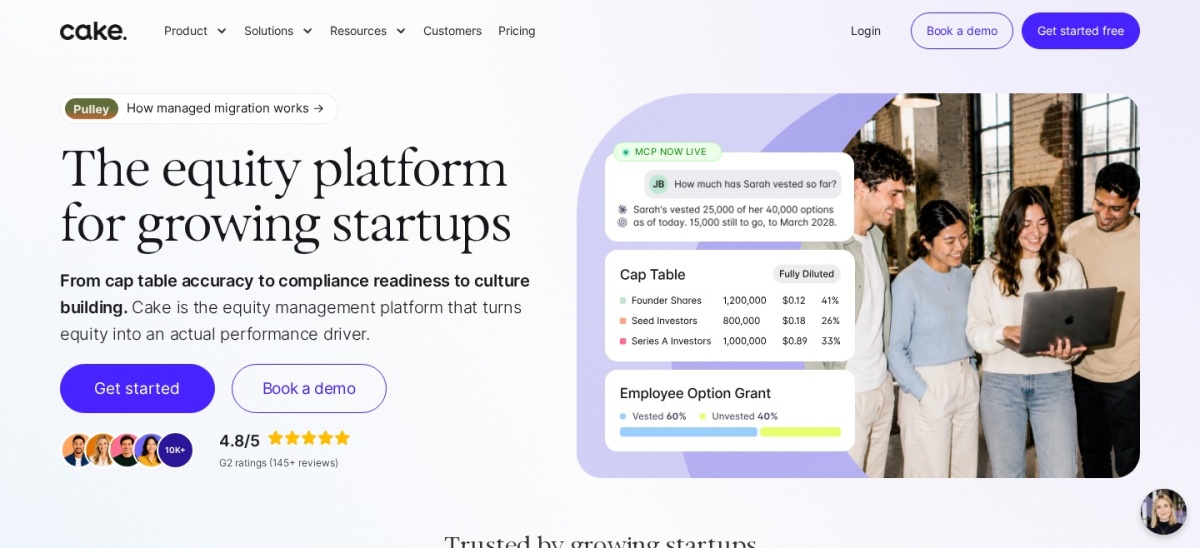
Cake Equity homepage, captured Nov 2026.
Cake Equity is a cap table and equity management platform for startups, covering cap tables, stock options, SAFEs, fundraising modelling and 409A valuations in one place. It is rated 4.8 out of 5 on G2 from 143 reviews, the highest score in this list, and its free plan covers 5 stakeholders with access to Starter and Growth features.
The trade off is scale: paid plans are priced by stakeholder count, so a growing team pays more with every hire, and the Pro plan is quote-only. It suits seed to Series B startups that want published prices and a free managed migration from Carta or Pulley.
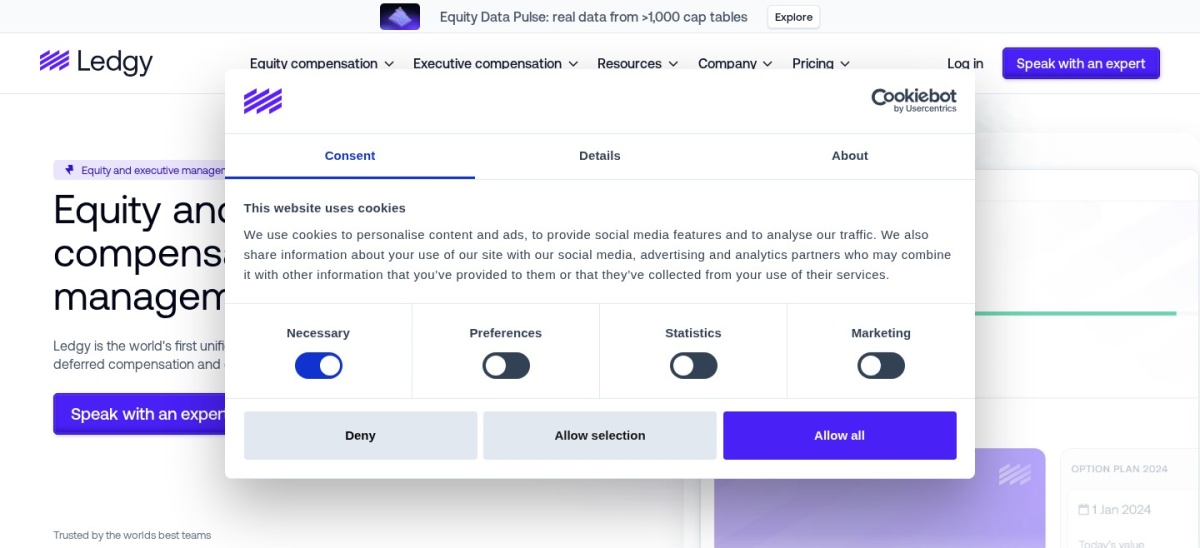
Ledgy is a European equity and executive compensation platform that unifies cap tables, share plans, deferred compensation and carried interest in one system. It is rated 4.7 out of 5 on G2 from 84 reviews, and it covers IFRS 2 expensing, global mobility reporting and 70-plus HRIS integrations.
The trade off is price and transparency: Scale starts from about 5,000 euros a year, Enterprise is quote-only, and Ledgy publishes no rate card on its pricing page. It suits European scale-ups granting equity across several countries and preparing for an IPO.
What we like
Strongest multi-country compliance in this list
70-plus HRIS integrations
Free Launch plan for early teams
ISO 27001 certified
Watch out for
No rate card on its pricing page
Scale price varies by source
Enterprise is quote-only
Scale price from a 14 Nov 2026 read of Ledgy's pricing page; G2 lists €300/moVisit ledgy.com
03
Qapita
4.7/5on Capterra (64 reviews, checked Nov 2026)
Paid from$1,600/yr
Best for companies across Asia
Free planSpark, 25 stakeholders
Surge$1,600/yr, 40 stakeholders
Growth$3,000/yr, 50 stakeholders
409A$1,500 add-on
qapita.com
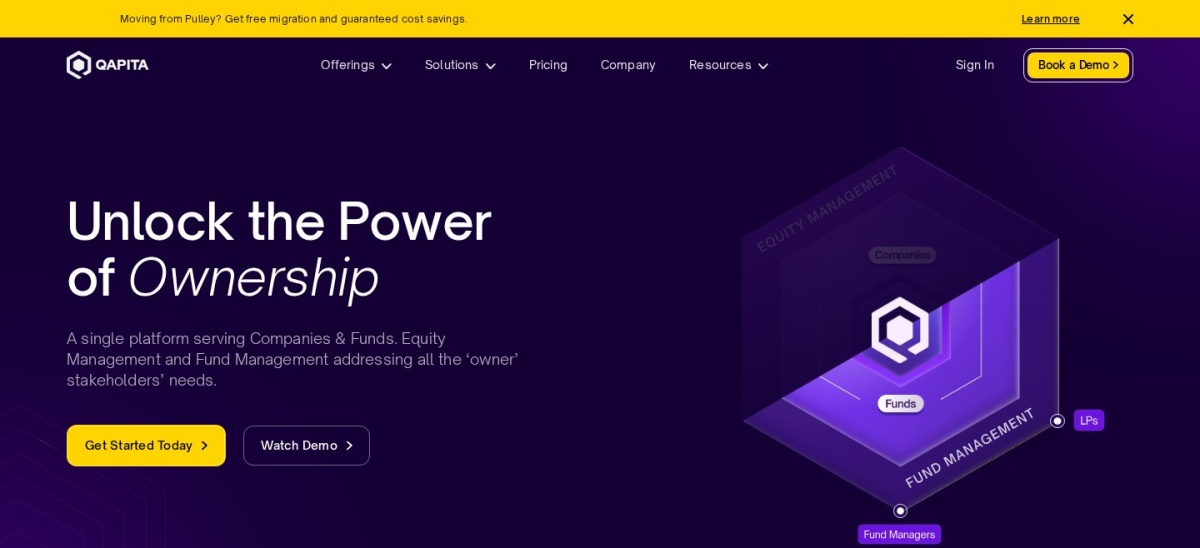
Qapita homepage, captured Nov 2026.
Qapita is a cap table and equity plan platform built for companies with stakeholders across jurisdictions, with the strongest coverage in Singapore, India and Indonesia. It is rated 4.7 out of 5 on Capterra from 64 reviews, and its free Spark plan covers 25 stakeholders and under 1 million dollars raised.
The trade off is reach outside Asia: Qapita is less known in the US and Europe, and a 409A valuation is a 1,500 dollar add-on on the entry plans. It suits seed to IPO companies whose cap table spans several Asian jurisdictions.
What we like
Published prices, rare in this category
Free Spark plan to 25 stakeholders
Strong Singapore and India compliance
409A available from the same vendor
Watch out for
Less known outside Asia
409A is a $1,500 add-on on entry plans
Bill grows $40 per extra stakeholder
Surge $1,600/yr confirmed by dated reads of Qapita's pricing page, Oct-Nov 2026Visit qapita.com
04
Vestd
4.7/5on G2 (67 reviews, checked Nov 2026)
Pricing£25/mo
Best for UK EMI share schemes
EssentialsFrom £25/mo
StarterFrom £220/mo
GuidedFrom £420/mo, EMI included
Term12-month minimum
vestd.com
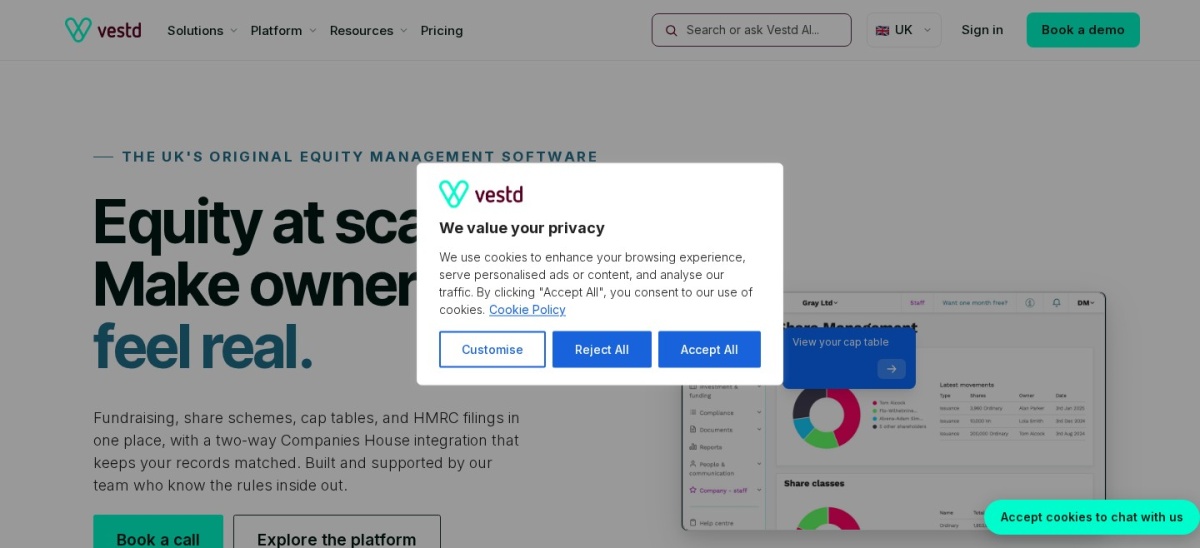
Vestd homepage, captured Nov 2026.
Vestd is a UK equity management platform built around share schemes, covering EMI, CSOP, growth shares and unapproved options with a two-way Companies House integration. It is rated 4.7 out of 5 on G2 from 67 reviews, and it is authorised and regulated by the Financial Conduct Authority.
The trade off is that the 25 pound Essentials plan covers only the cap table and filings; EMI and CSOP schemes open only on the Guided service from about 420 pounds a month. It suits UK limited companies issuing EMI options to employees.
What we like
Only UK-native EMI and CSOP specialist here
Two-way Companies House integration
Unlimited HMRC valuations on Guided
FCA regulated, ISO 27001 certified
Watch out for
No free plan at all
EMI schemes need the Guided service
12-month minimum term, prices exclude VAT
Guided from £420/mo (Oct 2026); some sources list £435/moVisit vestd.com
05
Astrella
4.5/5on G2 (51 reviews, checked Nov 2026)
Starts at$1,200/yr
Best flat-rate pricing for growing teams
Early Stage$1,200/yr, 0-25 stakeholders
Emerging$3,200/yr, 26-100
Accelerate$8,200/yr, 101-300
ReportingASC 718 and IFRS included
astrella.com
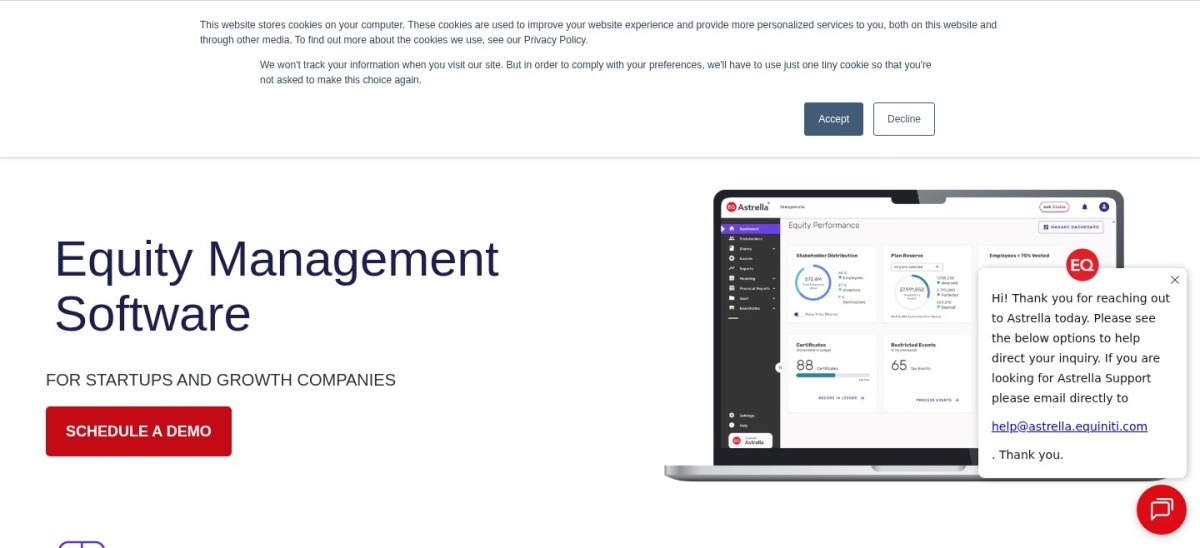
Astrella homepage, captured Nov 2026.
Astrella is a cap table and equity management platform with flat annual pricing by stakeholder band, covering option grants, vesting, ASC 718 and IFRS reporting on every plan. It is rated 4.5 out of 5 on G2 from 51 reviews, and its Early Stage plan costs 1,200 dollars a year for up to 25 stakeholders.
The trade off is that 409A valuations, 83(b) elections and HRIS integrations are add-ons rather than included, and implementation takes about two months. It suits US startups that want a predictable flat annual fee instead of per-stakeholder billing.
What we like
Flat annual fee, no per-stakeholder billing
ASC 718 and IFRS on every plan
Published prices by stakeholder band
All features on every package
Watch out for
409A and HRIS are add-ons
Implementation takes about two months
Smaller review base than Carta or Cake
Prices vendor-provided on G2; vendor-page read 21 Oct 2026Visit astrella.com
06
Certent
4.4/5on G2 (117 reviews, checked Nov 2026)
PricingCustom/yr
Best for public-company equity reporting
FocusPublic and late-stage
ReportingASC 718, SEC filings
TrialDemo request
PricingQuote only
certent.com
Certent homepage, captured Nov 2026.
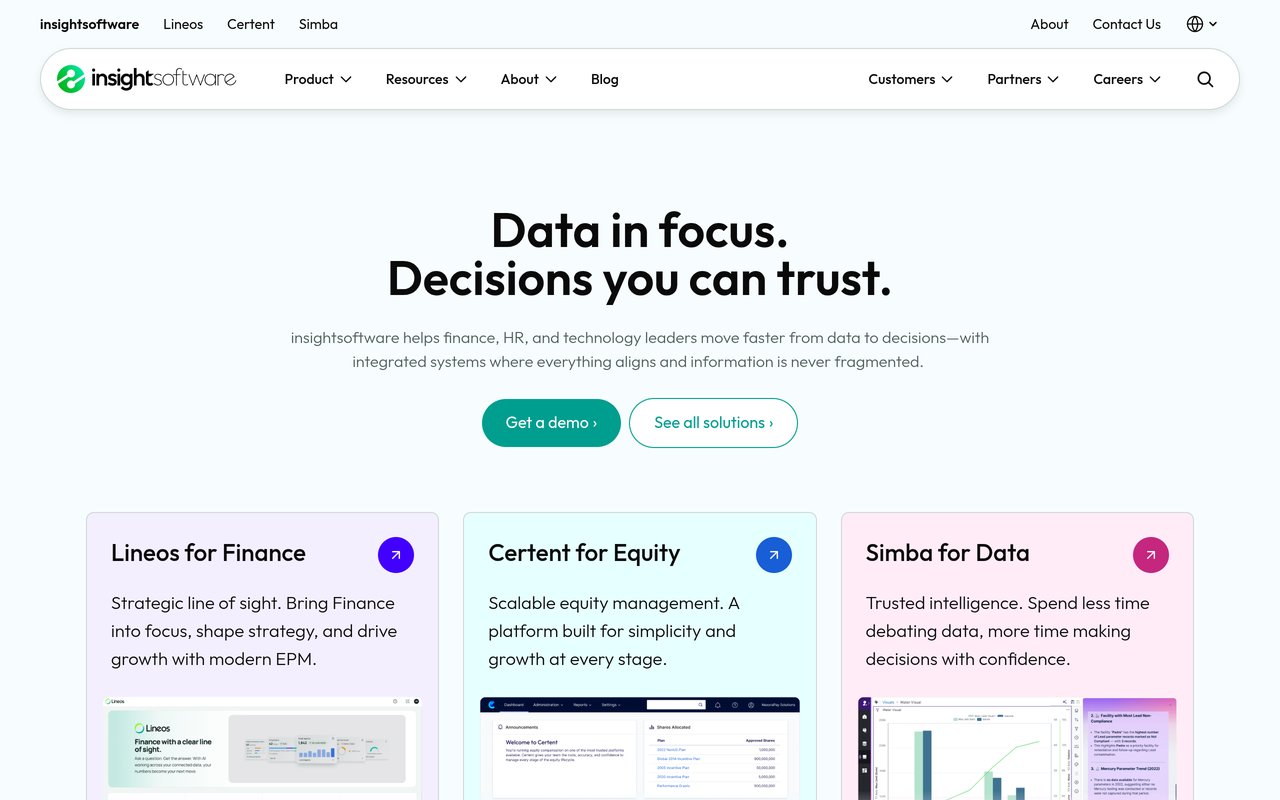
Certent is an equity management platform for public and late-stage companies, built around ASC 718 reporting, SEC filings and complex equity plans. It is rated 4.4 out of 5 on G2 from 117 reviews, and it is part of insightsoftware, which gives it the reporting depth the startup tools lack.
The trade off is that Certent publishes no price, offers no free plan, and is far heavier than a startup cap table needs. It suits public companies and late-stage privates whose auditors and SEC reporting drive the purchase.
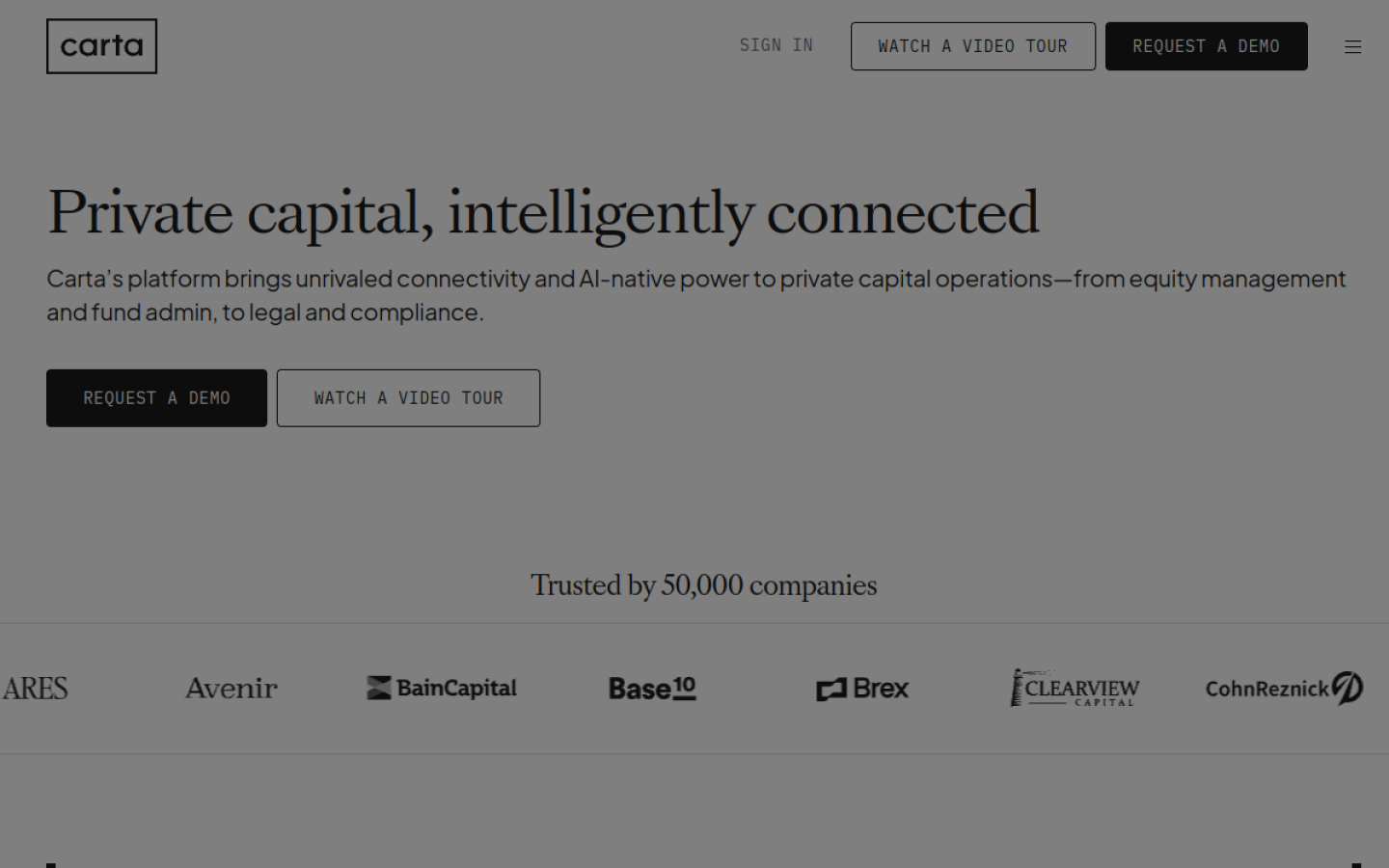
Carta is the industry-standard cap table platform, used by more than 55,000 companies, covering cap tables, option grants, 409A valuations and fund administration. It is rated 4.3 out of 5 on G2 from 232 reviews, the largest review base in this list, and its free Launch plan covers 25 stakeholders and under 1 million dollars raised.
The trade off is price opacity: paid plans are quote-only, and Vendr puts median annual spend near 14,725 dollars from 679 contracts analysed. It suits startups whose investors and lawyers expect Carta, and companies that outgrow the free tier.
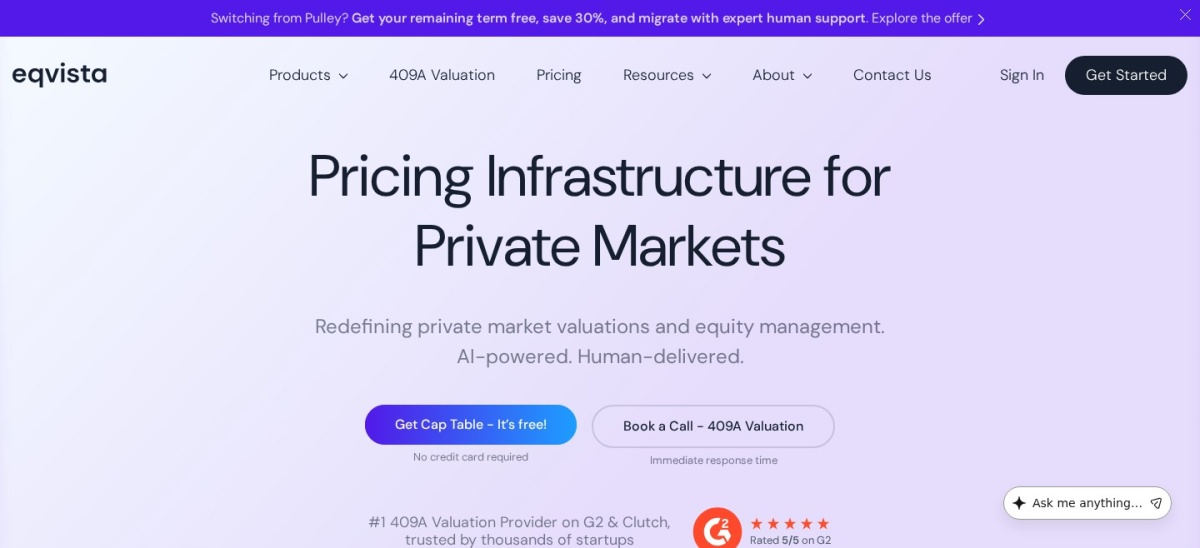
Eqvista is a low-cost cap table and 409A valuation platform for early startups, with a free plan under 20 shareholders and a Premium plan at 2 dollars per shareholder a month. It is rated 4.2 out of 5 on G2 from 10 reviews, and it is a SEC-registered transfer agent.
The trade off is the thin review base: the G2 rating rests on only 10 reviews, and Eqvista's own site claims a far higher score. It suits cash-strapped founders who want a free cap table and a cheap 409A bundle from the same vendor.
What we like
Free under 20 shareholders
409A plus Premium bundle from $990 a year
SEC-registered transfer agent
Watch out for
G2 rating rests on only 10 reviews
Vendor claims a far higher score
Smallest review base in this list
Rating 4.2/10 per rankite Oct 2026; vendor claims 4.9 on G2Visit eqvista.com
Startup cap tables vs public-company equity
Startup cap table tools such as Cake Equity, Qapita, Carta and Eqvista are built for founders: free tiers, SAFE and convertible note tracking, fundraising modelling and a 409A when options are granted. Prices are published or free to start, and migration is usually free.
European and UK tools such as Ledgy and Vestd are built for scheme rules: IFRS 2 expensing, EMI and CSOP schemes, HMRC valuations and Companies House filings. They cost more per month because the advice and filings are part of the product.
Public-company tools such as Certent are built for auditors: ASC 718 reporting, SEC filings and complex equity plans across thousands of holders. They are quote-only, have no free plan, and are far heavier than any startup needs.
Pick by your next milestone, not your current size. A seed startup needs a free cap table; a company planning an IPO needs the reporting depth, and switching later costs weeks of reconciliation.
How we chose
We started from the cap table platforms startups and finance teams actually evaluate in 2026, cross-checked against the comparison guides we cite: rankite, softwarecompare, Cake Equity's own guide and the Pulley migration guides.
Prices come from vendor pricing pages where they exist. Cake Equity's prices were confirmed on its own pricing page on 25 November 2026. Ledgy and Qapita prices rest on dated reads of their vendor pricing pages, from 14 November 2026 and October to November 2026, and Carta and Certent publish no rate card, so the list says Custom rather than inventing a figure.
Ratings and review counts come from G2, except Qapita, whose rating comes from Capterra. No vendor paid for a place, and we do not claim hands-on testing for this list.
How to choose equity management software
Start from your country and your stakeholder count, then price the 409A, not just the licence.
Count your stakeholders first. Free plans end at 5 to 25 stakeholders or 1 million dollars raised. A seed round can end the free tier even with ten people on the cap table, so check both limits.
Match the tool to your country. US startups suit Cake, Carta or Eqvista; European teams suit Ledgy; UK EMI schemes suit Vestd; companies across Asia suit Qapita; public companies suit Certent.
Price the 409A, not just the licence. A 409A valuation is included on Cake Team but costs 1,500 dollars as an add-on at Cake Build and Qapita, and Vestd charges from 700 pounds. Add it to the first-year total.
Ask about migration before you sign. Cake offers free managed migration in about 48 hours, and Ledgy Enterprise migration takes weeks. Confirm who reconciles your data and what the cutover looks like.
FAQ
What is the best equity management software?
Cake Equity is the best equity management software for startups, rated 4.8 out of 5 on G2 from 143 reviews, with a free plan for 5 stakeholders and paid plans from 1,000 dollars a year. Ledgy leads for multi-country equity, Qapita for companies across Asia, and Vestd for UK EMI schemes.
How much does equity management software cost?
Entry paid plans run from 1,000 dollars a year at Cake Equity and 1,600 dollars at Qapita to about 5,000 euros a year at Ledgy. Carta and Certent are quote-only, and Vendr puts Carta's median annual spend near 14,725 dollars. Most tools also offer a free plan for small cap tables.
Is Carta or Cake Equity better?
Carta is better if your investors and lawyers expect the industry standard, since it is the platform most venture-backed startups use. Cake Equity is better if you want published prices, a free plan and free migration, with the highest G2 score in this list at 4.8 from 143 reviews.
What happened to Pulley?
Pulley is shutting down on 8 December 2026 and is moving its customers to Carta through an assisted migration. Do not start a new cap table on Pulley. Cake Equity and Qapita both offer free managed migration for teams leaving Pulley or Carta.
Do I need a 409A valuation?
Yes, if you grant stock options in the US, you need a 409A valuation to set the strike price and stay tax compliant. Cake Equity includes two a year on its Team plan and charges 1,500 dollars each as an add-on, while Qapita also charges 1,500 dollars and Eqvista bundles one from 990 dollars a year.
Which equity tool is best for UK EMI schemes?
Vestd is the best equity management software for UK EMI schemes, with a two-way Companies House integration and unlimited HMRC valuations on its Guided service. The 25 pound Essentials plan covers only the cap table, so budget from about 420 pounds a month for full EMI and CSOP support.
Can I try equity management software for free?
Yes. Cake Equity is free for 5 stakeholders, Qapita and Carta are free for 25 stakeholders under 1 million dollars raised, Ledgy has a free Launch plan and Eqvista is free under 20 shareholders. Vestd and Certent have no free plan, so ask for a demo instead.
SaaS SEO and WordPress specialist with about 8 years of experience. Rakib compares WordPress plugins, themes, hosting and software using public pricing, documentation and user reviews. See how we rank.