REDCap is the best electronic data capture software for academic and investigator-initiated trials because it is free to non-profit institutions and deeply proven. For large commercial trials, Medidata Rave is the industry standard, while Castor is the fastest modern alternative for teams that want self-service study builds.
How we make this list: we compare pricing pages, product documentation and public user reviews, then re-check every price before each update. No product paid for a place. Disclosure.
REDCap is free to non-profit institutions in the REDCap Consortium, making it the default for academic and investigator-initiated research.
Pricing is quote-based across every commercial vendor. Budget for validation, study build services and training on top of the license.
Medidata Rave remains the industry standard for large global trials, with the deepest site familiarity of any EDC here.
Veeva Vault EDC has no product-specific G2 rating we could verify, so it is not in this list despite being a leading platform.
Castor is the fastest modern alternative, with self-service study builds and AI-assisted source data extraction.
What electronic data capture software covers
Electronic data capture software replaces paper case report forms with validated electronic forms, audit trails and query management. Every serious platform supports 21 CFR Part 11, GDPR, HIPAA and ICH-GCP, so compliance is table stakes rather than a differentiator.
The market splits in two. Enterprise platforms such as Medidata Rave, Oracle Clinical One and Veeva serve large pharma sponsors and global CROs, while accessible tools such as REDCap, Castor, OpenClinica and Medrio serve academic centers and mid-size teams.
Pricing is quote-based across every commercial vendor. Budget for validation, study build services and training on top of the license, and ask for the per-study and per-patient figures in writing before you shortlist.
Study build speed is the practical differentiator. REDCap and Castor let research teams build studies themselves in days or weeks, while enterprise platforms take weeks to months with vendor services. Our project management guide covers the surrounding trial operations work.
For sponsors wanting one unified eClinical platform
Custom/yr
No free plan
4.1/5
Price ladder: cheapest paid plan per year
List prices, USD, checked Nov 2026
REDCapFree
RaveCustom
CastorCustom
ViedocCustom
cubeCDMSCustom
MedrioCustom
OpenClinicaFree
ClinionCustom
OracleCustom
The 9 best electronic data capture software tools
01
REDCap
4.3/5on G2 (221 reviews, checked Nov 2026)
PriceFree
Best for academic and non-profit research
DeploymentSelf-hosted or cloud
PricingFree for non-profits
Free optionConsortium membership
StrengthSurveys and registries
projectredcap.org
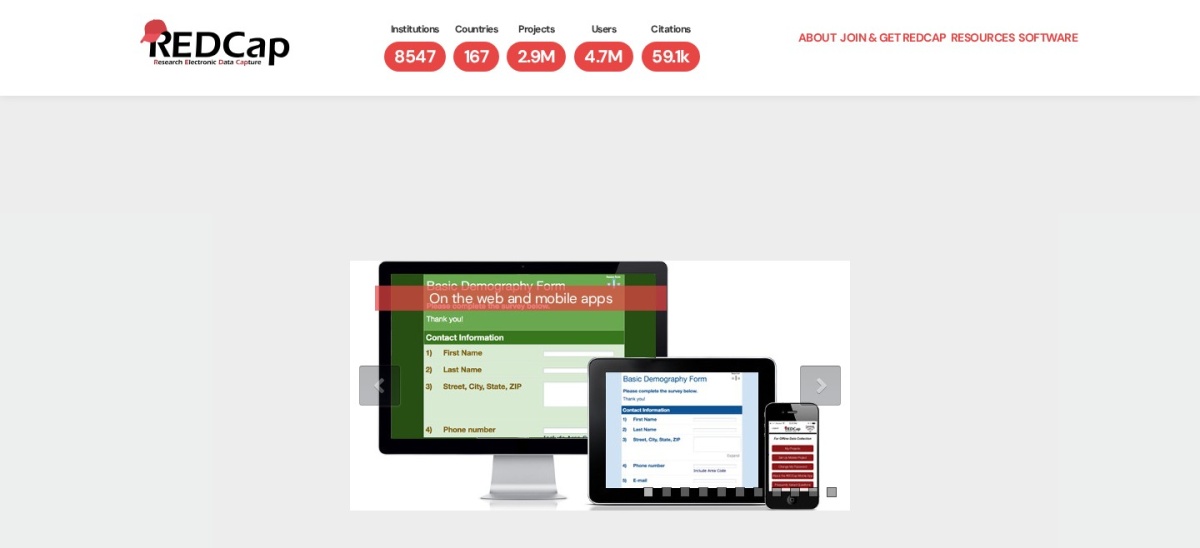
REDCap homepage, captured Nov 2026.
REDCap is a secure web application for building and managing online surveys and databases, developed at Vanderbilt and free to non-profit institutions that join the REDCap Consortium. It handles surveys, multi-site studies and secure data collection, and exports to every common statistics package. More than 57,000 journal articles cite it, which shows how deeply embedded it is in published research.
The trade off is access and scope. Access runs through an institution's license agreement rather than individual signups, and the interface shows its age. It targets investigator-initiated research rather than adaptive Phase III trials with complex randomization, so large commercial programs will outgrow it.
What we like
Free to non-profit institutions in the consortium
Enormous global user community
Proven reliable since 2004
Exports to every common statistics package
Watch out for
Institutional license required, no individual access
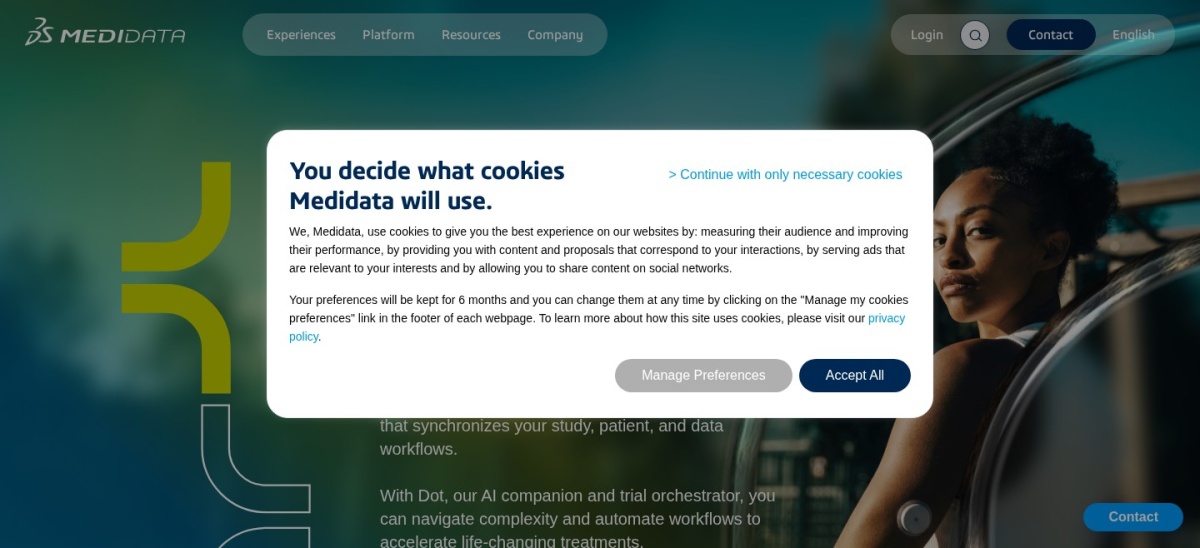
Medidata Rave is the EDC the industry measures itself against, with 1.8 million users and more than 35,000 studies on the platform. The 2025 ISR benchmarking report named it the most preferred EDC based on independent sponsor evaluations. Sites know it, CROs staff for it, and regulators have seen it thousands of times, which cuts site training burden.
The trade off is cost and complexity. This is enterprise software with enterprise services attached, and Rave Lite exists for smaller Phase I, Phase IV and device studies. For a pivotal multi-country trial it is the safe choice; for a 50-patient investigator study it is overkill.
What we like
Industry-standard EDC with the deepest site familiarity
Number one preferred EDC in the 2025 ISR benchmark
Best for research teams wanting modern, AI-assisted EDC
DeploymentCloud
PricingQuote-based
Free optionNone
StrengthAI-assisted extraction
castoredc.com
Castor homepage, captured Nov 2026.
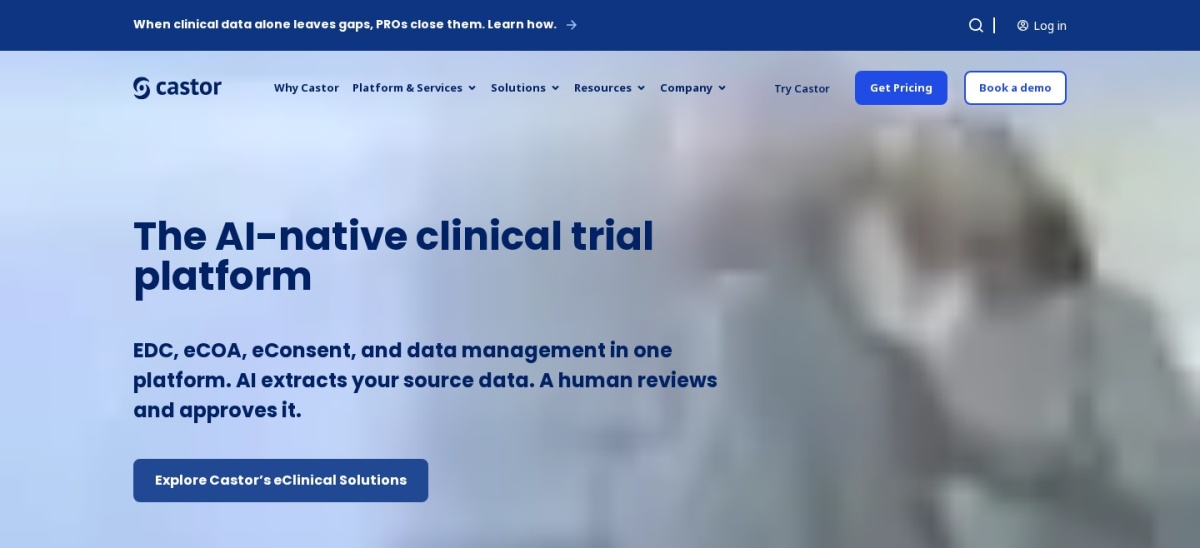
Castor is the modern challenger built for teams that find the incumbents slow, covering EDC, eConsent and eCOA on one system. The headline feature is Castor Catalyst, AI that reads source documents and EHR data and proposes structured eCRF values, with a human reviewer confirming every result before it enters the record. The company reports more than 19,000 studies and 900-plus customers.
The trade off is youth and pricing. Castor is younger than the enterprise incumbents, pricing is quote-based, and the AI features add a validation conversation with regulators. It sits between REDCap and Rave: more capable than free academic tools and faster to deploy than enterprise EDC.
What we like
Self-service study builds in weeks
AI-powered source data extraction with human review
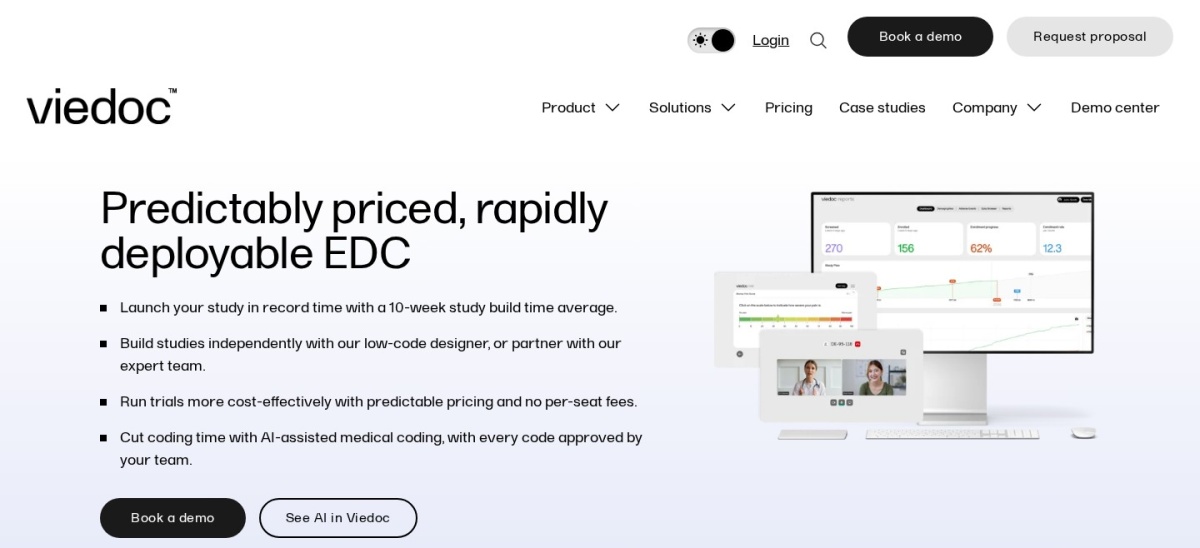
Viedoc is a cloud EDC platform built around flexibility, with a drag-and-drop interface, modular pricing and integrated ePRO and eCOA modules. It supports all trial phases with 99.99% uptime and global reach, and it pairs EDC with eTMF and RTSM integrations. Reviewers praise its modern, intuitive interface and responsive support.
The trade off is ecosystem depth. Viedoc does not carry the site familiarity of Rave or the suite gravity of Veeva Vault, so sites may need more onboarding. It suits sponsors that want a modern interface and fast builds without committing to a single vendor's full clinical suite.
What we like
Drag-and-drop interface, intuitive and user-friendly
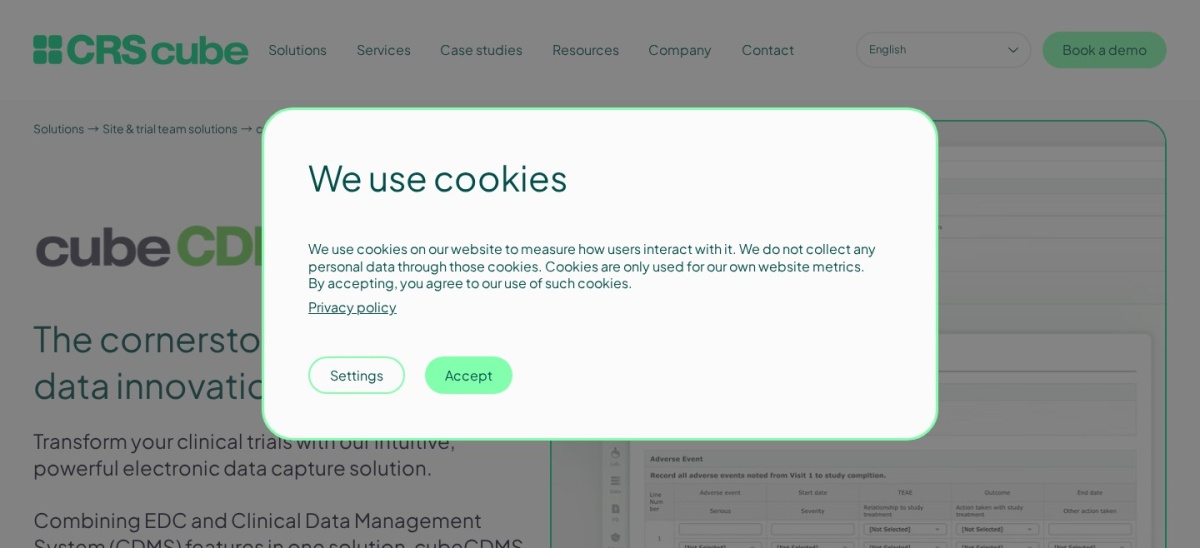
cubeCDMS is a no-code EDC platform from CRScube that lets study teams configure eCRFs from a library of more than 55 pre-validated forms and edit checks. It combines EDC and clinical data management in one system, with automatic protocol-violation detection, batch query management and risk-based monitoring built in. The vendor reports use in over 3,000 clinical trials across 20 countries.
The trade off is geography and scale. CRScube is headquartered in South Korea, so support coverage and site familiarity vary by region, and the platform is less known in North America than the enterprise names. Teams that value fast database setup and a ready form library will like it most.
Medrio is a unified platform for EDC, eCOA, eConsent and randomization, built for small sponsors, emerging biotechs and CROs running lean operations. Study builds are no-code and go live in days instead of months, and the expert services team handles data management support from build through database lock. The company cites more than 375 regulatory approvals supported by its software.
The trade off is scale. Medrio will not win a 200-site global Phase III against Rave on site familiarity, and pricing is quote-based. For early-phase, device and mid-size studies, the speed-to-startup story is compelling, especially for teams without a deep in-house data management bench.
What we like
No-code study builds in days
Purpose-built for lean teams
20+ years of clinical use with 375+ regulatory approvals
Best for academic centers and mid-size sponsors on grant budgets
DeploymentSelf-hosted or cloud
PricingFree community edition
Free optionCommunity edition
StrengthOpen-source heritage
openclinica.com
OpenClinica homepage, captured Nov 2026.
OpenClinica is an open-source-rooted clinical trial platform that has served the academic and mid-market research world since the mid-2000s. The current commercial offering uses a modular approach: build the study yourself with templates and tools, or send the protocol and let their experts build a complete validated study. Use spans more than 15,000 studies, with an open-source Community Edition still available for self-hosting.
The trade off is scale and self-hosting. Enterprise features trail Rave and Veeva, the vendor is smaller than the enterprise names, and the Community Edition requires self-hosting and your own validation. For investigator-initiated and mid-size commercial studies on grant budgets, the value is hard to beat.
Best for fast-startup teams and AI-enabled workflows
DeploymentCloud
PricingQuote-based
Free optionNone
StrengthCodeless study builds
clinion.com
Clinion homepage, captured Nov 2026.
Clinion is a cloud EDC platform built for teams that need to start fast, with codeless study builds that go live in one to three weeks and AI-enabled workflows across EDC, CTMS, RTSM, ePRO and eConsent. It targets sponsors that prioritize study-build flexibility and implementation speed over the site familiarity of the incumbents. Compliance spans 21 CFR Part 11, ICH-GCP and GDPR.
The trade off is maturity and recognition. Clinion is a younger vendor with a smaller review base than Rave or Medrio, and pricing is quote-based per study. Teams that want one suite covering EDC, randomization and patient-reported outcomes without a long implementation will find it worth evaluating.
Best for sponsors wanting one unified eClinical platform
DeploymentCloud
PricingQuote-based
Free optionNone
StrengthUnified data and supply
oracle.com
Oracle Clinical One homepage, captured Nov 2026.
Oracle Clinical One is a unified cloud platform where you build the study once and enter data once, spanning data collection, randomization and trial supply management. Oracle Health Sciences has been in EDC for two decades, and Clinical One is its answer to teams stitching together siloed point solutions. Oracle's global infrastructure supports the largest trials.
The trade off is the one that follows every Oracle enterprise product: significant implementation effort, quote-based pricing and a sales process built for large organizations. The G2 rating shown here is for the Oracle Clinical listing, which covers Oracle's clinical data management line. Best-of-breed buyers should look elsewhere; platform consolidators should shortlist it.
What we like
Build once, enter data once across the trial lifecycle
Combines data collection with randomization and supplies
No commercial EDC vendor in this list publishes a price list. The price depends on study count, patient numbers, modules, validation scope and services, so vendors quote per program rather than per seat.
Third-party sites publish per-patient estimates, but those figures are unverified and vary by an order of magnitude. We show Custom where no vendor price exists instead of printing a guess.
REDCap is the exception: it is free to non-profit institutions that join the REDCap Consortium, and OpenClinica offers a free self-hosted Community Edition.
How we chose
We started from the EDC platforms sponsors and CROs actually buy, checked each vendor's product and pricing pages and compared study build speed, compliance, site usability and free access. Every tool here has a G2 rating with a review count, checked on 25 November 2026.
Prices come from each vendor's pricing page or vendor-supplied pricing. Every commercial EDC vendor prices by quote, which is standard in this market, so we show Custom instead of printing third-party estimates as fact.
We left out Veeva Vault EDC because its G2 rating covers the broader Vault platform rather than the EDC product specifically, and Datatrak and Captivate because neither has a verifiable G2 rating we could use. No vendor paid for a place, and we do not claim hands-on testing for this list.
How to choose electronic data capture software
Match the platform to your study size, then ask for the quote in writing and check validation support.
Match the platform to your study size. Academic and investigator-initiated studies start with REDCap or OpenClinica. Small commercial teams compare Castor, Medrio and Clinion. Large global programs shortlist Medidata Rave, Oracle Clinical One and Veeva.
Ask for the quote in writing. Every commercial vendor prices by quote. Get the per-study and per-patient figures, plus validation, build services and training, before you compare.
Check study build speed. Ask how long a study takes to build and who builds it. Self-service builds go live in days to weeks; vendor-built enterprise studies take weeks to months.
Confirm validation and support. Ask who validates the system, how amendments are handled mid-study, and what support covers. A fast build means little if a protocol amendment stalls.
FAQ
What is the best electronic data capture software?
REDCap is the best electronic data capture software for academic and investigator-initiated trials, because it is free to non-profit institutions and deeply proven. Medidata Rave is the best pick for large commercial trials, and Castor is the fastest modern alternative.
How much does EDC software cost?
Every commercial EDC vendor prices by quote, based on study count, patient numbers, modules and services. Small studies can start in the tens of thousands of dollars a year, while large global programs run into six or seven figures. REDCap is free to non-profit institutions.
Is REDCap really free?
REDCap is free to non-profit institutions that join the REDCap Consortium, which covers most academic medical centers and universities. Access runs through an institutional license agreement rather than individual signups, and the institution hosts and supports its own REDCap instance.
What is 21 CFR Part 11 and why does it matter?
21 CFR Part 11 is the FDA rule for electronic records and signatures in regulated research. It requires audit trails, access controls and validated systems. Every platform in this list supports it, or can be configured for it, so it rarely separates the tools.
Which EDC is best for a small biotech?
Castor and Medrio are the best fits for small biotechs, because both offer self-service or no-code study builds that go live in days to weeks. REDCap works when the study is investigator-initiated at an academic center, while Rave suits larger programs.
Can I switch EDC systems mid-study?
Switching EDC mid-study is possible but expensive, because data migration, re-validation and site retraining all take time. Most sponsors switch between studies rather than during one, so choose a platform that can grow with your program.
SaaS SEO and WordPress specialist with about 8 years of experience. Rakib compares WordPress plugins, themes, hosting and software using public pricing, documentation and user reviews. See how we rank.