Best Customer Data Platform in 2026: 7 Tools Compared
WLWPLegible EditorsLast verified 22 Nov 2026How we rank9 min read
★ Short answer
Twilio Segment is the best customer data platform in 2026 thanks to its 700+ integrations, Reverse ETL syncs, and a permanent free plan for 1,000 monthly visitors. RudderStack suits engineering teams that prefer event-based billing, while Brevo fits small businesses needing contacts, email, and SMS on a tight budget.
How we make this list: we compare pricing pages, product documentation and public user reviews, then re-check every price before each update. No product paid for a place. Disclosure.
Twilio Segment includes 1,000 monthly tracked users free and starts at $120/mo ($1,440/yr) for 10,000 visitors and unlimited sources.
RudderStack bills by event volume instead of tracked users, offering 250,000 free monthly events and a Growth plan at $265/mo ($3,180/yr).
Brevo offers the lowest paid entry at $9/mo ($108/yr) for 5,000 emails, while storing up to 100,000 contacts on its free plan.
ActiveCampaign starts at $15/mo billed yearly ($180/yr) for 1,000 contacts with multi-step behavior-triggered automations.
Klaviyo includes 250 active profiles free and starts at $20/mo ($240/yr) for ecommerce stores unifying storefront events with email.
Customer.io starts at $100/mo ($1,200/yr) for 5,000 people and object profiles with multi-channel messaging workflows.
What to look for in a customer data platform
A customer data platform (CDP) collects behavioral events from your website, mobile apps, and backend servers, merges them into unified user profiles, and routes clean data to analytics, ad networks, and messaging tools. Without a central pipeline, teams end up maintaining brittle point-to-point scripts that break whenever a schema changes.
The single biggest pricing variable is the billing metric. Tools like Twilio Segment meter Monthly Tracked Users (MTUs), which counts anonymous website visitors alongside logged-in customers. High-traffic sites with low conversion rates often pay far less on event-metered pipelines like RudderStack, which charge by total events processed rather than unique visitors.
You also need to decide between a pure data pipeline and an all-in-one activation suite. Dedicated CDPs focus on ingestion, governance, and warehouse syncing, leaving email and SMS execution to downstream apps. Hybrid platforms like Klaviyo, Brevo, and Customer.io combine profile unification with built-in messaging builders so smaller teams can act on data immediately.
Twilio Segment is an API-first customer data pipeline that captures web, mobile, and server events once and routes them to over 700 destinations. Its permanent Free plan covers up to 1,000 monthly tracked visitors, 2 sources, 1 data warehouse destination, and 500,000 Reverse ETL records per month.
The trade off is MTU-based overage fees, as Team starts at $120/mo ($1,440/yr) for 10,000 visitors and charges $10 to $12 per extra 1,000 anonymous or known users. Full identity resolution and Unify profiles also require custom Business contracts. It suits SaaS and consumer teams wanting the widest catalog of turnkey connectors.
What we like
Over 700 pre-built source and destination integrations
Permanent free tier includes warehouse sync and Reverse ETL
Live event debugger speeds up schema verification
10 workspace seats included on Free and Team plans
Watch out for
Anonymous traffic counts toward Monthly Tracked User limits
Team unlocks unlimited sources, 10,000 visitors/mo, 1M Reverse ETL records, and Public API access.Visit twilio.com
02
RudderStack
4.7/5on G2 (52 reviews, checked Nov 2026)
Paid from$265/mo
Best for warehouse-first data teams
Free tier250,000 events/mo forever
Entry paid tier1M events/mo on Growth
Integrations16 SDK sources, 200+ destinations
Reverse ETL25 connections on Growth
rudderstack.com
RudderStack homepage, captured Nov 2026.
RudderStack is a warehouse-native customer data platform built for engineering teams that store raw event logs in Snowflake, BigQuery, or Databricks. Its Free plan includes 250,000 monthly events, 16 SDK sources, over 200 cloud destinations, and basic Reverse ETL.
The trade off is a higher entry price of $265/mo ($3,180/yr, or $225.25/mo billed annually) for the 1 million event Growth tier, plus steeper technical setup than marketer-led suites. Advanced identity resolution Profiles sit on custom Enterprise plans. It suits data teams with high anonymous traffic that prefer per-event pricing.
What we like
Bills by monthly events rather than unique anonymous visitors
Writes raw event streams directly to your cloud data warehouse
Supports JavaScript and Python event transformations in transit
Requires data engineering skills to configure and maintain
Growth tier starts at $265/mo with no intermediate paid step
Growth raises volume to 1M events/mo and adds 25 Reverse ETL connections across 2 workspaces.Visit rudderstack.com
03
Klaviyo
4.6/5on G2 (1,372 reviews, checked Nov 2026)
Paid from$20/mo
Best for ecommerce stores
Free tier250 active profiles, 500 emails
Entry paid tier251-500 active profiles
Integrations350+ ecommerce and app connectors
Advanced CDPAdd-on from $500/mo for 100K profiles
klaviyo.com
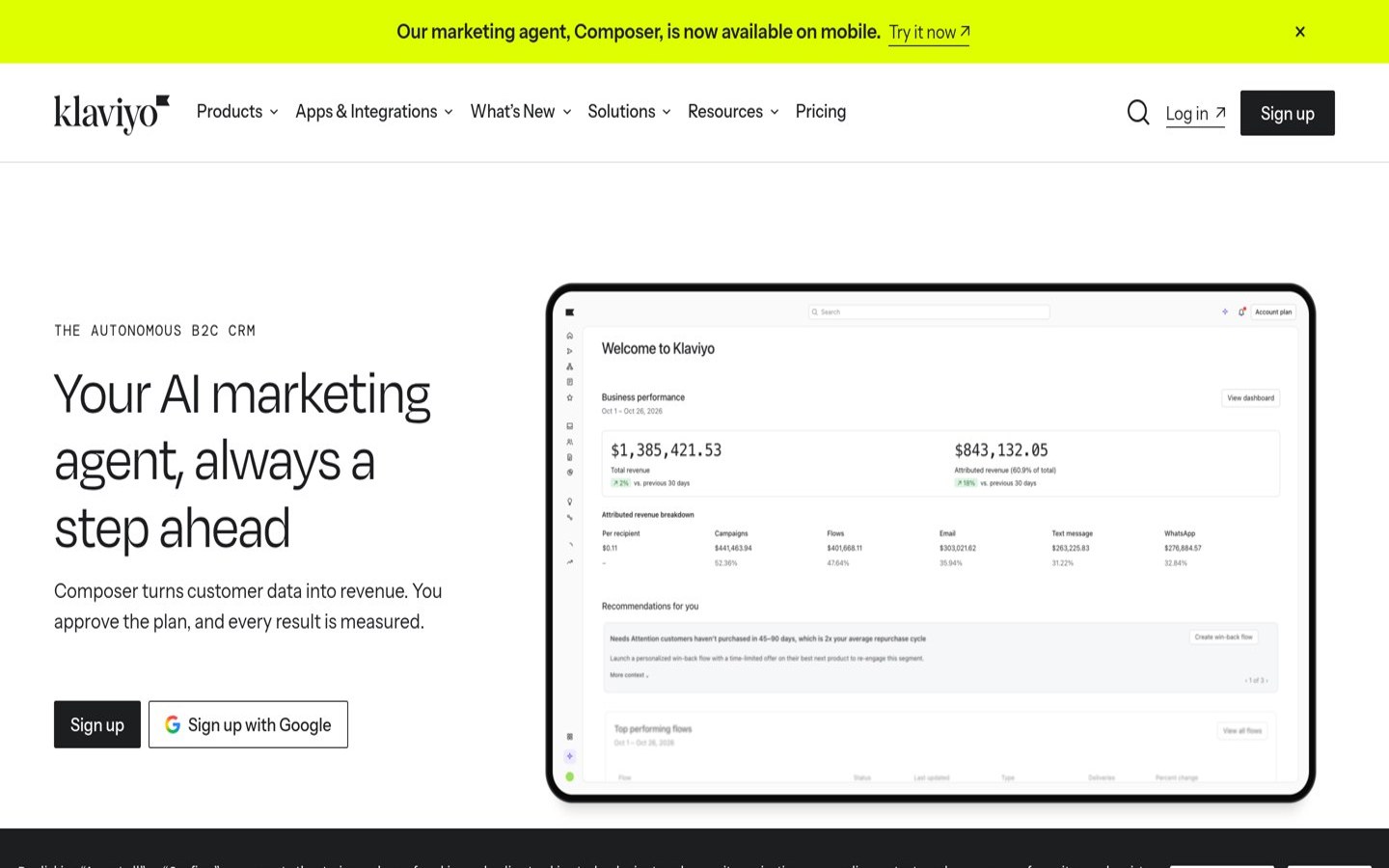
Klaviyo homepage, captured Nov 2026.
Klaviyo is a unified customer platform that combines ecommerce profile storage with automated email, SMS, and mobile push campaigns. Every tier includes full historical customer profiles, predictive lifetime value analytics, and over 350 integrations, starting free for up to 250 active profiles and 500 monthly emails.
The trade off is rapid profile-based price scaling: the Email plan starts at $20/mo ($240/yr) for 251 to 500 profiles, jumps to $150/mo at 10,000 profiles, and Advanced Klaviyo Data Platform features cost $500/mo extra. It suits online retailers wanting storefront data and messaging in one system.
What we like
Deep native sync with Shopify and major ecommerce carts
Predictive churn and customer lifetime value models included
No feature gating between entry and higher email tiers
Watch out for
Monthly bill climbs steeply as active profile counts grow
Advanced CDP warehouse syncs require a $500/mo add-on
Paid Email plans unlock higher profile limits and remove the 500-email monthly free cap.Visit klaviyo.com
04
Brevo
4.5/5on G2 (2,780 reviews, checked Nov 2026)
Paid from$9/mo
Best for small business budgets
Free tier100,000 contacts, 300 emails/day
Entry paid tier5,000 emails/mo, 500 contacts
ChannelsEmail, SMS, WhatsApp, web push
Warehouse syncEnterprise tier from $2,499/mo
brevo.com
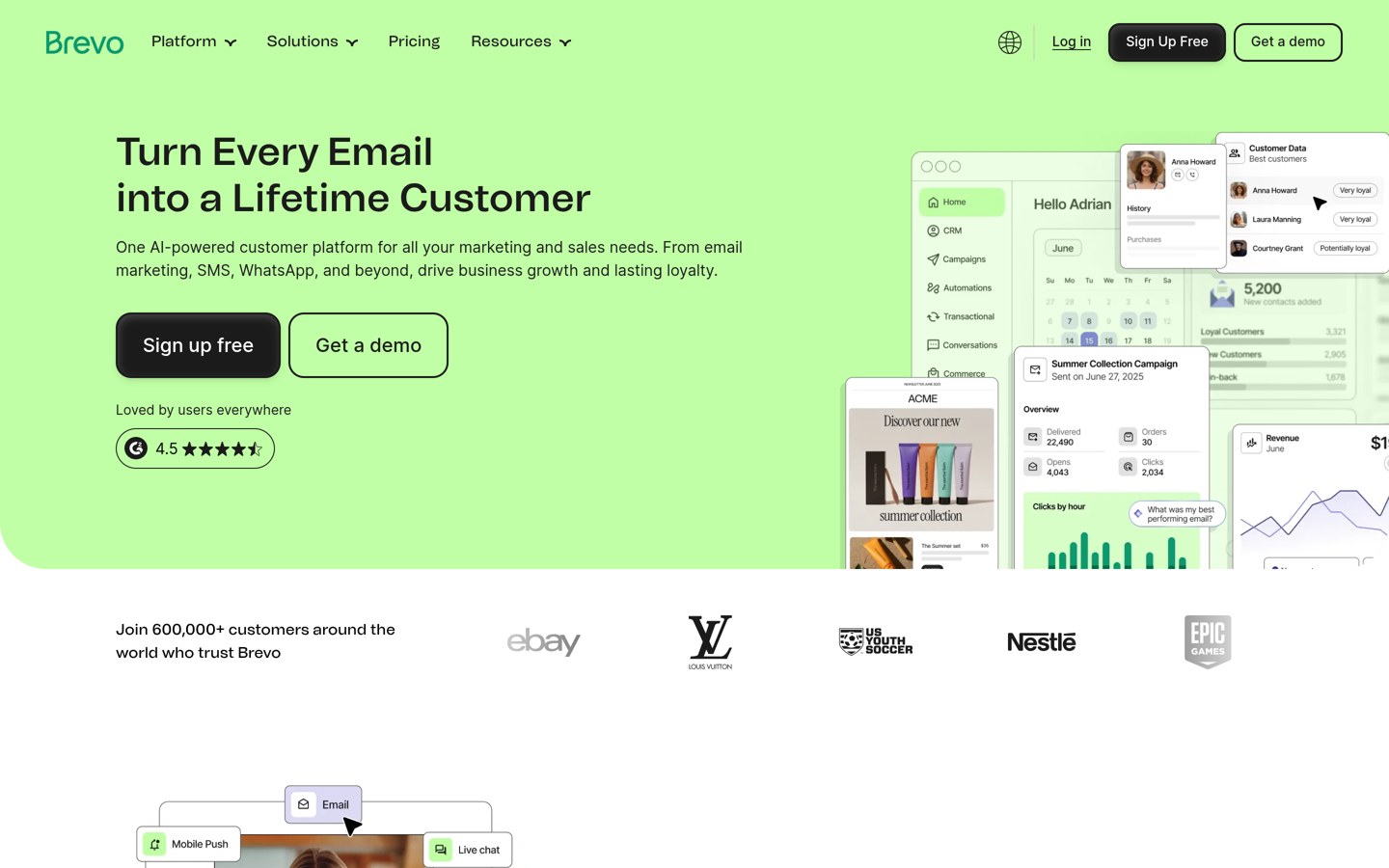
Brevo homepage, captured Nov 2026.
Brevo is a multi-channel customer engagement and contact management platform that pairs a lightweight CRM with email, SMS, WhatsApp, and web push campaigns. Its Free plan stores up to 100,000 contacts with 300 daily email sends, transactional SMTP relay, and basic automation for up to 2,000 contacts.
The trade off is that true CDP capabilities like custom objects and direct warehouse or POS connectors are locked behind the $2,499/mo Enterprise plan, while Starter begins at $9/mo ($108/yr, or $8.08/mo billed yearly) for 5,000 emails and 1 seat. It suits small businesses needing affordable contact segmentation.
What we like
Lowest paid entry price at $9/mo on monthly billing
Free tier stores up to 100,000 contacts without subscriber fees
Includes transactional email API, SMTP, and Zapier out of the box
Watch out for
Web event tracking requires upgrading to Standard at $18/mo
Warehouse connectors and custom objects require Enterprise
Starter removes the 300-email daily sending cap and provides 5,000 monthly sends with no daily limit.Visit brevo.com
05
Customer.io
4.4/5on G2 (1,013 reviews, checked Nov 2026)
Starts at$100/mo
Best for event-driven messaging
Free tierNone (startup program available)
Entry paid tier5,000 profiles, 1M emails/mo
Data modelPeople plus 2 custom object types
ChannelsEmail, SMS, push, in-app, WhatsApp
customer.io
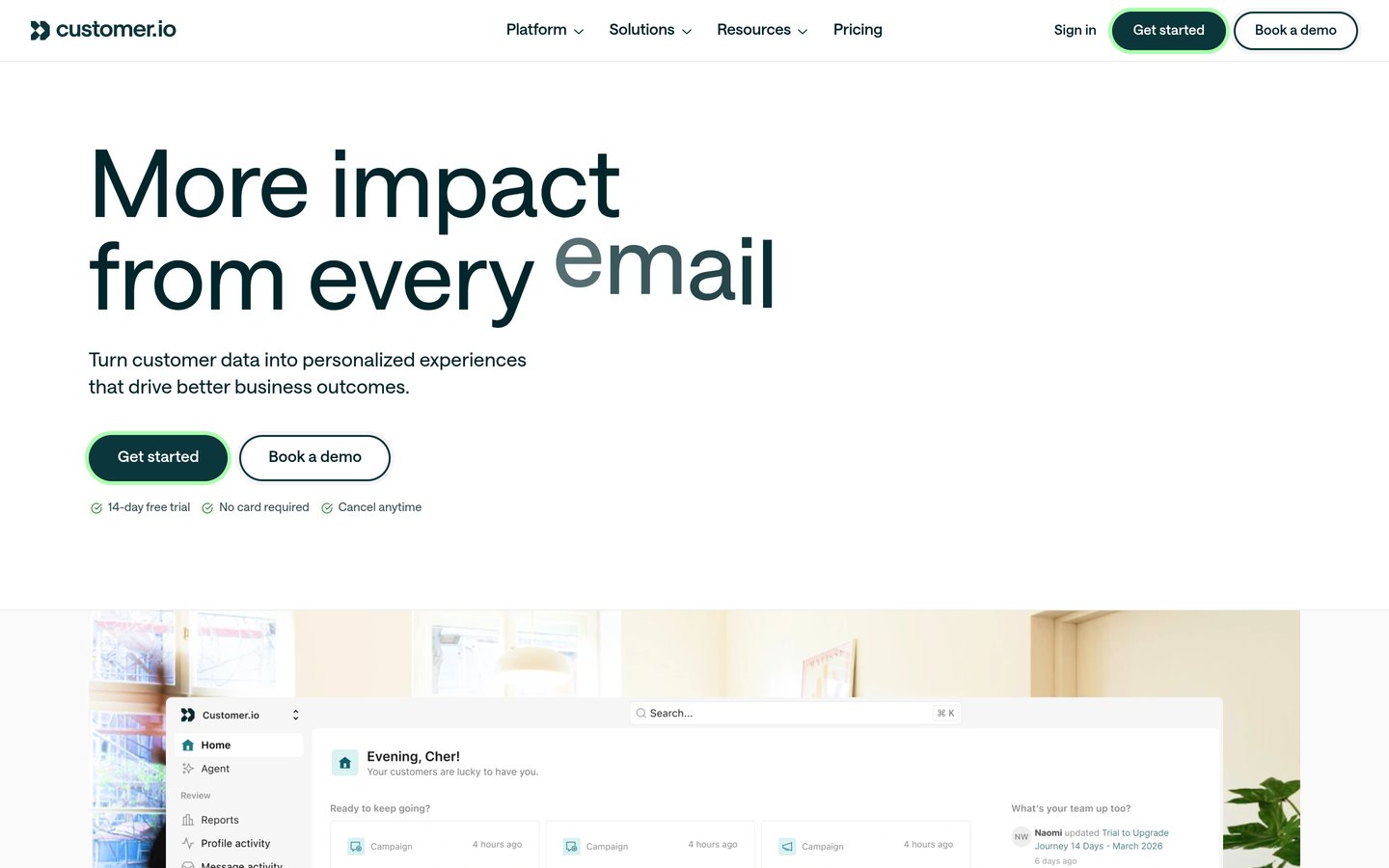
Customer.io homepage, captured Nov 2026.
Customer.io is a data-driven messaging and customer profile platform designed around real-time behavioral events and relational objects such as accounts, workspaces, or subscriptions. Its Essentials plan starts at $100/mo ($1,200/yr) and includes 5,000 people and object profiles, 2 object types, 1 million monthly emails, and a visual workflow builder.
The trade off is the lack of a standard free tier outside its early-stage startup program, plus per-profile overages at $0.009 per extra profile and a steep jump to $1,000/mo for Premium. It suits B2B SaaS and subscription apps triggering lifecycle messages from product events.
Generous 1 million monthly email allowance on the entry plan
Orchestrates email, SMS, push, and in-app messages in one canvas
Watch out for
No permanent free tier for standard self-serve signups
Large jump between $100/mo Essentials and $1,000/mo Premium
Essentials provides 5,000 profiles, 1M monthly emails, visual workflows, and basic data integrations.Visit customer.io
06
ActiveCampaign
4.4/5on G2 (14,882 reviews, checked Nov 2026)
Starts at$15/mo
Best for behavioral email automation
Free tier14-day trial only (100 contacts)
Entry paid tier1,000 contacts, 10,000 emails/mo
Integrations1,000+ apps, webhooks, API, MCP
Seats included1 user seat on Starter and Plus
activecampaign.com
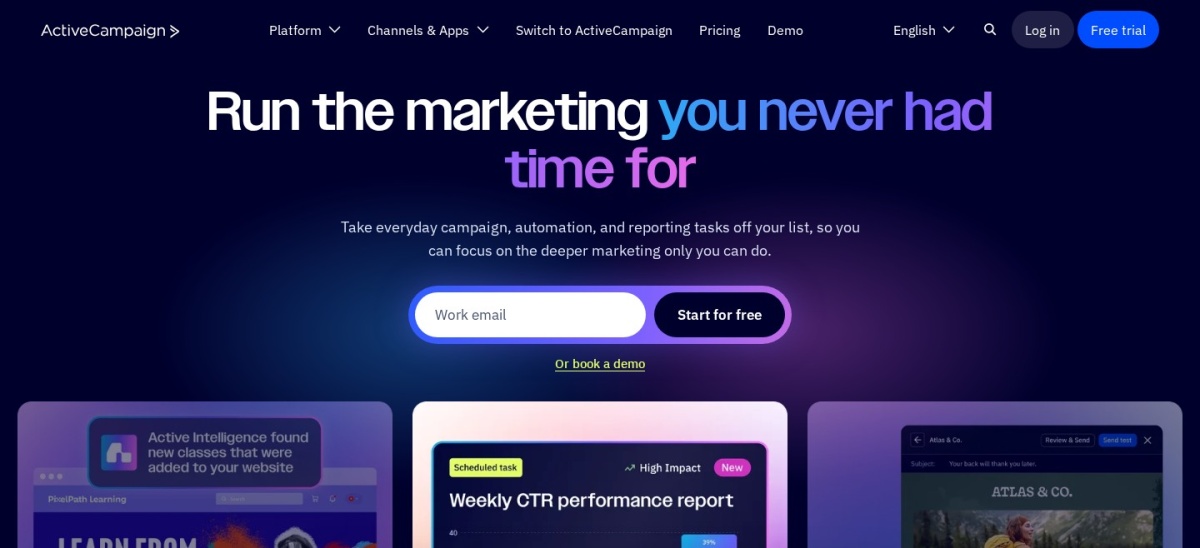
ActiveCampaign homepage, captured Nov 2026.
ActiveCampaign is a cross-channel marketing automation and customer data hub backed by over 1,000 app integrations, webhooks, and a public API. Its Starter plan costs $15/mo billed yearly ($180/yr) for 1,000 contacts, 10,000 monthly email sends, multi-step automations, and 500 monthly AI credits.
The trade off is that Starter caps automations at 5 actions each and includes only 1 user seat, while custom objects and native Salesforce sync require the $145/mo Enterprise tier. It suits small marketing teams that want deep behavioral segmentation without managing a separate data warehouse.
What we like
Over 1,000 native integrations plus webhooks and API access
Multi-step behavioral automation available on the $15/mo tier
Includes 500 monthly AI credits across every plan
Watch out for
No permanent free tier beyond a 14-day trial
Starter restricts automations to 5 actions and 1 user seat
Starter includes 1,000 contacts, 10,000 email sends/mo, multi-step automations, and 1,000+ app connectors.Visit activecampaign.com
07
HubSpot
4.4/5on G2 (16,100 reviews, checked Nov 2026)
Paid from$20/mo
Best for unified CRM and marketing
Free tier2 users, 1,000 contacts
Entry paid tierStarter Customer Platform per seat
Email sends2,000/mo free; 5x contacts paid
Pipelines15 deal pipelines on Starter
hubspot.com
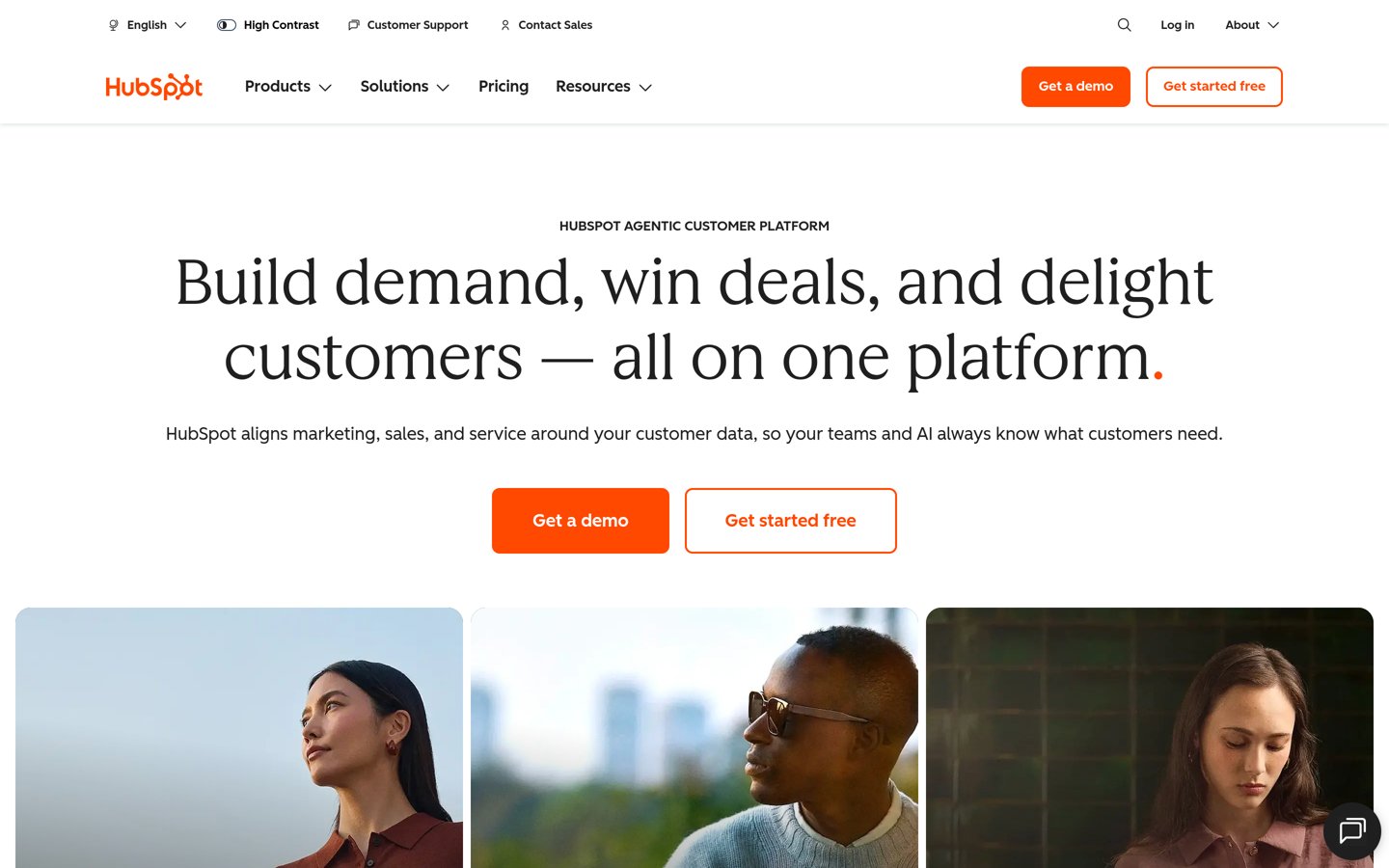
HubSpot homepage, captured Nov 2026.
HubSpot unifies marketing, sales, service, and data management around a shared Smart CRM record so every team sees the same contact timeline. Its Free plan supports up to 2 users, 1,000 contacts, 2,000 monthly marketing emails, and basic deal pipelines with no credit card required.
The trade off is per-seat pricing that climbs fast: Starter Customer Platform carries a regular rate of $20/seat/mo ($240/yr, though HubSpot advertises new-customer discounts as low as $7/seat/mo billed annually), and Professional tiers add a $1,500 onboarding fee. It suits B2B teams aligning sales and marketing records.
What we like
Single shared contact timeline across sales, service, and marketing
Usable free tier for up to 2 users and 1,000 contacts
Starter bundles Marketing, Sales, Service, Content, and Data Hubs
Watch out for
Per-seat licensing multiplies costs as teams add users
Professional tiers require a $1,500 one-time onboarding fee
Starter removes HubSpot branding, unlocks 15 pipelines, and includes 500 calling minutes and credits.Visit hubspot.com
How CDP billing metrics affect your yearly bill
Customer data platforms generally charge in one of three ways: Monthly Tracked Users (MTUs), monthly event volume, or stored contact profiles. Because an anonymous visitor who bounces after viewing two pages counts as 1 MTU on Twilio Segment, high-traffic content or ecommerce sites can trigger overage charges even when conversions stay flat.
Event-based pipelines like RudderStack charge by total events processed rather than unique visitors, making them predictable for apps with steady logged-in activity. Conversely, hybrid engagement platforms like Klaviyo and ActiveCampaign bill by stored contact count, whereas Brevo bills primarily by monthly email sends while allowing up to 100,000 free contacts.
How we chose
We evaluated standalone event pipelines, warehouse-native customer data platforms, and all-in-one CRM and engagement hubs that unify customer profiles across channels. To qualify, each vendor had to maintain active public documentation, offer self-serve entry pricing without mandatory enterprise sales calls, and hold at least 50 verified user reviews on G2.
Every rating, review count, feature allowance, and regular entry price in this guide was verified against G2 and each vendor's official pricing page on 22 Nov 2026. Where vendors display introductory promotional discounts, we listed the regular published rate and noted the discount in the review text.
We excluded enterprise-only CDPs such as Adobe Real-Time CDP, Tealium, Amperity, Treasure AI, and Ortto because they do not publish self-serve entry pricing on their websites. No vendor paid for a place, and we do not claim testing for this list.
How to choose the right customer data platform
Follow these four steps to match a customer data platform to your traffic volume, engineering resources, and activation tools.
Audit your data sources and destinations. Count how many websites, mobile apps, backend servers, and SaaS tools generate customer events today. If you have fewer than three sources and already use a single CRM, an all-in-one platform like HubSpot or Brevo may cover your needs without a separate pipeline.
Compare your anonymous visitors against event volume. Check your analytics for monthly unique visitors versus total tracked events. High anonymous traffic favors event-based billing like RudderStack, while smaller visitor counts with heavy event depth fit MTU-based plans like Twilio Segment.
Decide whether your warehouse is the source of truth. If your data team already models customer tables in Snowflake or BigQuery, choose a tool with strong Reverse ETL and warehouse-native syncing such as RudderStack or Twilio Segment rather than duplicating logic inside a marketing app.
Check seat limits and profile overage rates before signing. Confirm whether extra team logins, custom objects, or identity resolution require jumping to a higher tier. Modeling your 12-month contact and traffic growth prevents unexpected auto-upgrades.
FAQ
What is the difference between a CDP and a CRM?
A CRM primarily stores known leads, sales deals, and support tickets entered by your team or forms. A customer data platform captures high-volume behavioral events from websites, mobile apps, and servers, merges anonymous and known activity, and syncs those profiles to downstream tools.
Which customer data platform has the best free plan?
Twilio Segment offers the most complete free data pipeline, covering 1,000 monthly tracked users, 2 sources, 1 warehouse destination, and 500,000 Reverse ETL records. For engineering teams focused on raw event volume, RudderStack provides 250,000 free events per month.
Why do some CDPs charge by Monthly Tracked Users instead of events?
Monthly Tracked User (MTU) billing charges once per unique visitor each month regardless of how many clicks or pageviews they generate. This makes bills predictable for apps with heavy per-user activity, though spikes in anonymous web traffic can increase costs.
Can small businesses use a CDP without a data engineer?
Yes, if you choose a hybrid engagement platform like Klaviyo, Brevo, ActiveCampaign, or HubSpot. These tools include visual setup wizards, pre-built website tracking scripts, and built-in email or SMS builders so marketers can segment audiences without writing SQL.
What is Reverse ETL in a customer data platform?
Reverse ETL copies modeled customer data—such as lifetime value scores or subscription status—from your cloud data warehouse back into operational tools like CRMs, ad platforms, and email software so frontline teams can act on warehouse insights.
Why are enterprise CDPs like Tealium and Adobe not priced in the ladder?
Enterprise vendors including Adobe Real-Time CDP, Tealium, and Amperity negotiate custom annual contracts based on profile volume and throughput rather than publishing self-serve tier rates, so we excluded them to keep price comparisons verifiable.