Best Enterprise Search Software in 2026: 9 Tools Compared
WLWPLegible EditorsLast verified 23 Nov 2026How we rank12 min read
★ Short answer
Coveo is the best enterprise search software for most large teams, with AI relevance, generative answering and a unified index across service, website, commerce and workplace search. Pick Glean for internal search across workplace apps, or Algolia when developers need a fast search API.
How we make this list: we compare pricing pages, product documentation and public user reviews, then re-check every price before each update. No product paid for a place. Disclosure.
Coveo leads with AI relevance and generative answering across service, website, commerce and workplace search.
Glean is the highest-rated tool here at 4.7 out of 5 on G2, from 338 reviews.
Algolia is the only tool with a free plan that fits real use: 10,000 search requests and 50,000 records a month.
Elasticsearch and OpenSearch are the control picks: self-managed Elasticsearch is free, and OpenSearch is open source.
Five of the nine tools publish no prices at all, so budget for a quote and a multi-week rollout.
What enterprise search should cover
Enterprise search connects the systems where company knowledge lives, from documents and tickets to wikis and product catalogs, and returns one ranked answer instead of ten tabs.
The best tools respect permissions. A result an employee cannot open should never appear in their search, and answers should cite the source document.
AI answering is now the dividing line. Some tools return links, while others write a cited answer from your content. Our guide on adding AI search to a WordPress site shows the same split on a smaller scale.
Pricing is the hard part. Five tools in this list publish no prices, and the ones that do charge by queries, seats, capacity or indexed documents, so compare like with like.
Coveo is an AI relevance platform that indexes content across service, website, commerce and workplace search into one unified index. Each pricing unit covers 100,000 queries a month, and the platform adds query suggestions, automatic relevance tuning and recommendations on top of hybrid search.
The trade off is price and setup. Coveo publishes no dollar prices, so every deal is a quote, and G2 reviewers report an average implementation time of about 4 months. It suits large teams that need one search layer across customer-facing and internal content.
What we like
One unified index for service, website, commerce and workplace
Generative answering and passage retrieval as add-ons
Document-level security and permissions
Named a Leader in Gartner's 2026 Magic Quadrant for Search and Product Discovery
Watch out for
No published prices; every deal needs a quote
Average implementation takes about 4 months, per G2
Generative AI features cost extra as add-ons
Paid plans add generative answering and recommendationsVisit coveo.com
02
Glean
4.7/5on G2 (338 reviews, checked Nov 2026)
PricingCustom/quote
Best for internal AI search
Connectors100+ workplace apps
AI answersCited, permission-aware
Knowledge graphPeople, content, activity
PricingPer user, annual contract
glean.com
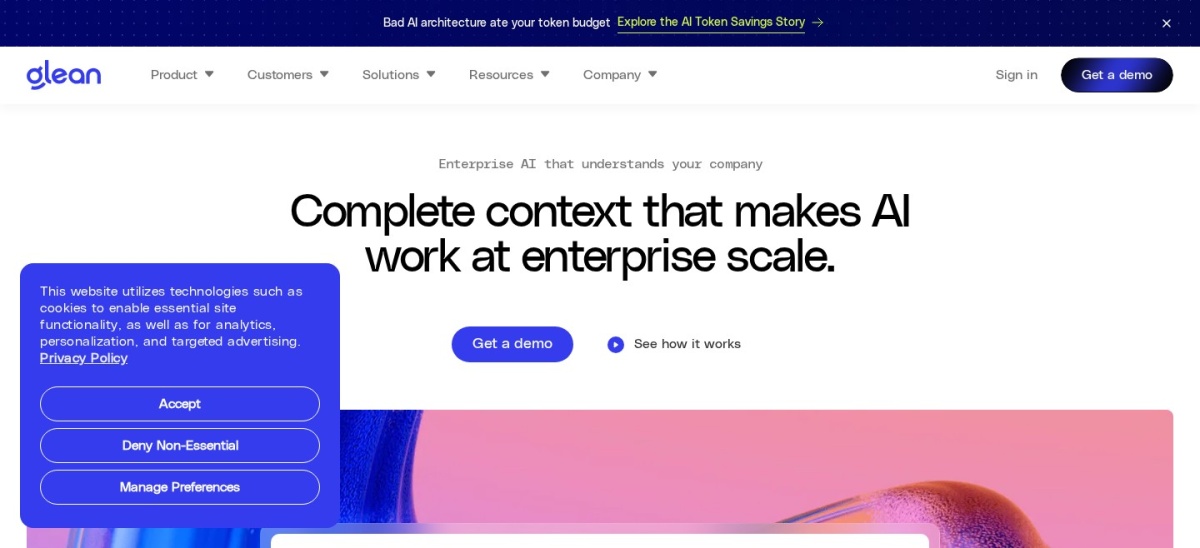
Glean homepage, captured Nov 2026.
Glean is a work AI platform that connects workplace apps into one permission-aware search box with cited AI answers. It builds a knowledge graph of people, content and activity, so answers respect what each employee is allowed to see.
The trade off is cost and opacity. Glean publishes no prices, and buyer reports put seats at roughly $50 to $75 per user a month with a 100-seat minimum, so small teams should look elsewhere. It suits mid-size and large companies that live in Google Workspace or Microsoft 365 and Slack.
What we like
Highest G2 rating in this list at 4.7 out of 5
Cited answers grounded in company knowledge
Permission-aware results across 100+ apps
Assistants and agents built on the same index
Watch out for
No public pricing; contracts are quote-only
Reported 100-seat minimum puts it out of reach for small teams
Heavy AI use is metered with FlexCredits on top of seats
Paid plans add assistants, agents and deeper AI useVisit glean.com
03
Algolia
4.5/5on G2 (453 reviews, checked Nov 2026)
PriceFree
Best for developer-built site and app search
Free plan10k searches/mo
Free records50,000
Grow plan$0.50 per 1k searches
AI searchNeuralSearch on Elevate
algolia.com
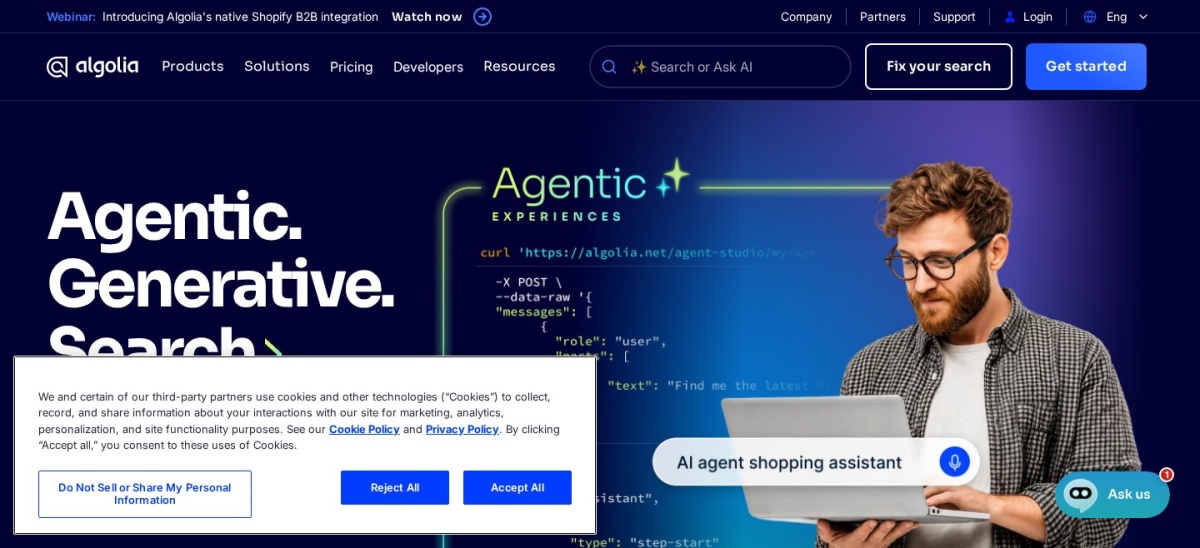
Algolia homepage, captured Nov 2026.
Algolia is a hosted search API that developers use to add fast search, browse and recommendations to websites and apps. The free plan includes 10,000 search requests and 50,000 records a month with no credit card, and paid Grow plans are pay-as-you-go.
The trade off is that AI costs more. Grow covers keyword search at $0.50 per extra 1,000 requests, while AI ranking, AI synonyms and NeuralSearch sit in Grow Plus at $1.75 or the quoted Elevate plan. It suits product teams that want an API, not a ready-made workplace search box.
What we like
Generous free plan with no credit card
Pay-as-you-go Grow plans with no contract
AI ranking and personalization on Grow Plus
Crawler, recommendations and merchandising included
Watch out for
Usage bills climb fast at high search volume
Full AI suite needs the quoted Elevate plan
Built for customer-facing search, not internal knowledge
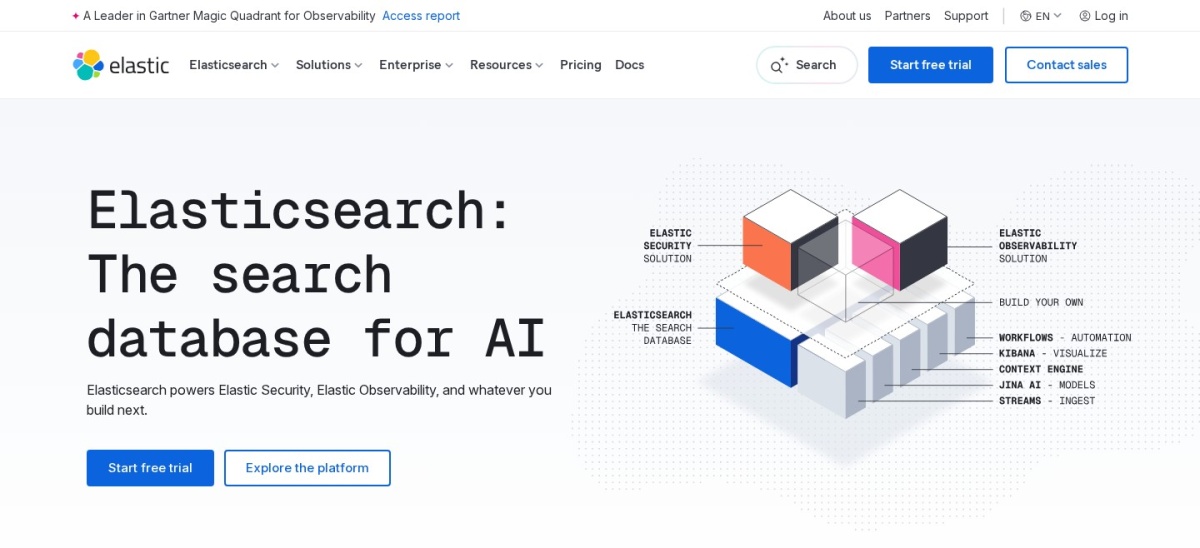
Elasticsearch is a search and analytics engine that combines keyword, vector and hybrid search in one index. Self-managed Elasticsearch is free to download, while Elastic Cloud Hosted starts at $99 a month on the Standard tier, and serverless search bills from $0.09 per compute-unit hour.
The trade off is effort. You size clusters, tune relevance and manage upgrades yourself unless you pay for hosted or serverless, and costs rise with data kept and queries served. It suits engineering teams that want to build search their way and already run infrastructure.
What we like
Keyword, vector and hybrid search in one engine
Free self-managed download
Hosted and serverless options on AWS, Azure and Google Cloud
Largest review base for a search engine here, at 292 G2 reviews
Watch out for
Needs engineering time to run well
Hosted costs scale with RAM, storage and retention
No ready-made workplace connectors like Glean or Coveo
Hosted tiers add support, security features and scaleVisit elastic.co
05
Sinequa
4.3/5on Gartner Peer Insights (60 reviews, checked Nov 2026)
PricingCustom/quote
Best for regulated, governed search
Connectors200+
DeploymentSaaS, cloud or on-premises
AI answersCited, traceable to source
PricingBy indexed volume
sinequa.com
Sinequa homepage, captured Nov 2026.
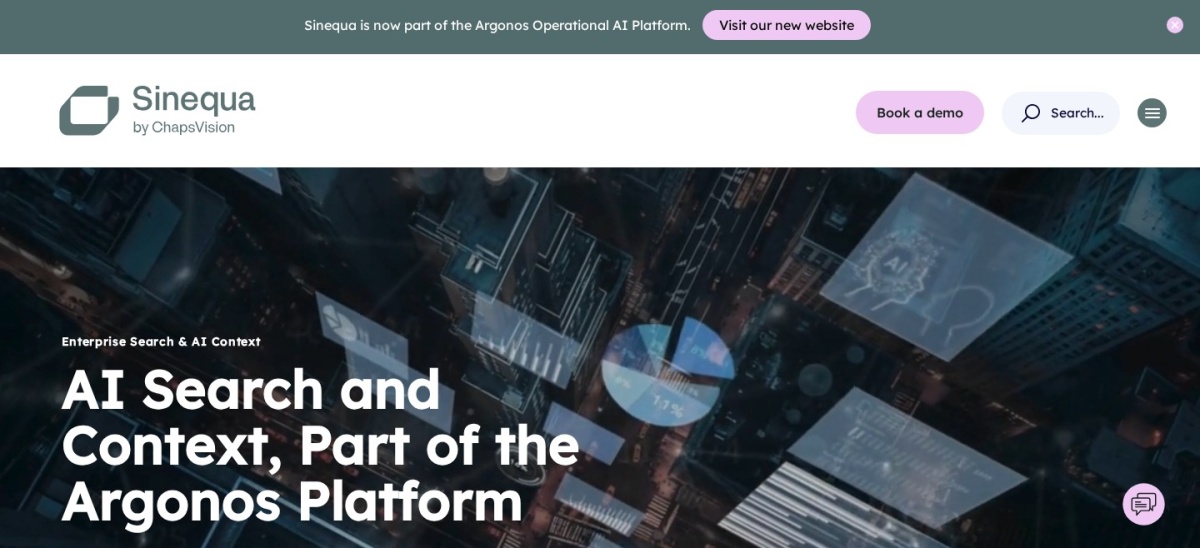
Sinequa is an enterprise search platform built for large organizations with vast, mixed estates of structured and unstructured data. It offers more than 200 connectors, permission-aware retrieval and AI answers that trace back to the source document, and it now sits inside the Argonos platform after ChapsVision acquired it in November 2024.
The trade off is scale and price. Sinequa publishes no prices and sells multi-year, quote-only contracts priced by indexed volume and search applications, with heavy implementation work. It suits regulated industries such as pharma, aerospace and finance, where governance and audit trails matter as much as relevance.
What we like
More than 200 connectors for complex estates
Cited, auditable AI answers
SaaS, private cloud or on-premises deployment
Strong fit for regulated industries
Watch out for
No public prices; quote-only, multi-year contracts
Implementation is enterprise-scale work
Thin public review base: 60 Gartner Peer Insights reviews
Paid plans are scoped by indexed volume and applicationsVisit sinequa.com
06
Lucidworks
4.5/5on G2 (12 reviews, checked Nov 2026)
PricingCustom/quote
Best for tuned relevance on Solr
Search engineBuilt on Apache Solr
DeploymentSaaS, self-hosted, hybrid
RelevanceQuery pipelines and tuning
PricingQuote-only
lucidworks.com
Lucidworks homepage, captured Nov 2026.
Lucidworks is an AI-powered search and discovery platform built on Apache Solr for complex, high-scale search programs. It gives teams query pipelines, relevance tuning and personalization for commerce and workplace search, with SaaS, self-hosted and hybrid deployment.
The trade off is price visibility and proof. Lucidworks publishes no prices and its pricing page routes buyers to sales, and only 12 G2 reviews back its 4.5 rating. It suits enterprises that want vendor-led relevance work instead of running Solr themselves.
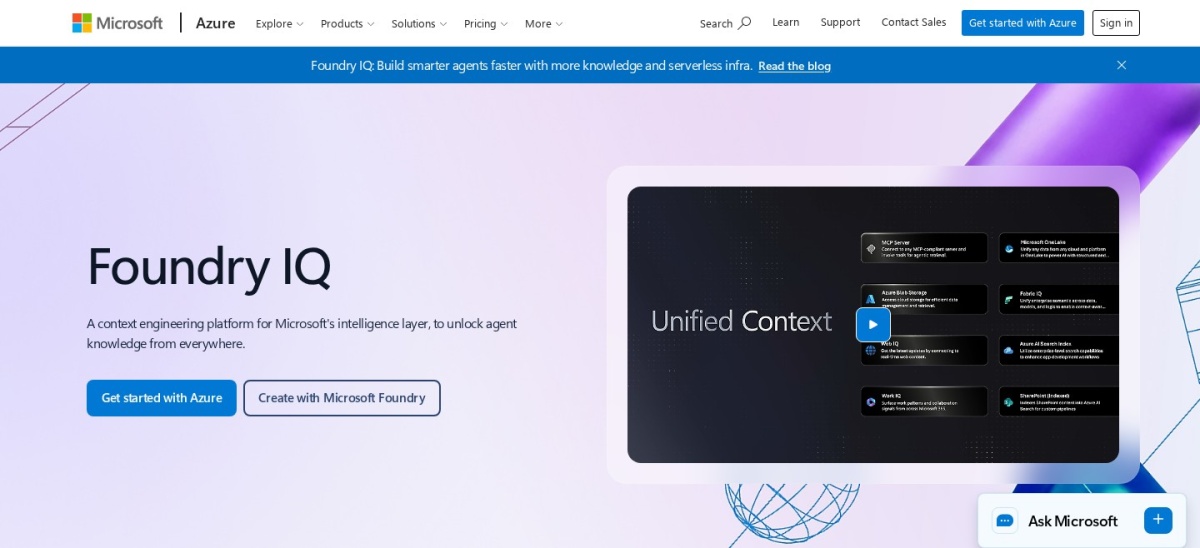
Azure AI Search is Microsoft's managed search service for indexing content and querying it with keyword, vector or hybrid search. The free tier covers 50 MB and 3 indexes, the Basic tier costs $73.73 a month per search unit, and semantic ranking and AI enrichment are built in.
The trade off is that you build the experience yourself. Azure AI Search is an index and API, not a ready-made search box, and costs rise with replicas, partitions and AI features. It suits teams already on Azure and Microsoft 365 that have developers to build on top.
What we like
Keyword, vector and hybrid search in one service
Free tier for dev and small pilots
Deep integration with Azure and Microsoft 365
Semantic ranking and AI enrichment built in
Watch out for
No ready-made search interface; developers must build it
OpenSearch is an open-source search and analytics engine under the Apache 2.0 license, forked from Elasticsearch. It covers keyword, vector and hybrid search with dashboards for exploring data, and teams can self-host it free or run it as the managed Amazon OpenSearch Service.
The trade off is that freedom means work. Self-hosting needs cluster care, upgrades and tuning, and the managed service bills by instance and storage, so costs rise with scale. It suits AWS teams and open-source shops that want no license fees and full control of the engine.
Mindbreeze InSpire is an enterprise AI search platform that turns internal content into a governed base for search, assistants and agents. It ships with more than 490 connectors, charges by indexed documents rather than seats, and offers unlimited users and queries on larger packages.
The trade off is entry cost. Mindbreeze prices by indexed documents, and the smallest published package starts at 1 million documents, so small teams should look elsewhere. It suits large organizations that want document-level security and a search layer for wider AI work.
Five of the nine tools sell on quote only: Coveo, Glean, Sinequa, Lucidworks and Mindbreeze. Ask each vendor for the same scope: users, indexed documents, queries a month and connectors.
Get the quote in writing with the billing unit named. Coveo bills by 100,000-query units, Glean by seat, Sinequa by indexed volume and applications, and Mindbreeze by indexed documents.
Add implementation and support to the comparison. G2 reviewers report about 4 months to implement Coveo, and Sinequa and Lucidworks both need vendor-led setup work.
If a vendor will not quote without a sales cycle, use the priced tools as anchors: Algolia starts free, Azure AI Search Basic is $73.73 a month, and Elastic Cloud Hosted starts at $99 a month.
How we chose
We started from the established enterprise search platforms ranked by G2 and analyst lists, then kept nine that cover workplace search, site search and developer search.
Prices come from each vendor's pricing page, checked on 23 November 2026. Ratings come from G2 on the same day, except Sinequa, whose G2 base is thin, so we used Gartner Peer Insights. Where a vendor shows no prices, the list says so instead of guessing.
We left out tools that are mainly listings, local SEO or single-site search. No vendor paid for a place, and we do not claim hands-on testing for this list.
How to choose enterprise search software
Start with where your knowledge lives, then match the tool to that estate.
Map where knowledge lives. List the systems search must cover, from documents and tickets to wikis and catalogs, then check each tool's connectors.
Decide who searches what. Internal staff need permission-aware answers, customers need site search, and developers need an API. One tool rarely does all three well.
Ask for a quote on the same scope. Give every quote-only vendor the same users, documents, queries and connectors, and ask for implementation and support in writing.
Run a pilot on real content. Index a slice of real documents and test the questions staff actually ask, with permissions on, before signing a multi-year deal.
FAQ
What is the best enterprise search software?
Coveo is the best overall pick for most large teams, with AI relevance and generative answering across service, website, commerce and workplace search. Glean is the better pick when the search box is only for staff, and Algolia wins for developer-built site search.
How much does enterprise search software cost?
It varies widely. Algolia starts free, Azure AI Search Basic costs $73.73 a month and Elastic Cloud Hosted starts at $99 a month. Coveo, Glean, Sinequa, Lucidworks and Mindbreeze publish no prices, so expect a quote and a multi-week sales process.
What is the difference between enterprise search and site search?
Site search covers one website or store, while enterprise search indexes many systems at once, such as documents, tickets, wikis and catalogs. Enterprise tools also enforce permissions, so staff only see results they are allowed to open.
Do I need AI answers, or are links enough?
Links are enough when staff know what they are looking for and just need the document. AI answers help when questions are phrased in plain language and the answer sits across several documents, as long as every answer cites its source.
Is open-source enterprise search a good idea?
Yes, when you have engineers to run it. Elasticsearch and OpenSearch cost nothing to download and give full control, but you own upgrades, tuning and scaling. Teams without that capacity should pick a hosted or managed service instead.
How long does enterprise search take to set up?
It depends on the tool and the estate. API tools such as Algolia can run in days, while G2 reviewers report about 4 months to implement Coveo. Large governed rollouts with many connectors often take several months, so plan a pilot first.