Close is the best CRM for small companies that sell by phone, with the highest G2 rating here and built-in calling. Pick Capsule for the simplest setup, or Freshsales for the lowest paid price.
How we make this list: we compare pricing pages, product documentation and public user reviews, then re-check every price before each update. No product paid for a place. Disclosure.
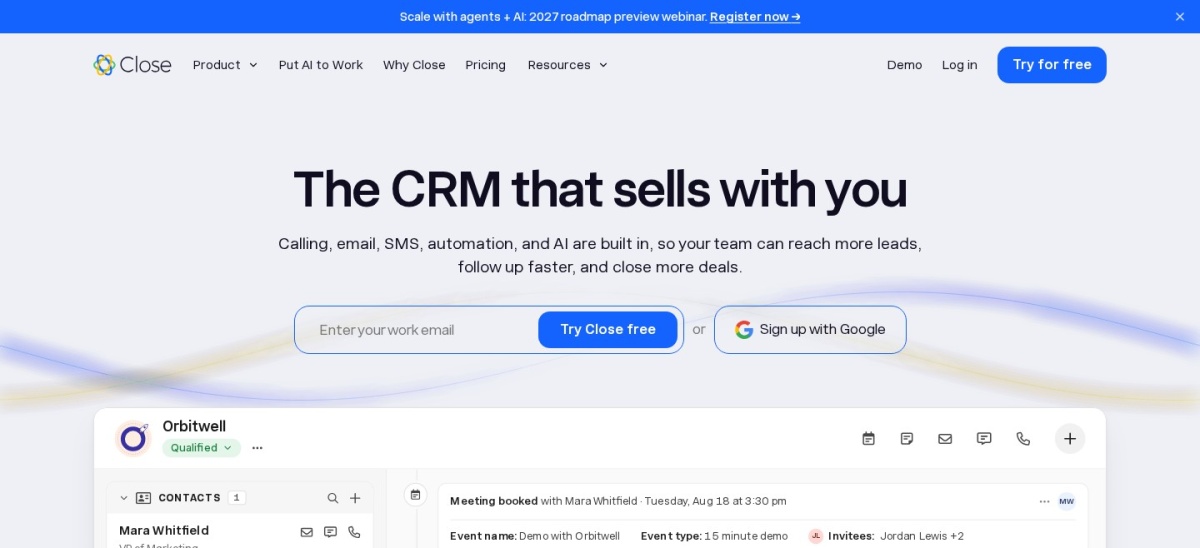
Close leads this list with a 4.7 out of 5 G2 rating from 2,040 reviews and built-in calling, at 49 dollars a user a month.
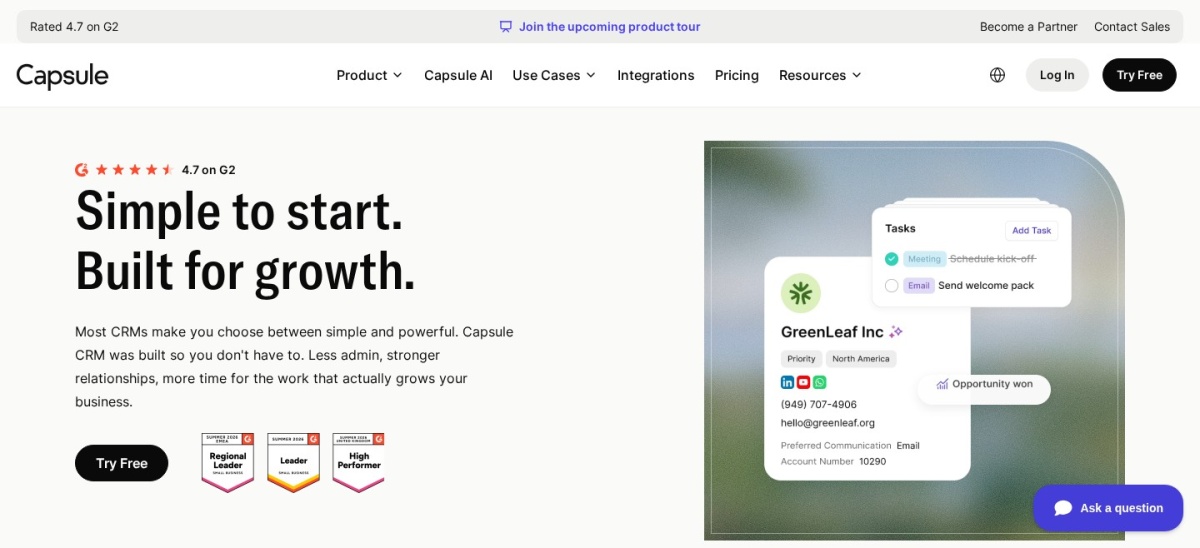
Capsule matches Close at 4.7 on G2 and is the simplest CRM here, with a free plan for two users.
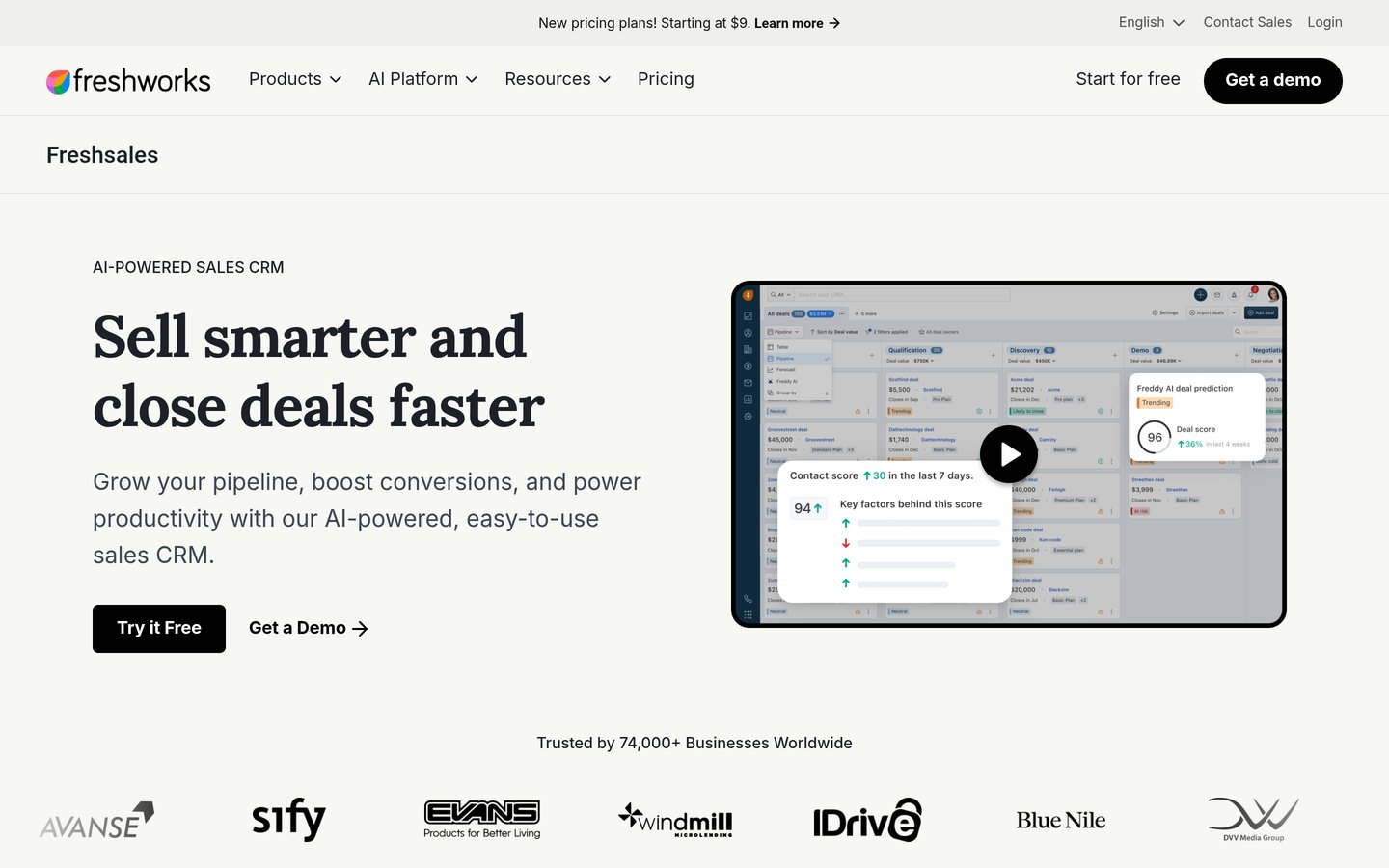
Freshsales is the cheapest paid CRM in this list at 9 dollars a user a month, with a free plan for three users.
HubSpot has the largest review base at 14,365 G2 reviews and a free plan for two users.
Monday Basic costs 12 dollars a seat but needs a three-seat minimum, so the floor is 36 dollars a month.
What to look for in a CRM for small companies
A CRM for a small company is not a smaller Salesforce. It should be set up in hours, not weeks, and the team should actually use it every day.
Free plans matter here. HubSpot, Freshsales, Zoho and Capsule all offer a free plan, while Pipedrive, Monday and Close offer a trial only. Our guide on sales tools covers the wider stack around the CRM.
Per-user prices look small but add up fast. At 20 dollars a seat, a team of ten pays 200 dollars a month, so check the price at your real team size, not for one user.
Watch the upgrade path. The cheapest plan often lacks automation, and the jump to the next tier can be four times the price, as with Freshsales.
Close is a sales CRM built for teams that sell by phone, email and SMS, with a built-in power dialer, call recording and SMS in the product. It holds a 4.7 out of 5 rating on G2 from 2,040 reviews, the highest score in this list.
The trade off is price. Startup costs 49 dollars a user a month on annual billing, the highest entry price here, and there is no free plan. It suits inside sales teams that live on the phone.
Capsule is a deliberately simple CRM for small businesses, covering contacts, opportunities, tasks and the projects that follow a won deal. It holds a 4.7 out of 5 rating on G2 from 491 reviews, and its free plan covers two users and 250 contacts.
The trade off is depth. Reporting and automation are thin on the cheaper plans, and the free plan stops at 250 contacts. It suits small teams that want a clean CRM without a learning curve.
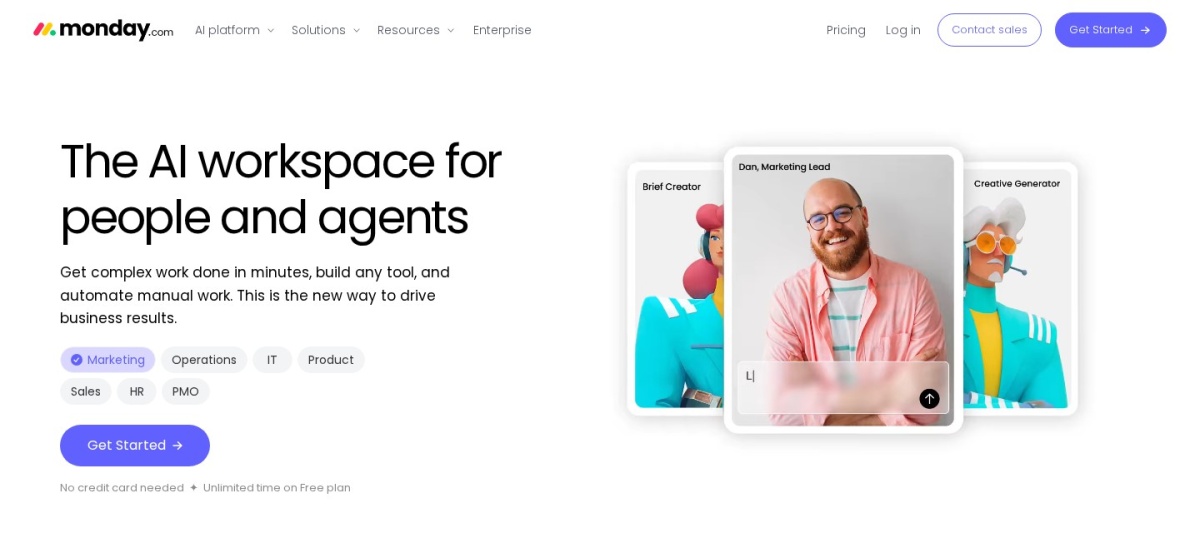
Monday is the sales product of the monday.com work platform, with visual boards, pipelines, email tracking and automations. It holds a 4.6 out of 5 rating on G2 from 1,136 reviews, and Basic costs 12 dollars a seat a month on annual billing.
The trade off is the minimum. Every plan needs at least three seats, so a solo seller still pays for three, and Basic caps at 1,000 contacts. It suits teams already running their work on monday.com.
Freshsales is the CRM of Freshworks, built for smaller teams that want a clean, affordable CRM without a long setup. It holds a 4.5 out of 5 rating on G2 from 1,235 reviews, and Growth costs 9 dollars a user a month on annual billing.
The trade off is the tier jump. Growth allows one pipeline and basic workflows, and Pro costs 39 dollars a user, more than four times as much. It suits small teams that want the lowest paid entry price.
HubSpot is the most widely used CRM in this list, with a free plan covering two users, 1,000 contacts, email sync and a pipeline. It holds a 4.4 out of 5 rating on G2 from 14,365 reviews, and Sales Hub Starter costs 20 dollars a seat a month.
The trade off is the upgrade path. Sequences and real automation start at Professional, 90 dollars a seat, so the real cost of automation is far above Starter. It suits small companies that want to start free and grow in one platform.
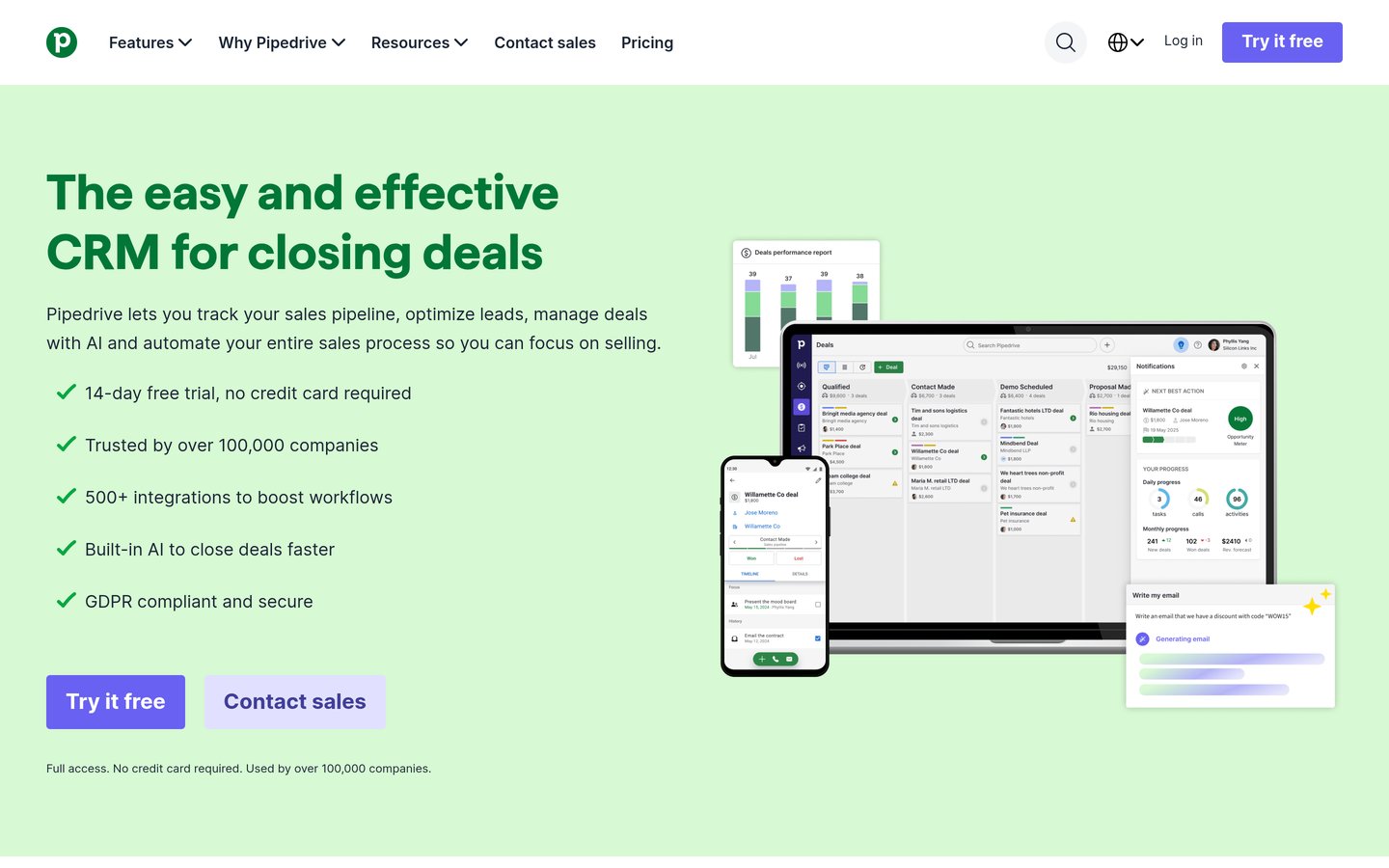
Pipedrive is a sales-focused CRM built around a visual pipeline, with drag-and-drop deals, activity reminders and simple reports. It holds a 4.3 out of 5 rating on G2 from 5,086 reviews, and Essential costs 14 dollars a user a month on annual billing.
The trade off is automation. Essential covers pipeline and contact management but little automation, and there is no free plan. It suits sales teams that want the simplest daily workflow.
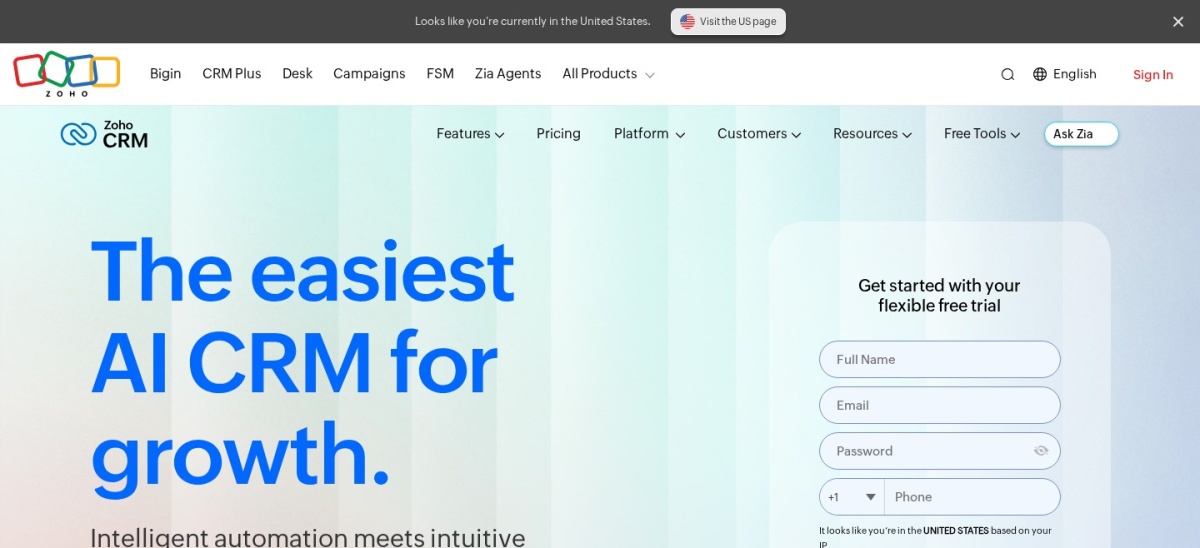
Zoho is a full-featured CRM that packs pipelines, workflow rules, forecasting and an AI assistant into its cheaper plans. It holds a 4.1 out of 5 rating on G2 from 2,945 reviews, and Standard costs 14 dollars a user a month on annual billing.
The trade off is complexity. The interface takes time to learn, and five editions make it hard to know which one holds the feature you need. It suits small teams that want a lot of CRM for little money.
Four CRMs in this list offer a free plan: HubSpot for two users, Freshsales and Zoho for three, and Capsule for two users and 250 contacts. A free plan is enough to run a small pipeline and prove the CRM fits.
Paid plans add automation, more pipelines and more contacts. Freshsales Growth at 9 dollars a user is the cheapest paid step, while Monday Basic at 12 dollars is the cheapest way into a visual board CRM.
The trap is the second tier. Freshsales Pro costs 39 dollars against 9 for Growth, and HubSpot Professional costs 90 dollars against 20 for Starter. Our lead generation guide shows how to fill the pipeline once the CRM is in place.
How we chose
We started from the most reviewed CRMs for small business on G2, then kept those with a verifiable G2 rating and a plan suited to small teams.
Prices come from each vendor's pricing page or third-party checks of it, read on 25 November 2026. Ratings and review counts come from G2 on the same day. Prices are per user per month on annual billing.
We left out CRMs with no scored G2 rating or no small-team plan. No vendor paid for a place, and we do not claim hands-on testing for this list.
How to choose a CRM for a small company
Start free where you can, then check the price at your real team size.
Start with the free plan. Four CRMs here offer a free plan. Try it with real deals before you pay for anything.
Count the cost at your team size. A 20 dollar seat costs 200 dollars a month for ten people. Multiply before you commit.
Check what the cheapest plan lacks. Automation, calling and forecasting are often gated. Know what you give up on the entry tier.
Test the pipeline view. Your team will live in the pipeline. Pick the view they find clearest, not the one with the most features.
FAQ
What is the best CRM for small companies?
Close is the best CRM for small companies that sell by phone, with a 4.7 out of 5 rating on G2 from 2,040 reviews. Capsule is the best simple pick, also at 4.7, while Freshsales has the lowest paid price at 9 dollars a user.
How much does a CRM cost for a small company?
Paid plans in this list run from 9 dollars a user a month at Freshsales to 49 dollars at Close, on annual billing. Four CRMs also offer a free plan, so a team of two or three can start at no cost.
Is there a free CRM for small businesses?
Yes, four in this list are free to start. HubSpot covers two users, Freshsales and Zoho cover three users, and Capsule covers two users and 250 contacts. Pipedrive, Monday and Close offer a 14-day trial instead.
Which CRM is easiest to use?
Capsule scores highest for ease of use on G2 at 9.4 out of 10, and reviewers call it the simplest CRM here. Pipedrive is close behind, with a pipeline view that new reps learn in days.
Do I need a CRM if my team is only two people?
Yes, a free plan is enough at that size. HubSpot, Freshsales, Zoho or Capsule will hold your contacts and deals for free, and you can upgrade when the team grows.
What is the cheapest paid CRM here?
Freshsales Growth is the cheapest paid plan in this list at 9 dollars a user a month on annual billing. Monday Basic is next at 12 dollars a seat, and Pipedrive and Zoho both start at 14 dollars a user.
SaaS SEO and WordPress specialist with about 8 years of experience. Rakib compares WordPress plugins, themes, hosting and software using public pricing, documentation and user reviews. See how we rank.