WLWPLegible EditorsLast verified 22 Nov 2026How we rank13 min read
★ Short answer
HubSpot Sales Hub is the best sales tool overall for teams needing contact management, deal pipelines, and sales activity tracking. Its free tools support 2 users, while Starter has a regular monthly price of $20 per seat. Apollo.io is better for B2B prospecting, and Pipedrive excels at visual pipeline management.
How we make this list: we compare pricing pages, product documentation and public user reviews, then re-check every price before each update. No product paid for a place. Disclosure.
HubSpot Sales Hub offers free sales tools for 2 users. Starter has a regular monthly price of $20 per seat, with new-customer discounts advertised separately.
Apollo.io receives 4.7/5 from 9,863 G2 reviews. Its Basic plan costs $49 per user monthly with annual billing and includes 30,000 annual credits.
Pipedrive Lite costs $14 per seat monthly with annual billing, or $168 annually, and connects with more than 500 applications.
Freshsales Growth starts at $9 per user monthly with annual billing and combines deal management with chat, email, and phone features.
Close offers a Solo plan at $9 monthly with annual billing, while Essentials costs $35 per user monthly for teams.
Saleshandy Starter costs $34 monthly with annual billing, supports unlimited connected email accounts, and includes 2,000 active prospects.
What to look for in the best sales tools
Sales tools help businesses find prospects, organize customer information, manage opportunities, automate follow-ups, and track revenue. The right software depends on which part of the sales process needs improvement.
Start by distinguishing CRM software from sales prospecting tools. A CRM stores contacts, deals, and activity histories. Prospecting platforms help identify potential buyers and find contact information. Sales engagement tools automate communication across email, phone, and other channels.
For teams managing inbound leads, pipeline visibility and follow-up reminders are often the highest priorities. Outbound teams may benefit more from contact databases, verified email addresses, sequencing, and reply management.
Consider integrations before choosing a product. Sales data becomes difficult to maintain when prospecting, communication, and customer records sit in disconnected systems. Native integrations and reliable synchronization can reduce duplicate records and manual administration.
Finally, compare the full cost of each tool. Some charge per user, others charge per workspace, and prospecting platforms may add credit-based fees. Check annual commitments, communication charges, contact limits, and which automation features require higher plans.
HubSpot Sales Hub is a sales management platform combining CRM records, deal tracking, sales communication, and reporting. Its free tools support 2 users and include contact management, deal tracking, email features, and basic sales activities. Starter adds expanded pipeline management, sales productivity features, and additional CRM capabilities.
The trade off is that advanced sales automation, sequences, and forecasting require more expensive plans. Starter has a regular monthly price of $20 per seat, equivalent to $240 annually, although the vendor advertises a $7 introductory offer. It suits growing teams wanting sales data and customer relationships in one platform.
What we like
Free CRM and sales tools for 2 users
Contact, deal and activity management
Starter supports up to 15 pipelines
Integrates with marketing and service workflows
Extensive public review history
Watch out for
Advanced automation requires Professional
Higher plans can become expensive for larger teams
Some features have usage or credit limits
Discounted introductory pricing differs from regular pricing
Starter expands pipeline capacity, removes some branding and adds sales productivity featuresVisit hubspot.com
02
Apollo.io
4.7/5on G2 (9,863 reviews, checked Nov 2026)
Paid from$49/mo
Best for B2B lead generation and prospecting
Contact database240M contacts
Company database30M companies
Basic credits30,000/year
Paid planBasic, $49/user/mo annually
apollo.io
Apollo.io homepage, captured Nov 2026.
Apollo.io is a B2B sales intelligence and engagement platform for discovering prospects, enriching contact records, and running outreach sequences. Its free plan supports light prospecting and email campaigns. Basic costs $49 per user monthly with annual billing and includes 30,000 annual credits, unlimited sequences, and CRM integrations.
The trade off is its credit-based system, which can add costs when teams frequently reveal contact information or enrich records. Basic costs $588 per user annually, and unused credits expire according to the billing cycle. It suits outbound sales teams that need prospect data and follow-up automation together.
What we like
Database covering 240 million contacts
Company intelligence and prospect filters
Free plan available
Basic includes unlimited sequences
Connects with major CRM platforms
Watch out for
Contact and enrichment credits have limits
Unused credits do not roll over
Contact data may require additional verification
More advanced features require higher subscriptions
Basic adds higher data allowances, unlimited sequences, CRM integrations and intent topicsVisit apollo.io
03
Pipedrive
4.3/5on G2 (5,131 reviews, checked Nov 2026)
Starts at$14/mo
Best for visual sales pipeline management
Free trial14 days
Integrations500+
Pipeline managementIncluded in Lite
Paid planLite, $14/seat/mo annually
pipedrive.com
Pipedrive homepage, captured Nov 2026.
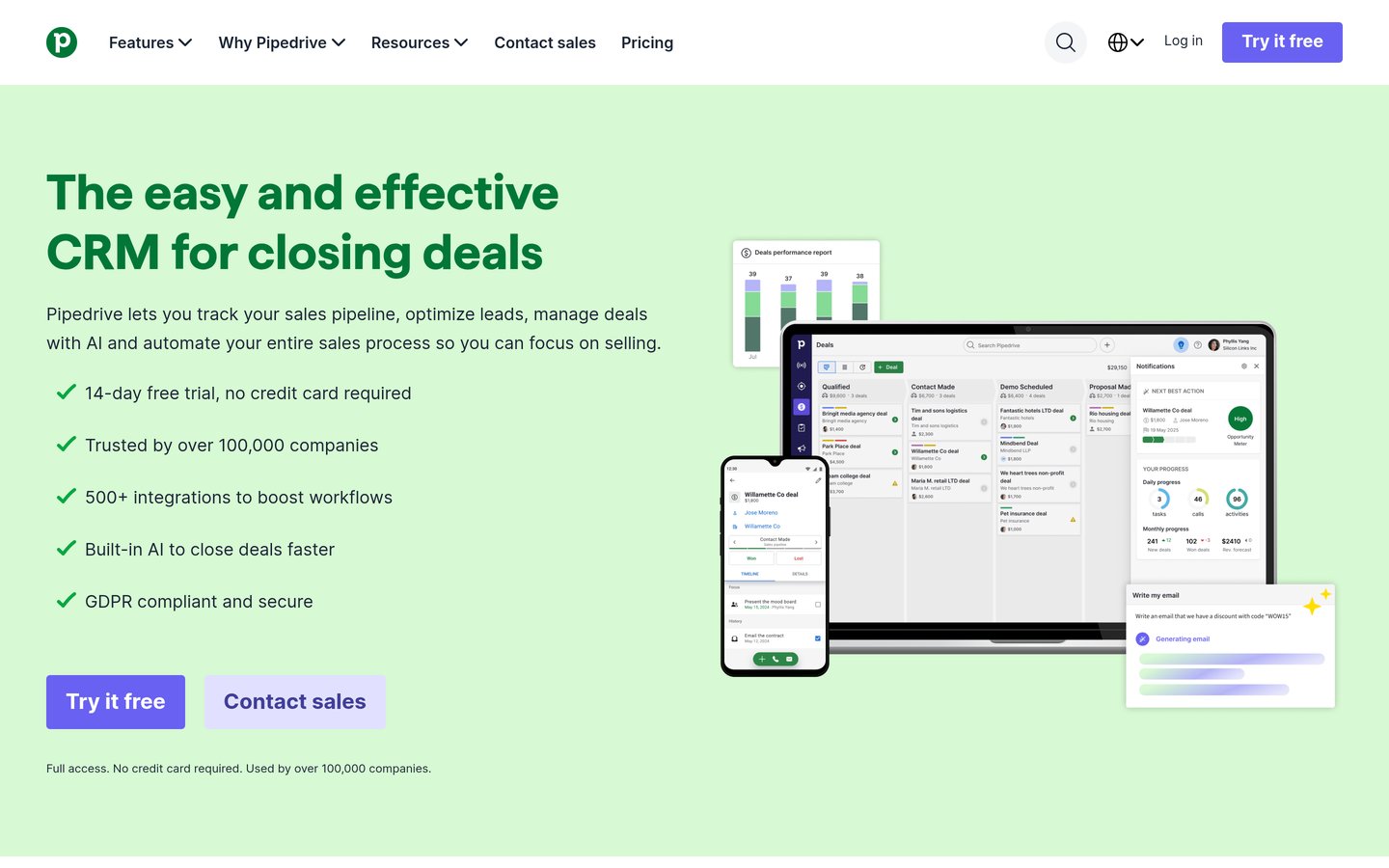
Pipedrive is a sales CRM focused on visual deal pipelines, lead tracking, activities, and sales reporting. Lite costs $14 per seat monthly with annual billing and includes lead, contact, calendar, and pipeline management. Teams also get AI-assisted reporting, meeting intelligence, and access to more than 500 integrations.
The trade off is that full email synchronization, workflow automation, and nurturing sequences require Growth rather than Lite. The entry subscription costs $168 per seat annually, and optional sales add-ons may increase spending. It suits teams that prioritize deal visibility and consistent follow-ups over extensive marketing features.
What we like
Clear visual deal pipelines
More than 500 integrations
AI-assisted reporting tools
Lead, calendar and contact tracking
14-day free trial
Watch out for
No permanent free plan
Full email synchronization requires Growth
Advanced lead generation features may cost extra
Workflow automation is not included in Lite
Growth adds full email sync, nurturing sequences, automation and subscription forecastingVisit pipedrive.com
04
Freshsales
4.5/5on G2 (1,244 reviews, checked Nov 2026)
Starts at$9/mo
Best for CRM with integrated sales communication
Free trial14 days
Pipeline viewKanban
CommunicationChat, email and phone
Paid planGrowth, $9/user/mo annually
freshworks.com
Freshsales homepage, captured Nov 2026.
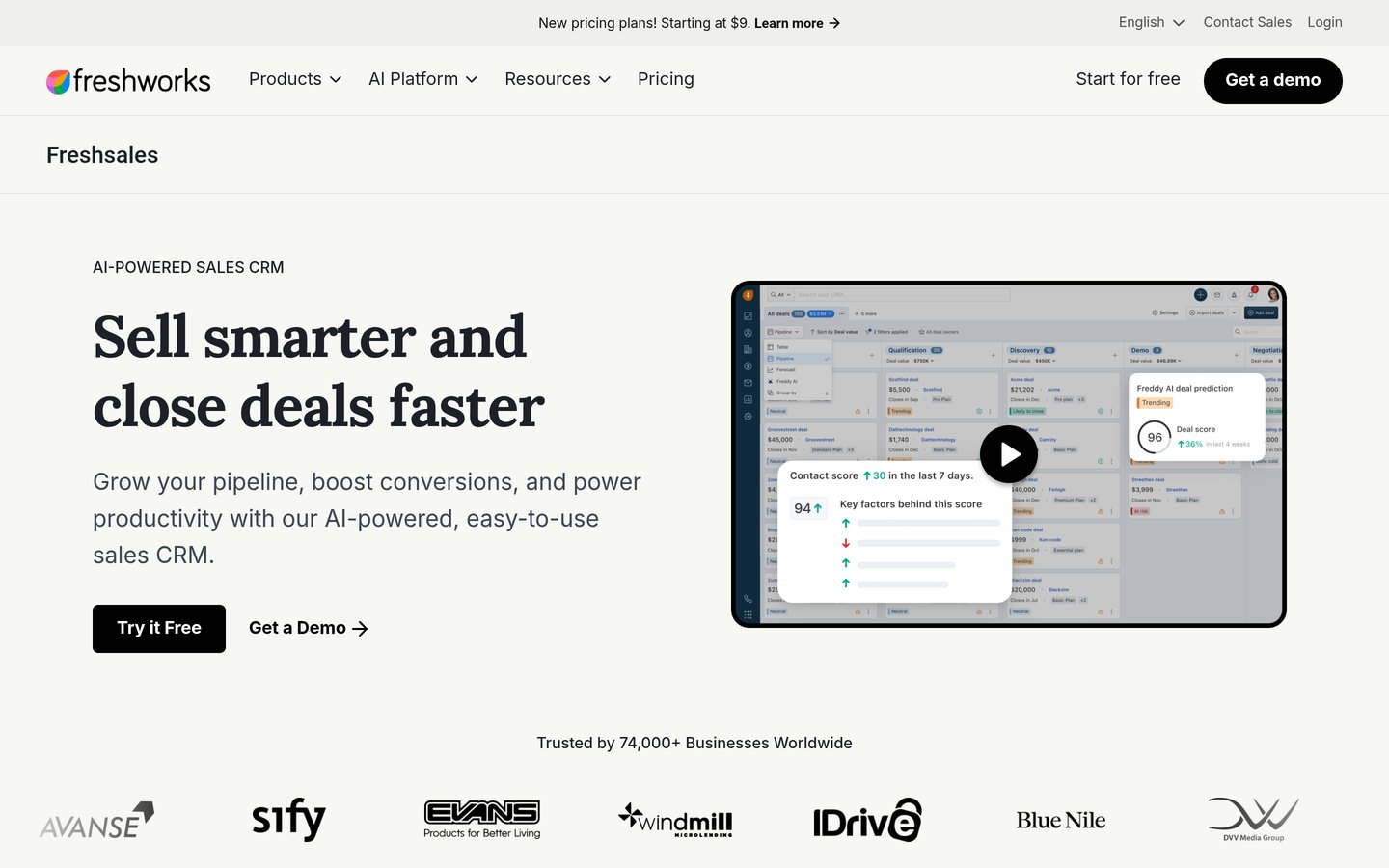
Freshsales is a sales CRM combining contact management, deal tracking, customer communication, and basic automation. Growth costs $9 per user monthly with annual billing and includes Kanban views, contact lifecycle stages, chat, email, phone, templates, custom fields, and basic workflows. Teams can manage conversations alongside their sales opportunities.
The trade off is that sales sequences, territory management, and advanced deal insights require Pro at $39 per user monthly with annual billing. Growth costs $108 per user annually before optional add-ons. It suits smaller teams that need communication tools connected directly to their CRM records.
What we like
Built-in email, phone and chat features
Growth includes basic workflows
Visual Kanban deal management
Custom fields and email templates
Affordable entry-level subscription
Watch out for
Advanced sales sequences require Pro
Additional AI tools may cost extra
Advanced forecasting requires higher plans
Communication usage may involve separate charges
Pro adds sales sequences, contact scoring, territory management and deal insightsVisit freshworks.com
05
Close
4.7/5on G2 (2,169 reviews, checked Nov 2026)
Starts at$9/mo
Best for phone-focused sales teams
Entry plan users1 on Solo
Free trial14 days
CommunicationCalling, email and SMS
Paid planSolo, $9/mo annually
close.com
Close homepage, captured Nov 2026.
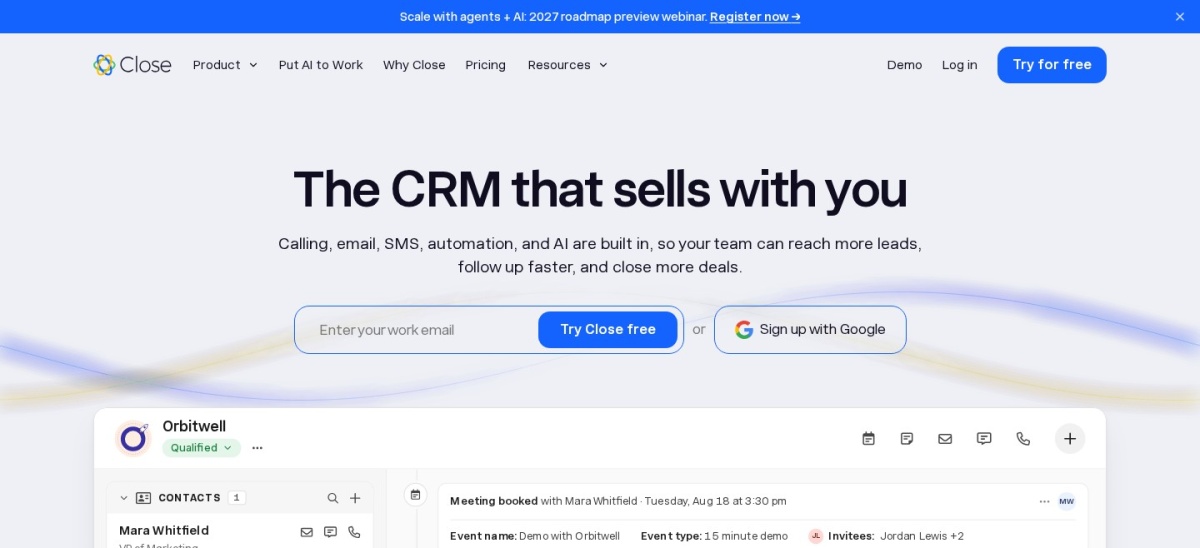
Close is a sales CRM that combines lead tracking, calling, email, SMS, and sales activity management. Solo costs $9 monthly with annual billing and supports one seller, while the platform includes communication and CRM functionality. Teams can keep customer conversations and opportunity records together without maintaining separate calling software.
The trade off is that Solo supports only one user, while shared team features require Essentials at $35 per user monthly with annual billing. Calling and SMS usage also cost extra. It suits individual sellers and phone-heavy sales teams that want communication integrated with pipeline management.
What we like
Calling and SMS integrated with CRM records
Affordable Solo entry plan
Email communication and activity tracking
14-day free trial
Built-in AI assistance and sales workflows
Watch out for
Solo supports only one user
Calling and SMS usage fees are additional
Team collaboration requires Essentials
Power Dialer requires a higher plan
Essentials adds shared leads, team reporting, tasks and Local Presence callingVisit close.com
06
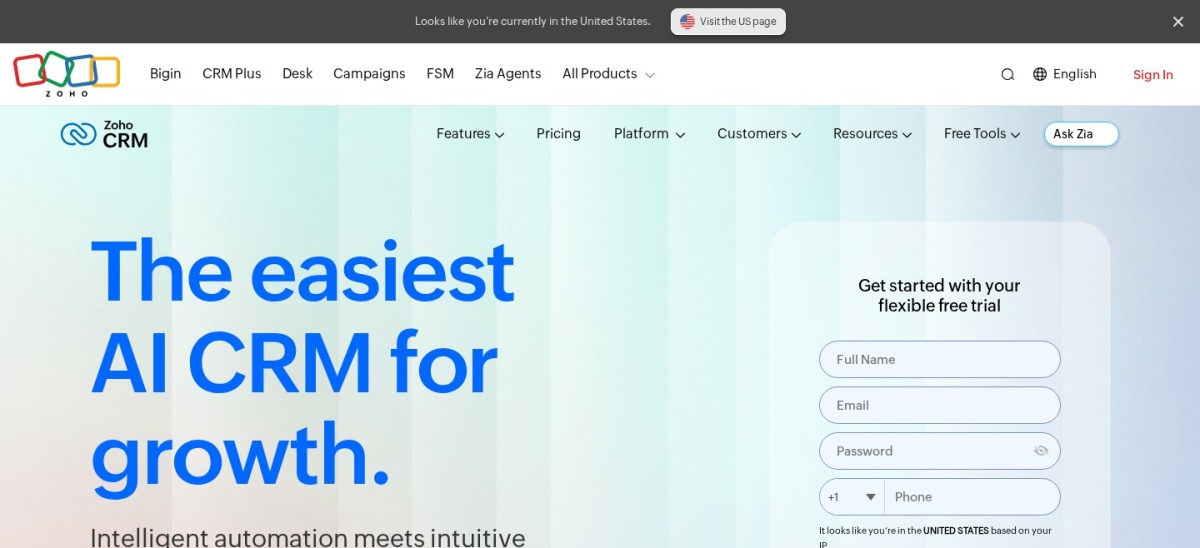
Zoho CRM
4.1/5on G2 (2,963 reviews, checked Nov 2026)
Paid from$14/mo
Best for customizable sales workflows
Free users3
Free email templates10
Free API allowance5,000 calls/day
Paid planStandard, $14/user/mo annually
zoho.com
Zoho CRM homepage, captured Nov 2026.
Zoho CRM is a customizable sales management platform for organizing leads, contacts, opportunities, activities, and customer relationships. Its free edition supports 3 users, follow-up reminders, 10 custom email templates, standard reports, and 5,000 API calls daily. Standard costs $14 per user monthly with annual billing and expands its sales management capabilities.
The trade off is that Zoho CRM requires more configuration than simpler pipeline tools, especially when teams add custom workflows and integrations. Standard costs $168 per user annually, while advanced process management requires higher editions. It suits businesses that want a flexible CRM they can expand as sales operations become more complex.
What we like
Free edition supports 3 users
Customizable sales records and processes
Standard reporting and activity tracking
Integrates with other Zoho applications
Supports workflow customization
Watch out for
More configuration than lightweight CRM tools
Advanced automation requires higher editions
Some integrations depend on additional subscriptions
Reporting complexity increases with customization
Standard expands sales management and reporting; higher editions add advanced process automationVisit zoho.com
07
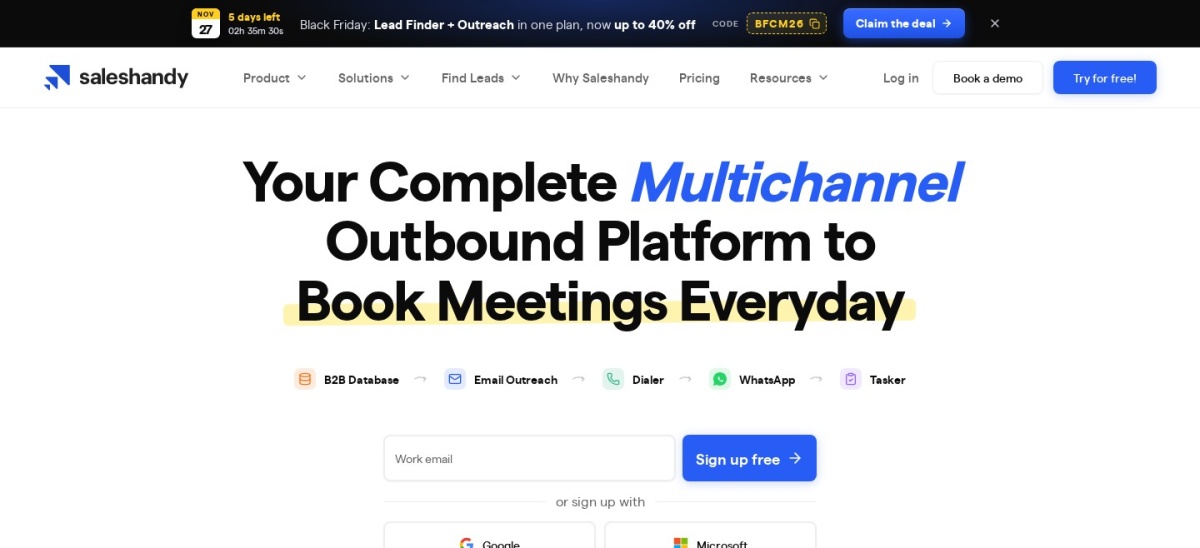
Saleshandy
4.6/5on G2 (825 reviews, checked Nov 2026)
Starts at$34/mo
Best for scalable outbound sales outreach
Email accountsUnlimited
Active prospects2,000
Free trial7 days
Paid planStarter, $34/mo annually
saleshandy.com
Saleshandy homepage, captured Nov 2026.
Saleshandy is an outbound sales platform combining lead discovery, email sequencing, prospect management, and deliverability tools. Starter costs $34 monthly with annual billing and includes unlimited connected email accounts, unlimited sequences, and capacity for 2,000 active prospects. It also provides a unified inbox and built-in CRM capabilities.
The trade off is that Starter has active prospect and sending limits, while additional prospecting or communication capacity may require upgrades or extra purchases. Its annual subscription costs $408 before optional email infrastructure and usage expenses. It suits outbound teams and agencies managing outreach across multiple mailboxes.
What we like
Unlimited connected email accounts
Unlimited outreach sequences
Built-in prospect management and unified inbox
Email deliverability and follow-up features
No additional per-seat subscription pricing
Watch out for
Starter limits active prospects
Additional infrastructure can increase total costs
Not as comprehensive for post-sale CRM management
No permanent free platform plan
Pro increases prospect limits, sending capacity and outreach featuresVisit saleshandy.com
The main types of sales tools and when to use them
CRM tools organize contacts, companies, deals, activities, and sales performance. HubSpot Sales Hub, Pipedrive, Freshsales, Close, and Zoho CRM are primarily used to manage these records and keep sales processes organized.
Sales intelligence tools help teams research potential customers and discover contact information. Apollo.io combines B2B prospecting data with enrichment, filtering, and outbound engagement features.
Sales engagement tools automate prospect communication and follow-ups. Saleshandy focuses on outreach sequences, mailbox management, and reply tracking, while Close combines calling and communication with CRM functions.
Sales analytics tools help managers understand pipeline value, conversion rates, activity levels, and expected revenue. Many CRM platforms include basic reporting, while advanced forecasting and analytics often require higher subscription tiers.
How to build a sales tool stack without overspending
Begin with a CRM that stores your contacts, opportunities, and customer interactions. A central customer database reduces duplicated records and gives the team a consistent way to track sales progress.
Add a prospecting platform only when your business needs to identify customers beyond existing inbound leads. Compare data coverage, verification methods, export credits, and CRM synchronization before purchasing.
Introduce outreach automation when manual follow-ups become difficult to manage. Check sending limits, mailbox requirements, contact permissions, and whether your salespeople can maintain personalized communication.
Review your subscriptions regularly. Overlapping CRM, outreach, and reporting features can create unnecessary costs. Choose integrated functionality when it meets your needs, but use specialized platforms when they solve a clear limitation.
How we chose
We shortlisted established sales software products covering CRM, prospect discovery, outbound engagement, pipeline management, and sales communication. We prioritized actively maintained platforms with public pricing, substantial independent review histories, and features relevant to businesses managing real sales workflows.
For this comparison, the editorial verification date is 22 Nov 2026, and official pricing and public G2 review pages were checked on 23 Nov 2026. All prices are reported in USD. Annual equivalents use the cheapest regular paid plan and identify annual billing, introductory discounts, and variable charges where relevant.
We excluded quote-only products, tools without confirmable entry-level pricing, and software with insufficient public review evidence. Ratings reflect the products overall rather than specific features, and we did not treat marketing claims as independently verified performance results. No vendor paid for a place, and we do not claim testing for this list.
How to choose the best sales tools for your business
Identify where your sales process needs improvement, then compare product capabilities, integrations, and subscription costs before selecting a platform.
Identify your biggest sales bottleneck. Determine whether your team struggles with finding prospects, managing opportunities, following up consistently, or reporting sales performance. Start with software that solves the highest-priority problem rather than buying an entire sales stack immediately.
Match features to your sales workflow. Choose a CRM for contact and pipeline management, a prospecting platform for lead discovery, or a sales engagement tool for outbound communication. Consider combined products when your team needs several capabilities together.
Calculate total costs and usage limits. Compare per-user subscriptions, workspace charges, contact credits, sending allowances, and optional communication fees. Use your expected team size and activity volume to estimate annual costs rather than relying on advertised entry prices.
Verify integrations and data quality. Check whether tools synchronize contacts, activities, and opportunities with your existing systems. Evaluate reporting accuracy, permission controls, duplicate handling, and how easily the team can move data if requirements change.
FAQ
What are the best sales tools in 2026?
HubSpot Sales Hub is our top overall choice for CRM, pipeline management, and sales collaboration. Apollo.io is better for B2B prospecting and contact discovery, while Pipedrive focuses on visual deal management. Saleshandy suits teams that prioritize automated outbound email and follow-ups.
What is the best free sales tool?
HubSpot Sales Hub offers free CRM and sales tools for up to 2 users, while Zoho CRM supports 3 free users. Apollo.io also provides free access for limited prospecting and email campaigns. The best option depends on whether your priority is customer management or finding new leads.
What sales tools do small businesses need?
Most small businesses benefit from a CRM, contact management, follow-up reminders, and basic sales reporting. Companies actively prospecting for customers may also need lead intelligence and outreach software. Start with essential functions, then introduce specialized tools when the team has a clear requirement.
What is the difference between CRM and sales engagement software?
CRM software stores and organizes customer relationships, deals, and sales activities. Sales engagement software helps representatives communicate with prospects through sequences, email, calls, and follow-ups. Some platforms combine both functions, but their capabilities and pricing structures differ.
Which sales tool is best for B2B prospecting?
Apollo.io is particularly suitable for B2B prospecting because it combines contact and company data, filters, enrichment, and outreach sequences. Its Basic plan costs $49 per user monthly with annual billing. Teams should independently validate important contact information before relying on it for outreach.
Which sales tools are best for cold email outreach?
Saleshandy is designed for outbound sequences, connected sending accounts, prospect management, and reply tracking. Apollo.io also supports email outreach alongside prospect discovery. Businesses should compare sending limits, contact data, deliverability features, and compliance requirements before choosing either platform.
How much do sales tools cost?
The entry-level paid plans in this comparison range from $9 monthly for Close Solo to $49 per user monthly for Apollo.io Basic, using their stated annual-billing terms. Some tools offer free plans, while communication charges, credits, add-ons, and higher-tier automation may increase total costs.
Can sales tools improve conversion rates?
Sales tools can help teams track opportunities, organize follow-ups, understand prospect behavior, and reduce missed activities. These improvements may support better conversion rates, but software alone cannot guarantee results. Lead quality, sales messaging, market conditions, and consistent team adoption remain important.
Should I buy an all-in-one sales platform or separate tools?
An all-in-one platform is often easier to administer because customer records, communication, and reporting share the same workspace. Separate tools can provide deeper prospecting or engagement features. Compare integration quality, workflow complexity, and total costs before deciding whether specialization is worthwhile.