Best Sales Management Software for Small Business in 2026: 7 Tools Compared
WLWPLegible EditorsLast verified 22 Nov 2026How we rank12 min read
★ Short answer
Bigin by Zoho CRM is our top sales management software for small businesses because its free plan includes a sales pipeline and 500 records, while Express starts at $7 per user monthly. Freshsales is better for teams needing built-in communication, and Less Annoying CRM suits businesses wanting straightforward pricing.
How we make this list: we compare pricing pages, product documentation and public user reviews, then re-check every price before each update. No product paid for a place. Disclosure.
Bigin by Zoho CRM offers a free single-user plan with 500 records. Express starts at $7 per user monthly with annual billing and supports 3 team pipelines.
Freshsales Growth costs $9 per user monthly with annual billing and includes Kanban views, contact lifecycle stages, and basic workflows.
Less Annoying CRM costs $15 per user monthly with no annual contract or higher-priced feature tiers. It holds a 4.9/5 G2 rating from 674 reviews.
Zoho CRM offers a free plan for 3 users, while Standard costs $14 per user monthly with annual billing and adds more sales management capabilities.
Capsule CRM supports 2 free users and 250 contacts. Starter costs $18 per user monthly with annual billing.
Insightly CRM Plus costs $29 per user monthly with annual billing and includes lead management, project management, and reporting.
What small businesses should look for in sales management software
Sales management software helps small businesses organize leads, track opportunities, assign follow-ups, and understand how deals move through the sales process. It replaces scattered spreadsheets, inboxes, and personal notes with shared customer records.
The most important feature is a visual sales pipeline. Salespeople should be able to see which opportunities need attention, which deals are approaching a decision, and where prospects stop progressing. Customizable stages make the software useful for different sales processes.
Contact management and activity tracking come next. Look for email integrations, meeting reminders, call records, task assignments, and a searchable history of customer interactions. These features help teams coordinate follow-ups without relying on individual memory.
Reporting should match the business's size. Small teams often need pipeline value, deal status, sales activity, and conversion reporting before they need advanced forecasting. Avoid paying for sophisticated analytics that the team will not use.
Finally, check how pricing changes as your business grows. Free plans can be useful initially, but automation, multiple pipelines, email synchronization, custom reporting, and additional users may require paid subscriptions.
The 7 best sales management software for small business
01
Bigin
4.6/5on G2 (877 reviews, checked Nov 2026)
Paid from$7/mo
Best for affordable sales pipeline management
Free users1
Free records500
Express pipelines3
Paid planExpress, $7/user/mo annually
bigin.com
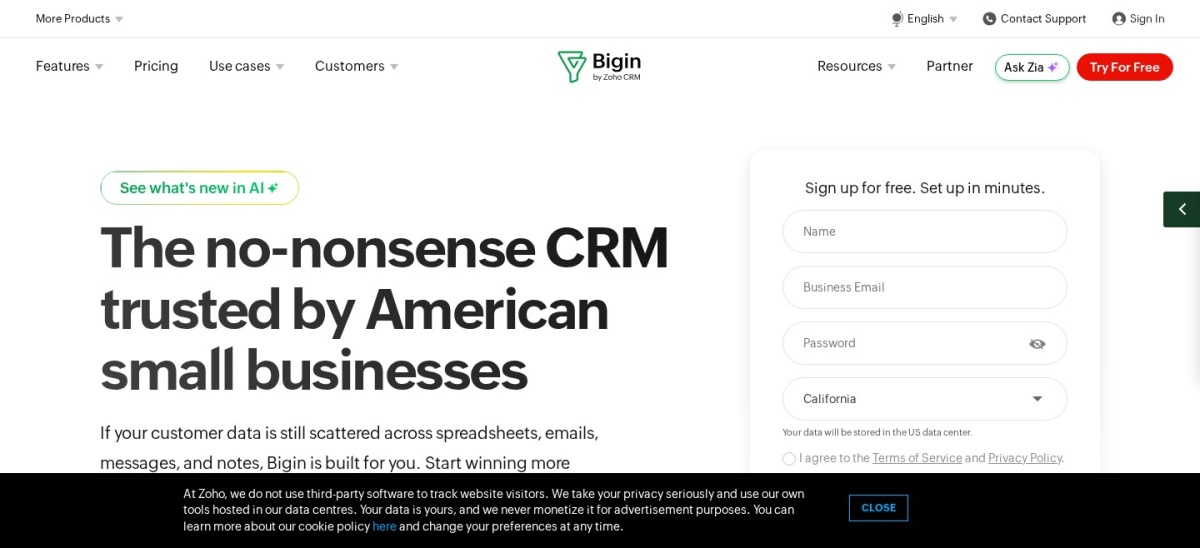
Bigin homepage, captured Nov 2026.
Bigin is a sales CRM designed for small businesses moving from spreadsheets to structured pipelines. Its free plan supports 1 user, 500 records, a single pipeline, and 3 automations. Express starts at $7 per user monthly with annual billing and adds 3 team pipelines, 50,000 records, email integrations, and 30 automations.
The trade off is that Bigin offers fewer advanced sales management capabilities than the full Zoho CRM platform. Express costs $84 per user annually, with higher plans and add-ons available for expanding requirements. It suits small sales teams that want organized deals and follow-ups without complicated configuration.
What we like
Free plan includes a working sales pipeline
Express costs $84 per user annually
Express supports 50,000 records and 3 pipelines
Built-in email integration and workflow automation
Can migrate to Zoho CRM as requirements grow
Watch out for
Free plan is limited to 1 user
Advanced CRM features require higher plans or Zoho CRM
Additional pipelines and records may require upgrades
Express adds team pipelines, email integration, custom fields, and more automationVisit bigin.com
02
Freshsales
4.5/5on G2 (1,244 reviews, checked Nov 2026)
Paid from$9/mo
Best for sales communication and deal management
Free planAvailable
Sales communicationChat, email and phone
Pipeline viewKanban
Paid planGrowth, $9/user/mo annually
freshworks.com
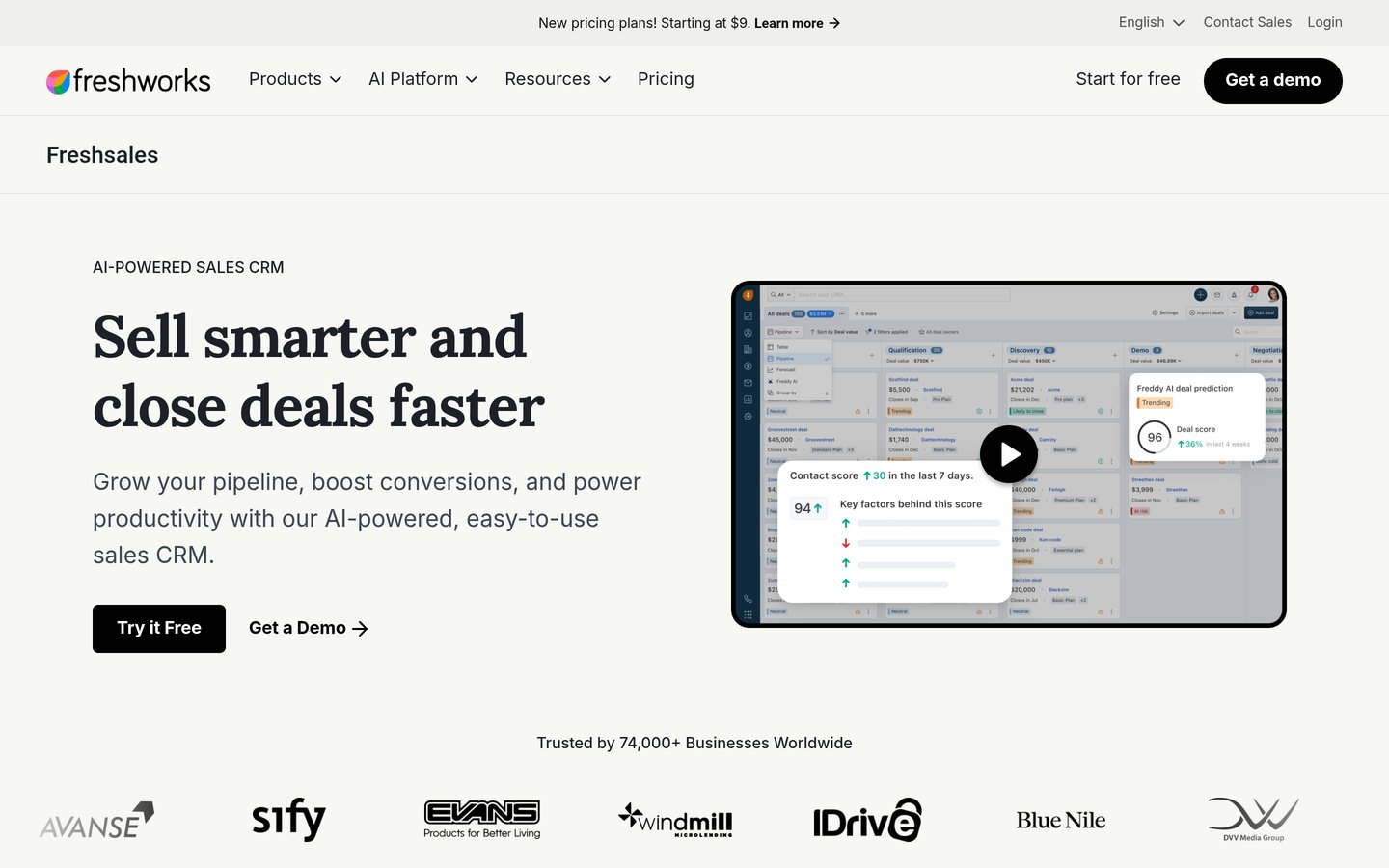
Freshsales homepage, captured Nov 2026.
Freshsales is a sales CRM that combines contact management, deal pipelines, and customer communication. Growth costs $9 per user monthly with annual billing and includes Kanban views, contact lifecycle stages, chat, email, phone, custom fields, and basic workflows. Teams can manage opportunities and customer interactions from a shared workspace.
The trade off is that advanced sales sequences, territory management, and deal insights require Pro at $39 per user monthly with annual billing. Growth costs $108 per user annually before optional add-ons. It suits small businesses that want communication tools connected directly to sales records.
What we like
Built-in chat, email and phone capabilities
Visual Kanban deal management
Growth includes basic workflows
Contact lifecycle stages and custom fields
Published entry price of $108 per user annually
Watch out for
Advanced sales sequences require Pro
Territory management is not included in Growth
Optional AI and document tools add costs
Advanced reporting is available on higher plans
Pro adds sales sequences, contact scoring, territory management, and deal insightsVisit freshworks.com
03
Less Annoying CRM
4.9/5on G2 (674 reviews, checked Nov 2026)
Starts at$15/mo
Best for simple CRM with predictable pricing
Pricing tiers1
Free trial30 days
Billing commitmentMonth-to-month
Paid plan$15/user/mo
lessannoyingcrm.com
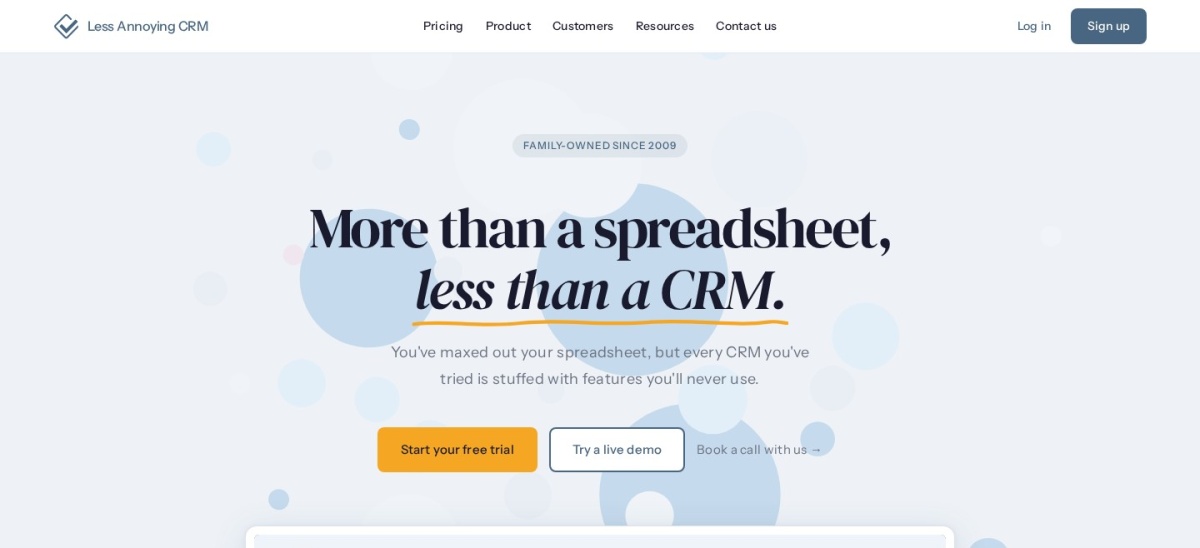
Less Annoying CRM homepage, captured Nov 2026.
Less Annoying CRM is a contact and sales management platform designed around simple workflows and transparent pricing. Its single $15 per user monthly subscription includes pipeline management, contact records, calendars, email syncing, and customer support. New customers can use a 30-day free trial without committing to an annual contract.
The trade off is that Less Annoying CRM prioritizes essential CRM features over advanced forecasting, AI tools, and complex automation. Its $15 monthly subscription equals $180 per user annually, with no separate feature tiers or annual commitment. It suits small businesses that value ease of administration and predictable costs.
What we like
Single pricing tier with no feature-based upgrades
Month-to-month billing without annual contracts
30-day free trial
Contact management and pipeline tracking included
G2 rating of 4.9/5 from 674 reviews
Watch out for
No permanent free plan
Limited advanced sales automation
Not intended for complex enterprise sales operations
Fewer advanced analytics features than larger CRM platforms
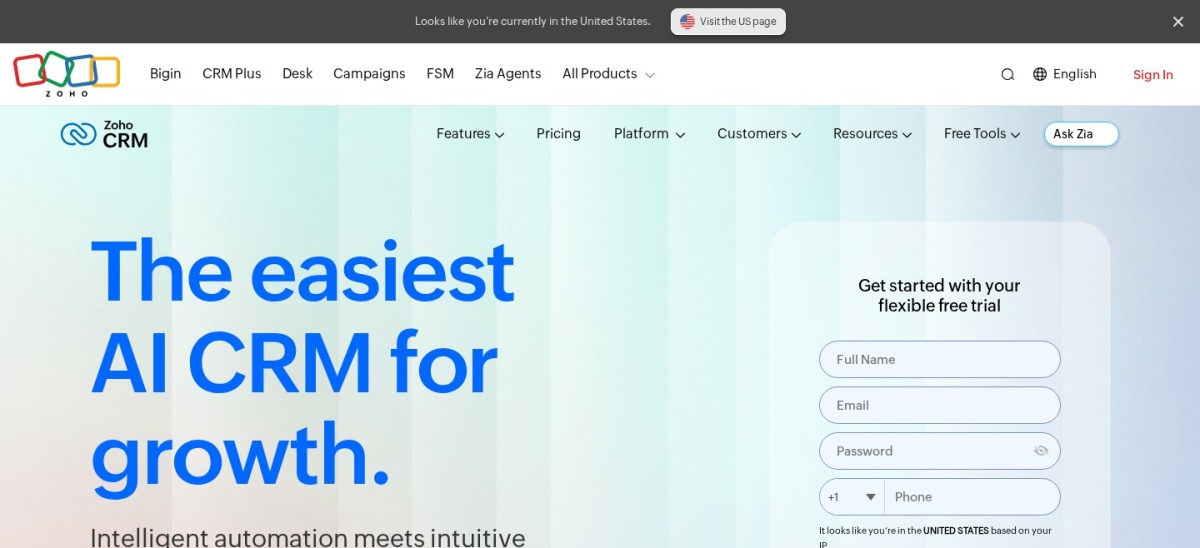
Zoho CRM is a customizable customer relationship management platform for tracking leads, contacts, sales opportunities, and activities. Its free edition supports 3 users, follow-up reminders, standard reporting, and 10 custom email templates. Standard costs $14 per user monthly with annual billing and adds more comprehensive sales management features.
The trade off is that configuring Zoho CRM can require more setup than using a simpler pipeline-focused tool. Standard costs $168 per user annually, while advanced automation and process management are concentrated in higher editions. It suits small businesses planning to expand their sales workflows over time.
What we like
Free edition supports 3 users
Customizable sales pipelines and customer records
Built-in follow-up reminders and reporting
Integrates with the wider Zoho ecosystem
Supports more complex workflows as teams grow
Watch out for
More configuration than lightweight CRM software
Advanced process management requires upgrades
Some integrations and automation capabilities vary by edition
Interface complexity may increase with customization
Standard adds expanded sales management tools; Professional adds more process automationVisit zoho.com
05
Capsule CRM
4.7/5on G2 (533 reviews, checked Nov 2026)
Paid from$18/mo
Best for relationship-focused sales teams
Free users2
Free contacts250
Free trial14 days
Paid planStarter, $18/user/mo annually
capsulecrm.com
Capsule CRM homepage, captured Nov 2026.
Capsule CRM is a customer relationship management platform for organizing contacts, sales opportunities, tasks, and customer communications. Its free plan supports 2 users and 250 contacts, while Starter costs $18 per user monthly with annual billing. Teams can manage sales pipelines alongside calendars, activities, and client relationship histories.
The trade off is that businesses needing multiple sales pipelines and more advanced workflows may need Growth at $36 per user monthly with annual billing. Starter costs $216 per user annually. It suits small service businesses and relationship-driven sales teams that want a CRM without extensive setup.
What we like
Free plan supports 2 users
Combines contact and opportunity management
Built-in task and calendar tracking
Connects with accounting and productivity applications
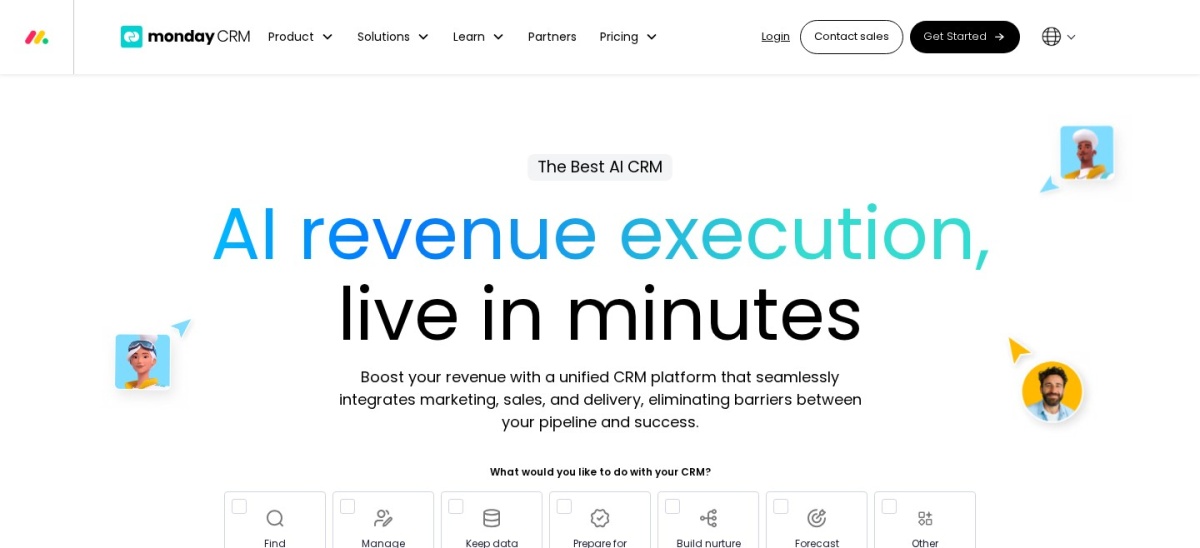
monday CRM is a visual sales management platform for coordinating leads, contacts, deals, and team activities. Its Basic plan displays a price of $18 per seat monthly on the official pricing page, with annual billing available and a minimum purchase of 3 seats. Basic includes customizable boards and a dashboard for organizing sales records.
The trade off is that the displayed per-seat price does not represent the total subscription because monday CRM requires a minimum seat package. At $18 per seat monthly, the annual per-seat equivalent is $216 before considering package requirements. It suits sales teams that prefer visual workflows and shared dashboards.
What we like
Visual boards for managing sales activity
Customizable contact and deal workflows
Dashboard-based team visibility
Connects sales data with collaborative work
G2 rating of 4.5/5 from 2,015 reviews
Watch out for
Minimum paid seat requirement
Advanced automation requires higher plans
Pricing depends on selected seat packages
Can require configuration for traditional CRM workflows
Insightly CRM is a sales and relationship management platform that connects customer records, opportunities, and project work. Plus costs $29 per user monthly with annual billing and includes lead and contact management, project management, advanced reports, and prebuilt dashboards. Teams can coordinate customer relationships beyond the initial sale.
The trade off is that workflow automation, lead routing, and more advanced sales tools require Professional at $49 per user monthly with annual billing. Plus costs $348 per user annually. It suits service-oriented businesses that need visibility into both sales opportunities and work delivered after a deal closes.
What we like
Combines sales and project management
Includes lead and contact tracking
Advanced reporting on the entry plan
Prebuilt dashboards
Suitable for businesses managing post-sale delivery
Watch out for
Entry price is higher than budget CRM options
Workflow automation requires Professional
No permanent free CRM plan
Advanced configuration may require additional administration
Professional adds workflow automation, lead routing, and AI-assisted sales featuresVisit insightly.com
CRM software vs sales management software: what is the difference?
CRM software organizes customer relationships, including contacts, communication histories, support interactions, and sales opportunities. Sales management software focuses more directly on managing revenue-generating activities and improving sales team performance.
Most modern CRM platforms include sales management capabilities. Pipeline views, follow-up reminders, activity tracking, deal ownership, forecasting, and dashboards allow managers to understand sales performance without purchasing separate software.
For small businesses, a CRM with appropriate sales management features is usually the practical starting point. Dedicated sales engagement, forecasting, or analytics software becomes more relevant when the organization needs capabilities beyond its existing CRM.
Sales metrics small businesses should monitor
Pipeline value shows the total value of open opportunities. Reviewing pipeline value alongside expected close dates helps managers understand potential revenue and identify where additional opportunities may be needed.
Deal conversion rate measures how effectively opportunities move toward a successful sale. Comparing conversion across pipeline stages can reveal qualification problems, weak follow-up processes, or obstacles near the final decision.
Sales cycle length measures how long opportunities take to close. Longer cycles may indicate delayed customer decisions, unclear pricing, or internal approval issues. Comparing similar deal types gives managers more useful insights.
Sales activity includes calls, meetings, emails, proposals, and completed follow-ups. Activity metrics can help explain changes in pipeline performance, but teams should evaluate the quality of customer interactions rather than simply maximizing activity volume.
How we chose
We selected established CRM and sales management platforms with relevant capabilities for small businesses, including pipeline tracking, contact management, activity monitoring, reporting, and sales collaboration. We compared simpler tools with more configurable systems to represent different budgets and team requirements.
The article uses 22 Nov 2026 as its editorial date. Official vendor pricing and G2 review pages were opened and checked on 23 Nov 2026. All reported prices are in USD, with annual-billing requirements, monthly commitments, and minimum-seat limitations identified where applicable.
We excluded products without a confirmable public entry-level price, tools focused primarily on enterprise sales operations, and software lacking substantial independent reviews. We prioritized practical features, understandable costs, and suitability for small teams. No vendor paid for a place, and we do not claim testing for this list.
How to choose sales management software for a small business
Identify your sales workflow, compare the features your team will actually use, and calculate the cost of maintaining accurate customer and pipeline records.
Map your existing sales process. List how leads enter the business, how opportunities progress, and which follow-ups determine whether deals close. Choose software that can reflect this process with clear stages, ownership, and activity records.
Prioritize essential sales features. Start with contact management, visual pipelines, reminders, and basic reporting. Add email synchronization, automation, forecasting, and advanced analytics only when your team has a clear need for them.
Calculate the total subscription cost. Multiply the regular per-user price by the number of required seats. Check minimum seat packages, annual commitments, add-on charges, and whether important functionality requires a higher subscription tier.
Evaluate usability and future growth. Choose a platform that salespeople can maintain consistently. Check data import options, mobile access, integrations, customization, and whether the system can accommodate additional users or sales processes without a difficult migration.
FAQ
What is the best sales management software for a small business?
Bigin by Zoho CRM is our top pick because it combines visual pipelines, contact management, and basic automation with an affordable paid plan. Express starts at $7 per user monthly with annual billing. Freshsales is better for integrated communication, while Less Annoying CRM offers simpler administration.
Is there free sales management software?
Yes. Bigin offers a free single-user plan with 500 records, while Zoho CRM supports 3 free users. Capsule CRM provides a free plan for 2 users and 250 contacts. These options work for basic sales tracking, although larger teams and advanced features may require paid subscriptions.
What is the cheapest paid sales management software?
Bigin Express has the lowest verified paid starting price in this comparison at $7 per user monthly with annual billing, equivalent to $84 annually. Freshsales Growth costs $9 per user monthly with annual billing. Compare included features before choosing solely on price.
What features should small-business sales software include?
Essential features include contact records, a visual deal pipeline, follow-up reminders, activity tracking, and basic sales reports. Email integration and workflow automation can reduce manual administration. Teams with more complex sales cycles may also need multiple pipelines, forecasting, custom fields, and approval workflows.
What is the difference between CRM and sales management software?
CRM software manages customer relationships across sales, marketing, and service interactions. Sales management software focuses on activities that generate revenue, such as pipeline progression, opportunity tracking, sales performance, and forecasting. Many CRM platforms include these sales management functions, making separate products unnecessary for smaller businesses.
Which sales management software is easiest to use?
Less Annoying CRM is a good choice for businesses that want straightforward contact management and pipeline tracking without multiple subscription tiers. Capsule CRM is another option for relationship-focused teams. The easiest platform ultimately depends on existing processes, technical familiarity, and required integrations.
Can sales management software help increase sales?
Sales management software can help teams respond to leads consistently, track opportunities, identify stalled deals, and organize follow-ups. These improvements may contribute to stronger sales performance, but the software itself does not guarantee revenue growth. Results depend on lead quality, sales processes, and team adoption.
How much does sales management software cost?
The entry-level paid plans in this comparison range from $7 per user monthly for Bigin Express to $29 per user monthly for Insightly CRM Plus, using the stated billing terms. Some products offer free plans, while others require seat packages or annual commitments. Additional automation may cost more.
When should a small business upgrade from spreadsheets to a CRM?
A CRM becomes useful when customer information is scattered, follow-ups are missed, multiple employees handle the same leads, or management cannot clearly see pipeline progress. Even a simple CRM can improve consistency by keeping customer records, activities, and opportunities in one shared system.