Slack is the best collaboration platform for most teams, with more than 2,600 app integrations and dedicated communication channels for organizing conversations. Asana is better for structured project collaboration, while ClickUp suits teams that want tasks, documents and communication inside a single workspace.
How we make this list: we compare pricing pages, product documentation and public user reviews, then re-check every price before each update. No product paid for a place. Disclosure.
Slack connects team conversations with more than 2,600 apps and costs $7.25 per user monthly with annual billing.
Asana Starter costs $10.99 per user monthly and includes unlimited workflow automations.
ClickUp has a 4.6/5 G2 rating and supports unlimited members on its free plan.
Trello offers the cheapest per-user paid subscription in this comparison at $60 annually.
Basecamp Freelancer costs $29 monthly for up to 5 users and 3 projects.
What makes a good collaboration platform?
A collaboration platform gives employees a shared place to communicate, exchange files, organize responsibilities and coordinate projects. It reduces dependence on scattered email threads and makes important information easier to find.
Communication and project management are different needs. Messaging platforms prioritize conversations and immediate feedback, while work management platforms focus on deadlines, responsibilities and project progress.
Document collaboration matters for distributed teams. Shared editing, searchable knowledge bases and contextual comments help employees contribute without arranging meetings for every decision.
Check the subscription model before choosing a platform. Most collaboration tools charge per user, while some offer packages with fixed limits on users and projects. Storage allowances, guest permissions and automation limits can also influence the total cost.
Security deserves particular attention when employees share confidential information. Look for account protection, access controls and administrative features appropriate for your organization.
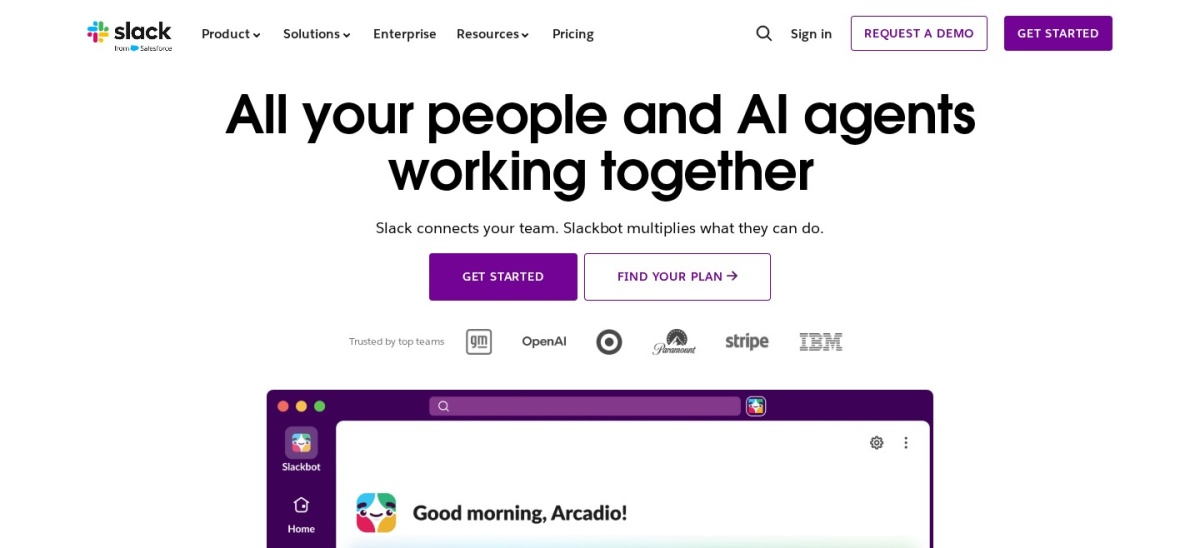
Slack is a communication platform that organizes workplace discussions into channels, direct messages and conversation threads. Its free subscription supports 10 connected apps, individual audio or video meetings and access to the previous 90 days of conversations.
The trade off is restricted access to older discussions and group meetings on the free tier. Pro costs $7.25 per user monthly with annual billing; a temporary monthly promotion does not change the regular annual price. It suits distributed teams that depend on frequent communication.
What we like
Extensive third-party application directory
Channels keep departmental discussions organized
Searchable conversations and shared files
Supports informal voice and video collaboration
Watch out for
Frequent notifications can interrupt focused work
Limited native project scheduling capabilities
Free accounts have restricted conversation history
Pro removes message history and integration limits.Visit slack.com
02
Asana
4.4/5on G2 (14,148 reviews, checked 25 Nov 2026)
Paid from$10.99/mo
Best for cross-functional project collaboration
Free users2
Free file size100 MB per file
Workflow automationStarter and above
Entry planStarter, per user
asana.com
Asana homepage, captured 25 Nov 2026.
Asana is a collaborative work management platform for assigning responsibilities, tracking deadlines and coordinating projects across departments. Its Personal plan supports 2 users, unrestricted task creation and multiple project layouts for organizing work.
The trade off is that larger teams need paid subscriptions, and advanced resource planning requires a higher tier. Starter costs $10.99 per user monthly on an annual subscription. It suits marketing, operations and product teams managing interconnected assignments.
What we like
Clear ownership of individual tasks
Useful visual project scheduling
Customizable workflow rules
Project status reporting
Watch out for
Restrictive free membership allowance
Portfolio management requires Advanced
Not a complete replacement for team messaging
Starter adds scheduling timelines, forms and automated workflows.Visit asana.com
03
ClickUp
4.6/5on G2 (15,921 reviews, checked 25 Nov 2026)
Paid from$12/mo
Best for all-in-one work collaboration
Free membersUnlimited
Free storage60 MB
Core automation allowance1,000 monthly
Entry planCore, per user
clickup.com
ClickUp homepage, captured 25 Nov 2026.
ClickUp is a shared workspace combining project tracking, document editing and workplace communication. Its free plan allows unlimited members and assignments but provides only 60 MB of file storage, making external storage useful for document-heavy projects.
The trade off is the time required to configure its many features and workspace settings. Core lists a regular price of $12 per user monthly, with a reduced $9 annual-billing offer displayed on the pricing page. It suits teams consolidating multiple productivity applications.
What we like
Multiple collaboration functions in one workspace
Flexible task organization
Collaborative documents
Generous free membership allowance
Watch out for
Numerous settings can complicate onboarding
Small free file storage allowance
Advanced reporting requires higher subscriptions
Core adds expanded storage, unlimited chat and Gantt charts.Visit clickup.com
04
Notion
4.6/5on G2 (14,019 reviews, checked 25 Nov 2026)
Paid from$10/mo
Best for document and knowledge collaboration
Shared documentsYes
Team knowledge baseYes
Database managementYes
Entry planPlus, per seat
notion.com
Notion homepage, captured 25 Nov 2026.
Notion is a document-centered workspace where teams create company wikis, project trackers and shared knowledge databases. Its Plus subscription starts at $10 per seat monthly, providing a collaborative environment for teams that organize work around written information.
The trade off is that teams must design their own organizational structure, which takes longer than adopting a conventional task manager. Plus costs $120 per seat annually, while expanded AI capabilities require higher subscriptions. It suits remote businesses that prioritize documentation and asynchronous collaboration.
What we like
Highly customizable knowledge bases
Documents and structured databases coexist
Collaborative page editing
Reusable workspace templates
Watch out for
Initial workspace design takes time
Less suitable for immediate team conversations
Advanced AI capabilities increase subscription costs
Plus expands collaboration beyond personal workspace use.Visit notion.com
05
monday.com
4.7/5on G2 (17,977 reviews, checked 25 Nov 2026)
Paid from$9/mo
Best for visual workflow collaboration
Free seats2
Free boards3
Workspace templates200+
Entry planBasic, per seat
monday.com
monday.com homepage, captured 25 Nov 2026.
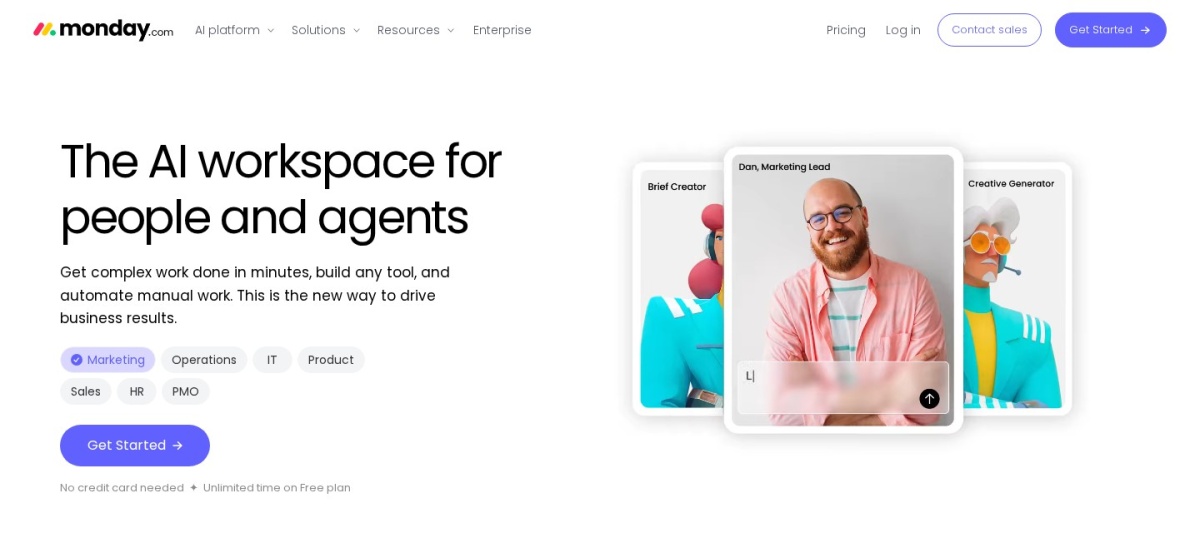
monday.com is a visual work management platform that helps teams coordinate assignments through customizable boards, documents and workflow statuses. Its free subscription supports 2 seats and 3 boards, with templates covering various business processes.
The trade off is that useful scheduling and workflow automation features depend on higher subscriptions. Basic starts at $9 per seat monthly with annual billing, and seat requirements or AI credit purchases can increase the final bill. It suits teams that prefer visual work tracking.
What we like
Clear visual representation of work progress
Customizable board structure
Templates for different departments
Accessible interface for nontechnical users
Watch out for
Subscription seat requirements affect small teams
Advanced automation requires higher plans
AI usage can introduce additional charges
Basic expands work capacity and provides access to additional AI features.Visit monday.com
06
Trello
4.4/5on G2 (14,078 reviews, checked 25 Nov 2026)
Paid from$5/mo
Best for affordable visual task collaboration
Free collaborators10 per workspace
Free boards10 per workspace
Free automation runs250 monthly
Entry planStandard, per user
trello.com
Trello homepage, captured 25 Nov 2026.
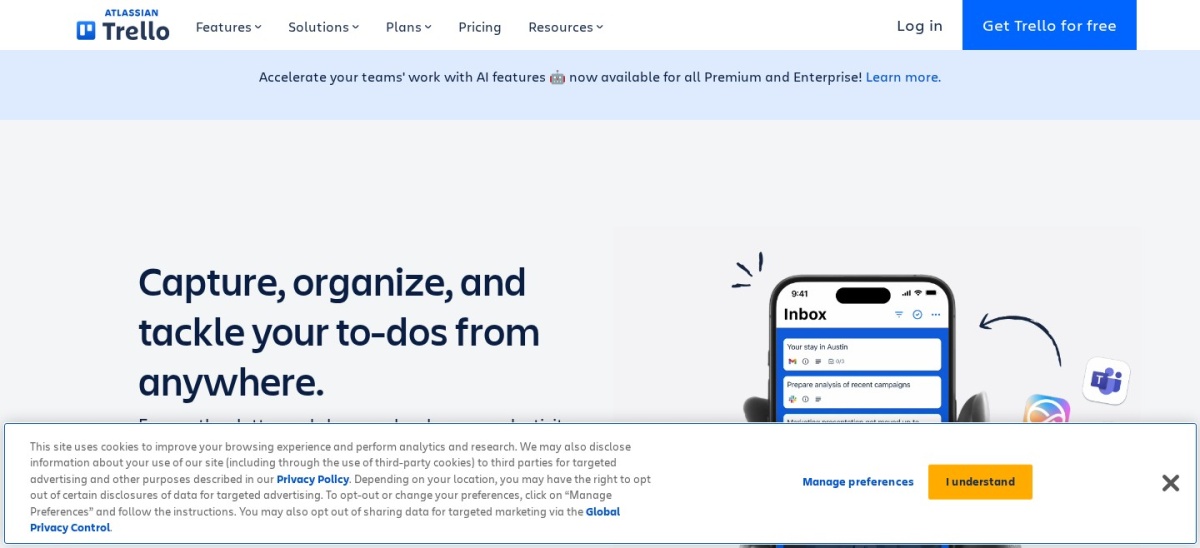
Trello is a board-based collaboration application that organizes work into movable task cards. Its free workspace accommodates 10 collaborators and 10 boards, giving small teams enough capacity to organize assignments without purchasing subscriptions.
The trade off is that complex project reporting and additional planning layouts require more expensive subscriptions. Standard costs $5 per user monthly with annual billing and expands board capacity. It suits small businesses, editorial teams and straightforward project workflows.
What we like
Easy drag-and-drop task organization
Affordable entry-level subscription
Practical free collaboration allowance
Built-in rule-based task automation
Watch out for
Limited complex project dependency management
Advanced reporting requires Premium
Large boards can become cluttered
Standard adds custom fields, unrestricted boards and higher automation allowances.Visit trello.com
07
Basecamp
4.1/5on G2 (5,490 reviews, checked 25 Nov 2026)
Paid from$29/mo
Best for small agencies and client collaboration
Free projects1
Freelancer users5
Freelancer storage10 GB
Entry planFreelancer, fixed package
basecamp.com
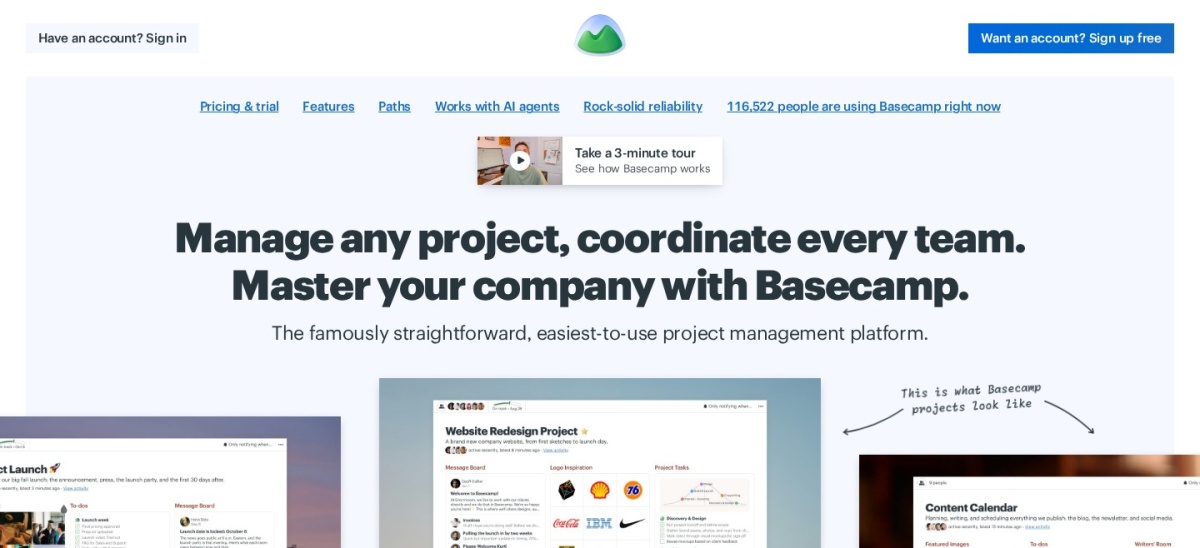
Basecamp homepage, captured 25 Nov 2026.
Basecamp is a project collaboration platform that combines discussions, shared files, schedules and task lists inside project-specific spaces. Its free Personal subscription provides a single project, while the Freelancer package accommodates 3 projects and up to 5 users.
The trade off is that its entry-level business package restricts project capacity and excludes features such as reusable project templates and time tracking. Freelancer costs $29 monthly for the package rather than each participant. It suits small agencies managing a handful of simultaneous client projects.
What we like
Project conversations stay organized
Predictable package-based pricing
Useful client collaboration structure
Less configuration than complex project management systems
Watch out for
Entry package limits concurrent projects
Limited advanced scheduling capabilities
Growing teams may need more expensive packages
Freelancer expands project capacity and includes 10 GB of storage.Visit basecamp.com
How much does a collaboration platform cost?
Entry-level per-user subscriptions in this comparison range from $5 monthly for Trello to a regular $12 monthly for ClickUp. Most displayed subscription rates assume annual billing, and temporary promotional prices are excluded from the price ladder.
The annual price ladder represents an individual paid seat for per-user subscriptions and the entire entry package for fixed-price subscriptions. Multiply individual seat prices by your required membership before comparing organizational costs.
For example, a team of 5 paying Trello's annual Standard rate would spend $300 annually. Basecamp's Freelancer package costs $348 annually and accommodates the same team size, although it restricts the number of projects.
Should you choose a messaging or project collaboration platform?
Messaging platforms are particularly useful when teams need immediate answers, frequent discussions and informal coordination. Slack focuses on these activities through organized conversation channels and connected applications.
Project collaboration platforms provide a more structured record of assignments, deadlines and work progress. Asana, ClickUp, monday.com and Trello help teams track commitments that might otherwise disappear inside conversations.
Document-centered platforms such as Notion serve teams that rely heavily on written procedures, research and internal knowledge. Choose according to where your organization experiences the most communication or coordination problems.
How we chose
We selected established collaboration platforms from the workplace communication, project management and knowledge management software categories. The comparison considers communication features, shared workspaces, task organization, subscription flexibility and suitability for different team sizes.
Official subscription pages and G2 product profiles were checked on 25 Nov 2026. Prices represent regular entry-level paid subscriptions, excluding temporary promotional offers. Annual subscription rates are calculated from published monthly equivalents, and review counts come from the corresponding G2 product profiles.
We excluded discontinued products, narrowly focused utilities and platforms without substantial public review histories. The rankings prioritize practical collaboration capabilities rather than review scores alone. No vendor paid for a place, and we do not claim testing for this list.
How to choose the best collaboration platform
Identify your team's biggest coordination problems before comparing subscriptions and feature lists.
Identify your primary collaboration needs. Determine whether your team needs faster communication, clearer task ownership, shared documents or centralized client coordination. Choose a platform that addresses the most important requirement.
Calculate your total subscription cost. Count employees, contractors and external collaborators who require access. Check minimum seat requirements, billing commitments, storage allowances and potential charges for additional features.
Check integrations and security controls. Confirm compatibility with your existing email, storage, calendar and business applications. Review account security, guest permissions and administrative controls before introducing confidential information.
Evaluate how easily employees can adopt it. Create a representative workspace using actual organizational requirements. Gather feedback on navigation, notifications, task assignments and document access before committing to a wider rollout.
FAQ
What is the best collaboration platform overall?
Slack is our top overall choice because it supports organized team discussions, searchable conversations and integrations with more than 2,600 applications. Asana or ClickUp may be more suitable if project tracking is your organization's primary collaboration requirement.
What is the best free collaboration platform?
ClickUp is a good free choice for teams that need shared task management without membership restrictions. Trello is another practical option, supporting up to 10 collaborators per free workspace. Slack works well when communication is more important than task tracking.
What is the cheapest paid collaboration platform?
Trello Standard is the cheapest per-user paid option in this comparison at $5 monthly with annual billing. Its subscription expands board capacity and introduces additional task organization features without requiring teams to purchase a more expensive project management suite.
Which collaboration platform is best for remote teams?
Slack works well for distributed teams that need regular communication and quick feedback. Notion is a better fit for organizations that emphasize written updates and asynchronous knowledge sharing, while ClickUp combines communication with centralized task management.
What is the difference between collaboration software and project management software?
Collaboration software focuses on helping employees communicate, exchange information and work together. Project management software emphasizes assignments, schedules, responsibilities and progress tracking. Many modern platforms combine both functions, although their primary strengths differ.
Is Slack better than Asana for team collaboration?
Slack is better for immediate conversations, informal meetings and workplace messaging. Asana is more suitable for structured assignments, project schedules and accountability. Organizations with substantial communication and project management requirements may benefit from using both applications.
Which collaboration platform is best for small businesses?
Trello is a practical starting point for small businesses because of its straightforward boards and affordable subscriptions. Basecamp is useful for small agencies that prefer package-based pricing, while ClickUp offers more extensive workspace customization.
Are collaboration platforms secure for business use?
Security depends on the platform, subscription and account configuration. Businesses should review authentication options, access permissions, data retention policies and administrative controls. Employees should also follow internal procedures for sharing confidential documents and inviting external collaborators.
SaaS SEO and WordPress specialist with about 8 years of experience. Rakib compares WordPress plugins, themes, hosting and software using public pricing, documentation and user reviews. See how we rank.