Best Cluster Management Software in 2026: 7 Tools Compared
WLWPLegible EditorsLast verified 22 Nov 2026How we rank6 min read
★ Short answer
Portainer leads for accessible multi-cluster governance with a free Business Edition license covering 3 nodes and paid plans starting at $1,045/yr. SUSE Rancher fits multi-cluster Kubernetes governance across clouds and on-premises environments, while Google Kubernetes Engine suits autoscaling Google Cloud workloads.
How we make this list: we compare pricing pages, product documentation and public user reviews, then re-check every price before each update. No product paid for a place. Disclosure.
Portainer holds a 4.8/5 rating across 306 reviews on G2 and starts at $1,045/yr for its Starter plan.
SUSE Rancher offers a free platform option alongside enterprise subscription tiers and carries a 4.4/5 score across 167 reviews on G2.
Google Kubernetes Engine provides $74.40 in monthly free tier credits and charges $0.10 per cluster per hour after credits.
Azure Kubernetes Service offers a free tier with no SLA and a Standard tier at $73 per cluster per month.
Red Hat OpenShift Dedicated starts at $0.076/hr per 4 vCPUs on a 3-year commitment.
What to look for in cluster management software
Cluster management software spans lightweight operator consoles, multi-cluster control planes, and fully managed cloud Kubernetes services. The right fit depends on whether your team runs on-premises servers, edge devices, or a single cloud provider.
Control plane fees and node licensing models shape long-term budgets far more than headline hourly rates. Some platforms bill per cluster hour, others license by node or worker core, and managed cloud services bill underlying compute and storage separately.
Operational overhead also varies sharply across tools. A self-hosted control plane gives portability across infrastructure, whereas a cloud-native service shifts upgrades and control plane operations to the cloud vendor.
Security controls, role-based access, and upgrade reliability matter once multiple teams share clusters. Checking how a platform handles version lifecycle, access policies, and cluster drift saves trouble during day-two operations.
Best for accessible multi-cluster container management
Entry paid planStarter at $1,045/yr (5–15 nodes)
Free option3 free Business Edition nodes
RuntimesKubernetes, Docker, Swarm, Podman
Node CPU capUp to 16 vCPUs per node on Starter
portainer.io
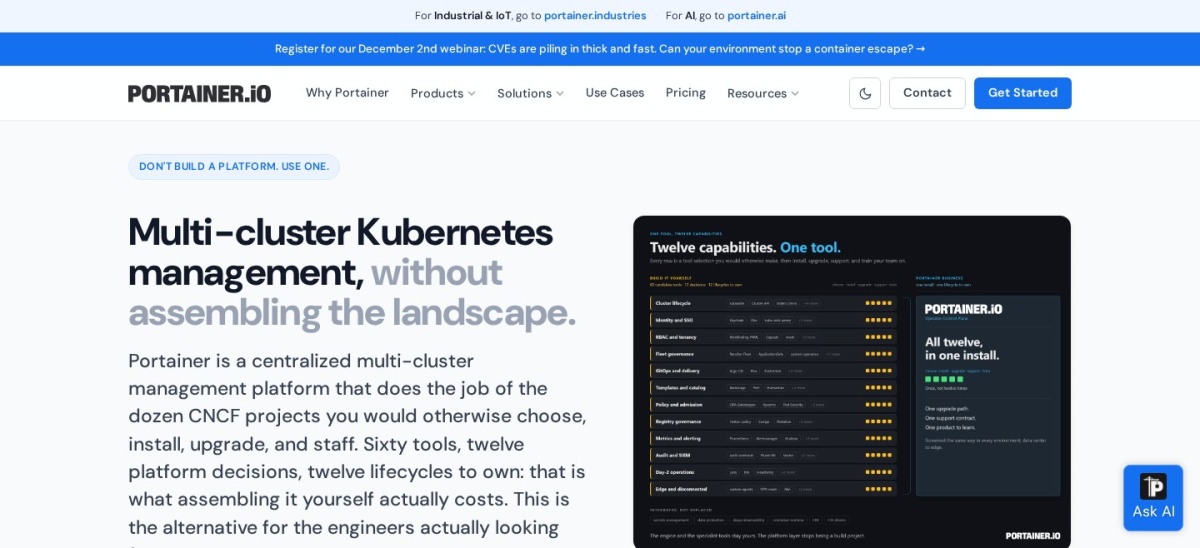
Portainer homepage, captured Nov 2026.
Portainer is a container and Kubernetes management console that centralizes governance across clusters without heavy platform overhead. Its free Business Edition licensing covers 3 nodes, while the paid Starter plan starts at $1,045/yr for 5, 10, or 15 nodes.
The trade off is that paid plans start at $1,045/yr once you grow past the 3 free nodes, and advanced Kubernetes workflows can feel lighter than direct CLI tooling. It suits small and mid-sized teams wanting a clear web interface across mixed container environments.
What we like
Includes 3 free Business Edition nodes for getting started
Covers Kubernetes, Docker, Swarm, and Podman under one license
High 4.8/5 rating across 306 reviews on G2
Watch out for
Starter plan begins at $1,045/yr above the 3-node free allowance
Some advanced Kubernetes operations still favor CLI tools
Paid Starter and Scale plans add higher node limits, team support options, and broader vCPU caps per node.Visit portainer.io
02
SUSE Rancher
4.4/5on G2 (167 reviews, checked Nov 2026)
PriceFree
Best for multi-cluster Kubernetes governance
Free optionRancher platform free option available
Paid tierRancher Prime via sales quote
ScopeMulti-cluster, on-prem, cloud, edge
G2 rating4.4/5 across 167 reviews
rancher.com
SUSE Rancher homepage, captured Nov 2026.
SUSE Rancher is a multi-cluster Kubernetes management platform that centralizes access control, cluster operations, and application delivery across environments. Teams can run the Rancher platform for free, while Rancher Prime provides enterprise support and security assurances on a custom quote.
The trade off is that paid Rancher Prime pricing requires contacting sales, and users note operational complexity during setup and cluster upgrades. It suits platform teams managing multiple Kubernetes clusters across clouds, edge sites, or on-premises infrastructure.
What we like
Free Rancher platform option available alongside enterprise tiers
Centralized governance and access controls across multiple clusters
Supports hybrid, on-premises, and cloud Kubernetes deployments
Watch out for
Rancher Prime pricing is custom quote rather than public self-serve
Initial setup and upgrades carry a learning curve
Rancher Prime adds enterprise support, extended lifecycle coverage, and hardened security artifacts.Visit rancher.com
03
Google Kubernetes Engine
4.5/5on G2 (269 reviews, checked Nov 2026)
Paid from$0.10/hr
Best for autoscaling Google Cloud workloads
Cluster fee$0.10 per cluster per hour
Free tier$74.40 monthly credits per billing account
ModesAutopilot and Standard clusters
G2 rating4.5/5 across 269 reviews
cloud.google.com
Google Kubernetes Engine homepage, captured Nov 2026.
Google Kubernetes Engine is a managed Kubernetes service on Google Cloud offering Autopilot and Standard modes with automated upgrades and scaling. It provides $74.40 in monthly free tier credits for zonal and Autopilot clusters, then charges $0.10 per cluster per hour.
The trade off is that $0.10/hr equals $876/yr per cluster before underlying compute, storage, and networking charges, and costs can climb quickly at scale. It suits teams already running workloads on Google Cloud that want automated cluster operations.
What we like
$74.40 monthly free tier credits help offset small cluster fees
Autopilot mode manages nodes and workload capacity automatically
Tight integration with Google Cloud IAM and billing services
Watch out for
Cluster management fees and compute costs add up across active clusters
Tied to the Google Cloud ecosystem
Beyond the $0.10/hr cluster management fee, GKE bills pod or node compute resources, persistent storage, and add-ons by usage.Visit cloud.google.com
04
Azure Kubernetes Service
4.4/5on G2 (116 reviews, checked Nov 2026)
Paid from$73/mo
Best for Microsoft Azure workloads
Paid control plane$73 per cluster/month (Standard SLA)
Free optionFree tier available without SLA
Long-term supportPremium tier at $438 per cluster/month
G2 rating4.4/5 across 116 reviews
azure.microsoft.com
Azure Kubernetes Service homepage, captured Nov 2026.
Azure Kubernetes Service is a managed Kubernetes service on Microsoft Azure with free and SLA-backed control plane tiers. It offers a free tier with no SLA and a Standard tier at $73 per cluster per month ($876/yr) with a financially backed uptime SLA.
The trade off is that the Standard tier costs $73 per cluster per month before Azure virtual machine, storage, and networking fees, and cluster upgrades can take care. It suits organizations standardized on Azure identity, networking, and cloud billing.
What we like
Includes a free control plane tier for non-SLA testing and small setups
Standard tier at $73/month adds a financially backed SLA
Integrates directly with Azure virtual machines, reservations, and savings plans
Watch out for
Underlying Azure compute and storage add separate ongoing costs
Cluster upgrades and networking options can feel complex for beginners
Standard and Premium tiers add SLA coverage, higher cluster scale options, and long-term support at $438/month per cluster.Visit azure.microsoft.com
05
Red Hat OpenShift
4.5/5on G2 (308 reviews, checked Nov 2026)
Starts at$0.076/hr
Best for enterprise compliance and hybrid platforms
Reserved rateFrom $0.076/hr per 4 vCPUs (3-yr term)
1-year rate$0.114/hr per 4 vCPUs on 1-year term
Hourly rate$0.171/hr per 4 vCPUs on-demand
G2 rating4.5/5 across 308 reviews
redhat.com
Red Hat OpenShift homepage, captured Nov 2026.
Red Hat OpenShift is an enterprise Kubernetes platform combining cluster lifecycle management, security guardrails, and developer workflows across clouds and on-premises. OpenShift Dedicated starts at $0.076/hr per 4 vCPUs on a 3-year contract (about $666/yr per 4-vCPU block).
The trade off is that non-committed rates are higher at $0.114/hr (1-year) or $0.171/hr (hourly) per 4 vCPUs, and the platform carries heavier resource and operational overhead. It suits regulated enterprises needing strict security policies and vendor-backed support.
What we like
Strict built-in security guardrails and enterprise lifecycle tooling
Supports hybrid, multi-cloud, and on-premises deployments
Strong 4.5/5 score across 308 reviews on G2
Watch out for
Higher hourly pricing without a multi-year commitment
Heavier system footprint and steeper learning curve than basic Kubernetes
Higher commitment and platform tiers add managed operations, multi-zone availability options, and expanded enterprise services.Visit redhat.com
06
Spectro Cloud Palette
4.5/5on G2 (13 reviews, checked Nov 2026)
PricingCustom/yr
Best for declarative full-stack cluster lifecycle
Pricing modelUsage (kCh) or node/GPU licensing
DeploymentsSaaS, self-hosted, cloud, bare metal, edge
Core featureDeclarative cluster profiles and add-on packs
G2 rating4.5/5 across 13 reviews
spectrocloud.com
Spectro Cloud Palette homepage, captured Nov 2026.
Spectro Cloud Palette is a Kubernetes management platform built around declarative cluster profiles spanning OS, Kubernetes, networking, storage, and add-ons. It prices by worker core-hours in cloud and virtualized setups, node count for bare metal and edge, and per GPU for AI editions.
The trade off is that pricing requires contacting Spectro Cloud for a quote, and advanced customization carries a learning curve. It suits platform teams standardizing cluster templates across cloud, on-premises, and edge fleets.
Supports SaaS, self-hosted, bare metal, edge, and VM workloads
4.5/5 rating across 13 reviews on G2
Watch out for
No public self-serve pricing table on the editions page
Steep learning curve for complex cluster customizations
Enterprise and specialized editions add air-gapped compliance options, dedicated support tiers, and GPU-focused management.Visit spectrocloud.com
07
Rackspace Spot
5/5on G2 (1 reviews, checked Nov 2026)
Starts at$40/mo
Best for auction-priced managed Kubernetes clusters
Prod control plane$40 per month (non-prod free)
Compute pricingAuction market from $0.001/hr base
Load balancer$10 per month per load balancer
Egress after allowance$0.01 per GB
spot.rackspace.com
Rackspace Spot homepage, captured Nov 2026.
Rackspace Spot delivers managed Kubernetes clusters backed by dynamic market-priced compute, with non-production control planes free and production control planes at $40/mo ($480/yr). Compute starts from a $0.001/hr base price, while load balancers cost $10/mo each.
The trade off is that auction-based compute fluctuates with market supply and demand, and G2 currently shows only 1 review. It suits cost-conscious teams running flexible, batch, or fault-tolerant Kubernetes workloads.
What we like
Non-production control planes are free and production control planes cost $40/mo
Dynamic market compute starts from a $0.001/hr base rate
$0.01/GB outbound transfer rate above included allowances
Watch out for
Market-driven capacity pricing can vary by region and demand
Limited public review count on G2 so far
Adding production high-availability control planes, load balancers, and persistent volumes adds predictable monthly usage charges.Visit spot.rackspace.com
Control plane vs. node pricing
Managed cloud Kubernetes services often charge a per-cluster control plane fee alongside worker node compute, storage, and load balancers. A small cluster that looks inexpensive on paper can cost noticeably more once worker nodes and egress traffic are added.
Self-hosted and multi-cluster control planes usually license by node, worker core, or usage metrics instead of charging a per-cluster hourly fee. That structure can favor teams running many smaller clusters when compute is already provisioned.
How we chose
This list covers established cluster management platforms and managed Kubernetes services across multi-cluster control planes, lightweight operator consoles, and cloud providers.
All pricing figures, plan tiers, and G2 ratings and review counts were verified on 22 Nov 2026 from vendor documentation and public review listings.
Tools without verifiable public pricing or current documentation for this category were excluded so every entry reflects current product details. No vendor paid for a place, and we do not claim testing for this list.
How to choose cluster management software
Follow four steps to narrow down a cluster management platform for your infrastructure.
Map your target infrastructure first. Decide whether you need single-cloud managed clusters, hybrid and on-premises control, or edge fleet management.
Check how licensing scales with clusters and nodes. Compare per-cluster hourly fees against per-node or per-core subscriptions based on how many clusters and nodes you plan to run.
Factor in underlying compute and add-on costs. Include worker nodes, persistent storage, load balancers, and network egress when estimating total monthly spend.
Match operational overhead to your team. Choose a managed cloud service to offload control plane upgrades, or a self-hosted platform when you want portable governance across environments.
FAQ
What is the difference between a managed Kubernetes service and a multi-cluster control plane?
A managed Kubernetes service runs and upgrades clusters inside a specific cloud provider, while a multi-cluster control plane centralizes governance, access, and lifecycle management across many clusters on cloud, on-premises, or edge infrastructure.
Does Google Kubernetes Engine have a free tier?
Yes, Google Kubernetes Engine includes $74.40 in monthly free tier credits per billing account for zonal and Autopilot clusters, after which cluster management is billed at $0.10 per cluster per hour plus compute and resource usage.
How does Azure Kubernetes Service price its control plane?
Azure Kubernetes Service offers a free tier with no SLA, a Standard tier at $73 per cluster per month with a financially backed SLA, and a Premium tier at $438 per cluster per month, excluding underlying Azure compute and storage.
Can you start with Portainer without a paid plan?
Yes, Portainer provides a free Business Edition licensing allowance for 3 nodes, with paid Starter plans starting at $1,045/yr for 5, 10, or 15 nodes.
Why do cluster management costs vary so much between teams?
Total spend depends on cluster count, node size, control plane fees, commitment discounts, and add-ons like load balancers, storage, and outbound data transfer.
When does a multi-cluster tool make sense over a single cloud console?
It makes sense when you manage clusters across multiple clouds, on-premises servers, or edge locations and want consistent policies and visibility from one place.