Best Auto Scaling Software in 2026: 8 Tools Compared
WLWPLegible EditorsLast verified 24 Nov 2026How we rank9 min read
★ Short answer
AWS Auto Scaling is the best auto scaling software for most teams, because it is free and built into AWS. Cast AI is the best Kubernetes automation pick, and Zesty suits teams that want scaling and commitments handled together.
How we make this list: we compare pricing pages, product documentation and public user reviews, then re-check every price before each update. No product paid for a place. Disclosure.
AWS Auto Scaling is free and built into AWS, so it is the default for EC2 and container workloads.
Cast AI combines node and workload autoscaling with rightsizing, rated 4.5 out of 5 on G2 from 283 reviews.
Zesty and nOps both hold 4.8 out of 5 on G2 and charge from usage or savings, not a flat fee.
Densify is the pick for enterprises whose real problem is rightsizing across clouds.
Azure VM Scale Sets are rated 4.5 out of 5 on G2 from 30 reviews and cost nothing beyond the VMs.
Karpenter, KEDA and HPA have no verifiable G2 rating, so they are not in this list despite being widely recommended.
What auto scaling software should cover
Auto scaling adds or removes compute capacity as demand changes, so an application stays available during a spike without paying for idle servers all month.
The cloud-native scalers cost nothing extra beyond the resources they run. AWS, Azure and Google Cloud all ship autoscaling with the platform, so start there if you already use one cloud.
Kubernetes scaling has two layers. Pod autoscalers change how many replicas run, while node autoscalers change how many machines the cluster needs, and most clusters need one from each layer.
Managed platforms trade control for simplicity. They provision nodes, rightsize pods and handle Spot instances together, which suits teams that would rather not tune scaling by hand.
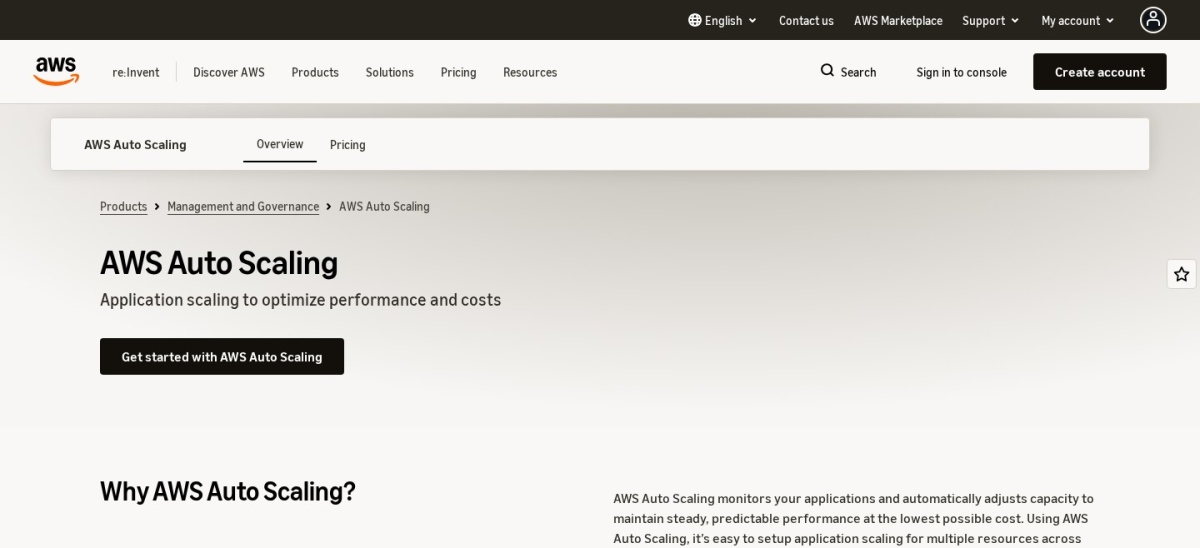
AWS Auto Scaling is the native scaler for AWS workloads. It adjusts EC2 capacity, ECS tasks and other AWS resources automatically based on demand, with target tracking policies that hold metrics like CPU use and predictive scaling that provisions ahead of expected traffic.
The trade off is scope. It is free, with no extra fee beyond the EC2 instances, storage and CloudWatch alarms you use, but it only scales AWS resources. It suits teams already running on AWS who want scaling without another vendor.
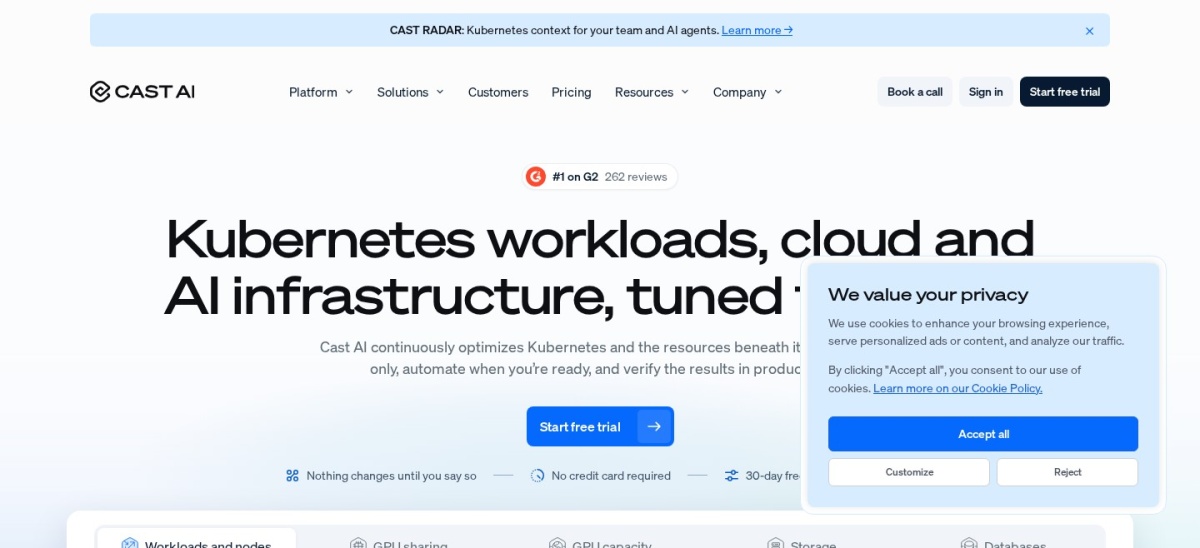
Cast AI is a Kubernetes automation platform that combines node and workload autoscaling with rightsizing. It provisions nodes, consolidates idle capacity, adjusts pod requests and handles Spot instances with automatic on-demand fallback, in one layer.
The trade off is price. Cost monitoring is free, but paid Growth and Enterprise plans are priced by vCPU, so the bill scales with cluster size. It suits teams running many Kubernetes clusters who want scaling and cost control handled together.
What we like
Node and workload scaling in one tool
Automatic Spot handling with fallback
Rated 4.5 out of 5 on G2 from 283 reviews
Free cost monitoring plan
Watch out for
Paid plans priced by vCPU, so costs scale
Needs a running cluster to show value
Smaller teams may not need the full platform
Paid plans priced by vCPU; monitoring is freeVisit cast.ai
03
Zesty
4.8/5on G2 (80 reviews, checked Nov 2026)
PricingCustom/yr
Best for scaling and commitments
CloudsAWS-focused
Commitment automationYes
Kubernetes optimizationYes
Paid planUsage-based, custom
zesty.co
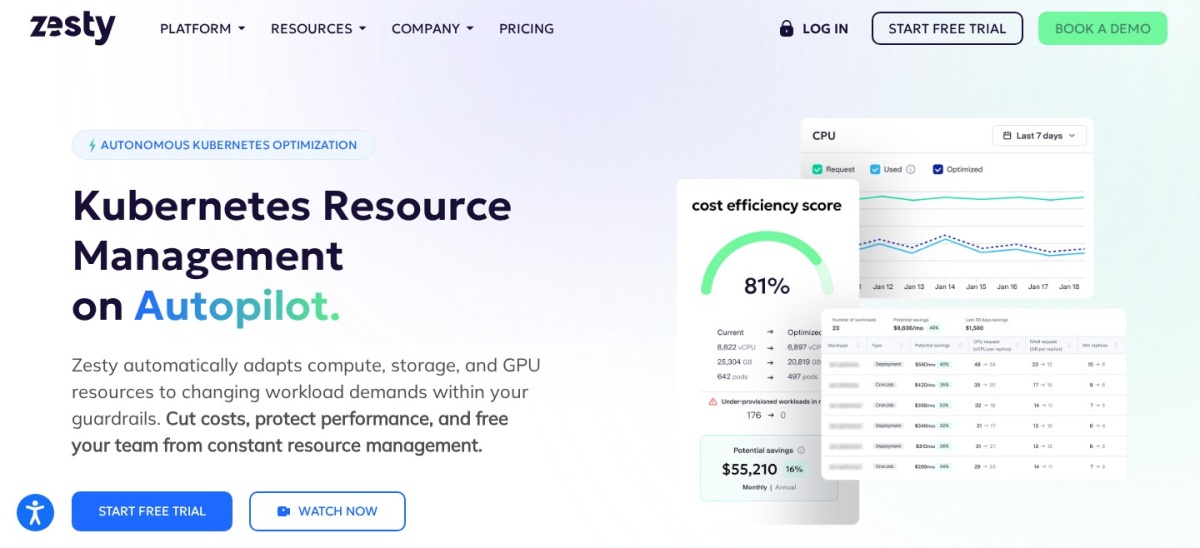
Zesty homepage, captured Nov 2026.
Zesty is a cloud automation platform that makes AWS infrastructure more elastic by adjusting resources to match real-time demand. It started with commitment management and expanded into EBS volumes and Kubernetes optimization, right-sizing in the moment rather than forecasting up front.
The trade off is pricing. Zesty charges usage-based tiers plus a share of savings, so there is no fixed monthly price to quote. It suits teams that want scaling, instance choice and commitment handling together rather than tuned by hand.
nOps is a cloud management platform that combines cost visibility with automated optimization. It covers commitment management, rightsizing, Spot optimization and cleanup, with a free option and a percentage-of-savings model that means you pay for results.
The trade off is scope. nOps is AWS-first, and its autonomous optimization charges a share of realized savings, so the fee moves with the saving. It suits AWS teams that want visibility and automation in one platform.
What we like
Cost visibility plus automation in one
Rated 4.8 out of 5 on G2 from 134 reviews
Free option available
Optimizes $5+ billion in cloud spend
Watch out for
AWS-first, thinner on other clouds
Fee is a share of savings
Setup takes time to show results
Free option; autonomous plans take a share of savingsVisit nops.io
05
Densify
4.7/5on G2 (29 reviews, checked Nov 2026)
PricingCustom/yr
Best for rightsizing first
CloudsAWS, Azure, GCP, Kubernetes
RightsizingYes, ML-based
AutomationAfter recommendation
Paid planQuote-only
densify.com
Densify homepage, captured Nov 2026.
Densify is an analytics platform that analyzes actual resource use with machine learning and recommends the right instance types, sizes and scaling settings across AWS, Azure, GCP and Kubernetes. It focuses on getting the size right before automation changes anything.
The trade off is price and pace. Densify is priced by quote and suits enterprises, and it recommends before it automates, so teams that want instant scaling should pair it with a scaler. It suits enterprises whose real problem is rightsizing.
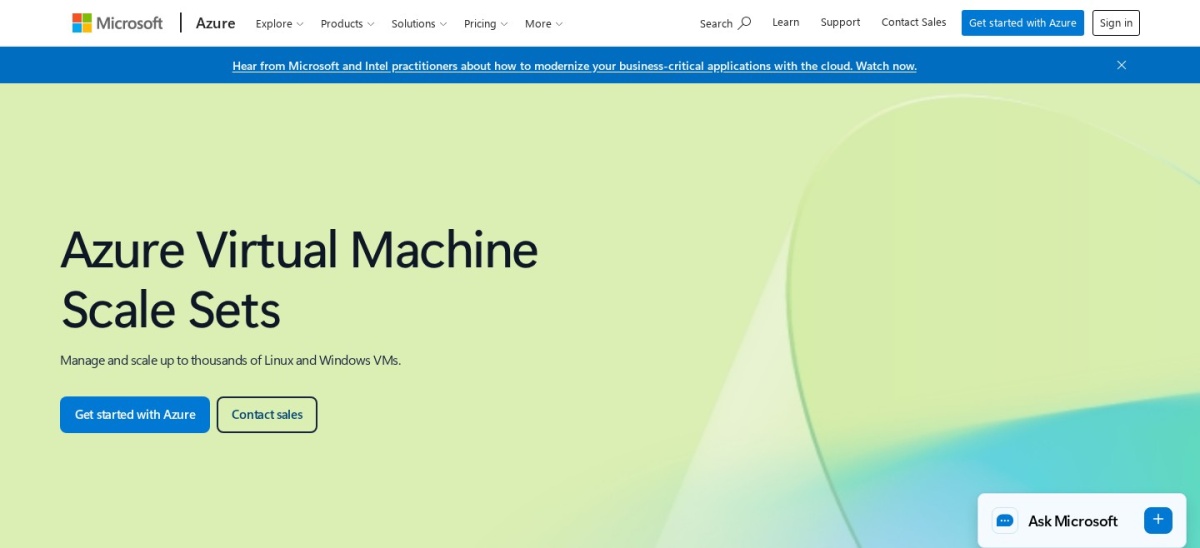
Azure VM Scale Sets is the Azure way to run and scale identical VMs. Autoscale rules add or remove instances based on metrics or schedules, and the sets work with App Service plans and AKS clusters, with no separate fee for the autoscale feature itself.
The trade off is scope. You pay for the Azure resources you run, not for autoscaling, but the feature only scales Azure resources. It suits Azure teams that want native scaling without another vendor.
4.1/5on G2 (Not published reviews, checked Nov 2026)
PricingCustom/yr
Best for Spot instance scaling
Spot orchestrationYes
Interruption predictionYes
Multi-cloudYes
Paid planUsage-based, custom
spot.io
Spot by NetApp homepage, captured Nov 2026.
Spot by NetApp is a cloud optimization service that automates resource provisioning, performance tuning and cost reduction by using Spot instances intelligently. It predicts interruption risk, rebalances affected nodes and falls back to on-demand capacity when Spot capacity is unavailable.
The trade off is price and proof. Spot is priced by usage and quote, and its G2 rating of 4.1 out of 5 has no published review count. It suits teams that want scaling, instance choice and cost control handled together across clouds.
IBM Turbonomic is an application resource management platform that automates scaling decisions across clouds. It analyzes application demand and adjusts compute, storage and database resources continuously, so applications get what they need without manual tuning.
The trade off is price and weight. Turbonomic is priced by quote for enterprise teams, and it is a broad platform rather than a focused scaler. It suits enterprises running many applications across clouds that want automation with governance.
Native scalers are free and close to the metal. They know the cloud they run on, but they leave tuning, rightsizing and Spot handling to your team.
Managed platforms such as Cast AI, Zesty and nOps combine scaling with cost control. They provision nodes, consolidate idle capacity and pick cheaper instances automatically.
The right pick depends on team size. A small team on one cloud should start native, while a team running many Kubernetes clusters gains more from a managed layer.
How we chose
We started from every auto scaling tool still sold or maintained in 2026, then kept those with a verifiable G2 rating and a working vendor site.
Prices come from vendor pricing pages and November 2026 comparisons, checked on 24 November 2026. Most tools in this category are free or priced by usage and savings, so there is no fixed monthly price to quote. Ratings come from G2 on the same day.
We left out Karpenter, KEDA, HPA, the Cluster Autoscaler, Azure Autoscale and Google Cloud Autoscaler because no verifiable G2, Capterra or Trustpilot rating could be found for them. No vendor paid for a place, and we do not claim hands-on testing for this list.
How to choose auto scaling software
Start with where your workloads already run, then decide how much tuning you want to hand over.
Start with your cloud's native scaler. If you run on AWS, Azure or Google Cloud, the built-in scaler is free and the fastest way to start.
Split pod scaling from node scaling. Pick a pod autoscaler for replicas and a node autoscaler for machines, or use a managed platform that covers both.
Check Spot handling before you commit. Spot instances cut costs, but you need automatic fallback to on-demand when capacity disappears.
Measure savings after a month. Compare the bill before and after autoscaling, and keep the tool only if the saving beats its fee.
FAQ
What is the best auto scaling software?
AWS Auto Scaling is the best auto scaling software for most teams, because it is free and built into AWS. Cast AI is the best Kubernetes automation pick, and Zesty suits teams that want scaling and commitments handled together.
Is auto scaling software free?
The cloud-native scalers are free: AWS Auto Scaling, Azure Autoscale and Google Cloud Autoscaler charge no extra fee beyond the resources they run. Cast AI also has a free cost monitoring plan, while managed platforms charge by usage or savings.
What is Karpenter and why is it not in this list?
Karpenter is the modern open-source Kubernetes node provisioner, and most guides call it the default for AWS and Azure teams. It is not in this list because no verifiable G2, Capterra or Trustpilot rating could be found for it.
How does auto scaling save money?
Auto scaling removes idle capacity when demand falls, so you stop paying for servers nobody uses. Managed platforms add rightsizing and Spot instance handling, which can cut cloud bills by 40 to 60 percent in published customer reports.
Do I need one auto scaling tool or two?
Most Kubernetes clusters need two: a pod autoscaler such as HPA or KEDA, and a node autoscaler such as the Cluster Autoscaler or Karpenter. Managed platforms such as Cast AI combine both layers in one tool.
What is the difference between scaling and rightsizing?
Scaling changes how much capacity runs right now, while rightsizing changes the size of each unit. Densify focuses on rightsizing, analyzing actual use and recommending the right sizes before automation changes anything.