Best AI Orchestration Software in 2026: 7 Tools Compared
WLWPLegible EditorsLast verified 22 Nov 2026How we rank14 min read
★ Short answer
TrueFoundry is our top AI orchestration software pick because its free Developer plan supports up to 3 users and 10,000 gateway requests per user monthly. Dify is better for building visual AI agent workflows, while LangSmith suits developers who need agent tracing, evaluation, and production monitoring.
How we make this list: we compare pricing pages, product documentation and public user reviews, then re-check every price before each update. No product paid for a place. Disclosure.
TrueFoundry offers a free Developer plan for 3 users, with Pro starting at $25 per user monthly and 20,000 gateway requests per user.
Dify Professional costs $590 annually and includes 5,000 monthly message credits, 50 applications, and 3 team members.
LangSmith Plus costs $39 per seat monthly and includes 10,000 base traces before pay-as-you-go charges.
Zapier Professional starts at $19.99 monthly and connects AI workflows with more than 9,000 applications.
PromptLayer Pro costs $49 monthly, with unlimited workspaces and additional transactions priced at $0.003 each.
Botpress Plus costs $150 monthly billed annually with 250 conversations; Relevance AI uses custom enterprise pricing.
What to look for in AI orchestration software
AI orchestration software connects language models, AI agents, business applications, and data sources into coordinated workflows. Instead of managing every model call and integration separately, teams can control how information moves between systems and how automated tasks execute.
The biggest distinction is between model orchestration and workflow orchestration. Model orchestration handles routing, credentials, provider connections, monitoring, and usage policies. Workflow orchestration coordinates decisions, tools, agent handoffs, external applications, and business processes.
Development teams should prioritize debugging, evaluations, API compatibility, and production observability. Business users may prefer visual builders, ready-made integrations, approval steps, and straightforward deployment options.
Compare security and governance capabilities before connecting sensitive business data. Relevant features include role-based permissions, audit logs, credential storage, approval workflows, usage budgets, and private deployment.
Pricing can be more complicated than a subscription fee. Model tokens, agent executions, tracing events, workflow tasks, external integrations, and additional seats may generate separate charges. Calculate costs against an expected production workload.
TrueFoundry is an AI orchestration platform that centralizes model routing, agent connections, API access, and governance. Its free Developer plan supports 3 users, 10,000 gateway requests and tool calls per user monthly, an LLM gateway, an MCP gateway, and a registry for prompts, skills, and agents.
The trade off is that Developer lacks built-in guardrails, advanced access controls, and extended logging. Pro costs $25 per user monthly and increases the allowance to 20,000 gateway requests per user, while model-provider costs remain separate. It suits engineering teams building production AI applications across multiple models.
What we like
Free AI gateway for development teams
Centralizes model and MCP tool access
Supports virtual model groups and routing
Built-in governance and budget controls on Pro
Enterprise private deployment options
Watch out for
Model-provider charges are separate
Free plan has limited log retention
Advanced guardrails require Pro
Private deployment requires Enterprise
Pro adds guardrails, SSO, budget controls, longer logs, and expanded gateway usage.Visit truefoundry.com
02
Dify
4.1/5on G2 (20 reviews, checked Nov 2026)
Paid from$590/yr
Best for visual AI agent orchestration
Free applications5
Professional apps50
Message credits5K/month
Paid planProfessional, $590/yr
dify.ai
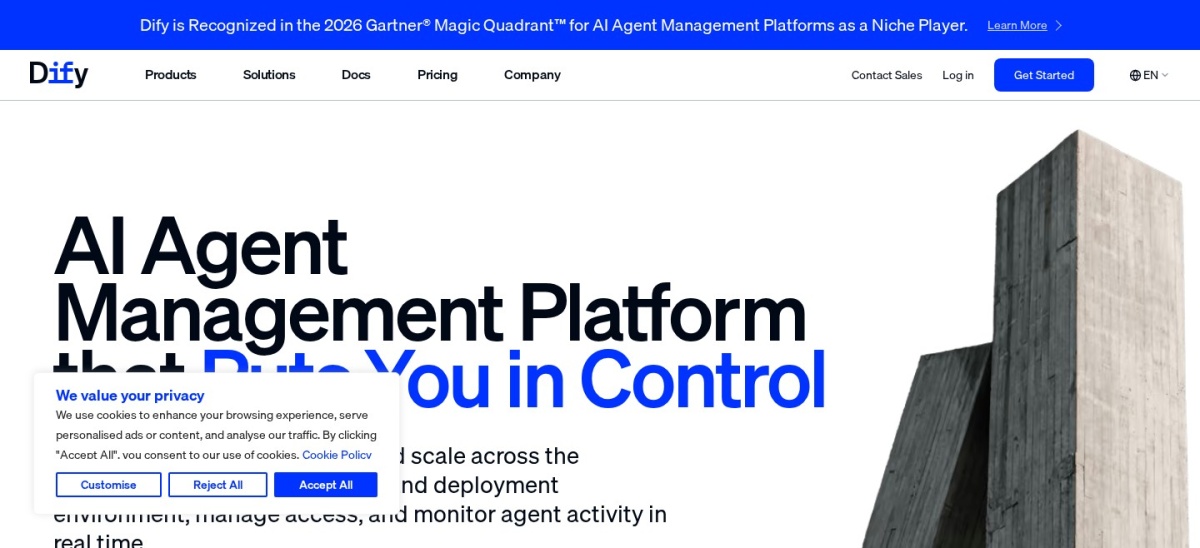
Dify homepage, captured Nov 2026.
Dify is an AI application platform for building workflows, agents, and retrieval-augmented generation systems through a visual interface. Its free Sandbox includes 5 applications and 200 message credits. Professional provides 50 applications, 3 team members, 5,000 monthly message credits, and 20,000 workflow trigger events monthly.
The trade off is that hosted plans limit message credits, knowledge storage, and application capacity. Professional costs $590 annually, and additional model usage may require external API keys. It suits developers and product teams creating AI workflows without maintaining every component through custom code.
What we like
Visual agent and workflow builder
Free cloud Sandbox
Supports multiple model providers
Built-in knowledge base and RAG features
Open-source self-hosted edition available
Watch out for
Cloud credits and application limits apply
Self-hosting requires technical maintenance
Advanced governance requires Enterprise
Complex workflows still need technical planning
Professional expands applications, credits, team access, and workflow trigger capacity.Visit dify.ai
03
LangSmith
4.4/5on G2 (97 reviews, checked Nov 2026)
Paid from$39/mo
Best for agent tracing and production monitoring
Free seats1
Free base traces5K/month
Plus base traces10K/month
Paid planPlus, $39/seat/mo
langchain.com
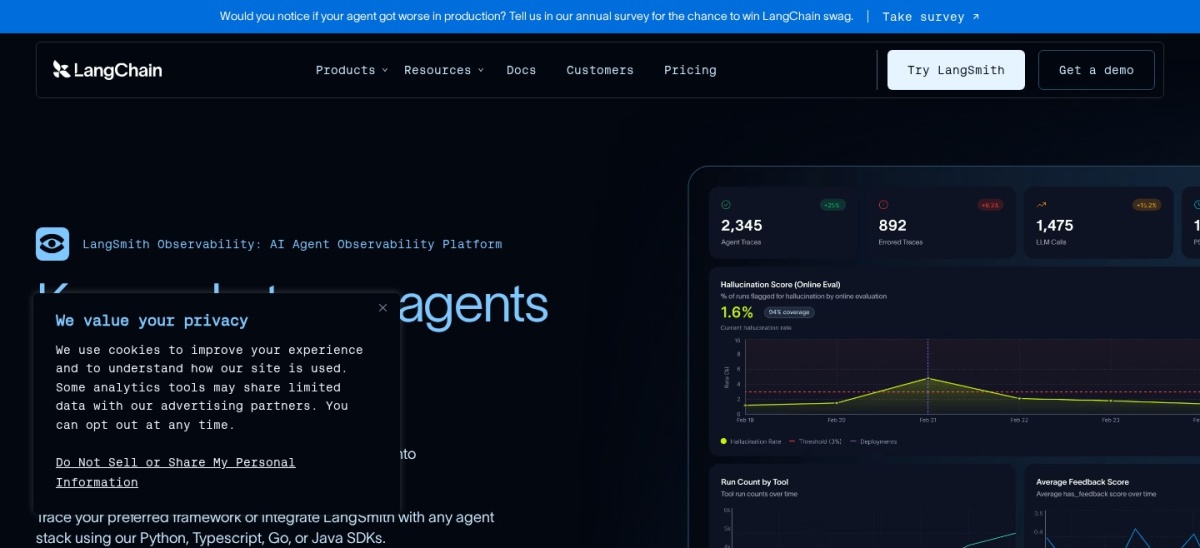
LangSmith homepage, captured Nov 2026.
LangSmith is an AI agent engineering platform for tracing execution, evaluating outputs, deploying agents, and monitoring production behavior. Its free Developer plan includes 1 seat and 5,000 base traces monthly. Plus provides 10,000 base traces per month, Agent Server access, and additional deployment capabilities.
The trade off is that tracing, deployment, and other services can incur pay-as-you-go charges beyond included allowances. Plus costs $39 per seat monthly, making team size another cost consideration. It suits developers who need detailed visibility into agent behavior and repeatable evaluation before production releases.
What we like
Detailed agent execution traces
Free development tier
Evaluation datasets and monitoring
Supports managed agent deployment
Works with different agent frameworks
Watch out for
Usage charges can increase total costs
Team access requires paid seats
Less suitable for simple no-code automation
Advanced hosting options require Enterprise
Plus adds team access, expanded tracing, and Agent Server deployment capabilities.Visit langchain.com
04
Zapier
4.5/5on G2 (2,170 reviews, checked Nov 2026)
Paid from$19.99/mo
Best for no-code AI workflow automation
App integrations9,000+
Free tasks100/month
Professional workflowsMulti-step
Paid planFrom $19.99/mo
zapier.com
Zapier homepage, captured Nov 2026.
Zapier is a no-code orchestration platform connecting AI tools, business applications, and automated workflows. Its free plan includes 100 monthly tasks, unlimited Zaps, Tables, and Forms, and basic two-step automations. Professional adds multi-step workflows, premium integrations, webhooks, and AI fields across a catalog of more than 9,000 applications.
The trade off is that Zapier focuses on business process orchestration rather than low-level model routing or hosting. Professional starts at $19.99 monthly, and task volume affects subscription costs. It suits marketing, sales, and operations teams connecting AI-generated information to existing software without building custom integrations.
What we like
More than 9,000 application connections
Free entry plan
Visual workflow automation
Multi-step AI workflows on Professional
Supports webhooks and MCP connections
Watch out for
Not a dedicated inference gateway
Task usage affects subscription costs
Advanced organizational controls require upgrades
Complex agent logic may require development work
Professional adds multi-step Zaps, premium integrations, webhooks, and AI fields.Visit zapier.com
05
PromptLayer
4.3/5on G2 (24 reviews, checked Nov 2026)
Paid from$49/mo
Best for prompt workflows and model evaluations
Free users5
Free requests2.5K/month
Pro workspacesUnlimited
Paid planPro, $49/mo
promptlayer.com
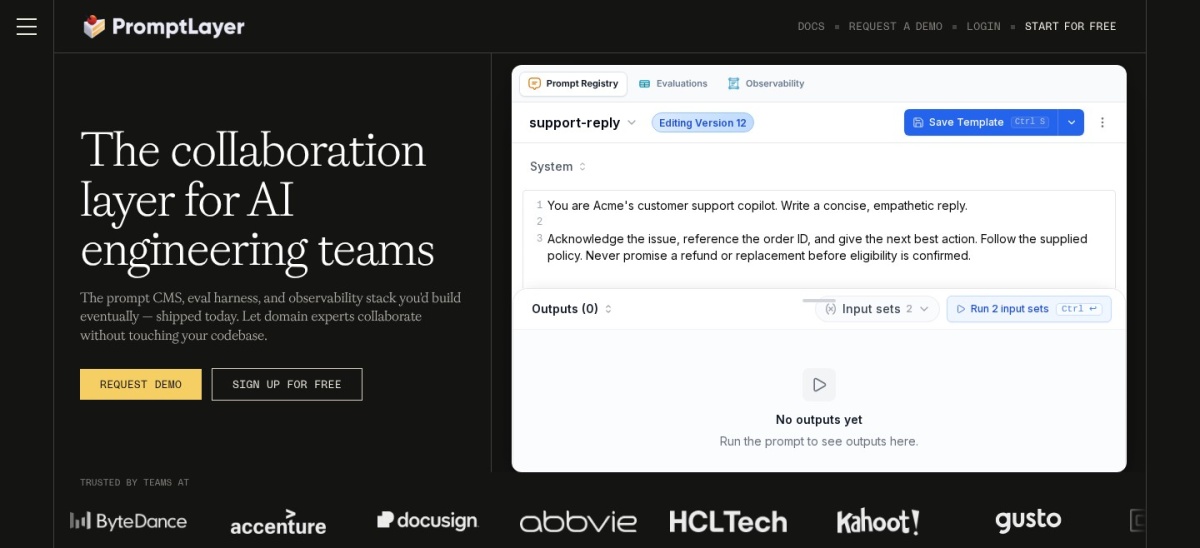
PromptLayer homepage, captured Nov 2026.
PromptLayer is an AI development platform that organizes prompt versions, agent workflows, evaluations, and model request monitoring. Its free plan supports 5 users, 2,500 monthly requests, 750 agent node executions, and 250 evaluation cell executions. Pro adds unlimited workspaces and playgrounds with larger dataset allowances.
The trade off is that Pro retains baseline usage limits and charges $0.003 per additional transaction. It costs $49 monthly, while larger teams may require Team at $500 monthly. It suits engineering teams that need structured prompt management and evaluations across evolving AI applications.
What we like
Centralized prompt version management
Free multi-user workspace
Agent execution and evaluation features
Request history and monitoring
Unlimited workspaces on Pro
Watch out for
Usage-based overage charges
Advanced access controls require Enterprise
Webhooks require higher plans
Learning curve for complex evaluation workflows
Pro adds unlimited workspaces, unlimited playgrounds, and larger dataset storage.Visit promptlayer.com
06
Botpress
4.5/5on G2 (519 reviews, checked Nov 2026)
Paid from$150/mo
Best for customer-facing AI agent orchestration
Free conversations100
Free agents3
Plus conversations250/month
Paid planPlus, $150/mo annually
botpress.com
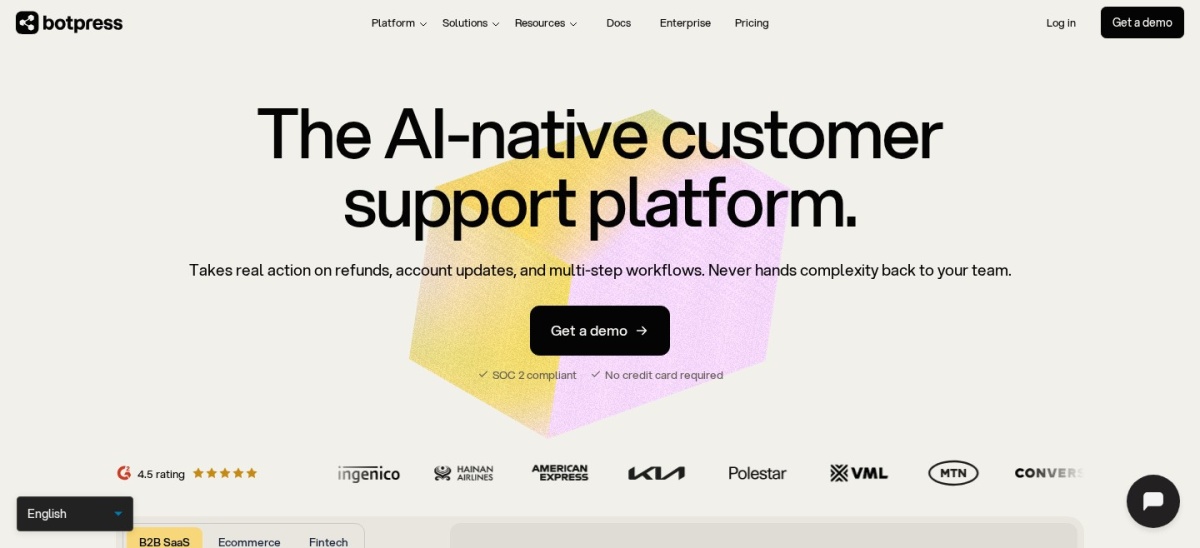
Botpress homepage, captured Nov 2026.
Botpress is a conversational AI orchestration platform for building, deploying, and managing customer support agents. Its free plan supports 100 conversations, 3 seats, and 3 AI agents. Plus includes 250 monthly conversations, unlimited AI agents, a customizable help center, and an included AI usage allowance.
The trade off is that Botpress specializes in conversational agents rather than general-purpose model infrastructure. Plus costs $150 monthly billed annually, and additional conversations are sold separately. It suits customer support teams coordinating AI responses, knowledge retrieval, human escalation, and external application workflows.
What we like
Visual AI agent builder
Free development access
Supports knowledge base connections
Unlimited agents on Plus
Human support and routing features
Watch out for
Conversation allowances apply
Additional conversations increase costs
Not designed primarily for model gateway management
Team-level controls require higher subscriptions
Plus adds unlimited agents, expanded conversations, and white-label customer experiences.Visit botpress.com
07
Relevance AI
4.3/5on G2 (20 reviews, checked Nov 2026)
PricingCustom pricing
Best for enterprise multi-agent automation
Enterprise agentsUnlimited
Integrations2,000+
GovernanceSSO, RBAC, audit logs
Paid planEnterprise, custom
relevanceai.com
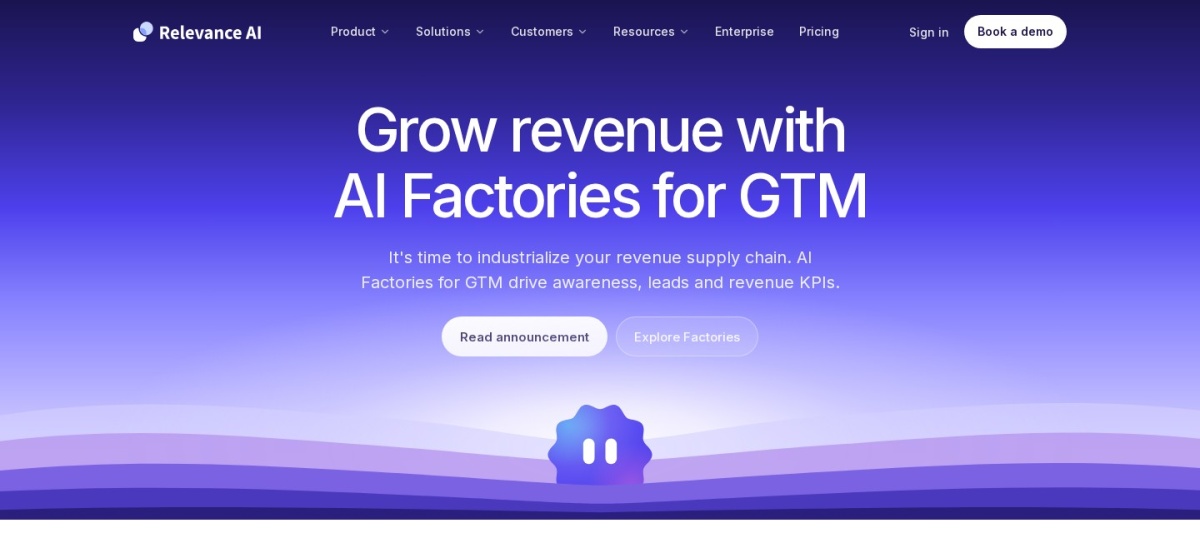
Relevance AI homepage, captured Nov 2026.
Relevance AI is a business AI orchestration platform for building and coordinating teams of autonomous agents. Its Enterprise offering includes unlimited agents, tools, users, projects, and workforces, with more than 2,000 integrations. It also supports agent evaluations, workflow approvals, analytics, and access controls.
The trade off is that the current official pricing page lists Enterprise through sales consultation without a standard public subscription price. Deployment scope and operating costs require a quotation. It suits larger organizations coordinating AI agents across sales, customer operations, and other repeatable business processes.
What we like
Supports coordinated multi-agent workflows
More than 2,000 integrations
Enterprise governance and audit controls
Agent evaluations and analytics
Unlimited agents and users on Enterprise
Watch out for
No published regular enterprise subscription price
AI model orchestration vs agent orchestration vs workflow automation
AI model orchestration manages the connection between applications and model providers. Common responsibilities include routing requests, selecting models, managing credentials, enforcing usage policies, and monitoring inference costs.
Agent orchestration manages how autonomous or semi-autonomous agents complete tasks. It may coordinate planning, tool execution, agent handoffs, shared context, error recovery, and human approvals.
Workflow automation connects AI operations with other business systems. For example, a workflow might extract information from a document, classify it with an AI model, update a database, and notify a team member.
TrueFoundry focuses on model access and governance. Dify, LangSmith, PromptLayer, and Botpress support different aspects of agent development and operation. Zapier connects AI activities to business applications, while Relevance AI coordinates business-focused agent workforces.
What production AI orchestration requires
Moving AI workflows into production requires more than connecting a model to an application. Teams need ways to observe execution, investigate errors, control permissions, manage changes, and limit operating costs.
Review how each platform handles failed requests, retries, timeouts, and external service outages. A workflow that automatically repeats unsuccessful calls can consume additional model tokens and integration credits.
Evaluation and logging are particularly important for multi-agent systems. Traces can help identify which model call, tool execution, or agent decision caused an incorrect result.
For sensitive business processes, consider approval checkpoints before agents send messages, change records, or perform other consequential actions. Human review may remain necessary even when the underlying workflow is automated.
How we chose
We selected established AI orchestration platforms with documented agent, model management, or AI workflow capabilities. The shortlist covers model gateways, visual agent development, observability, prompt management, conversational AI, no-code automation, and enterprise multi-agent coordination.
Official pricing pages and G2 product profiles were opened on November 24, 2026 for this article dated November 22, 2026. We compared published subscription prices, plan allowances, review scores, and review counts. Annual estimates use regular monthly prices multiplied by twelve, except where vendors explicitly publish annual subscription prices.
We excluded products with insufficient independent review evidence, discontinued standalone offerings, and services without clear relevance to AI orchestration. Relevance AI uses Custom pricing because its current enterprise offering does not disclose a standard subscription rate. No vendor paid for a place, and we do not claim testing for this list.
How to choose the best AI orchestration software
Identify the type of AI orchestration you need, then compare integrations, production controls, and the costs associated with your expected workload.
Define the orchestration problem. Choose model gateway software when the priority is routing requests across providers. Select an agent development platform for multi-step reasoning and tool execution. Use workflow automation when AI tasks need to connect with business applications and operational processes.
Check model, data, and integration support. Verify supported AI providers, API standards, MCP connections, databases, and external applications. Confirm whether workflows can use existing provider credentials and whether changing models requires significant development work.
Evaluate monitoring and governance. Look for traces, error reporting, evaluation tools, audit logs, access controls, approval workflows, and usage budgets. Production applications may also need deployment controls, retention settings, and enterprise security features.
Calculate the complete subscription cost. Include user seats, model inference, workflow executions, task allowances, agent tool calls, tracing, and storage. Estimate costs using your expected monthly volume and examine what happens when included credits or requests are exhausted.
FAQ
What is the best AI orchestration software in 2026?
TrueFoundry is our overall pick for teams that need model routing, agent connectivity, and centralized governance. Its free Developer plan offers an accessible starting point. Dify is better for visual workflow development, while LangSmith focuses on tracing, evaluations, and production agent monitoring.
What is AI orchestration software?
AI orchestration software coordinates models, agents, tools, and applications to complete automated tasks. Depending on the platform, it may handle model routing, workflow execution, knowledge retrieval, monitoring, approvals, and external integrations. It helps teams operate AI applications without managing every connection independently.
What is the difference between AI orchestration and AI automation?
AI automation uses artificial intelligence to perform specific tasks, such as classification, extraction, or content generation. AI orchestration coordinates multiple tasks, models, agents, and external systems into a broader process. An orchestration platform can manage when automated actions happen and how their results are handled.
Is there free AI orchestration software?
Yes. TrueFoundry offers a free Developer plan, Dify has a free cloud Sandbox and community edition, and LangSmith provides free individual tracing access. Zapier, PromptLayer, and Botpress also have free plans. Usage limits and external model costs vary by product.
How much does AI orchestration software cost?
Published entry prices include Zapier Professional from $19.99 monthly, TrueFoundry Pro at $25 per user monthly, LangSmith Plus at $39 per seat monthly, and PromptLayer Pro at $49 monthly. Total costs can increase with model inference, workflow usage, additional seats, and other consumption-based charges.
Which AI orchestration software is best for developers?
TrueFoundry is relevant for model gateways and governance, while LangSmith provides detailed tracing, evaluations, and agent deployment capabilities. Dify offers a visual development environment with an open-source edition. The right choice depends on whether your team prioritizes infrastructure, debugging, or application construction.
Can AI orchestration platforms manage multiple agents?
Yes. Platforms such as Dify, Botpress, LangSmith, and Relevance AI support different approaches to agent development or coordination. Capabilities vary from workflow-driven task execution to managed agent deployment and enterprise agent workforces. Confirm the supported coordination patterns before selecting a platform.
What security features should AI orchestration software have?
Important features include credential protection, access controls, audit logs, data retention settings, and approval workflows. Larger organizations may also require SSO, private deployment, vendor security documentation, and contractual safeguards. The appropriate controls depend on the sensitivity of the information involved.
Can no-code platforms handle AI orchestration?
Yes. Dify, Zapier, and Botpress provide visual ways to coordinate AI workflows and external services. They can support many business automations without extensive programming. More complex model routing, specialized infrastructure, or custom agent behavior may still require developer-oriented tools.