Best AI Model Orchestration Platforms in 2026: 7 Tools Compared
WLWPLegible EditorsLast verified 22 Nov 2026How we rank12 min read
★ Short answer
TrueFoundry is our top AI model orchestration platform pick because its Developer plan includes an LLM gateway, MCP gateway, and 10,000 monthly requests per user. LangSmith is better for tracing and evaluating agent workflows, while Dify offers visual AI application development with a free cloud sandbox.
How we make this list: we compare pricing pages, product documentation and public user reviews, then re-check every price before each update. No product paid for a place. Disclosure.
TrueFoundry offers a free Developer plan for up to 3 users and Pro at $25 per user monthly, excluding model-provider charges.
LangSmith Plus costs $39 per seat monthly and includes 10,000 base traces per month before usage charges.
Dify Professional costs $590 annually and includes 5,000 monthly message credits and 50 applications.
PromptLayer Pro costs $49 monthly, with unlimited workspaces and additional usage billed at $0.003 per transaction.
Botpress Plus starts at $150 monthly with annual billing and includes 250 conversations monthly.
Pipedream Startup costs $99 monthly with annual billing, while Zapier Professional starts at $19.99 monthly.
What to look for in AI model orchestration platforms
AI model orchestration platforms coordinate how applications access language models, execute workflows, call tools, and handle results. They can help development teams avoid maintaining separate integrations and operational controls for every model provider.
The first distinction is between model gateways and workflow orchestration. Gateways manage access, routing, requests, credentials, and policies. Workflow platforms connect model calls to business logic, external applications, retrieval systems, and other AI agents.
Observability is another important consideration. Production applications need visibility into latency, errors, costs, prompt versions, model responses, and agent execution paths. Evaluation tools help teams compare changes before releasing updates.
Security and governance requirements depend on the application. Look for access controls, credential management, audit trails, budget limits, data retention settings, and deployment options appropriate for the information being processed.
Compare subscriptions alongside variable costs. Model-provider tokens, workflow executions, tracing, storage, external users, and integration requests may be charged separately. The lowest subscription price does not necessarily represent the total production cost.
TrueFoundry is an AI orchestration and gateway platform for managing model access, routing, agent tools, and governance. Its free Developer plan supports up to 3 users, 10,000 requests and tool calls per user monthly, an LLM gateway, an MCP gateway, and 7-day log retention. It also includes a registry for prompts, skills, and agents.
The trade off is that advanced guardrails, expanded budget controls, SSO, and longer log retention require Pro at $25 per user monthly. Model-provider charges are separate, and private deployments require Enterprise. It suits engineering teams that want centralized control of multiple AI models and agent integrations.
What we like
Free gateway access for small development teams
Centralized LLM and MCP model access
Built-in routing and governance features
Pro includes SSO and budget controls
Supports enterprise deployment options
Watch out for
Model-provider usage is billed separately
Free log retention is limited
Private deployment requires Enterprise
Advanced guardrails are unavailable on Developer
Pro adds guardrails, budget limits, SSO, longer logs, and expanded request capacity.Visit truefoundry.com
02
LangSmith
4.4/5on G2 (97 reviews, checked Nov 2026)
Paid from$39/mo
Best for AI agent tracing and evaluation
Free seats1
Free traces5K/month
Plus traces10K/month
Paid planPlus, $39/seat/mo
langchain.com
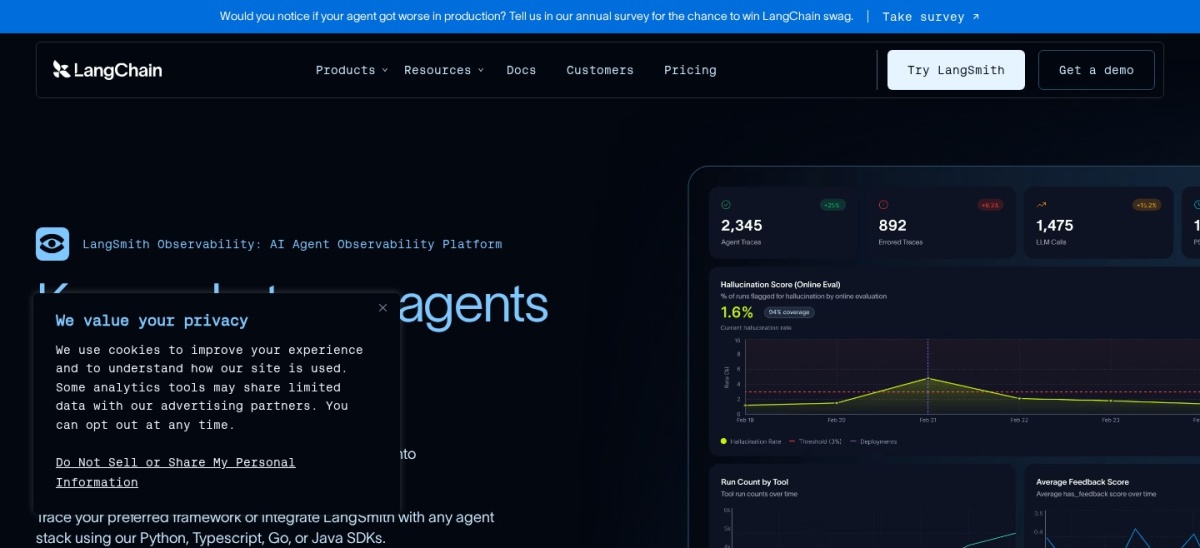
LangSmith homepage, captured Nov 2026.
LangSmith is an AI agent development and observability platform for tracing execution, evaluating outputs, and deploying agent applications. Its free Developer plan includes 1 seat and 5,000 base traces monthly. Plus adds 10,000 base traces, agent deployment capabilities, and access to additional engineering services.
The trade off is usage-based billing beyond included allowances, which makes total costs depend on traces, deployments, and other services. Plus costs $39 per seat monthly before additional consumption charges. It suits developers building AI agents who need detailed execution traces, evaluation datasets, and production monitoring.
Plus adds team seats, expanded tracing, Agent Server access, and deployment capabilities.Visit langchain.com
03
Dify
4.1/5on G2 (20 reviews, checked Nov 2026)
Paid from$590/yr
Best for visual multi-model AI application development
Free applications5
Professional apps50
Professional credits5K/month
Paid planProfessional, $590/yr
dify.ai
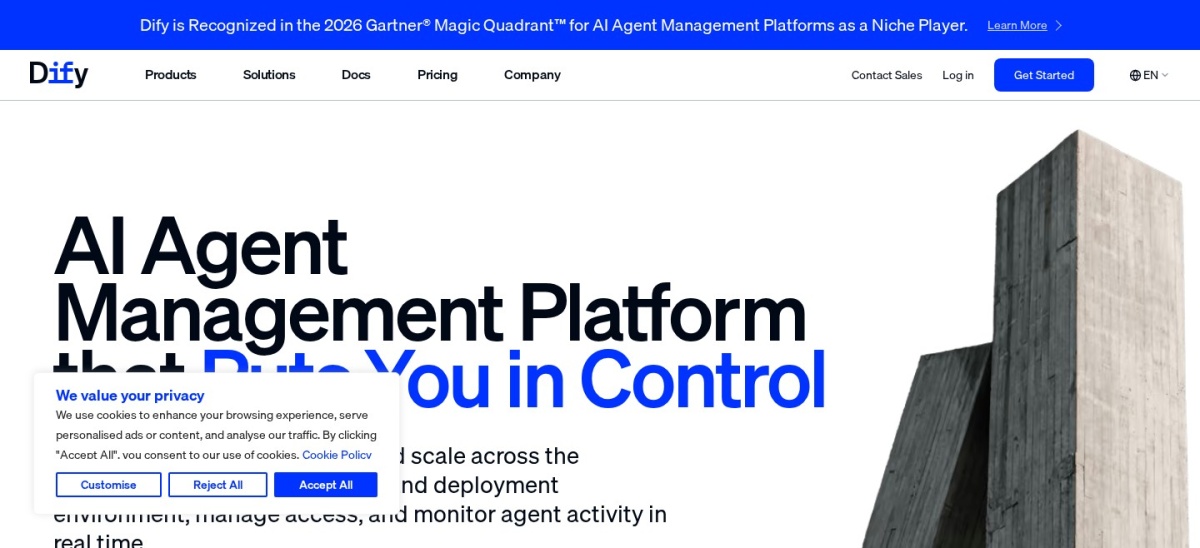
Dify homepage, captured Nov 2026.
Dify is an AI application development platform combining visual workflows, model management, retrieval-augmented generation, and agent capabilities. Its free Sandbox includes 5 applications and 200 message credits. Professional includes 50 applications, 3 team members, 5,000 monthly message credits, and 20,000 workflow trigger events monthly.
The trade off is that cloud plans limit applications, included credits, and workspace resources. Professional costs $590 annually, and additional model usage may require your own provider API keys. It suits developers and product teams that want a visual workflow builder without building every model integration from scratch.
What we like
Visual workflow and agent builder
Free cloud sandbox
Supports multiple model providers
Integrated knowledge base and RAG features
Open-source self-hosted edition available
Watch out for
Cloud credits and resources are limited
Self-hosting requires infrastructure management
Large team allowances require higher plans
Complex workflows require technical understanding
Professional adds more applications, message credits, team members, and workflow capacity.Visit dify.ai
04
PromptLayer
4.3/5on G2 (24 reviews, checked Nov 2026)
Paid from$49/mo
Best for prompt management and model evaluation
Free users5
Free requests2.5K/month
Pro workspacesUnlimited
Paid planPro, $49/mo
promptlayer.com
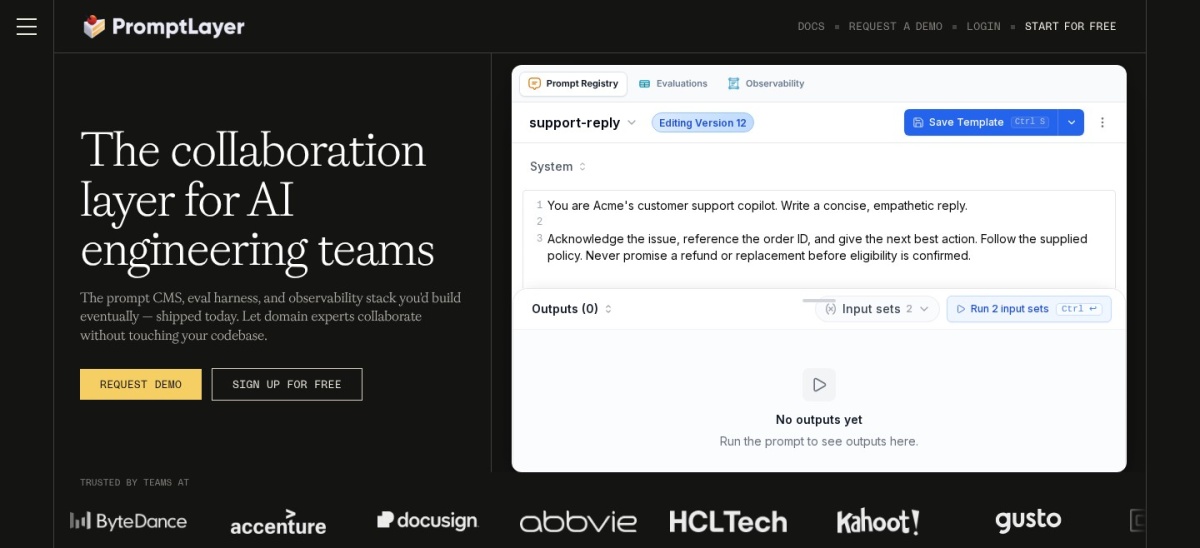
PromptLayer homepage, captured Nov 2026.
PromptLayer is an AI development platform for managing prompt versions, monitoring requests, and evaluating model responses. Its free plan includes 5 users, 2,500 monthly requests, 1 workspace, and 250 evaluation cell executions. Pro expands workspace access and supports unlimited playgrounds with usage-based transactions.
The trade off is that Pro retains baseline request allowances and adds $0.003 per transaction for additional usage. Pro costs $49 monthly, while larger teams may require the $500 monthly Team plan. It suits engineering teams managing prompt changes and evaluating applications across different language models.
What we like
Centralized prompt version management
Free multi-user plan
Model evaluation and testing tools
Request history and performance monitoring
Unlimited workspaces on Pro
Watch out for
Usage overages increase total costs
Advanced access controls require Enterprise
Learning curve for complex evaluations
Pro adds unlimited workspaces, playgrounds, larger datasets, and usage-based scaling.Visit promptlayer.com
05
Botpress
4.5/5on G2 (519 reviews, checked Nov 2026)
Paid from$150/mo
Best for orchestrating customer-facing AI agents
Free conversations100
Free agents3
Plus conversations250/month
Paid planPlus, $150/mo annually
botpress.com
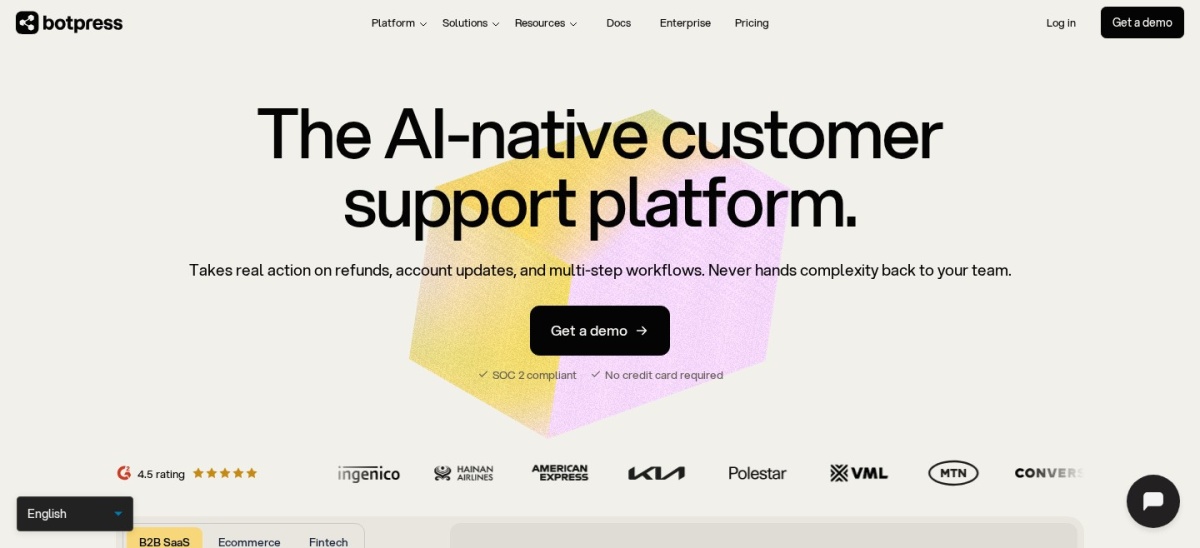
Botpress homepage, captured Nov 2026.
Botpress is an AI agent development platform focused on conversational applications and customer support workflows. Its free plan includes 100 conversations, 3 seats, and 3 AI agents. Plus includes 250 monthly conversations, unlimited AI agents, a customizable help center, and an included AI usage allowance.
The trade off is that Botpress focuses more on conversational orchestration than general-purpose model gateway management. Plus costs $150 monthly billed annually, with additional conversation packs available separately. It suits teams building customer support agents that need workflow routing, knowledge access, and external service connections.
What we like
Visual AI agent development environment
Free plan for initial projects
Knowledge base integration
Unlimited agents on Plus
Supports customer support workflows
Watch out for
Less suited to general-purpose LLM gateway management
Conversation allowances apply
Additional usage can increase costs
Advanced team controls require higher plans
Plus adds unlimited AI agents, expanded conversations, and branded customer-facing features.Visit botpress.com
06
Pipedream
4.6/5on G2 (16 reviews, checked Nov 2026)
Paid from$99/mo
Best for connecting AI agents to external applications
Connectors3,000+
Tools and triggers10,000+
Startup credits10K/month
Paid planStartup, $99/mo annually
pipedream.com
Pipedream homepage, captured Nov 2026.
Pipedream is an integration platform that connects AI agents and applications to external APIs and services. Its free development tier includes more than 3,000 connectors, over 10,000 prebuilt tools and triggers, MCP server support, and unlimited team members. Production deployment is available through the Startup subscription.
The trade off is that production integrations require Startup, priced at $99 monthly billed annually or $150 with monthly billing. Startup includes 100 external users and 10,000 usage credits, with overage charges applying. It suits developers who need managed authentication and external tools for AI agents.
What we like
Large connector and tool catalog
Free development environment
Managed API authentication
Supports MCP-based agent integrations
Production deployment options
Watch out for
Production access requires a paid plan
External user and usage overages apply
Not a dedicated model inference router
Smaller independent review sample than established automation platforms
Startup enables production integrations, external users, and monthly usage credits.Visit pipedream.com
07
Zapier
4.5/5on G2 (2,170 reviews, checked Nov 2026)
Paid from$19.99/mo
Best for no-code AI workflow orchestration
App connections9,000+
Free workflows2-step Zaps
Professional workflowsMulti-step
Paid planProfessional, from $19.99/mo
zapier.com
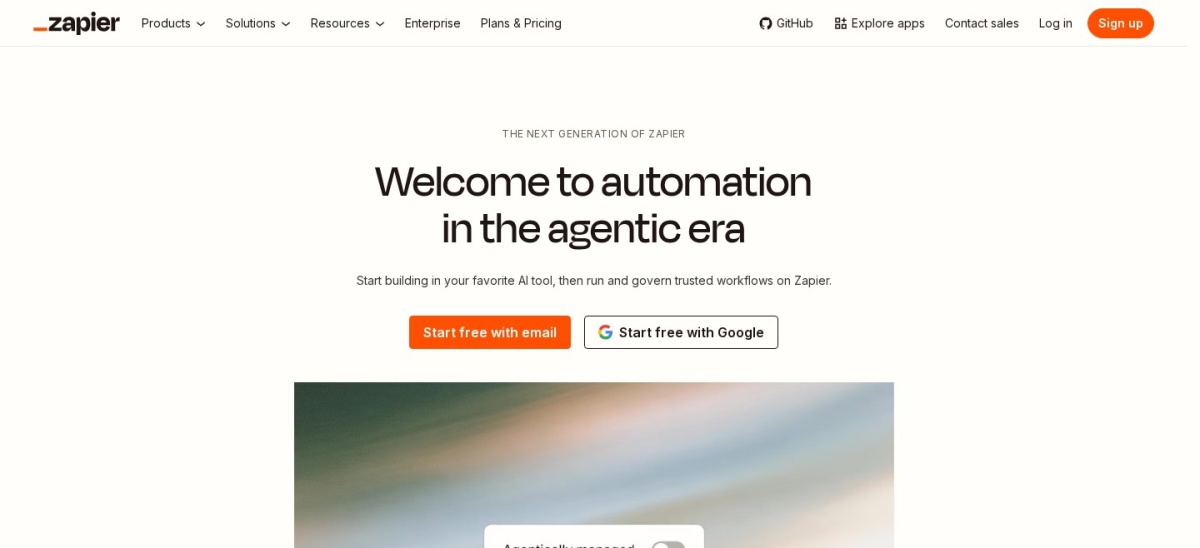
Zapier homepage, captured Nov 2026.
Zapier is a workflow automation platform that connects AI tools, applications, and business systems. Its free plan supports basic 2-step workflows, while Professional adds multi-step Zaps, premium integrations, webhooks, AI fields, and conditional logic. The platform supports more than 9,000 application connections.
The trade off is that Zapier specializes in application orchestration rather than direct model hosting or low-level inference routing. Professional starts at $19.99 monthly, and usage depends on task allowances and AI processing requirements. It suits teams connecting AI-generated results to everyday business processes without custom integration code.
What we like
Extensive application integrations
No-code workflow builder
Free entry plan
Supports AI processing and MCP connections
Multi-step workflows on Professional
Watch out for
Not a dedicated LLM gateway
Task usage affects operating costs
Advanced collaboration requires higher plans
Complex orchestration may need custom logic
Professional adds multi-step workflows, premium applications, webhooks, and advanced AI workflow tools.Visit zapier.com
AI model gateways vs AI workflow orchestration
AI gateways and workflow orchestrators address different parts of an application architecture. A gateway centralizes access to model providers and can manage routing, credentials, request policies, cost controls, and monitoring.
Workflow orchestration determines what happens before and after model calls. It coordinates data retrieval, tool execution, conditional decisions, agent handoffs, external applications, and final outputs.
TrueFoundry is especially relevant when centralized model access and governance are priorities. Dify and Botpress emphasize application and agent workflows, while Zapier and Pipedream focus on integrations with external services.
A production system may combine these approaches. For example, an application can use a gateway to access models and a workflow orchestrator to manage the surrounding process.
How AI orchestration platforms charge for usage
Subscription prices are only one part of orchestration costs. Model inference, workflow executions, tracing, external API calls, storage, and connected users may have separate billing rules.
A per-seat subscription scales with team size. Usage-based billing scales with activity, while credit-based systems require estimating how many operations a typical workflow consumes.
When comparing vendors, calculate the cost of a representative production workload rather than relying on the starting subscription alone. Include expected model calls, agent tool invocations, retries, and monitoring.
Set usage alerts and budgets where available. A workflow that retries failed requests or repeatedly calls external tools can generate additional costs even when the orchestration subscription remains unchanged.
How we chose
We selected established AI infrastructure, agent development, and automation platforms with documented model orchestration or AI workflow capabilities. The comparison covers model gateways, agent observability, visual workflow design, prompt management, and external application integrations.
Official vendor pricing pages and G2 review profiles were opened on November 24, 2026 for this article dated November 22, 2026. We checked entry subscription rates, free allowances, usage-based charges, and published review counts. Annual price estimates multiply regular monthly subscription prices by twelve unless an annual subscription rate is explicitly stated.
We excluded products without sufficiently verifiable pricing or numerical review ratings, and products whose current offerings no longer matched their earlier AI development positioning. Pipedream was retained despite its smaller review sample because of its established customer base and documented agent integrations. No vendor paid for a place, and we do not claim testing for this list.
How to choose the best AI model orchestration platform
Define the AI workflows you need to operate, then compare model connectivity, governance, monitoring, and production costs.
Identify the orchestration layer you need. Choose an AI gateway for centralized model access, routing, and request policies. Choose an agent workflow platform for multi-step reasoning and tool execution. Select an integration platform when the main requirement is connecting AI applications to existing business systems.
Verify model and tool compatibility. Check supported model providers, API standards, MCP integrations, external connectors, and deployment options. Confirm whether you can use existing API credentials and switch providers without rewriting substantial application logic.
Evaluate reliability and governance. Look for request monitoring, error handling, logs, evaluation tools, credential management, access controls, and usage limits. Production applications may also require approval workflows, audit records, private deployment, and contractual service guarantees.
Estimate the complete operating cost. Calculate subscriptions, per-user charges, model inference, requests, workflow executions, external users, and storage. Compare each vendor at an expected workload and review what happens when usage exceeds the included allowance.
FAQ
What is the best AI model orchestration platform in 2026?
TrueFoundry is our overall pick for centralized model access, routing, and governance. Its Developer plan offers a free starting point with an LLM gateway and MCP gateway. LangSmith is better suited to agent tracing and evaluation, while Dify emphasizes visual AI application development.
What does an AI model orchestration platform do?
An AI model orchestration platform coordinates how applications interact with models, tools, data sources, and workflows. Depending on the product, it may provide routing, execution management, monitoring, evaluation, security policies, and integrations. This reduces the need to maintain every component independently.
What is the difference between AI orchestration and an LLM gateway?
An LLM gateway primarily manages access to model providers, including routing, credentials, policies, and request monitoring. AI orchestration is broader and can coordinate multiple model calls, agents, tools, and external services. Some platforms combine both capabilities in the same product.
Are there free AI model orchestration platforms?
Yes. TrueFoundry offers a free Developer plan, LangSmith provides a free individual tier, and Dify includes a cloud Sandbox and an open-source edition. Free allowances vary considerably, and model-provider API charges or infrastructure costs may still apply.
How much does AI model orchestration software cost?
Starting subscriptions vary by product. TrueFoundry Pro costs $25 per user monthly, LangSmith Plus costs $39 per seat monthly, and PromptLayer Pro costs $49 monthly. Additional inference, tracing, integration, or workflow usage can increase total costs beyond these subscription prices.
Which platform is best for orchestrating multiple LLM providers?
TrueFoundry is particularly relevant for teams needing centralized access to multiple model providers through a gateway. Dify also supports multiple models inside its application workflows. The right choice depends on whether you prioritize routing and governance or visual application development.
Can AI orchestration platforms manage multiple agents?
Yes. Platforms such as Dify, Botpress, and LangSmith support aspects of agent development, execution, or deployment. Their approaches differ: some emphasize visual workflows, others provide code-oriented development and observability. Check whether your required agent coordination and tool execution patterns are supported.
What should developers monitor in an AI orchestration platform?
Important metrics include request latency, failure rates, model cost, token consumption, tool execution, prompt versions, and agent traces. Evaluation and monitoring help teams detect changes in output quality and investigate failures before they affect larger numbers of users.
Can no-code platforms handle AI model orchestration?
No-code and low-code products can manage many AI workflows, including model calls, branching, data transformations, and application integrations. Dify, Botpress, and Zapier are relevant options. More complex model routing, custom execution logic, or strict infrastructure requirements may still benefit from developer-oriented platforms.